

Every composite deck board has one of two core structures. It’s either solid all the way through, or built with a multi-chamber hollow core. That single difference shapes how the board handles weight, weather, and wear.
Pick the wrong one, and you’re dealing with call-backs, over-spec’d materials, or a deck that doesn’t hold up. This guide breaks down the solid vs hollow composite decking question by what matters on a real job site — strength, weight, cost, and which edge profile fits which job.
A note on U.S. terminology: Hollow and scalloped mean different things. Hollow boards have a fully enclosed multi-chamber core. Scalloped boards have open channels cut into the underside only — the top face is solid. They behave differently under load and at cut ends. In this guide, “hollow” means multi-chamber enclosed.
What Are Solid Composite Boards?
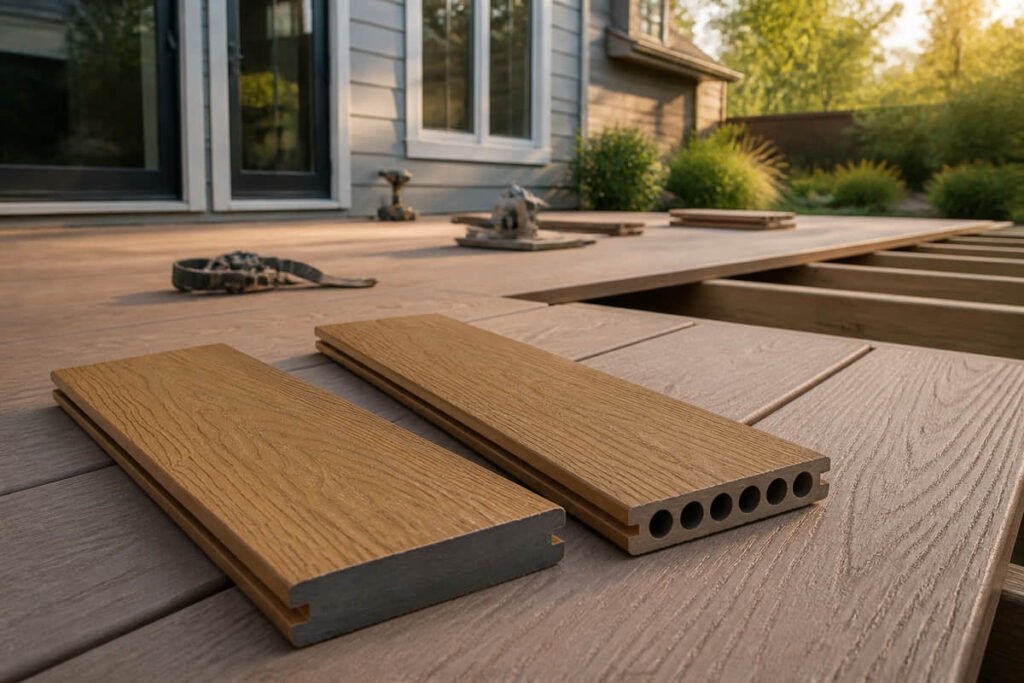
Solid composite decking is dense composite material all the way through — no channels, no chambers, no air gaps. Cut a solid board in half, and you see the same material edge to edge.
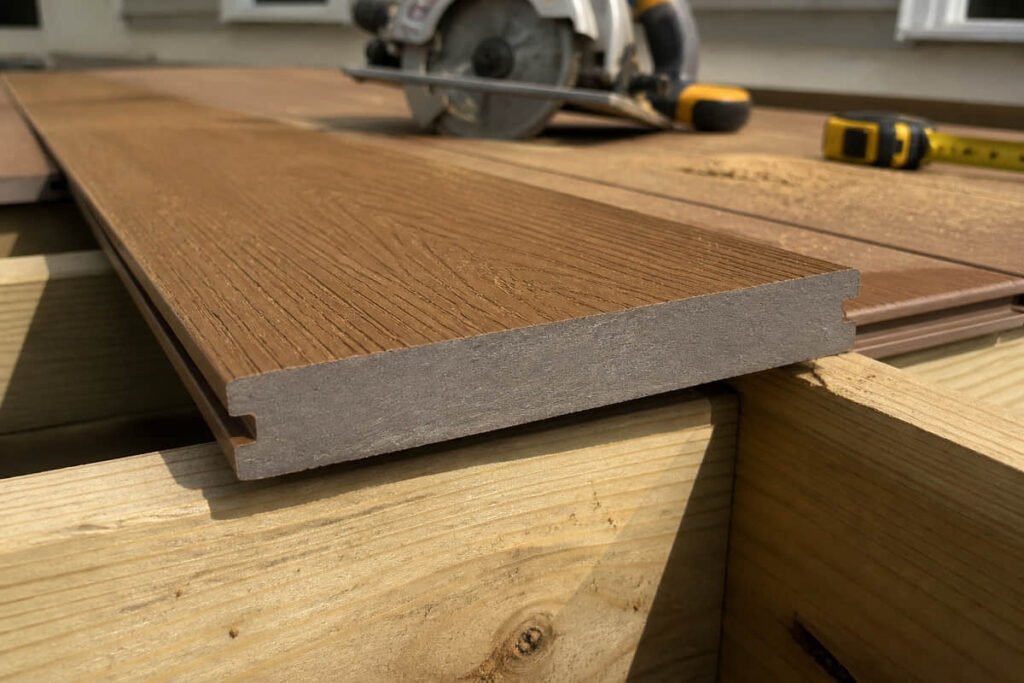
Solid composite boards come in grooved and square-edge (dual-flat) profiles. They’re tested well above the bending force most home and commercial decks demand.
All that density is why solid core boards are the first pick for high-load jobs. They resist point loads better and feel firm underfoot. The tradeoff is more weight per board and a higher price. Roughly 30–40% more material goes into each solid board compared to a hollow one of the same outer size.
New to composite? Our what is composite decking guide covers the basics.
What Are Hollow Composite Boards?
Hollow composite decking isn’t empty inside. These boards use a multi-chamber internal structure — ribbed walls engineered to carry load while cutting weight. Think of it like an I-beam: the shape puts strength where it’s needed most, using less material overall.
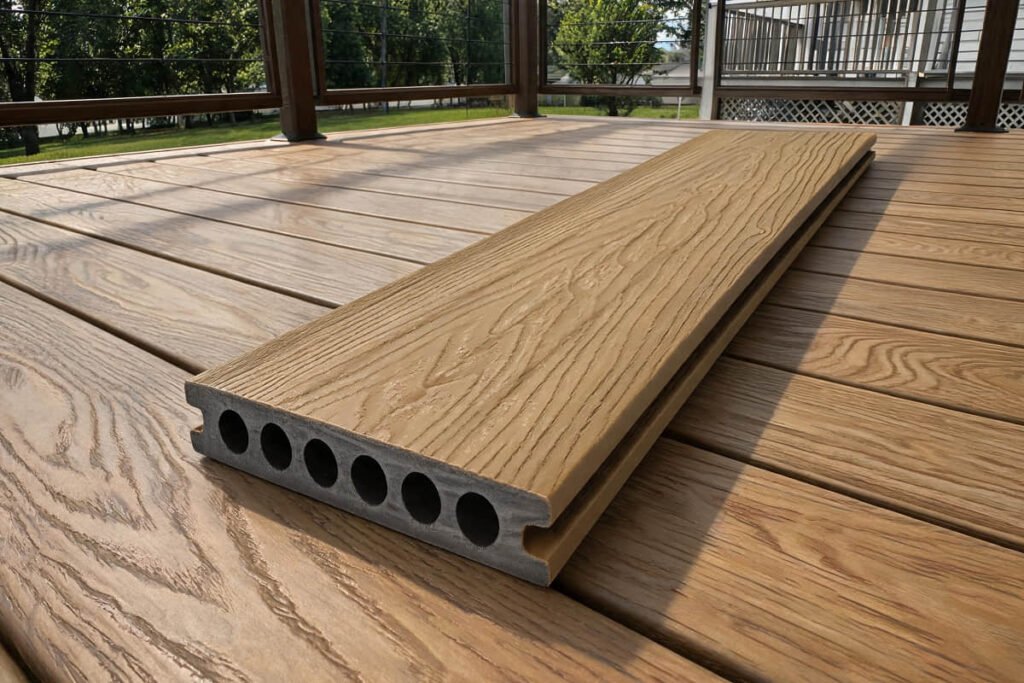
Wall thickness is the spec that separates good hollow boards from cheap ones. Budget hollow composite decking boards can run as thin as 2–3 mm. Better-built boards use thicker walls.
Other quality signals matter too. Look for boards that are fully capped on all four sides, backed by third-party test data, and covered by a real warranty. Look for hollow boards backed by a real warranty — 15 years or more is a good benchmark. Short or vague warranties are a red flag — no matter how low the price.
Because hollow decking uses less raw material per linear foot, these boards are lighter and cheaper to make. A hollow board at the same outer size is roughly 30% lighter than its solid equivalent. You feel that gap fast when you’re stacking a pallet.
→ Want to feel the difference? Request free samples of both solid and hollow boards.
Solid vs Hollow: Side-by-Side Comparison
Here’s how solid and hollow composite decking boards stack up on the factors that matter most:
| Factor | Solid Boards | Hollow Boards |
|---|---|---|
| Strength | Higher density; better point-load resistance | Strong under spread loads with proper joist spacing |
| Weight | Heavier (e.g., 2.82 lb/ft*) | Lighter (e.g., 1.95 lb/ft*) |
| Cost | Higher — more material per board | Lower — 30–40% less raw material |
| Thermal movement | Expands and contracts more | Handles temp swings better; chambers allow flex |
| Moisture risk | Cut ends expose the core; seal with fascia boards or end caps | Chambers can trap water if ends aren’t sealed; higher risk than solid |
| Sound underfoot | Quieter, more solid feel | Can sound slightly drummy on raised decks |
| End finishing | Fascia boards or end caps recommended to protect cut face | Fascia boards or end caps required — chambers are visible and open |
| Airflow | Flat underside; slower drying | Open chambers improve ventilation under the deck |
| Best for | High-traffic commercial, pool decks, hot tub areas | Home decks, retrofits, rooftop/balcony, budget builds |
*Weights shown are for 140 × 23 mm profile boards: Renew (hollow) and TimberLuxe (solid) from LastElegance.
The tradeoff is clean. Solid boards win on raw strength and sound. Hollow boards win on weight, cost, thermal stability, and underside airflow. Neither type is better across the board — the right pick depends on the project.
One more thing this table doesn’t cover: surface protection. Capping and core structure are two separate decisions — a board can be solid or hollow, capped or uncapped, in any combination. For that side of the spec, see our capped vs. uncapped composite decking guide.
Strength and Load Capacity
This is the first question most buyers ask about hollow boards: are they strong enough?
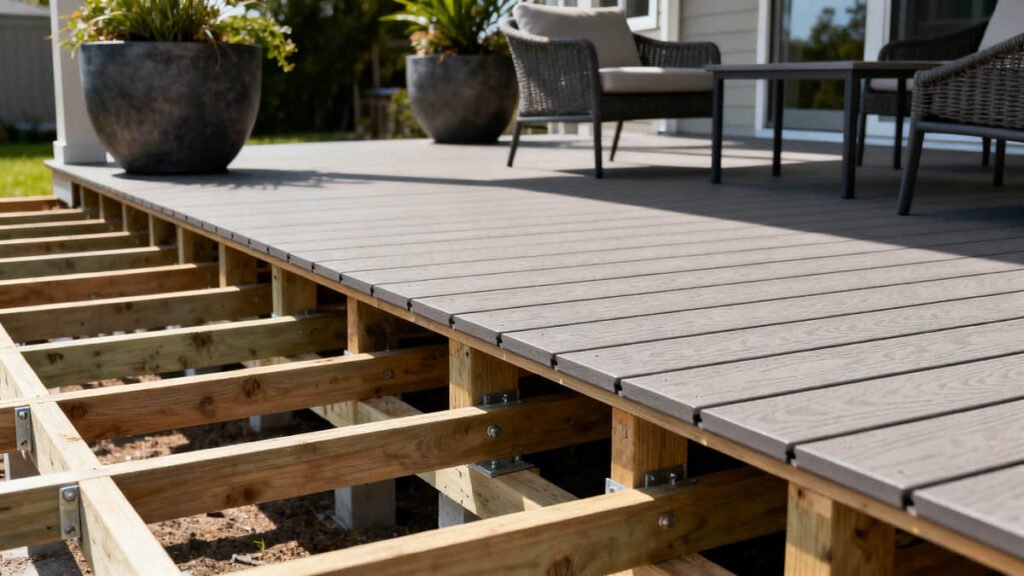
For spread loads — foot traffic, deck furniture, snow — a well-built hollow board handles the job fine. The multi-chamber design spreads weight across joist supports, much like a bridge deck spreads a truck’s weight.
Where solid composite boards pull ahead is point-load resistance. Heavy objects like planter pots, equipment legs, or dropped tools press down on a small area. The dense core of a solid board absorbs that focused pressure better.
Joist spacing matters more than core type for most load questions. The IRC and IBC set the framing standards for decks in the U.S. A common manufacturer recommendation is 11.8″ on center (300 mm) for both solid and hollow boards. That spacing keeps both types well within safe load limits for home and commercial use. For high footfall or heavy point loads, going even tighter is always the safer call.
Our decking boards are tested to 26.2 MPa (about 3,800 psi) flexural strength per EN 15534. That holds for both solid and hollow profiles.
Hot Tubs and Heavy Loads
A filled hot tub can weigh 3,000–5,000 lb. That comes up in nearly every buyer conversation.
Here’s what most people get wrong: the decking surface isn’t the main load-bearing element. The subframe is. Doubled joists, tighter spacing, and proper concrete footings carry that weight. The IRC governs structural needs for elevated loads — always check local codes.
That said, solid boards are the safer pick directly under and around a hot tub. Their denser core handles focused pressure from tub feet better than hollow alternatives. If you’re using hollow composite boards on the rest of the deck, switch to solid composite decking in the hot tub zone. And make sure your subframe is built for the load — that’s where the real safety margin lives.
Weight and Ease of Install
Weight adds up fast on a job site. Here’s what the numbers look like:
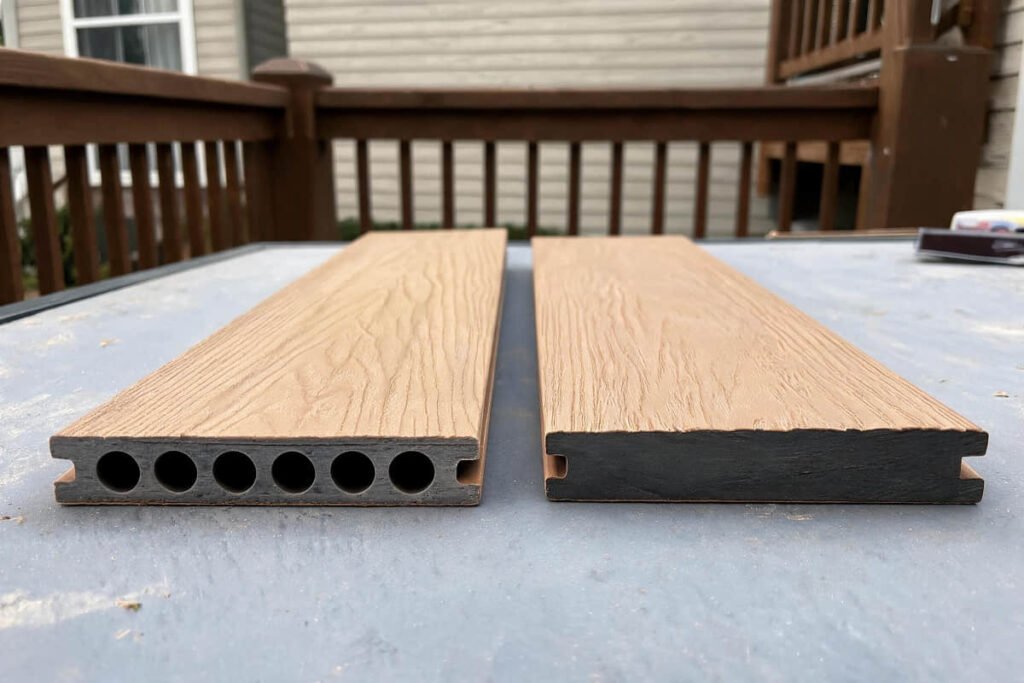
A hollow Renew board (140 × 23 mm) weighs 1.95 lb/ft. A solid TimberLuxe board at the same outer size weighs 2.82 lb/ft. That’s roughly 45% heavier per board.
Over a 500 sq ft deck, that gap means hundreds of extra pounds to move, lift, and fasten. Lighter boards mean less crew fatigue, faster handling, and easier transport — a real difference on second-story and rooftop jobs.
Hollow boards also help the subframe last longer. Their open chambers let air move under the deck surface, so the subframe dries faster after rain. In humid climates, that airflow cuts the risk of joist rot and fastener corrosion. It’s a small detail that adds up over a 15–20 year lifespan.
Hollow boards are a strong pick for retrofit projects over older subframes that may not handle extra weight. They’re also easier for a DIY enthusiast to manage without a full crew.
One more practical plus: hollow chambers make it easier to run low-voltage wiring for deck lights or outdoor speakers. That’s a useful detail when you’re speccing a deck with built-in lighting.
→ Need full weight and dimension specs for planning? → Explore our product categories.
Cost: Solid vs Hollow Boards
Hollow boards cost less per board. The reason is simple: they use less raw material — roughly 30–40% less than a solid board with the same outer size. As a manufacturer, we can tell you that material volume is the biggest single driver of board cost.
The savings carry through to shipping. Lighter boards mean more square feet per container at the same gross weight. For a factory-direct buyer ordering by the container, that means lower freight cost per sq ft on hollow boards. On large decking projects, that’s a real line-item saving.
On the other side, solid boards may carry a longer warranty. Our warranty tiers run by product line: Renew at 15 years, VerdeLife at 20 years, and TimberLuxe at 30 years. When you’re quoting a job, factor in warranty value and long-run deck maintenance costs — not just the board price.
The smart move is to think total project cost: board price plus shipping plus labor plus maintenance costs over the deck’s lifespan. For most home builds, hollow boards save money at every step. For commercial or high-load jobs, the extra cost of solid boards earns its keep.
→ For project-specific pricing on solid or hollow boards, request a quote from our team.
Weather, Moisture, and Thermal Behavior
Core structure affects how the board handles moisture and temperature — two things that matter in every U.S. climate zone.
Moisture. Every cut end exposes the board’s core to water — and that applies to both types. On solid boards, moisture can wick into the dense core through the cut face. On hollow boards, water enters the chambers and sits there. Either way, the fix is the same: always cover cut ends with fascia boards or end caps per the manufacturer’s instructions.
The risk is greater with hollow composite decking boards because trapped water leads to ice damage, mold, or debris buildup inside the chambers. But solid ends left unprotected will absorb moisture over time too. For reference, our boards absorb just 0.2% of their weight in water (ASTM D1037) on the protected surface — open ends are the real entry point.
Thermal movement. All composite decking boards expand and contract with temperature shifts. Hollow boards handle this better — the chambers give the composite material room to flex internally. Solid boards expand more, which can stress fasteners over time in areas with extreme temperature swings. Think coastal Texas summers or Minnesota winters. We recommend 5–8 mm (about 3/16″–5/16″) end-to-end gapping for all boards.
Subframe drying. Hollow boards let air circulate underneath, so the subframe dries faster after rain. Solid boards sit flat on the joist, trapping moisture longer. In wet climates, the airflow advantage of hollow boards can extend joist life.
Noise, Feel, and Looks
Sound. Solid boards absorb footstep noise better. Hollow boards can sound slightly drummy on raised decks with wide joist spacing. Tighter spacing (11.8″ on center) and adding pads between boards and joists help quiet the sound.
Feel. On the walking surface, both types feel the same. The surface finish is identical on solid and hollow boards. Both carry an R11 slip resistance rating, so grip is the same barefoot or in work boots. On a raised deck, hollow boards may feel slightly springier — proper joist spacing removes this.
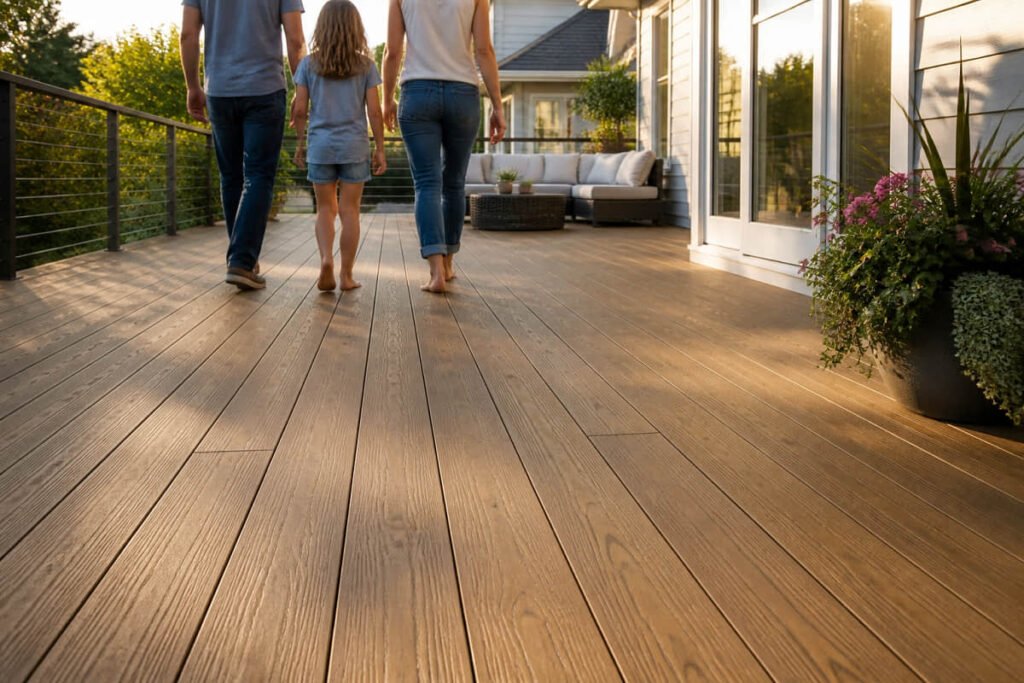
Looks. From the top, you can’t tell solid and hollow decking boards apart. Same colors, same grain patterns, same real wood appearance. The difference shows on the cut ends. Hollow boards reveal their internal chambers. Solid boards show a clean cross-section. Either way, fascia boards or end caps give the deck a finished look and protect the core from moisture.
Grooved vs Square Edge: Picking the Right Edge Profile
Core structure isn’t the only decision. Every composite deck board also comes in one of two edge profiles. Grooved boards have side slots for hidden clips. Square-edge boards have flat sides for face screws. The combination of core type and edge type determines how the board installs — and where it can go.
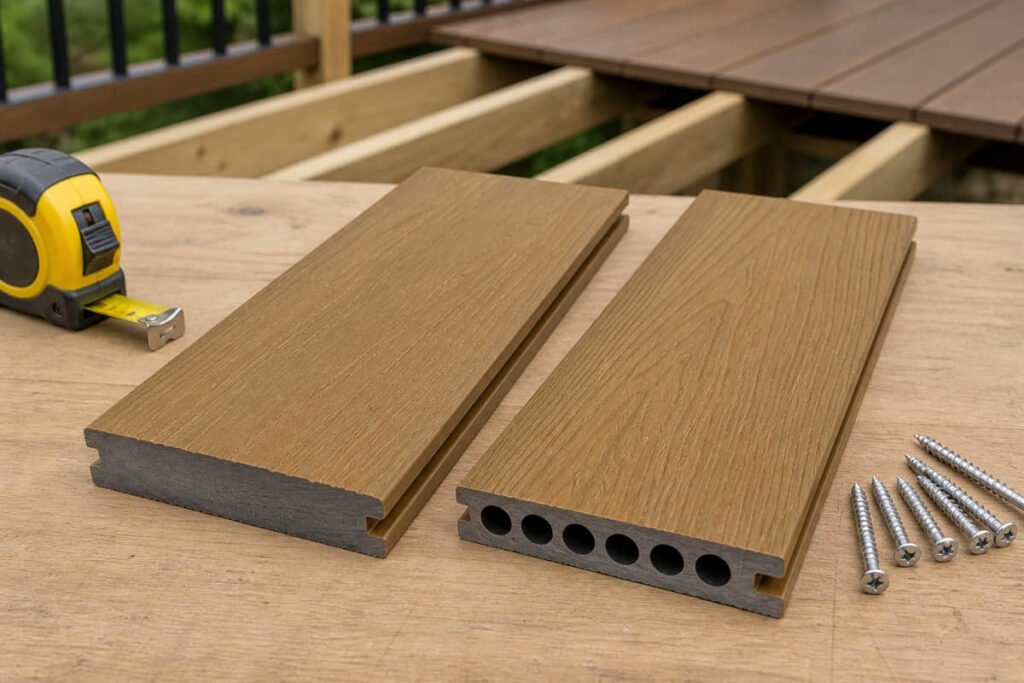
Here’s how the four combinations map to real jobs:
| Grooved (Hidden Clips) | Square Edge (Face Screws) | |
|---|---|---|
| Solid | Main deck surface on high-load commercial projects. Clean look, maximum strength. | Stair treads, perimeter boards, drink rails, picture-frame borders. Required at every exposed edge. |
| Hollow | Standard choice for home decks, balconies, light commercial. Clean look, easy handling. | Stair treads and edge boards on budget or lightweight builds. Lighter than solid square edge. |
The hard constraint builders need to know: stair treads, deck perimeter edges, and drink rails must use square-edge boards. Hidden clips can’t secure a board at an unsupported nose — there’s nothing for the clip to grip. If your project has stairs or a picture-frame border, order square-edge boards in the same color and type of decking as the field boards. This is the most common mis-spec we see on orders.
Grooved boards pair with stainless steel hidden clips that slot into the side grooves and fasten to the joist. The next board slides into the clip for even spacing and a screw-free surface. For step-by-step install details, see our composite deck installation guide.
Groove dimensions vary between suppliers. If you’re using third-party clips, check that the groove width and depth match the clip spec. LastElegance clips are sized to our boards — contact our team for groove dimensions if you’re matching to an existing system.
Which Board Fits Your Project?
There’s no single best choice. It comes down to matching the board to the job. Here’s a quick guide:
| Project Type | Recommended Board | Why |
|---|---|---|
| Commercial decks with high footfall | Solid, grooved | Point-load strength + clean surface |
| Pool decks and hot tub surrounds | Solid, grooved + square edge for borders | Denser core under heavy load; square edge at perimeter |
| Standard home decks | Either core, grooved | Pick based on budget and preference |
| Retrofit over existing subframe | Hollow, grooved | Lighter; less strain on older structures |
| Rooftop or balcony decks | Hollow, grooved | Lower weight where load limits apply |
| Stairs and elevated edges | Solid, square edge | Required at unsupported nosings |
| Budget-focused home builds | Hollow, grooved | Lower board, shipping, and labor costs |
| Custom projects with unique specs | Either | Custom sizes, colors, and profiles available |
Most domestic brands lock you into fixed product lines. We offer custom colors, textures, profiles, and lengths on both solid and hollow composite boards. Your decking project gets what it needs, not just what’s in stock.
→ Not sure which board type fits your project? Talk to our team — we’ll help you spec the right product.
FAQ
How long does hollow composite decking last?
With proper install and care, hollow composite decking lasts 15–25 years or more. Warranties vary by product line — The Renew line carries a 15-year warranty, while premium solid lines like TimberLuxe go to 30 years. Always check the specific warranty for the product you’re speccing.
Do composite deck boards need end caps or fascia?
Yes — both solid and hollow boards do. On hollow boards, open chambers trap water and debris if left exposed. On solid boards, the cut face wicks in moisture over time. Fascia boards or end caps seal those ends, protect the core, and give the deck a clean finish.
Do hollow composite decking boards feel different underfoot compared to solid boards?
On the walking surface, no. Both types share the same surface finish, so texture and grip are the same. On a raised deck with wide joist spacing, hollow boards may feel slightly springier — but 11.8″ on-center spacing removes this.
What’s the difference between hollow and scalloped composite decking?
Hollow boards have a fully enclosed multi-chamber core — think of it as tubes running the length of the board. Scalloped boards have open channels cut into the underside, with a solid top face. Both are lighter than full solid boards. All three types — solid, hollow, and scalloped — benefit from end caps or fascia at cut ends.
Are there specific situations where hollow composite decking is recommended over solid decking?
Yes. Hollow boards are the better pick for rooftop decks and balconies with weight limits. They also suit retrofit projects over older subframes and budget-focused home builds where cost per sq ft matters most. Their lighter weight makes them a good fit for small crews and DIY builds.
Solid and hollow composite boards aren’t “good vs bad.” They’re built for different jobs. The same goes for grooved and square edge — each has a place. Knowing the main difference helps you spec the right product the first time — saving money and avoiding call-backs on your next composite deck.
Want to see and feel both options? Contact the LastElegance team for project-specific guidance.