

Builders tell us the same thing: clients bring in photos from Instagram and Houzz, then ask “Can you build this?” The hard part isn’t finding the design. It’s matching a look to real board profiles, post systems, and install methods you can actually spec and quote.
That’s what this guide covers. Every design idea here ties back to specific composite fencing products — board widths, panel layouts, and fastener systems that work on a job site. We’ve organized by style: privacy, semi-privacy, horizontal slat, and decorative screens.
Horizontal Slat Fences
Horizontal slat fences are the dominant trend in modern composite fence design. Wide boards running side to side create clean lines that suit modern homes, commercial buildings, and mixed-use projects.
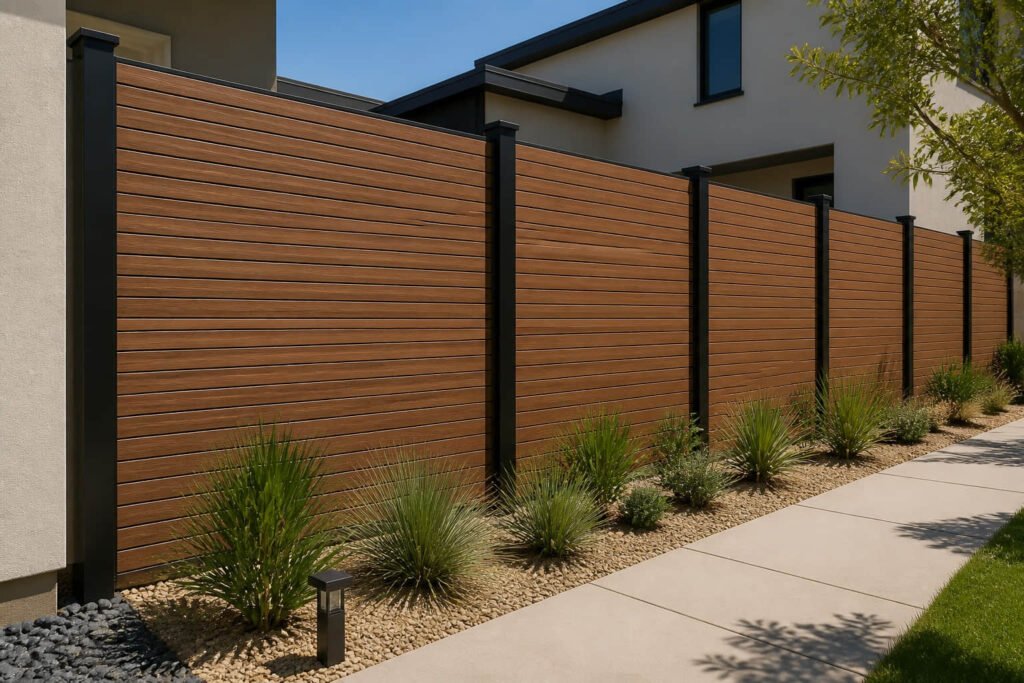
Board width shapes the look. A 6″+ board gives a bold, contemporary feel with fewer joints per section. Narrower boards in the 3.5″–4″ range create a layered, textured pattern with more visual rhythm. Both work — the right call depends on the project’s scale and style.
| Board Width | Visual Effect | Best For |
|---|---|---|
| 6″–7″ wide | Bold, minimal, fewer joints | Large panels, privacy runs, modern homes |
| 3.5″–4″ wide | Layered, fine-lined, more rhythm | Decorative screens, accent sections, urban lots |
Spacing matters too. Mount boards tight for full privacy. Leave consistent gaps for a semi-open screen that lets light and air through. Pair either approach with dark or matte-finish metal post frames for a sharp contrast.
One thing to check when speccing horizontal slats for high-UV areas like Florida or Texas: make sure the board has a co-extruded cap layer with UV stabilizers. That’s what keeps the horizontal lines crisp after years of sun exposure. Cheap uncapped boards will fade fast in those climates.
Want to compare board widths in person? Request free samples from us; we carry profiles from 3.5″ to 8.6″ wide.
Vertical Board Fence Styles
Vertical runs are the other major direction in modern composite fence design. Boards stand upright from ground to top rail — and the result has a different energy than horizontal layouts.
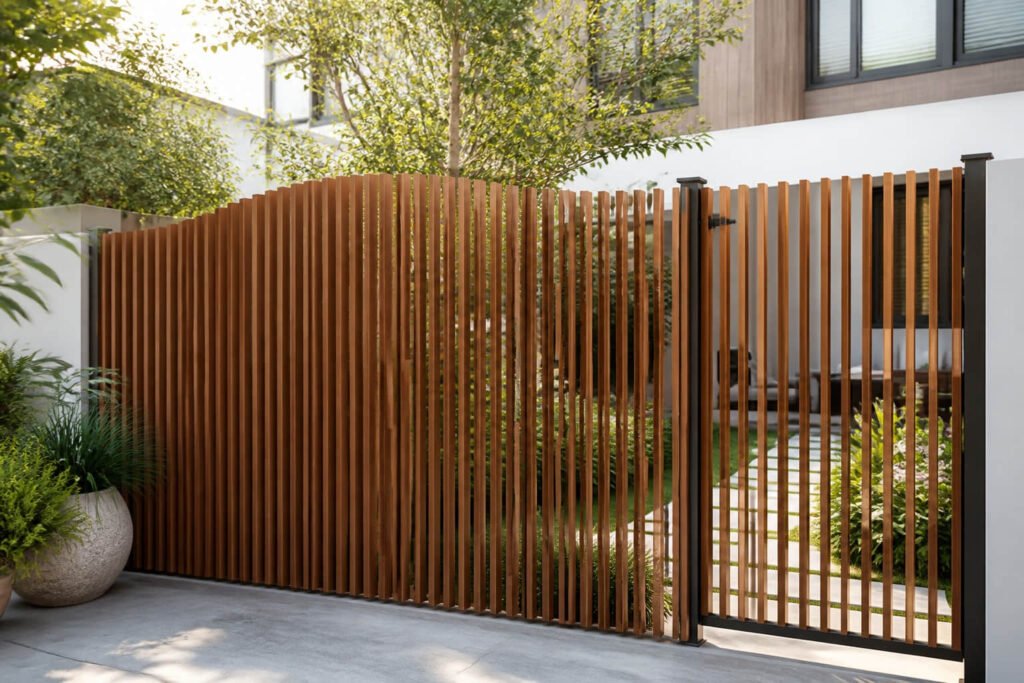
Three approaches work well here.
Classic vertical privacy. Boards mount edge-to-edge for a clean, uniform wall. It’s a traditional layout built with a modern material. Wide-format boards (8″+) cover more area per board, which speeds up the install and cuts labor time.
Staggered heights. Boards cut to different lengths create a wave-like silhouette along the top of the fence. This turns a simple boundary into a design statement. It works near entrances, pool areas, and homes with bold landscaping. Mid-width boards (6″–7″) suit this style — they add rhythm without feeling busy.
Vertical with decorative post caps. Flat-top or matte-black post caps add a polished finish. Small detail, big impact on the overall look.
One visual trick worth noting: vertical boards make a fence feel taller. That helps on tighter lots where every inch of privacy counts.
Full-Privacy Panel Designs
Full privacy is the most-requested composite fence use case. Two main approaches deliver it.
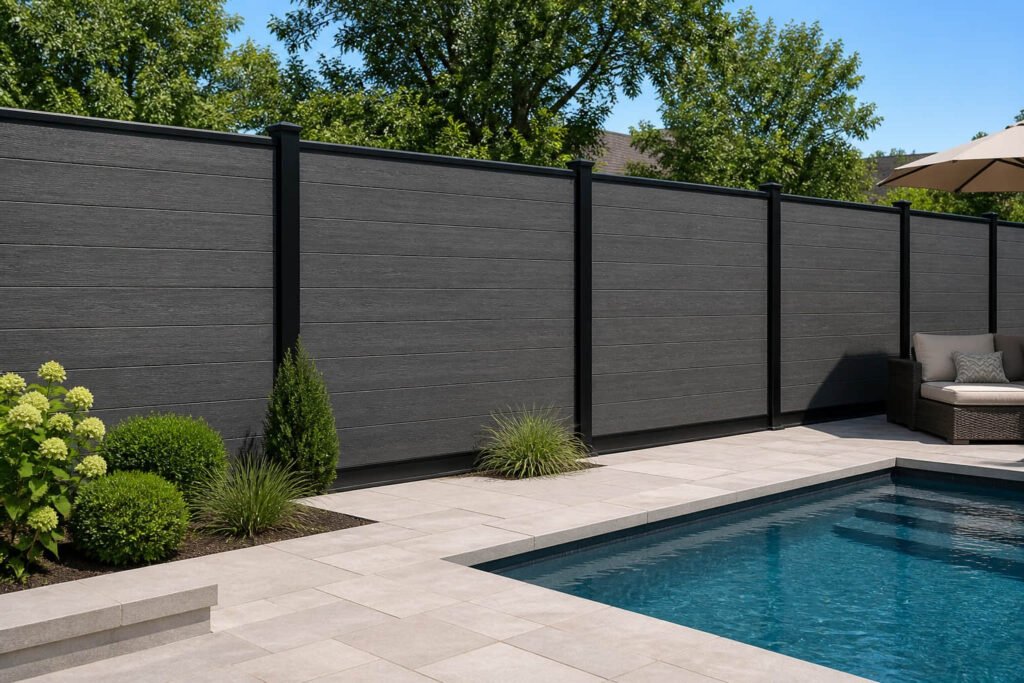
Solid panel. Boards mount edge-to-edge with no gaps, forming a clean, unbroken wall. This is the go-to for backyards, pool surrounds, and property lines. Simple, fast, and effective.
Board-on-board. Boards stagger on alternating sides of the fence rail so they always overlap. No direct sightline gets through, and the fence looks finished from both sides. That matters on shared property lines and in HOA neighborhoods where both faces need to look good.
Wide-format boards (8″+) speed up both approaches. Fewer boards per section means faster coverage. With a clip-based install system, a two-person crew can set posts, slot boards, and apply trim without face-screwing.
Both layouts work in horizontal or vertical runs. Mix them on the same project for visual depth across different outdoor areas.
Pro tip for high-wind zones: If you’re building solid-panel privacy fences along the Gulf Coast or in Florida, keep post spacing to 32″–40″ on center. Solid panels catch more wind load than spaced designs. Check local codes for specific wind load needs per ASCE 7.
Semi-Privacy and Slat Screens
Not every project needs a solid wall. Spaced-slat designs let light and air through while still marking a clear boundary.
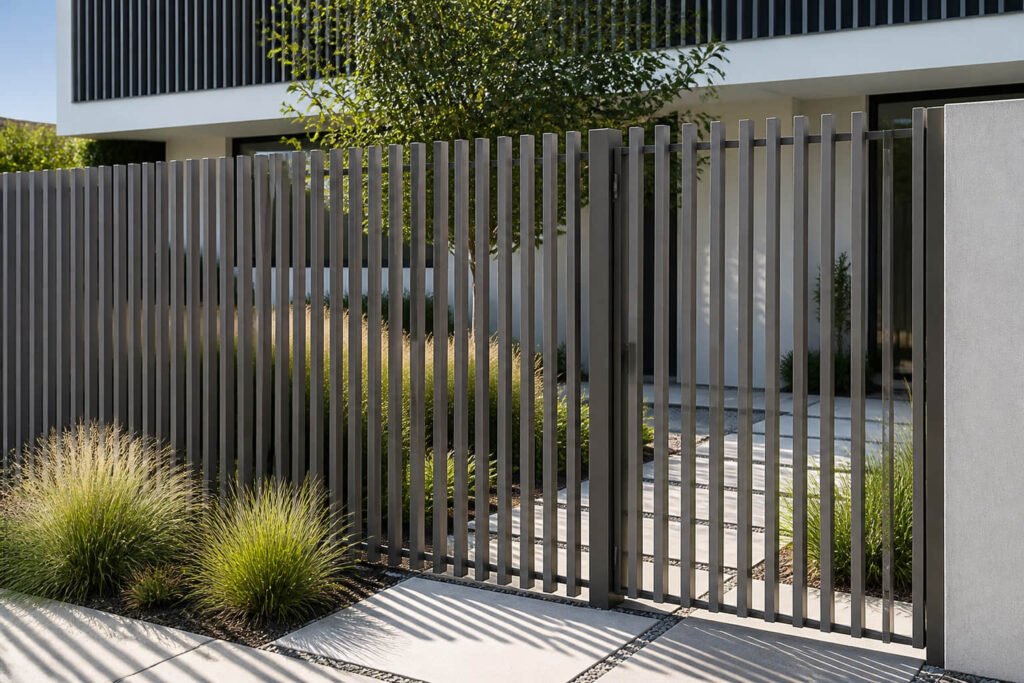
Mount boards with consistent gaps — typically 0.5″ to 1″ apart — for a clean, rhythmic pattern. This works well in front yards, side yards, garden borders, and pool-code-compliant enclosures. In urban settings, a solid wall can feel heavy. A slat screen keeps the space open and bright.
Narrower boards (3.5″–4″ wide) are the go-to for this look. The fine-lined pattern reads as contemporary, not industrial.
Here’s an install detail that matters: a clip-based fastener system keeps gaps even across the full run. No eyeballing the spacing board by board. That saves time and gives a tighter finish.
Slat screens also handle wind better than solid panels. The gaps cut wind load, so they’re a smart choice for exposed sites where full-privacy fencing would need closer post spacing.
Screens and Feature Walls for Outdoor Areas
Composite fencing boards go beyond the property line. The same boards that build a fence can screen equipment, divide spaces, and create accent walls.
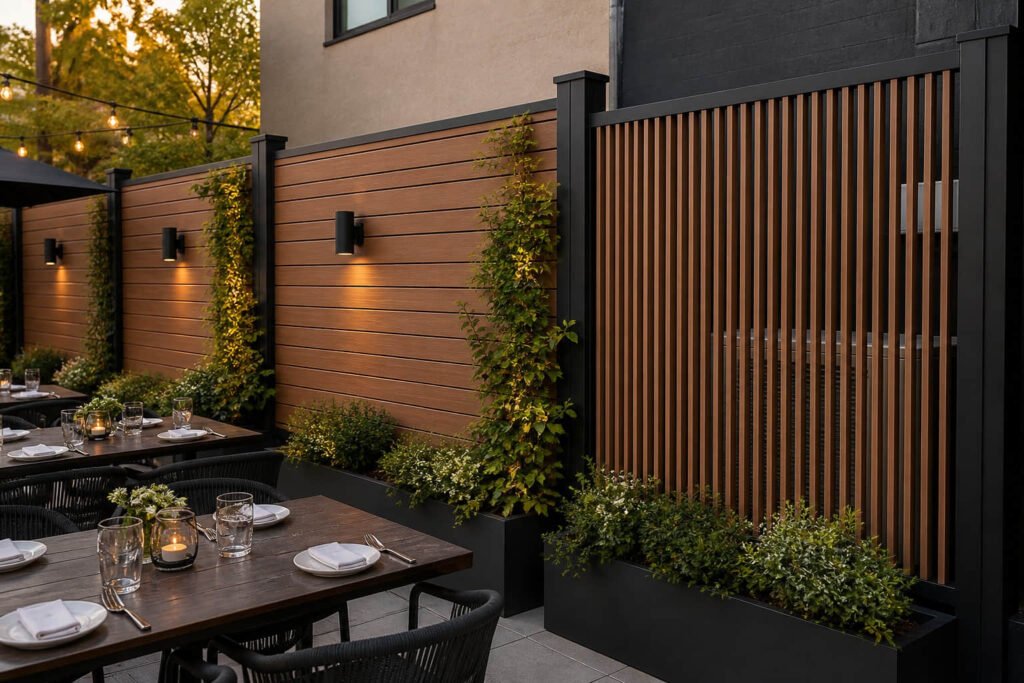
Here are the most common uses we see across commercial and multi-unit projects:
- HVAC and utility screening in multi-family builds — hides equipment behind a clean, low-maintenance wall
- Private outdoor dining zones for restaurants and hospitality projects
- Common-area dividers in resort and hotel developments
- Outdoor kitchen wraps — carry one material around bar areas and cooking stations for a unified look
- Feature walls with climbing plants trained along the boards to soften hard lines
Mixing board directions — horizontal on one section, vertical on another — adds visual interest. The same boards work as fence panels and wall cladding. That means designers can carry one material across fences, screens, and accent walls in a single project.
Working on a commercial or multi-unit project? Check our full product catalog for project specs.
Mixing Composite with Other Materials
One of the strongest composite fence design trends right now is pairing boards with other materials. Think aluminum posts, steel frames, stone columns, or concrete base walls.
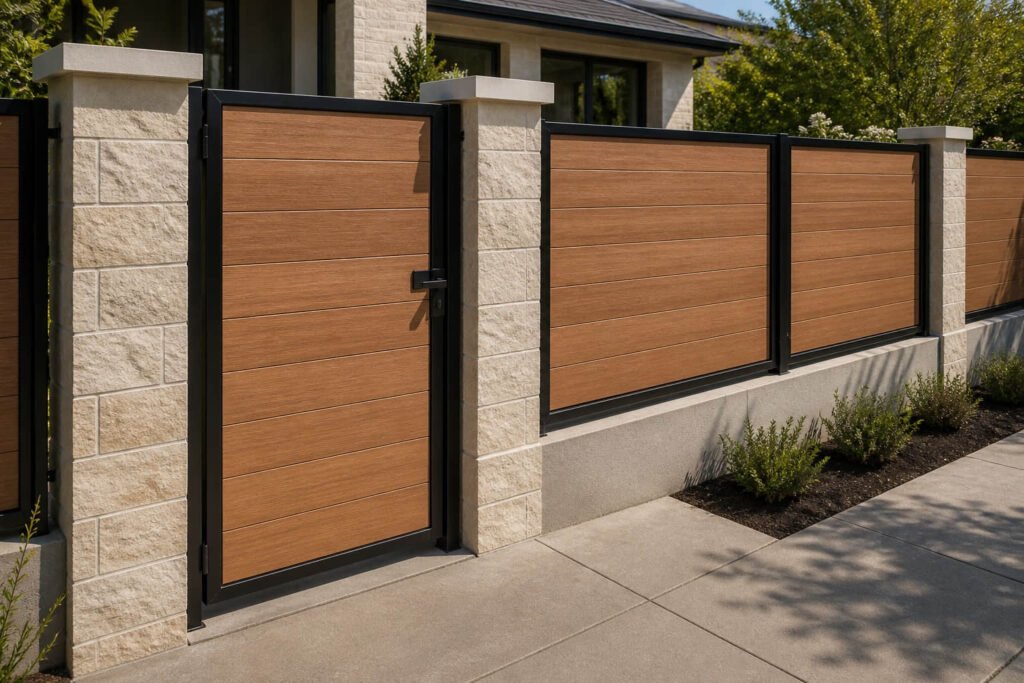
The logic is simple. Metal or stone handles the structural load and gives a sharp frame. Composite boards deliver the warm, textured infill. The contrast between hard frame and natural-look boards is what makes these designs feel modern.
When you’re speccing a mixed-material fence, look for a system that ships as a complete package — posts, trim strips, brackets, clips, caps, and skirts — not just loose boards. That saves you from sourcing hardware separately and makes sure everything fits.
Another option: match composite fencing with composite siding or decking on the same project. Many manufacturers now share their color palette across product lines, so you can build a unified look from fence to wall to deck.
Trending Composite Fence Colors for 2026
Color drives curb appeal — and it’s one of the areas where composite fence design has changed the most.
Here’s what’s trending in 2026 project specs:
- Dark tones — Charcoal, matte black, and deep gray are the most requested for modern builds. Dark colors pair well with light siding and natural stone.
- Warm wood tones — Walnut, teak, and cedar-look finishes stay popular for projects that want a natural look without real-wood upkeep.
- Cool grays — Mid-tone gray is a versatile pick for both residential and commercial properties.
- Two-tone combos — Dark posts with warm-toned boards, or gray boards with black trim. This adds contrast and a custom feel to any fence design.
Most domestic composite brands offer a fixed set of colors. If your project calls for a specific shade that’s not in a standard catalog, look for a manufacturer that offers custom color matching. That’s one area where factory-direct suppliers — like LastElegance — have a real edge over domestic brands with fixed product lines.
See these colors in person before you commit. Request free color swatches from us.
What to Check Before You Spec
Before you write composite fencing into a project, here’s what you need to know — regardless of which brand you’re quoting.
Board profiles. Composite fencing boards typically range from 3.5″ to 8.6″ wide, with thicknesses of 0.79″ to 1.02″. Match the board to the design style:
| Design Style | Recommended Width | Typical Thickness |
|---|---|---|
| Slat screens / semi-privacy | 3.5″–4″ | 0.79″ |
| Horizontal slats / mixed styles | 6″–7″ | 0.79″ |
| Full-privacy panels | 6″–7″ | 0.79″ |
| Wide-format privacy runs | 8″+ | 0.79″–1.02″ |
Post spacing. 32″–56″ on center, with a max of 63″ (1.6 m). In high-wind zones — Gulf Coast, Florida, plains states — use tighter spacing (32″–40″) and check local building codes.
Cap layer. This is the single biggest quality indicator. A good co-extruded cap layer wraps all four sides of the board and protects against UV, moisture, and staining. Ask your supplier for cap layer thickness — anything around 0.8 mm (31.5 mils) or above is solid. Avoid uncapped boards for any project where color hold matters.
Install method. Most modern composite fencing uses a clip-based slot-in system. No face-screwing, no special tools. Set posts, slot boards, apply finish trim. A two-person crew can handle it.
Custom options. If your project needs custom colors, lengths, textures, or profiles, ask whether the supplier can produce to order. Factory-direct manufacturers tend to offer more flexibility here than domestic brands with fixed product lines.
For a deep dive on composite materials, cap-layer technology, and how composite stacks up against wood and vinyl, see our guide: What Is Composite Fencing?
Contact our sales team for project pricing and custom specs.
Frequently Asked Questions
What Are the Downsides of Composite Fencing?
Composite costs more upfront than wood or chain-link, and color options are narrower than what paint or stain offers. Not all composite is equal — uncapped boards fade faster than capped (co-extruded) products. Always check that the product you’re quoting has a full cap layer on all four sides.
Do Composite Fences Look Like Real Wood?
Yes — modern co-extruded boards replicate wood grain closely. The cap layer is embossed with a wood-grain texture during production, so the pattern is molded in, not printed on. The look varies by product and color, so order samples before you commit.
What Is the Fire Rating for Composite Fencing?
Most composite fencing falls into ASTM E84 Class B or Class C. LastElegance products are rated Class C — Flame Spread Index (FSI) of 85, Smoke Developed Index (SDI) of 300. Class C is suitable for many exterior applications. Check your local building code for project-specific fire rating needs, especially on commercial jobs.
Can Composite Fencing Meet HOA Requirements?
Yes. Board-on-board layouts give a finished look from both sides, which most HOAs require on shared property lines. Composite also holds its color without staining or sealing, so it stays within HOA appearance standards long-term. Check your HOA’s material and height rules before you spec.
Are There Eco-Friendly Options with Composite Fencing?
Composite boards blend recycled wood fiber with recycled HDPE plastic. Recycled content typically ranges from 50% to 95% depending on the brand. The material needs no chemical treatment, which makes it a practical choice for projects with green building or LEED goals.
How Does Composite Fencing Handle Extreme Cold?
Composite boards expand and contract with temperature changes — that’s normal. Allow 5–8 mm (roughly 3/16″–5/16″) of end-to-end gapping based on board length and your local temperature range. Unlike vinyl, composite doesn’t become brittle in freezing weather. It stays structurally rigid in cold climates like the upper Midwest and Northeast.