

The spec looks right on paper. The client picks the lower-cost board. Eighteen months later, you’re fielding calls about faded color and surface staining on a deck that’s barely broken in.
That’s what happens when the wrong composite type goes on the wrong project.
Capped and uncapped composite share the same base material — wood fiber and HDPE. But they handle UV, moisture, and daily wear very differently. The gap grows fast in high-sun or wet climates. Choosing between them isn’t just a budget call. It’s a risk call — for contractors and distributors alike.
This guide breaks down how each type is built, where each holds up, and what drives the price gap. Use it to spec the right board the first time. New to composite? Our what is composite decking guide covers the basics — what it’s made of, how it’s made, and where it fits. This article assumes you’ve got that down and focuses on the capped-vs-uncapped call.
Key Differences at a Glance
| Factor | Capped Composite | Uncapped Composite |
|---|---|---|
| Upfront cost | Higher (40–80% more per sq ft) | Lower upfront cost |
| Lifespan | 20-30 years in most climates | 5–10 years in moderate conditions |
| UV resistance | Excellent | Lower — UV hits wood fiber directly |
| Stain resistance | Excellent | Lower — wood fiber absorbs stains |
| Water absorption | Typically <0.5% (quality boards: 0.2%) | Higher; often around 1–3% |
| Maintenance | Occasional cleaning | More frequent cleaning and stain removal |
| Typical applications | Residential premium decks, commercial decks, pool surrounds, high-sun environments | Budget-conscious residential projects, low-exposure areas |
| Market trend (U.S.) | Current industry standard | Declining market share |
What Is Uncapped Composite Decking?
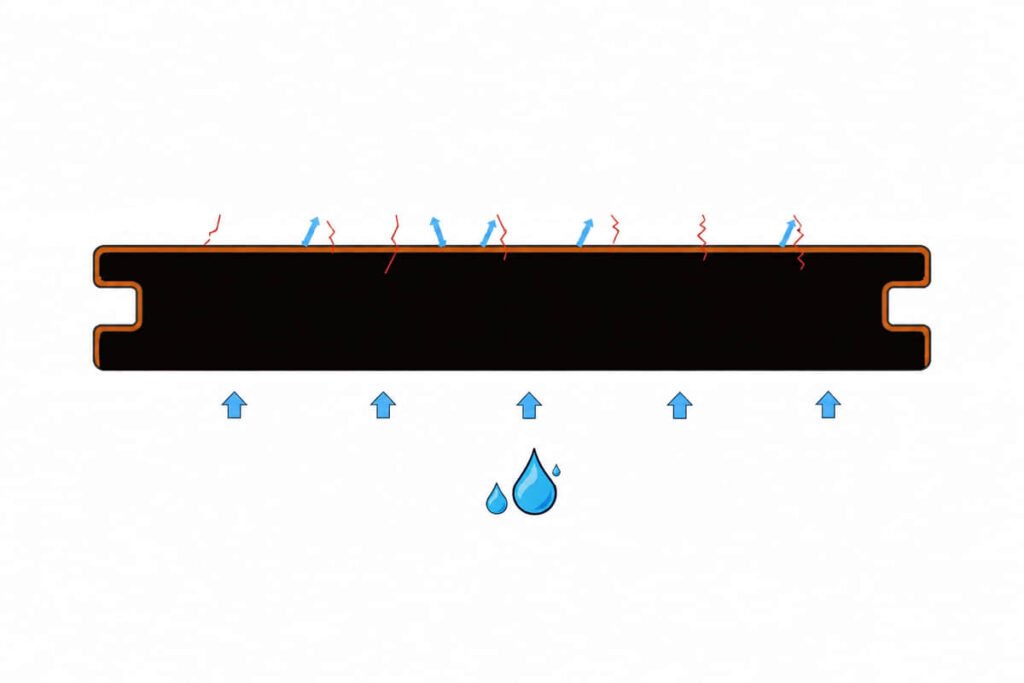
Uncapped composite decking is made from a blended composite core of wood fiber and HDPE. There’s no protective outer layer — the core runs to the surface on all sides. That makes it cheaper upfront, but more exposed to moisture, UV rays, and staining over time.
That exposed wood fiber is where the problems start. UV rays hit it directly. Moisture works in through the porous surface or through scratches. Stains soak in rather than sit on top.
Uncapped boards still have a place. In shaded, dry settings — covered patios, low-traffic residential decks in moderate climates — they perform well and cost less upfront. But in strong sun, consistent rain, or under heavy daily wear and foot traffic, the lack of a protective cap becomes a liability.
Water absorption data backs this up. ASTM D1037 testing shows uncapped composite decking boards typically absorb 1–3% of their weight in water, compared to under 0.5% for quality capped boards.
What Is Capped Composite Decking?
Capped composite decking shares the same wood-fiber-and-HDPE composite core as uncapped, but wraps it in a polymer layer applied during co-extrusion. That cap seals the wood fiber away from moisture, UV rays, and surface contact. The difference shows up in color stability, stain resistance, and how the board looks five years in.
Co-extrusion fuses the protective cap to the composite core in a single manufacturing pass — it’s not a post-applied coating. The cap bonds under heat and pressure, which is why it doesn’t peel or crack the way a surface treatment might.
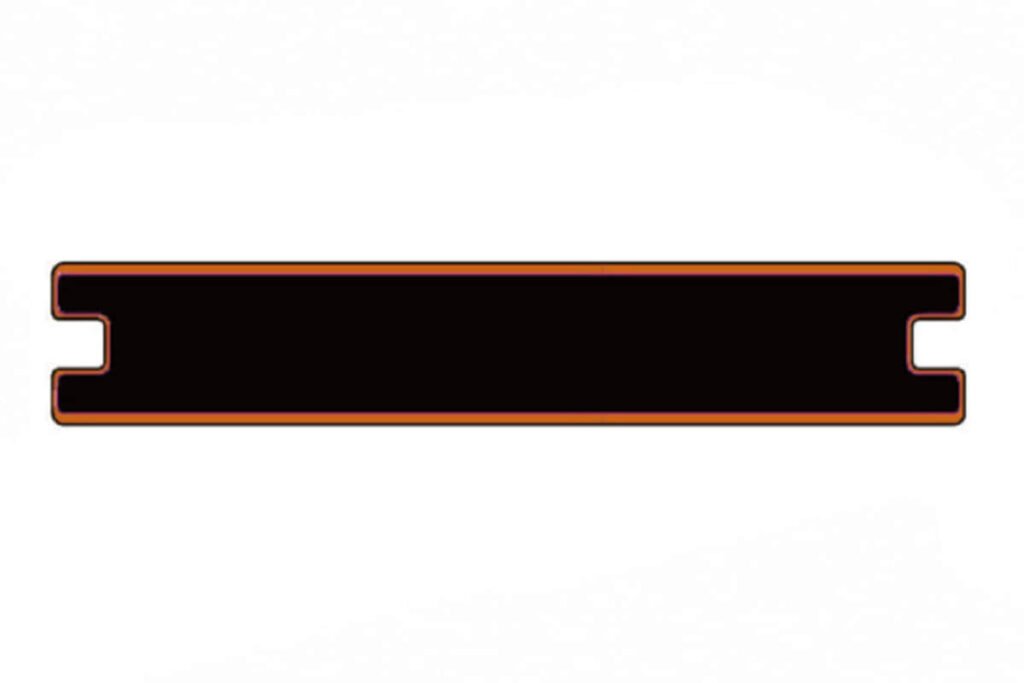
Some suppliers describe this outer layer as a polymer sleeve — a full wrap around the board’s composite core. Cap quality varies. A well-made cap layer runs 0.8 mm thick and wraps all four sides, including the grooves. That full coverage is what drives the performance gap over uncapped composite.
How Do Capped and Uncapped Boards Compare?
The definitions set the stage — performance is what drives buying decisions. Here’s how the two types of composite decking stack up across the factors that matter most to builders, contractors, and distributors.
Durability and Lifespan
Uncapped decking typically carries a 5–10 year warranty. It performs well in low-stress settings with limited UV and moisture exposure. Quality capped composite decking carries a 15-year product warranty at minimum — ours runs 15 years on Renew, 20 on VerdeLife, and 30 on TimberLuxe.
Our capped composite boards test at 26.2 MPa flexural strength (approx. 3,800 psi per EN 15534) across both solid and hollow profiles — a solid baseline for residential and commercial deck loads. Core structure is a separate decision from capping; see solid vs hollow composite decking for load and weight data.
UV Resistance and Color Stability
Color fade is the most visible gap between capped and uncapped composite over time.
On uncapped boards, UV rays hit the wood fiber directly. The fiber bleaches and weathers unevenly — especially where one part of the deck gets more sun than another. A few years in, the deck looks patchy.
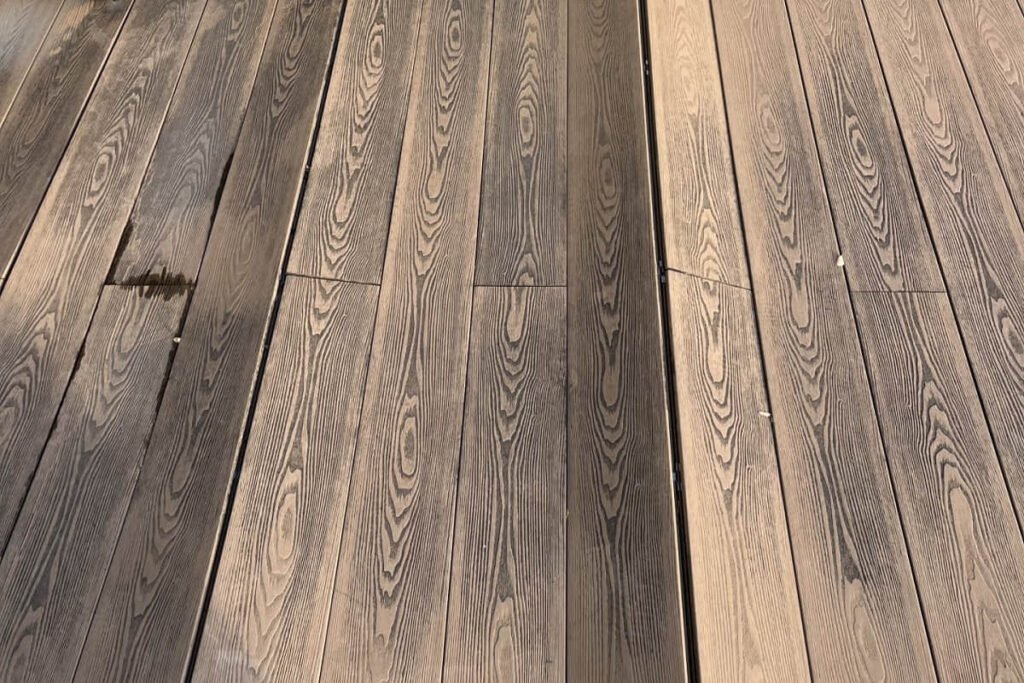
Capped boards use a HALS (Hindered Amine Light Stabilizer) + UV absorber system built into the cap layer. This blocks and absorbs UV energy before it reaches the wood fiber core. After 3,000 hours of QUV accelerated aging per ASTM G154, quality capped composite decking holds color shift to ΔE ≤ 4–5 — barely visible to the eye.
For Sun Belt states — Florida, Texas, Arizona, California — this gap matters. UV loads in those climates are far higher than in the North. Uncapped boards in Phoenix or Miami will fade years faster than the same board in Seattle.
Stain and Moisture Resistance
The wood fiber at the surface of an uncapped board acts like a sponge. Oil, food, tannins, and sunscreen work into the material fast. Leave a spill too long, and it’s permanent. Surface scratches make it worse — each one opens more wood fiber to moisture and staining.
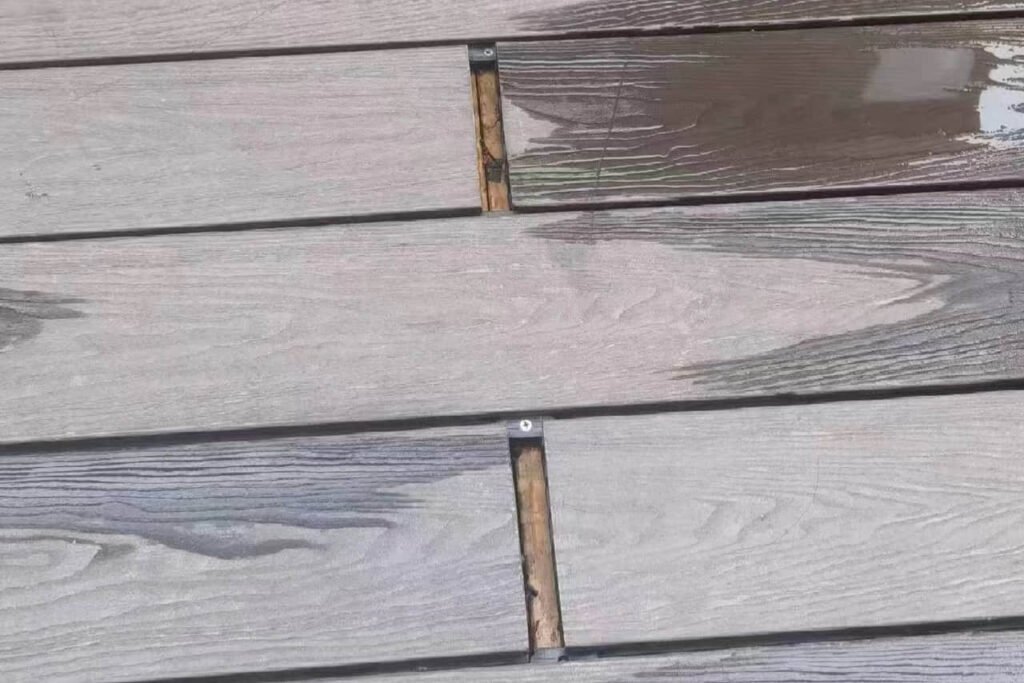
Capped boards handle this differently. The polymer cap is non-porous. Spills sit on the surface rather than soaking in, so routine cleaning handles most of it.
Water absorption is the clearest measure of this gap. Our capped composite decking boards test at 0.2% water absorption per ASTM D1037 — well under the 1–3% typical of uncapped composite. Higher absorption means more swelling, more dimensional movement, and a greater risk of mold and algae in wet climates.
Builders in the Southeast and Pacific Northwest tell us the same thing: algae and mold buildup is the most common upkeep complaint on uncapped boards in those regions.
Upkeep and Maintenance Costs
Neither type needs painting, staining, oiling, or sealing. That puts both well ahead of traditional wood decking. Pressure-treated lumber and cedar need re-staining or sealing every two to three years, and both are vulnerable to rot and insect damage without it — see composite decking vs. pressure-treated wood for the full cost picture. Composite is a genuine low-maintenance decking option by comparison.
Beyond that baseline, the two types split.
Uncapped decking needs sweeping regularly and a clean every three to six months with warm soapy water. In shaded or humid areas, mold and algae can get established between cleanings. Spills need attention fast to avoid permanent staining.
Capped boards still need cleaning, but the non-porous surface means stains don’t penetrate. A wash with soapy water or a composite deck cleaner twice a year handles most decks. For commercial properties, lower maintenance costs add up fast — fewer callbacks and less upkeep over the life of the install.
Not All Capped Boards Are Equal
Most product guides treat “capped” as a single category. It isn’t. It’s a spectrum — and where a board falls on that spectrum determines how it holds up over ten years.
Here are the five levels you’ll find in the market:
- No cap (uncapped core) — Wood fiber runs to all surfaces. No protection from UV rays, moisture, or staining.
- Cap with wood fibres mixed in — The cap itself contains wood fiber, so it’s still partly porous. Better than fully uncapped, but not fully sealed.
- Half-capped (top surface only) — The face is protected but the underside isn’t. Moisture enters from below. The wet underside and dry top absorb and release water at different rates, causing the board to cup and warp over time.
- Fully capped with post-cut grooves — The board is capped on all four sides, then grooves are cut afterward. Those groove channels run the full length of the board and are now exposed — they act as moisture paths into the composite core.
- True 360° co-extruded — The cap runs into the grooves during manufacturing, not after. All four sides and all groove surfaces are sealed. This is the benchmark.
The grooves are the detail most buyers miss. They run end to end along every board. An uncapped groove is a moisture channel straight into the composite core.
When you’re vetting a supplier, ask one question: are the grooves capped as part of the co-extrusion, or cut afterward? That answer tells you more about cap quality than any product brochure.
Want to verify cap coverage before you order? Check coverage with our team
What Does Each Type Cost?
Capped composite decking boards typically cost 40–80% more per square foot than uncapped. That higher upfront cost reflects the co-extrusion process and cap materials — you’re paying for a board that lasts longer and needs less work over its life.
But upfront cost is only part of the picture.
Factor in cleaning frequency — uncapped decking needs more product and labor time over its life. Factor in replacement risk: an uncapped board in a high-moisture or high-UV climate may need replacing a decade before a capped board would. For commercial properties, add the cost of callbacks and client complaints about a deck that’s started fading or staining.
A deck you replace twice uses twice the raw materials. One that lasts 30 years uses half. That’s a real difference in both cost and environmental impact over the life of a building.
For distributors and contractors buying at volume, the factory-direct model changes this math further. We ship direct from our factory to US trade partners — no importer markup, no reseller margin. That brings the landed cost of capped composite boards much closer to what you’d pay for a domestic brand’s uncapped product.
Supply chain at a glance: Standard MOQ is 100 sq meters (approx. 1,076 sq ft) per product line. For a 20′ container, production takes about 15 days, plus 24–42 days sea freight to the West Coast. A 40′ container adds five days to production. First-time buyers can discuss trial quantities. Sample boards and color swatches are available on request.
Get a project quote — share your specs and timeline with us.
Which Type Fits Your Climate?
| U.S. Climate Zone | Uncapped | Capped | Notes |
|---|---|---|---|
| Sun Belt (FL, TX, AZ, CA) | Not recommended | ✓ Strongly recommended | High UV loads cause uneven fade on uncapped boards |
| Southeast / High Humidity (GA, LA, Carolinas) | Use with caution | ✓ Recommended | Capped boards resist moisture ingress and mold far better |
| Upper Midwest & Northeast — freeze-thaw (MN, MI, New England) | Acceptable in covered installs | ✓ Recommended | Lower water absorption in capped boards reduces ice damage risk |
| Pacific Northwest — moderate | Acceptable for residential | ✓ Preferred | Algae builds faster on uncapped boards in shaded wet conditions |
At 0.2% water absorption (ASTM D1037), our capped boards soak up very little water — which matters in freeze-thaw climates where water inside the board can freeze and expand.
Joist spacing follows the board’s span table and local IRC rules, not the cap type. Our boards call for 12″–14″ on center; closer spacing is always the safer default on commercial or high-traffic installs.
How to Pick the Right Type for Your Project
The decision comes down to exposure level, traffic load, and how much upkeep the end user is prepared to carry.
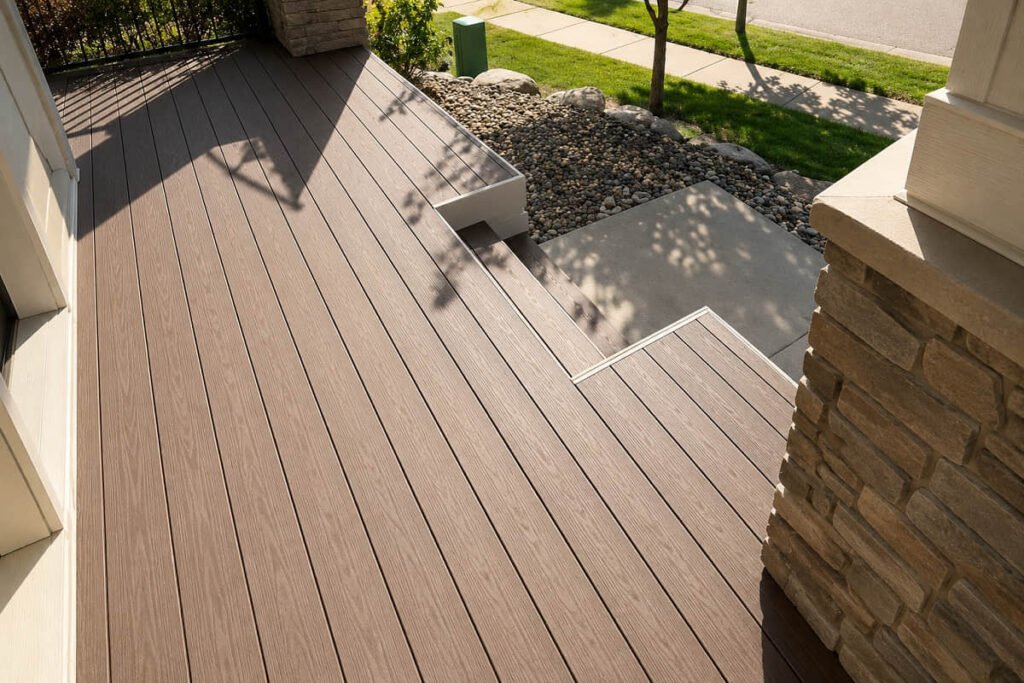
Choose capped composite decking when:
- The project is commercial or high-traffic
- The site gets strong sun or consistent rain (Sun Belt states, Southeast)
- It’s a pool deck, waterfront area, or any outdoor space with regular moisture exposure
- Appearance retention over 10+ years matters to the client
- You want to cut warranty claims and callbacks
Choose uncapped composite decking when:
- The project is residential with a tight budget
- The climate is moderate and the deck is shaded or covered
- The client accepts more frequent cleaning as a trade-off for a lower upfront cost
- It’s a low-exposure decking project where longevity is not the top priority
Fire rating: Our composite decking carries an ASTM E84 Class C rating (FSI 85, SDI 300). Class C is suitable for most exterior decking applications. For commercial builds — hotels, restaurants, public venues — verify the fire rating against local building codes and IBC requirements before specifying. Some jurisdictions require Class A or B for specific occupancy types.
Installation speed: Experienced crews using our hidden clip system typically complete 150–200 sq ft (14–19 m²) per hour, depending on deck layout and site conditions. That’s a real labor cost advantage on large multi-family and commercial outdoor living projects.
For pool decks and commercial installs requiring slip compliance, our capped composite deck boards are rated R11 per DIN 51130 / AS/NZS 4586 — consistent with ADA-adjacent requirements for wet outdoor surfaces.
Our composite decking carries CE, ISO, RoHS, and SGS certifications. Both types come in a full range of colors and surface textures. Custom dimensions and private-label packaging are available for volume orders.
FAQ
Does capped composite decking require less maintenance than uncapped?
Yes. The cap’s non-porous surface prevents stains from soaking in and slows moisture absorption, so cleaning is less frequent. Both types need periodic cleaning with soapy water or a composite deck cleaner — neither needs painting, staining, or sealing. In wet climates or shaded outdoor spaces, the maintenance gap between the two types is more noticeable.
Is capped composite more suitable for wet climates?
Yes. The cap seals the wood fiber core against moisture. Uncapped composite typically absorbs 1–3% of its weight in water, versus under 0.5% for quality capped boards per ASTM D1037. Higher absorption raises the risk of swelling, mold growth, and surface damage in consistently wet conditions.
Can uncapped composite decking fade faster than capped?
Yes — UV rays hit the wood fiber directly on uncapped boards, causing uneven color loss over time. Capped boards use a HALS + UV absorber system in the cap layer that slows fading. After 3,000 hours of QUV accelerated aging per ASTM G154, quality capped boards hold color shift to ΔE ≤ 4–5 — barely visible to the eye.
What are the downsides of uncapped composite decking?
The main drawbacks are higher susceptibility to color fade, staining, and moisture absorption over time. Uncapped boards need more frequent cleaning, especially in humid or high-UV climates. For commercial projects or high-traffic areas, the maintenance burden and shorter longevity make capped composite the stronger choice.
What is the fire rating for composite decking?
Our composite decking is rated ASTM E84 Class C (FSI 85, SDI 300). Class C is suitable for most exterior decking applications. Commercial projects — hotels, restaurants, public facilities — should verify against local building codes and IBC requirements before specifying.
What private-label options are available for distributors?
We produce composite deck boards to custom dimensions, colors, surface textures, and packaging under private-label programs. Volume orders qualify for custom mold production and dedicated account support. Contact our sales team to discuss program details and minimum volumes.
Ready to spec the right composite decking for your next project? Talk to us about your project