

A bad composite deck install costs more than a redo. It costs the client relationship.
Callbacks on buckling boards and rust stains aren’t product failures. They’re installation failures — and most of them void the warranty.
This guide covers every stage of composite deck installation: frame prep, joist spacing, board layout, fastener selection, and finishing. New build or frame retrofit — the steps are the same. Do them right, and the warranty holds, the client’s happy, and you don’t eat the callback.
What Tools Do You Need?
A carbide-tipped blade is the one non-negotiable. Use it on your miter saw, circular saw, or jigsaw — standard wood blades chip the cap layer on capped composite boards. Everything else is standard framing and finish carpentry gear.
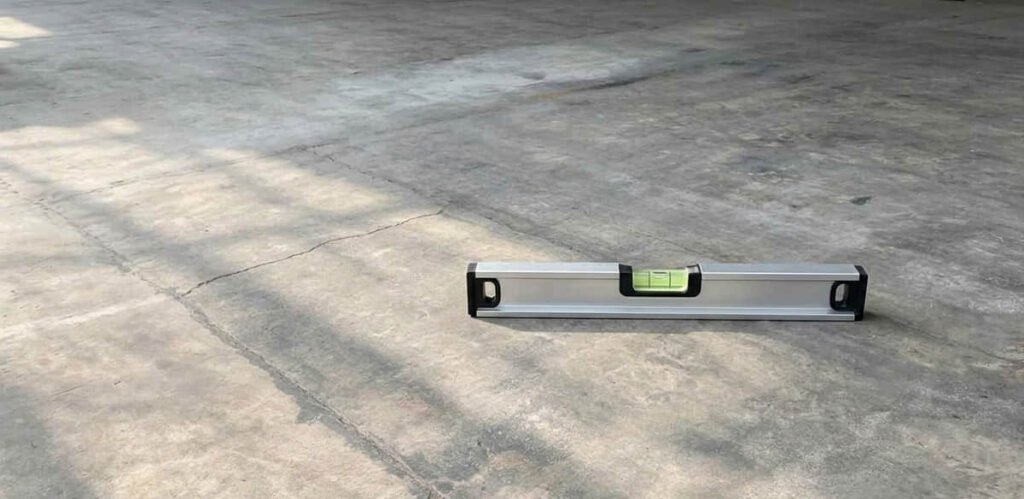
Cutting tools:
- Miter saw — primary crosscuts and fascia miters
- Circular saw — long rips on site
- Jigsaw — curves and notches around posts or obstacles
- Router — notching boards to fit around structural posts
Use a carbide-tipped blade on every cut. Standard wood blades chip the cap layer on capped composite boards. This is the trade-standard choice — it’s not optional on a quality install.
Layout tools:
- Chalk line
- Tape measure
- Speed square
Fastening tools:
- Drill/driver
Materials:
- Composite deck boards
- Hidden clips or composite deck screws
- Fascia boards
- Post anchors
- Joist tape (protects frame lumber at board contact points)
Check the spec sheet for your board profile before you order fasteners — clip dimensions vary by groove width.
Start With a Solid Deck Frame
No composite board performs well over a weak frame. A solid substructure is not a nice-to-have — it’s what the warranty depends on.
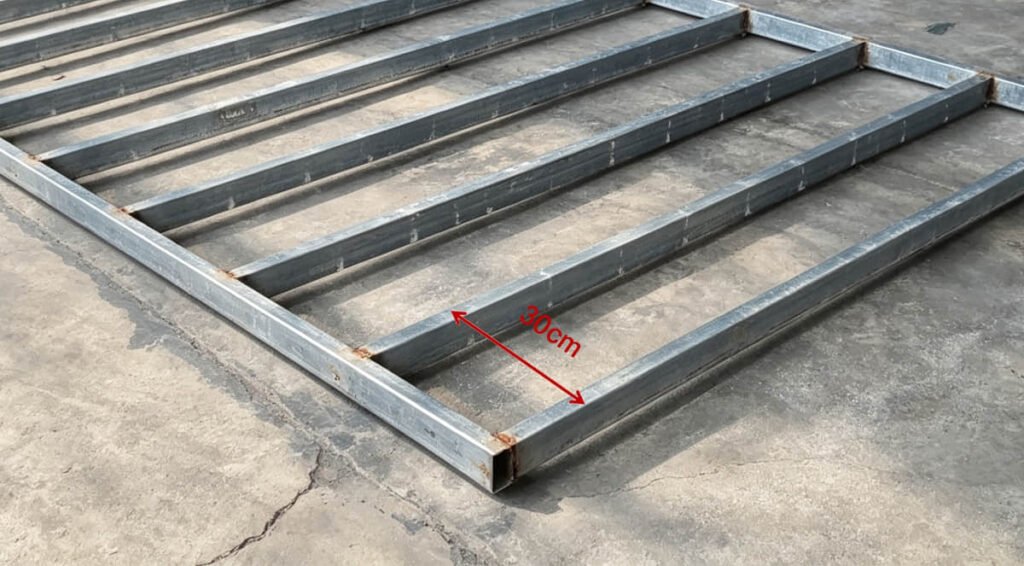
Building new: Use pressure-treated lumber rated for ground contact at posts and footings. In freeze-thaw climates, footings must go below the frost line, or posts will heave over winter. Attach the ledger board to the house per IRC Section R507 — through-bolts, not nails, with proper flashing and a moisture barrier behind it. Use joist hangers at every connection.
Reusing an existing frame: Inspect every member for rot. Press a screwdriver into any soft spot — if it sinks, that joist comes out. Check that the frame is level across all members, and verify joist spacing meets the composite spec. One bad joist causes a board to flex, creak, or crack. Find it before the boards go down.
Composite boards don’t hide or fix frame problems. They just make them harder to spot later.
Joist Spacing for Composite Decking
Joist spacing is the most common frame mistake on composite installs. The spec is tighter than standard wood framing — and it matters more than most contractors expect.
For straight-run installs, space joists 12″–16″ on center (300–400 mm). For diagonal patterns, drop to 12″ on center (300 mm). Diagonal boards span a longer distance corner-to-corner across each joist, so the frame needs to be tighter.
LastElegance boards are rated for 12″–14″ on center (300–350 mm). Always confirm with your product’s installation guide — board thickness affects the span rating. Thinner profiles need tighter spacing.
IRC R507.6 covers deck framing connections. Follow it.
| Install Pattern | Recommended Joist Spacing |
|---|---|
| Straight run | 12″–16″ on center |
| Diagonal (45°) | 12″ on center |
| Picture-frame border | 12″ on center at border joists |
Drainage and Ventilation Under the Frame
Composite boards don’t rot. But the lumber frame below them can — and that’s a structural risk worth taking seriously.
Keep at least 12″–18″ of clearance between the bottom of the frame and grade. This lets air move and moisture drain away from the frame. Without it, the substructure sits in a humid zone and wears faster.
Local building codes may require more than 12″. Check before you pour footings.
Plan Your Board Layout First
Five minutes of layout planning here prevents a half-day of wasted cuts later.
Snap a chalk line parallel to the house to set your starting reference line. Then decide on your layout direction:
- Parallel to the house — most common; works with 12″–16″ joist spacing
- Diagonal — visually strong, but requires 12″ OC joist spacing and adds roughly 15% material waste
- Picture-frame border — needs double joists or blocking at the perimeter to support the border run
Board count calculation: Measure total square footage. Divide by your board’s coverage width. Add 10% for cuts and waste — more if you’re going diagonal. On a 300 sq ft deck with 5.5″ (140 mm) boards, you need about 73 board lengths before waste. Add 8–10 more for the 10% waste factor.
Before you lay the first board, check where the last one will land. If the final board is less than 2″ wide after a rip cut, shift your starting line now. A narrow strip at the far end is hard to fasten and looks wrong.
Hidden Fasteners or Face Screws?
Most composite boards are designed for one method or the other. This isn’t a preference — it’s a spec.
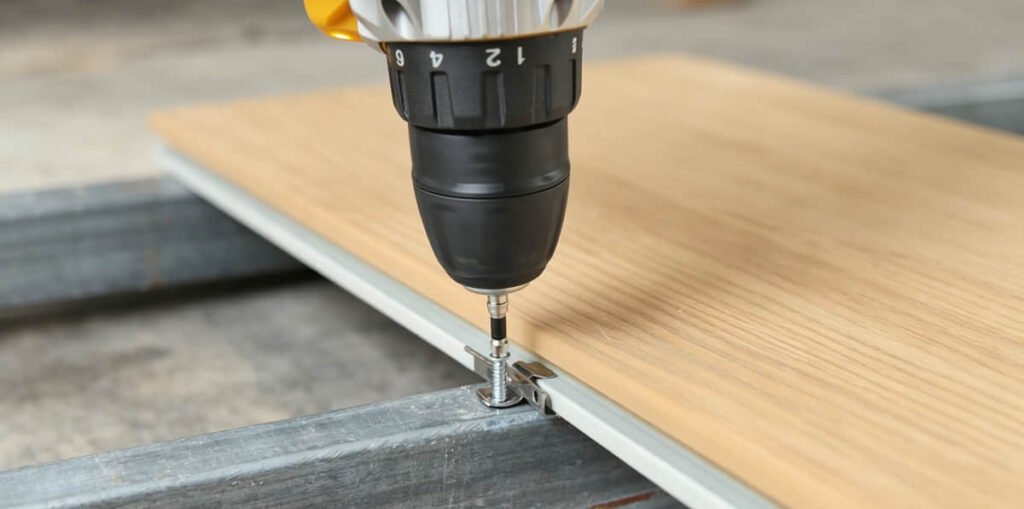
Hidden fastener system: Clips slot into the grooved edge of the laid board and fasten to the joist. The next board’s groove slides onto the same clips. The result is consistent gapping, a clean deck surface, and no visible screw heads.
Face screws: Screws go through the top of the board into the joist. Faster to install, visible when done. The right call for solid-edge profiles and budget-conscious jobs.
The key point: check your board’s groove profile before ordering fasteners. Get the wrong clips, and you’re making a return trip.
For coastal or high-humidity jobs, stainless steel clips only. Standard zinc or galvanized clips corrode in salt air and leave rust marks across the deck surface — marks that won’t clean up.
Installing Without Hidden Fasteners
Face screws are a legitimate choice on the right board and the right job. But they need to be done correctly.
Use composite deck screws — not standard wood screws. The thread profile and head geometry differ. Wood screws can crack the cap layer under torque.
Pre-drill every hole. On capped composite boards, driving screws without pre-drilling splits the cap layer at the entry point. Cap damage voids the warranty. Set screws flush — not countersunk. Countersinking creates a stress point that chips out.
Two screws per board at each joist crossing. Place them 3/4″ from the board edge.
Face screws still need proper end gaps. The screws don’t manage spacing — you do.
Step-by-Step: Installing the Deck Boards
Here’s the full install sequence. Each step is what to do and why it matters.
Step 1 — Let the Boards Acclimate
Leave boards flat on-site for at least 24 hours before install. Stack them so air can move between them — not bundled face-to-face.
Composite boards expand and contract with temperature. Boards installed cold in January can buckle in July if the end gaps were too tight. This step costs no extra effort and prevents one of the most common post-install complaints.
Size your end gaps for the temperature range at your install location. A job in Minnesota in March needs more gap than one in San Diego in October.
Step 2 — Set the First Board
The first board sets the line for the whole deck. A small error here multiplies across every board that follows.
Snap a chalk line parallel to the house. Set the board to the line, then check the square diagonally — measure corner to corner in both directions. If both measurements match, you’re square. If not, adjust before you fasten anything.
On hidden clip installs, the house-side edge of the first board gets face-screwed into the rim joist or ledger. The field side gets its first set of clips.
Pro tip: always check the square before driving a single fastener. Misalignment at the start compounds by the time you reach the far end.
Step 3 — Clip and Lay Each Board
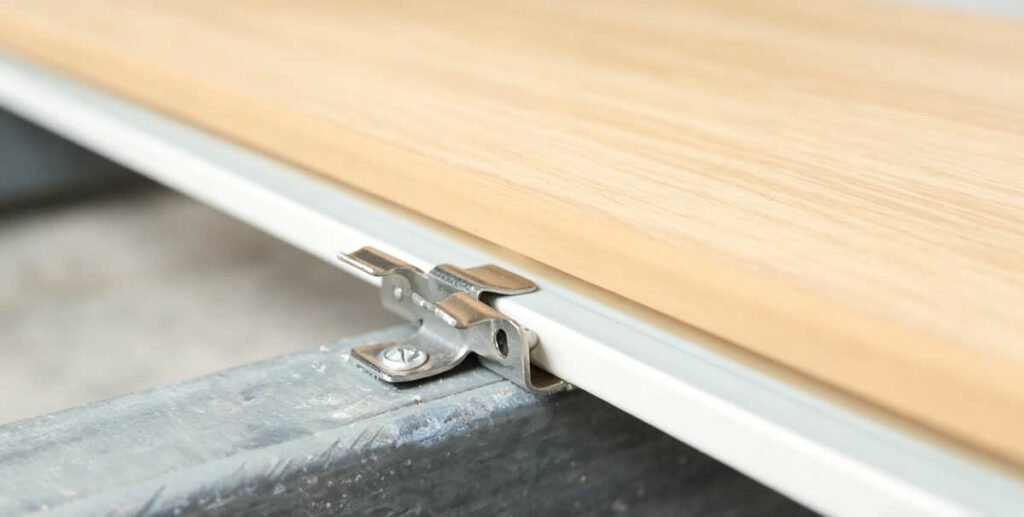
The slot stainless steel clips into the grooved edge of the laid board. Fasten each clip to the joist — one clip per joist crossing. Slide the next board’s groove onto the clips and press into place.
Repeat across the deck. Every 4–6 boards, check alignment with a tape measure. Small drift adds up fast and becomes visible before you’re halfway across.
When boards need to be spliced mid-run, stagger the joints. Never end two adjacent boards on the same joist.
Step 4 — Cut and Fit the Last Board
The last board almost never fills the remaining gap exactly. Plan for a rip cut.
Measure the gap. Subtract the required expansion gap. Rip the board to width with a miter saw or circular saw — carbide blade, cut from the face side down. Composite can chip on the underside if cut from below. Score the cut line with a utility knife first — this reduces cap layer chipping on thin profiles.
The outer edge of the last board gets face screws — clips can’t engage on the far side. Allow 1″–1.5″ (25–38 mm) of overhang past the rim joist on the outer edge.
Step 5 — Finish with Fascia Boards
Fascia covers the frame and board ends along the outer perimeter. It’s what most people see from the yard.
Cut the fascia to length with a miter saw. Miter outside corners at 45°. Face-screw into the rim joist. Match the fascia color to your deck surface — LastElegance fascia boards are available in every decking profile color.
Leave expansion gaps at fascia board joints — same spec as the deck surface (5–8 mm). If the deck includes stairs, apply fascia and stair treads in the matching color for a clean, finished look.
How to Install Composite Deck Railings
Railings go in after the deck boards are down. There are two mounting methods.
In-frame (embedded): Posts set through the deck frame into footings below. Stronger and preferred on elevated decks. This needs to be planned before the frame is built.
Surface-mount: Post bases bolt to the top of the deck frame. Faster and more common on retrofits. Requires correct torque specs and the right base plate for the deck height.
Per IRC Section R312, railings are required when a deck is 30″ or more above grade. Minimum railing height is 36″ for residential and 42″ for commercial or decks above 30″ in public settings. On decks over 5 ft above grade, get the post anchor spec engineered for the load.
Mistakes That Slow Down the Job
Most callbacks on composite decks trace back to six issues: wrong joist spacing, skipped board acclimation, no pre-drilling on face screws, missing end gaps, wrong fasteners in coastal zones, and boards laid over a rotted frame.
Each one is avoidable. For the full breakdown — causes, fixes, and a quick-reference table — see our guide: common composite decking installation mistakes.
Frequently Asked Questions
Is there any special maintenance required right after installing composite decking?
No special steps are needed immediately after installation. Let the deck sit for 24–48 hours before heavy foot traffic, and rinse off any sawdust or debris left from cutting. After that, occasional cleaning with soap and water is all that most composite decks need to stay in good shape.
Can I install composite decking over an existing wood deck frame?
Yes — if the frame is sound. Check the existing substructure for rot, verify joist spacing meets the composite spec, and confirm the frame is level across all members. If it passes inspection, you can install it directly over it without rebuilding the frame.
How long does composite deck installation take?
A two-person professional crew using hidden clips can typically lay 150–200 sq ft per hour on a straight-run deck. A 300 sq ft deck surface takes roughly half a day to a full day, not counting framework or finishing. Diagonal layouts and picture-frame borders add time.
What is the best time of year to install composite decking?
Composite can go in year-round, but temperatures between 50°F and 85°F make the job easier and reduce acclimation variables. In cold weather, boards are near their minimum contracted state — leave slightly larger end gaps for summer expansion. In hot weather, the opposite applies.
What are the recommended fasteners for composite decking?
Hidden stainless steel clips are the best choice for grooved-profile boards — they create consistent spacing and leave a clean surface with no visible screw heads. For solid-edge boards or face-screw installs, use composite deck screws, pre-drill every hole, and set screws flush.
Ready to spec your next composite deck project? Request a Quote to contact us for tailored information.