

You’re speccing a composite deck, and the supplier lists both hollow and solid boards. The price gap is obvious. The performance gap isn’t — until you’re on site or fielding a warranty call two years later.
This guide covers the structural, cost, and performance differences between hollow and solid composite decking, backed by test data and real project context. It’s written for builders, designers, and procurement managers who need to match the right board to the job — not just the budget.
What Sets Hollow and Solid Boards Apart?
The main difference between hollow and solid composite decking is what’s inside the board. Solid boards are dense all the way through. Hollow boards have chambered voids running along the length, using less material to form a lighter profile.
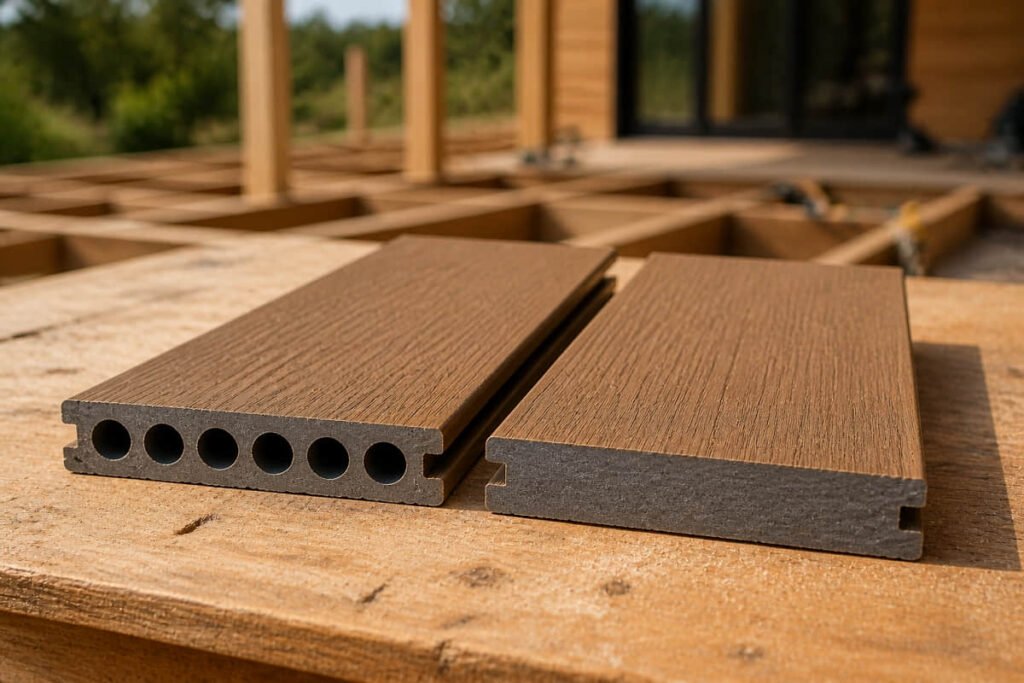
Both types use the same composite material — wood fibres blended with HDPE or PVC. The surface look, colour, and texture are the same. This one design choice — hollow or solid core — affects weight, cost, strength, and how the board behaves on site.
Capped composite applies to both types. The cap layer is a thin polymer shell that wraps the board and protects the core from UV, moisture, and wear. Cap layer thickness varies by manufacturer — most range from 0.5 mm to 1.0 mm. Thicker caps generally mean better UV protection and colour retention.
For a full breakdown of composite material, how it’s made, and how it compares to timber decking, see our What Is Composite Decking guide.
What Is Hollow Composite Decking?
Hollow composite decking boards have internal chambers that run the full length of the board. These voids cut the amount of raw material in each board, making them lighter and cheaper to produce.
Wall thickness is the key spec to check. Thinner walls mean less strength. Across the market, wall thickness ranges from about 3 mm to 6 mm. Boards at the lower end can feel flimsy underfoot; boards at 4–6 mm hold up well under normal foot traffic.
Like all composite deck boards, hollow profiles need end caps or edge trim at exposed cut ends. For hollow boards, this is especially important — open ends expose the internal chambers, which can trap water and debris over time.
What Is Solid Composite Decking?
Solid composite decking is dense from edge to edge. No internal voids — just solid core material all the way through. That full-density cross-section gives a firmer feel underfoot and higher load capacity.
The trade-off is weight. Solid boards are heavier per linear metre. A typical hollow board sits around 2.5–3.0 kg/LM, while solid boards range from 3.0 to 4.5 kg/LM depending on dimensions and density. On a large deck, that gap adds up fast — both in freight and in labour.
Solid boards still need end caps or edge trim at cut ends — the same finishing step as hollow boards. The difference is that a solid end looks cleaner even before the cap goes on, since there are no internal chambers on show. For projects where load, longevity, or a premium feel matter, solid core boards are the stronger pick.
Strength and Load Capacity Compared
This is the question builders ask most: which board handles more load?
Solid composite boards win here. More material through the cross-section means higher impact resistance and flexural rigidity. Hollow boards are still strong enough for most home decks — but solid boards are the pick when the deck carries real weight.
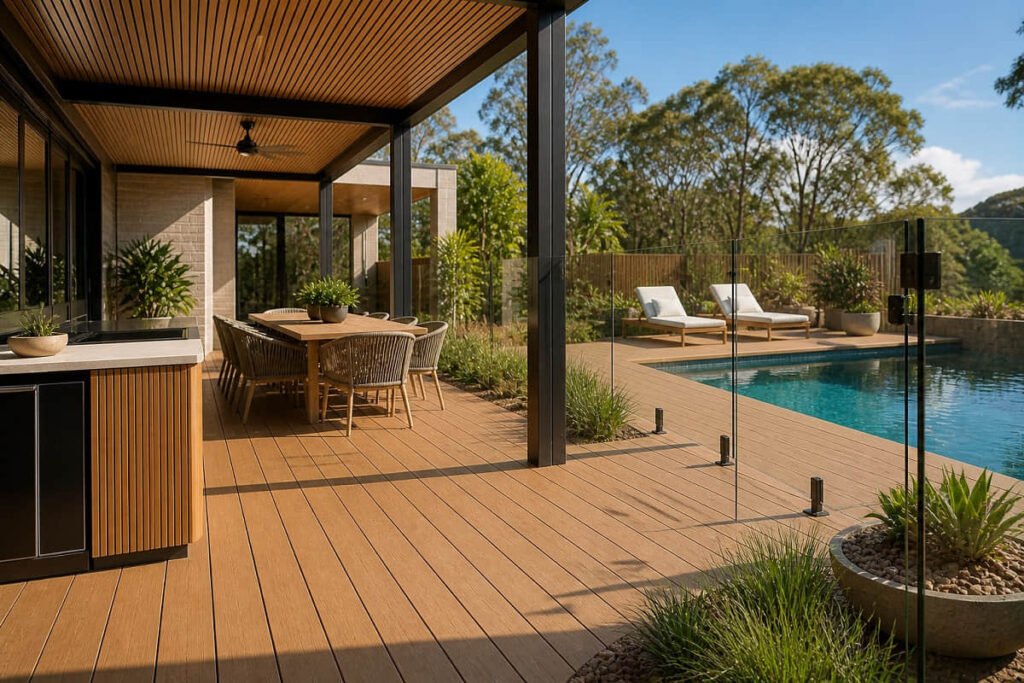
Most quality composite decking boards achieve a flexural strength around 20–30 MPa when tested to EN 15534. The recommended joist spacing for composite deck boards is typically 300–450 mm centre-to-centre, depending on the manufacturer and board profile. Always check the product spec sheet — don’t guess.
Where the difference shows up is under heavy or point loads. Outdoor kitchens, spa surrounds, hot tub platforms, and high footfall commercial areas put more stress on each board. Solid composite boards spread that load through a full cross-section. Hollow boards rely on their walls — and walls have limits.
Hollow vs Solid: Strength at a Glance
| Factor | Hollow Boards | Solid Boards |
|---|---|---|
| Flexural strength | Moderate — varies by wall thickness | Higher — full-density cross-section |
| Impact resistance | Lower — chambers can crack under sharp impact | Higher — no voids to collapse |
| Best suited for | Standard patios, entertaining areas | Heavy loads, commercial areas, spa surrounds |
| Joist spacing | Follow manufacturer spec (typically 300–400 mm) | Follow manufacturer spec (typically 300–450 mm) |
For builders speccing a commercial deck or pool surround, solid boards remove the guesswork. For a standard backyard entertainer, hollow boards do the job.
Need exact load specs for your project? Check the LastElegance composite decking range → for flexural strength, slip resistance ratings, and recommended joist spacings across each board profile.
Weight and Install Differences
Weight matters on site. Lighter boards are faster to carry, cut, and lay — and that cuts labour time on larger projects.
As a rough guide, hollow deck boards weigh about 30–40% less than solid boards of the same dimensions. On a 40 m² deck, that difference adds up across hundreds of boards. Hollow boards also put less load on the subframe, which matters for elevated decks or older structures being re-decked.
The installation process is the same for both types. Hidden clip systems are the industry standard for capped composite — stainless steel or plastic clips slot into grooves on the board edges and fix to the joist. No surface screws. The deck surface stays clean.
Both hollow and solid boards need end caps or edge trim at exposed cut ends. The steps are identical — the only difference is that hollow cut ends expose the internal chambers, so a clean cap fit matters more to keep water and debris out.
For builders pricing a job, the real question is: does the weight saving on hollow boards reduce enough labour time to offset any performance trade-off? On large-area residential decks and elevated builds, the answer is usually yes. On smaller, ground-level decks, the weight difference barely matters.
Cost: Hollow vs Solid Boards
Hollow boards use less material to make. That’s the core reason they cost less per linear metre — and the main reason hollow composite decking exists. It brings composite within reach for budget-sensitive projects where traditional timber might otherwise win on price.
The upfront cost gap between hollow and solid varies by brand, but expect solid boards to cost roughly 20–40% more per linear metre. That sounds like a big jump — until you factor in warranty.
Solid boards typically carry longer warranties than hollow boards. That’s true across most manufacturers. The logic is simple: more material, more durability, more confidence in long-term performance.
Example: LastElegance Warranty by Board Type
| Product | Profile Type | Warranty |
|---|---|---|
| Renew | Hollow | 15 years |
| VerdeLife | Grooved solid | 20 years |
| TimberLuxe | Solid | 30 years |
A 30-year warranty on a quality product changes the long-run cost-per-year equation. A board that costs more today but lasts twice as long can work out cheaper overall.
For trade buyers ordering at volume, also consider the supply chain. Buying manufacturer-direct — rather than through resellers — tightens the cost gap between hollow and solid. LastElegance, for example, manufactures in-house and supplies direct to trade partners, which keeps pricing closer across their range than you’d see from brands with longer distribution chains.
Request a quote tailored to your project →
Which Handles Australian Weather Better?
On the surface — literally — both board types perform the same. The cap layer handles UV, rain, and heat equally well, whether the core underneath is hollow or solid. What matters is the quality and thickness of that cap.
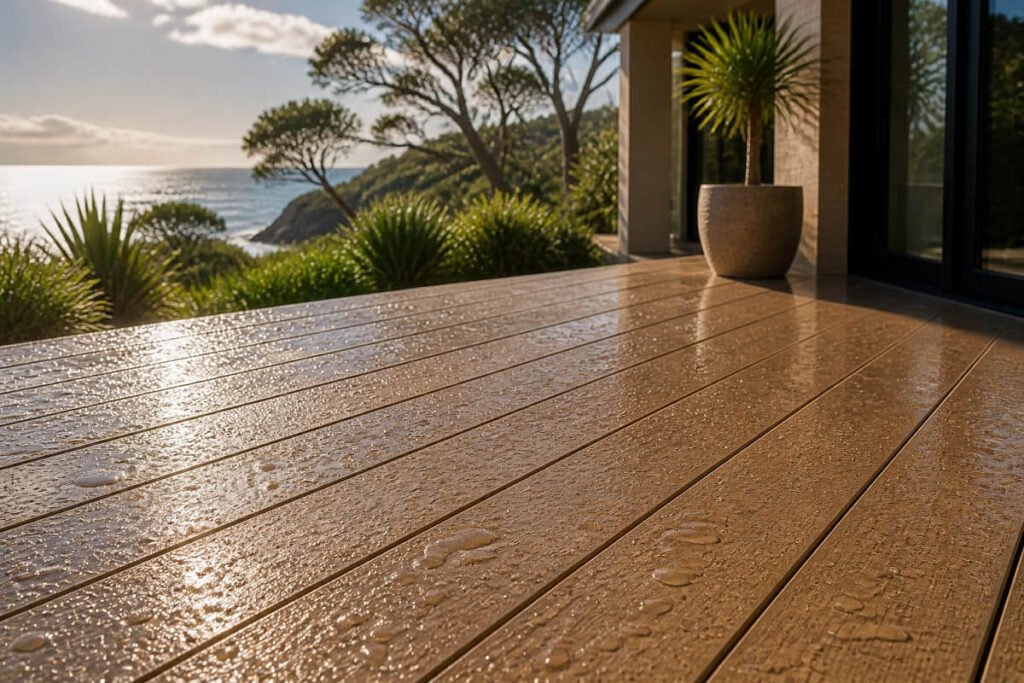
Look for boards with a combined HALS + UV absorber stabilisation system. This is the industry standard for premium capped composite. It controls colour fade under sustained UV exposure — a real concern in Australia, which has some of the highest UV levels in the world. Quality boards should hold colour change to ΔE ≤ 5 after 2,000–3,000 hours of QUV accelerated ageing. LastElegance boards, for reference, test at ΔE ≤ 4–5 after 3,000 hours — at the strong end of that range.
Water absorption is the other spec to check. Low is better. The industry benchmark for good capped composite is under 1% per ASTM D1037. Premium boards sit well below that — LastElegance tests at 0.2%.
Where the two board types differ is moisture behaviour inside the board. Hollow boards have internal chambers. If edge trim loosens or drainage under the deck is poor, water can sit inside those chambers. Over time, trapped moisture causes problems — especially in high-rainfall zones or coastal builds where salt air is a factor.
Solid boards don’t have this risk. There’s no hollow centre to trap water.
For coastal projects in Queensland or Western Australia, or any exposed deck without overhead cover, solid boards offer extra peace of mind. For covered patios, standard backyards, and well-drained installs, hollow boards handle Australian conditions well.
Both board types expand and contract with heat. Correct expansion gaps at install matter more than board type here — and that applies to every composite deck, hollow or solid.
Noise and Feel Underfoot
This is a smaller factor, but it’s real — and builders notice it after their first solid board install.
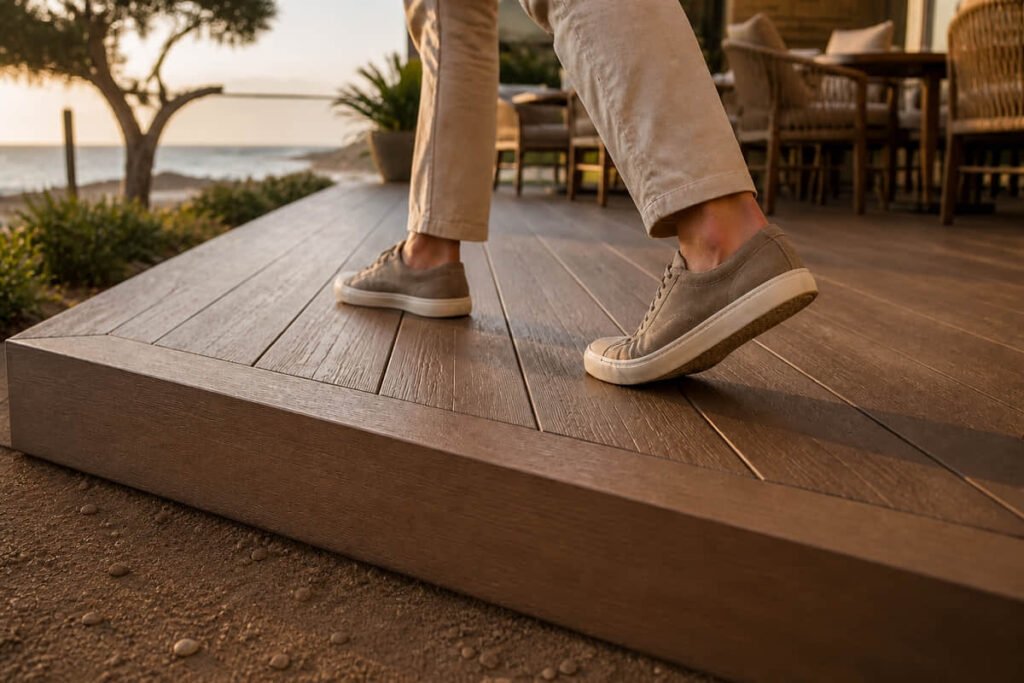
Solid composite decking feels firmer and quieter underfoot. There are no internal chambers to resonate, so footsteps land with a denser, more natural feel. It’s closer to the feel of real wood decking like spotted gum or blackbutt.
Hollow boards can produce a slightly hollow sound when walked on. It’s most noticeable on elevated decks with open airspace underneath. On ground-level decks with solid subframes, the difference is smaller.
For most home decks, this won’t drive your decision. But for commercial spaces, hospitality venues, or clients who expect a premium outdoor space, the solid board upgrade is worth it. Better noise absorption and a firmer surface make a noticeable difference in those settings.
Which Board Suits Your Project?
Start with two questions: what load will the deck carry, and where is the project?
Those two factors usually make the choice clear. Here’s a quick guide matched to real project types.
Hollow vs Solid: Project Match Guide
| Project Type | Recommended Board | Why |
|---|---|---|
| Standard backyard deck | Hollow | Cost-effective, light, easy to install |
| Large-area residential deck | Hollow | Lighter boards cut labour time on larger projects |
| Elevated deck or balcony overlay | Hollow | Less load on the subframe |
| Covered patio or pergola deck | Hollow | Protected from direct rain; drainage is simple |
| Pool surround | Solid | No hollow chambers to trap splash water; check for R11 slip rating |
| Outdoor kitchen or spa surround | Solid | Handles heavy point loads; longer warranty covers the investment |
| Commercial deck or high footfall area | Solid | Maximum strength, premium feel, longest warranty |
| Coastal or high-rainfall project | Solid | No moisture-trapping risk, extra peace of mind |
Hollow composite decking is the ideal choice when budget, weight, and install speed are your top priorities. Solid composite decking is the pick when load, longevity, and location demand a stronger board.
If you’re weighing both options for a specific project, it helps to feel the boards in hand. Request free samples → to compare weight, texture, and rigidity before you commit. Or get a project quote → and we’ll help you match the right board to the job.
FAQ
Do hollow and solid composite deck boards look different when installed?
No. Once laid, both board types look the same — same colours, textures, and grain patterns. Both use end caps at exposed cut ends. The only visual difference before capping is that hollow cut ends show the internal chambers, while solid ends are uniform. Once capped, both look identical.
Do hollow composite deck boards require special maintenance?
Both types are low maintenance. A wash with soapy water once or twice a year is enough — no staining, oiling, or sealing needed. For both board types, check that end caps stay secure. This matters more on hollow boards, since loose caps can let water into the internal chambers. Either way, it’s far less maintenance than a single coat of decking oil on timber.
Which lasts longer — hollow or solid composite decking?
Solid boards generally last longer. They have more material through the cross-section, which means better resistance to impact and wear over time. This is reflected in warranty terms — solid boards typically carry warranties of 20–30 years, while hollow boards sit around 10–15 years depending on the manufacturer.
Are there different qualities of composite decking?
Yes. The biggest quality split is between capped and uncapped composite. Capped boards have a polymer shell on all four sides that protects against UV, moisture, and staining. Uncapped boards leave some surfaces exposed and tend to fade and wear faster. Within capped composite, quality varies by cap layer thickness, UV stabiliser system, and the grade of HDPE or PVC used in the core.
Should composite decking be sealed?
No. Capped composite decking already has a protective outer shell — the cap layer — that handles UV and moisture. Sealing is not needed and not recommended. Applying sealant can interfere with the cap layer’s performance. Skip the sealant and the harsh chemicals. The board is built to handle Australian conditions as-is.
Is composite decking better than natural wood decking?
They solve different problems. Composite decking is low maintenance, resistant to termites and rot, and holds its colour longer — but it costs more upfront than most treated pine. Natural wood like spotted gum or blackbutt has a look and feel that’s hard to match, but it needs regular oiling, sanding, and insect damage checks. For a detailed comparison, see our Composite vs Timber Decking guide.