

Timber maintenance costs Australian builders real money — in call-backs, in client complaints, and in the hours spent re-quoting oiling jobs they never wanted. Composite decking has taken share for a reason. But the choice isn’t binary. Merbau, spotted gum, PVC, and composite each fit different projects.
This guide compares all four materials on cost, upkeep, lifespan, safety, and supply — written for importers, distributors, builders, and specifiers buying at volume.
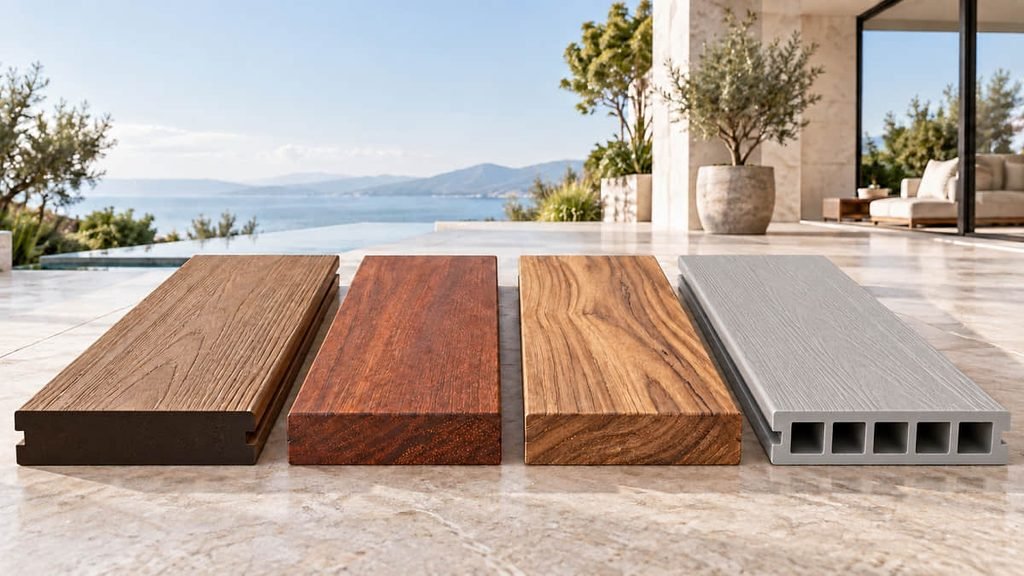
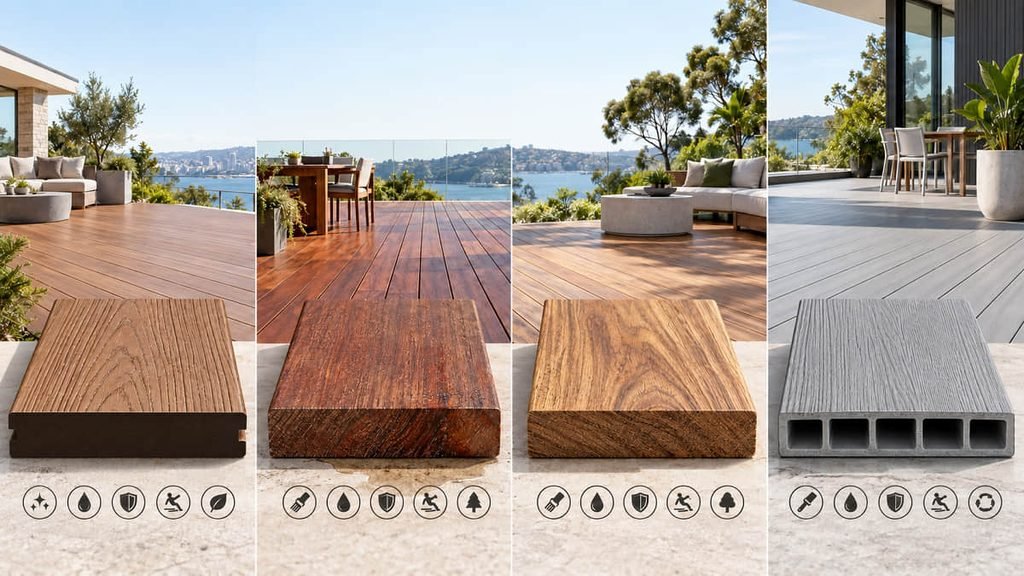
Four-Material Comparison Table
This table covers the factors trade buyers ask about most. Composite data is based on capped composite boards with a co-extruded cap layer — the specs below reflect our product range.
| Factor | Composite (Capped) | Merbau | Spotted Gum | PVC |
|---|---|---|---|---|
| Board cost per m² | $100–$190 | $100–$160 | $140–$250 | Higher than composite (varies by brand) |
| Installed cost per m² | $250–$450 | $300–$500 | $350–$550 | Varies — typically above composite |
| Expected lifespan | 25–30+ years | 20–25 years (maintained) | 25–30 years (maintained) | 25+ years |
| Annual maintenance | Wash only — no oil, no sanding | Oil 1–2×/yr, sand, inspect | Oil 1–2×/yr, sand, inspect | Wash only — slightly easier than composite |
| Maintenance cost (30 m²/yr) | ~$50–$100 | $300–$800 | $400–$1,000 | Minimal |
| Slip resistance | R11 (AS/NZS 4586) | Drops as oil wears | Drops as oil wears | Varies by product — check before specifying |
| Termite resistance | Yes — HDPE is inert to termites | Natural oils help, not guaranteed | Durability Class 1 — but lyctus beetle risk | Yes — no organic content |
| Tannin bleed | None | High — worst in first 6–12 months | Moderate — stains pavers after rain | None |
| Splinters over time | No | Yes — worsens with age | Yes — surface grain raises as timber dries | No |
| Water absorption | 0.2% (ASTM D1037) — below the 0.5–2% industry range | 5–15% depending on species | 5–15% depending on species | Near zero |
| Colour stability | ΔE ≤ 4–5 after 3,000-hr QUV | Greys without oiling | Greys without oiling | Good — but dark colours expand more in heat |
| Recycled content | Varies by manufacturer | None | None | Typically none — 100% virgin PVC |
| Fire testing | EN 13501-1: Class B-s1, d0 (above typical Class C/D) | Varies by species; untreated timber is combustible | BAL-29 at 18 mm+ thickness | Varies by product — check before specifying |
| Warranty | 15–30 years depending on product line | Varies by supplier | Varies by supplier | Varies by brand |
| Board weight (indicative) | 2.5–4.2 kg per linear metre (varies by profile) | ~3.5–4.5 kg/lm at 140 × 19 mm | ~4.0–5.5 kg/lm at 140 × 19 mm (densest AU hardwood) | Lighter than composite — varies by profile |
| Australian supply stability | Manufacturer-direct, made to order | Imported — SE Asia supply subject to harvest bans and log export controls | Domestic — but drought, fire, and demand affect supply | Imported — limited AU brands |
All costs are indicative and vary by project size, location, and supplier.
Request trade pricing for your project volume →
What Makes Each Material Different?
Composite (Capped)
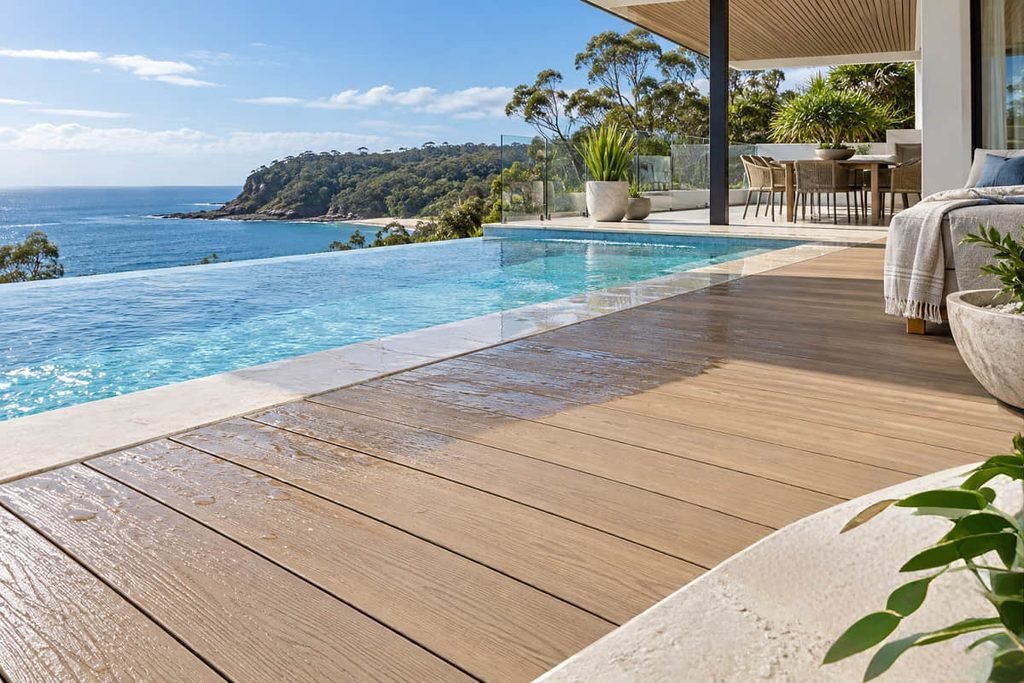
Composite boards blend wood fibre with recycled HDPE plastic. A co-extruded cap layer wraps the core on all sides. The cap blocks UV, moisture, and surface wear. Both solid and hollow profiles are available.
Our boards use a 0.8 mm cap layer — thicker than the 0.5–0.6 mm typical on most capped composite products. That extra thickness drives better UV protection and colour retention over time. Water absorption sits at 0.2% (ASTM D1037), well below the 0.5–2% range common across the category.
Other specs: HDPE density 0.95 g/cm³. Flexural strength 26.2 MPa (EN 15534). UV stabilisation uses a combined HALS + UV absorber system.
Merbau
Merbau (Intsia bijuga) is a tropical hardwood from Southeast Asia. Durability Class 1–2 above ground. Dense grain. Reddish-brown tones that look good when freshly oiled — but grey fast without annual treatment.
Spotted Gum
Spotted gum (Corymbia maculata) is a native Australian hardwood. Durability Class 1 above ground. Janka hardness of 11.0 kN — one of the toughest decking timbers in the country. That hardness matters for commercial boardwalks and very high-traffic public areas.
PVC
PVC decking is 100% polyvinyl chloride — no wood fibre, no organic content. Fully waterproof and immune to termites. For marine-adjacent installs or constant water exposure, PVC removes the moisture risk entirely. The trade-offs: higher board cost, more plastic feel underfoot, and harder to recycle at end of life.
Cost Over Time: Where the Numbers Shift
Board cost tells one story. Lifecycle cost tells a different one.
Timber is cheaper to buy — merbau at $100–$160/m², treated pine at $30–$50/m². Composite boards run $100–$190/m². PVC typically sits above composite.
The gap reverses once maintenance stacks up. Oiling, sanding, and re-staining a hardwood deck runs $300–$1,000 per year for a 30 m² area. Over 15–20 years, that’s $6,000–$20,000 in upkeep alone. Composite needs a wash. That’s it.
15-Year Lifecycle Cost: 30 m² Deck
| Cost item | Composite | Merbau | Spotted Gum |
|---|---|---|---|
| Installed cost | $7,500–$13,500 | $9,000–$15,000 | $10,500–$16,500 |
| Maintenance × 15 years | ~$1,100 | ~$8,250 | ~$10,500 |
| 15-year total | ~$8,600–$14,600 | ~$17,250–$23,250 | ~$21,000–$27,000 |
Indicative figures. Actual costs vary by location, trade rates, and timber grade.
Most trade buyers see the crossover at around 5–7 years. From that point, composite is the cheaper material to own.
For procurement managers specifying across multi-unit developments, this compounds fast. Each site with timber adds ongoing maintenance overhead. Each site with composite doesn’t. Buying composite from a manufacturer rather than a reseller also removes importer and distributor margins — for volume orders, that shifts the landed cost further.
Installation Speed and Labour Cost
For contractors, install speed is labour cost. That’s the whole equation.
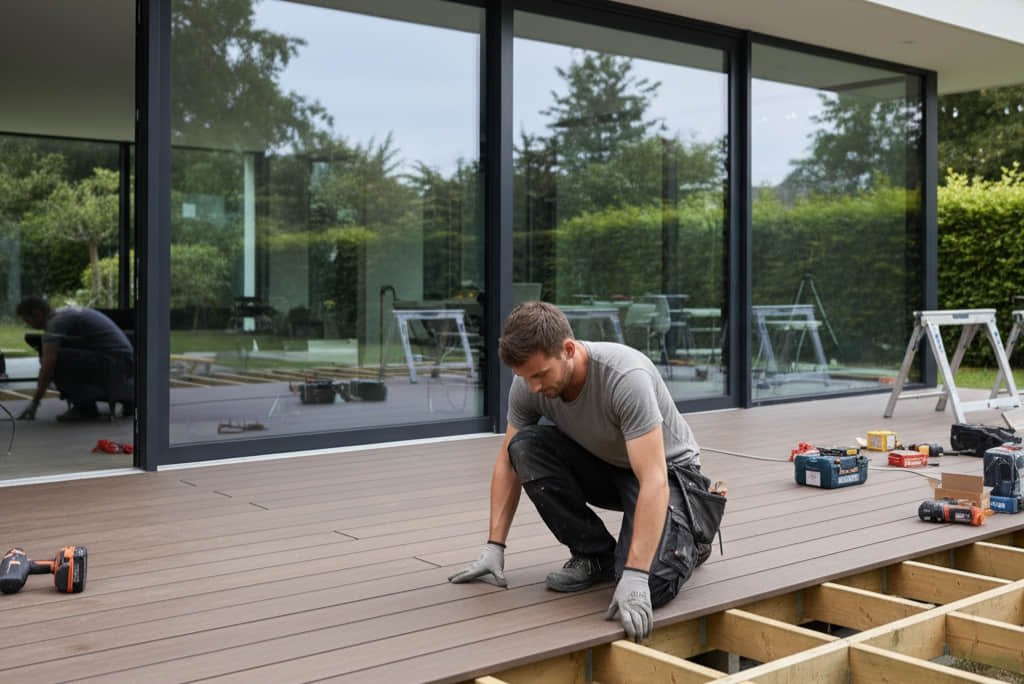
Composite uses a hidden clip system. Stainless steel clips slot into the board groove and lock onto the joist. No pre-drilling. No surface screws. The next board slides in and locks. Most crews see a 10–15% speed gain over hardwood.
Merbau and spotted gum are dense timbers. Every fastener needs pre-drilling to avoid board cracking. Spotted gum at 11.0 kN Janka wears blades faster and slows cuts. That adds labour hours on every job.
Recommended joist spacing for capped composite: 300 – 350 mm centre-to-centre. That’s standard framing. Installation guides and videos are available for crews fitting composite for the first time.
Maintenance: What Each Material Actually Needs
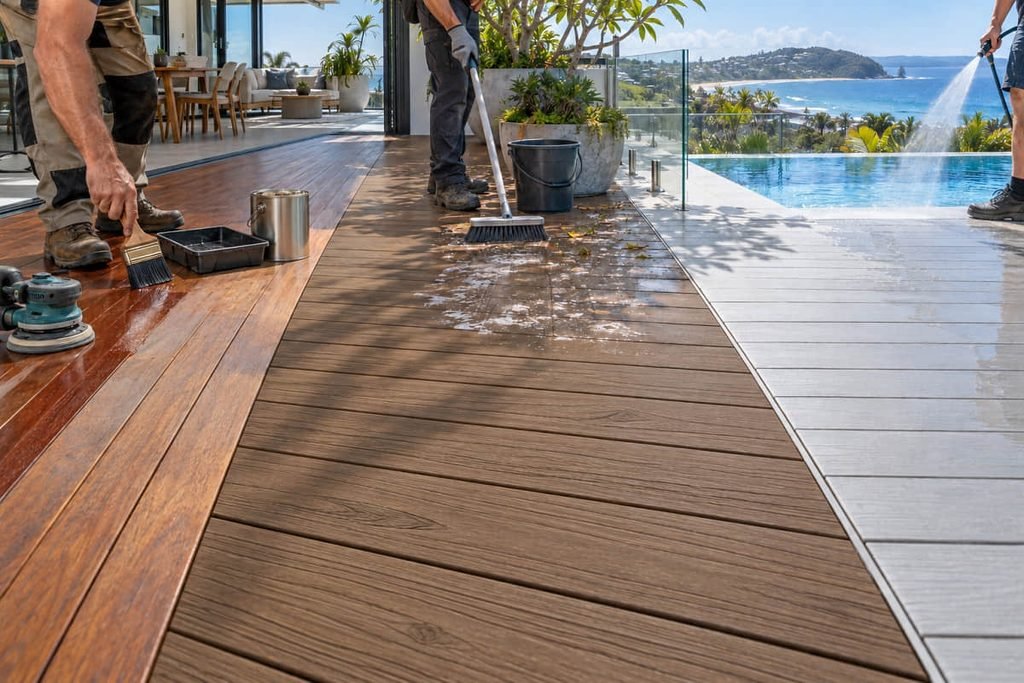
Merbau and spotted gum — annual cycle:
Sweep, clean with a deck wash, sand rough patches, apply 1–2 coats of hardwood oil, inspect for splits and pest activity. That’s a half-day of trade work per 30 m². In coastal Queensland and northern NSW, the cycle runs more often — UV and salt strip oil faster.
Skip a year, and moisture gets into the grain. Surface checking and greying follow. Two years without treatment, and you’re dealing with client complaints.
Composite — annual cycle:
Wash with soapy water and a soft brush, 2–4 times a year. No oil. No sanding. No sealant.
Composite isn’t zero-maintenance. Leaves and mildew can build up in grooves, especially in shaded or wet spots. But there’s a real gap between a light wash and a full oiling day.
PVC: Wash only — similar to composite. PVC’s fully synthetic surface is slightly easier to wipe clean.
For strata managers, developers, and body corporates, a deck that needs annual oiling is a recurring liability. Composite and PVC both remove that problem.
How Each Material Handles Australian Conditions
UV and Colour Stability
Untreated timber greys within months in strong Australian sun. Regular oiling slows this but doesn’t stop it.
Capped composite handles UV differently. The HALS + UV absorber system in the cap layer keeps colour stable over years of direct sun. On our boards, QUV testing shows colour shift held to ΔE ≤ 4–5 after 3,000 hours — a slight change over time, not a visible fade. Our distributors in high-UV regions tell us this is one of the first things contractors ask about — faded boards lead to client complaints.
PVC also holds colour well, but dark PVC boards can expand more in direct sun than composite.
Termites and Pests
Composite and PVC are fully termite-resistant — no organic material for termites to digest.
Merbau’s natural oils provide some resistance, but it’s not guaranteed. Spotted gum is Durability Class 1 for termites — the top rating — but it’s at risk from lyctus beetles (powderpost beetles), which bore through hardwood from the inside. In pest-active regions of Queensland and northern NSW, that’s a spec-stage conversation.
Moisture and Coastal Performance
At 0.2% water absorption, our boards sit well below the capped composite category average. In coastal salt air, high humidity, and subtropical rain, that gap matters.
Merbau and spotted gum both absorb moisture. Salt speeds up the oil breakdown cycle. Cracking and cupping follow when moisture swings between wet and dry seasons. PVC absorbs near zero moisture — for constant water exposure, it removes the risk entirely.
Tannin Bleed
This catches buyers out. Merbau is high in natural tannins — rain washes them onto surrounding surfaces. Pool coping, concrete, pavers, rendered walls all stain reddish-brown. Staining is worst in the first 6–12 months and can continue for 2–3 years. Oxalic acid–based cleaners help with fresh stains, but set-in marks on porous concrete may be permanent.
Spotted gum produces moderate bleed — less than merbau, but still enough to stain light pavers after rain. Some boards also weep gum residue near water in the first season.
Composite and PVC produce zero tannin bleed. For pool surrounds and projects where the surrounding hardscape matters, that’s a call-back risk you can remove entirely.
Surface Heat
All dark-coloured outdoor surfaces absorb heat in summer — composite, timber, and PVC all do this. Composite tends to retain more heat than timber due to its plastic content.
For projects with full afternoon sun exposure — schools, aged care, public pool surrounds — this is worth factoring into the spec. Lighter composite colours stay noticeably cooler than dark ones. Shade planning and board colour choice are the practical controls.
Slip Resistance and Splinters
Capped composite boards carry an R11 rating under AS/NZS 4586 — wet or dry, no maintenance needed to keep it. Timber slip resistance drops as surface oil wears off, and biofilm in humid conditions makes bare timber slippery.
Composite and PVC don’t splinter. Timber does — especially as boards age and the grain raises. For barefoot areas and builds with public liability exposure, splinter-free boards reduce risk.
Fire Testing
Our capped composite boards are tested to EN 13501-1: Class B-s1, d0 — a stronger result than the Class C or D rating common on most composite decking. If your project requires testing to a different standard, we can arrange it — tell us the requirement and we’ll scope it with you.
Spotted gum achieves BAL-29 at 18 mm+ board thickness under the NCC bushfire framework. PVC and merbau fire ratings vary by product.
Appearance: How Close Does Composite Get?
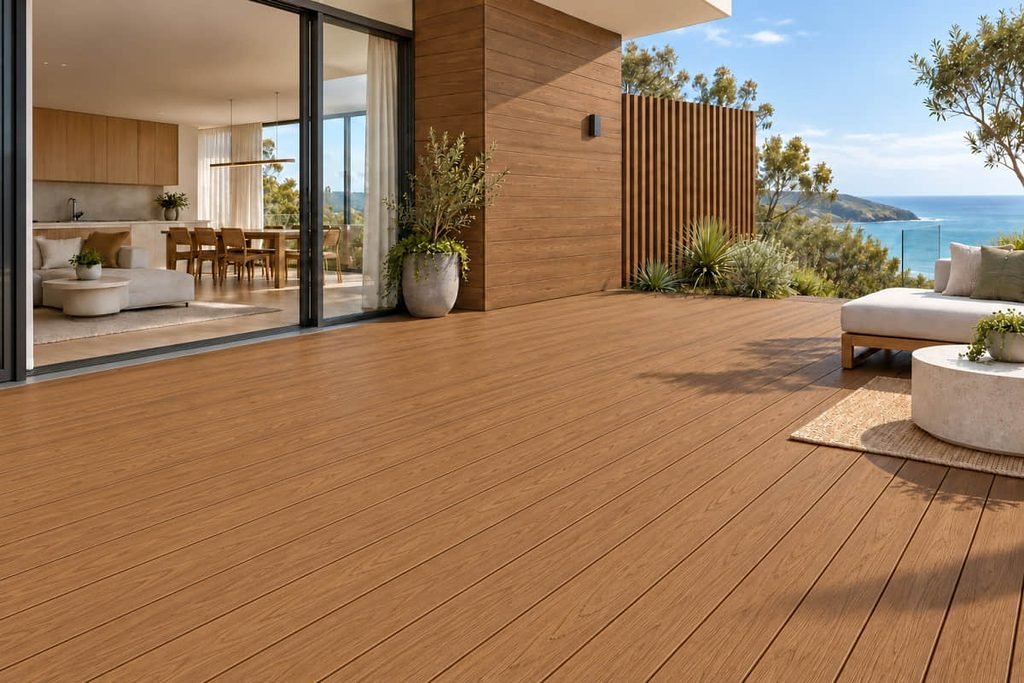
Fresh merbau and spotted gum look excellent. No composite fully replicates natural timber grain — and we won’t pretend otherwise.
The trade-off: timber only looks that way when freshly maintained. Skip a year of oiling and boards grey. After two years, the deck looks nothing like install day. That’s when client complaints start.
Modern capped composite has closed the visual gap. Multi-tonal colour blending, embossed grain textures, and spotted gum–tone colourways mean most buyers find the gap smaller than expected when comparing samples. Composite also comes in tones timber can’t offer — greys, charcoals, and custom colours for volume orders.
Look for a manufacturer whose boards share the same colour palette across decking, cladding, and screening. One colour system across every surface avoids mismatches on full-facade projects.
PVC has improved, but still reads as more plastic than composite for projects where a natural wood feel matters.
Request free samples to compare look and feel →
Sustainability and Recycled Content
Composite boards use a mix of recycled wood fibre and recycled HDPE — the exact share varies by manufacturer. Over the board’s lifespan, composite produces zero chemical runoff: no oils, stains, or sealers enter the environment. Our boards return not detected for formaldehyde under EN 717-1 testing — the best possible result, and below the threshold most manufacturers publish.
Merbau is imported from SE Asian tropical forests — FSC-certified stock is a small share of the Australian market. Spotted gum is Australian-grown with FSC options available, but supply is affected by drought and fire. PVC is 100% virgin plastic with no recycled content; most boards go to landfill at end of life.
If sustainability criteria appear in a tender, composite is the easiest material to document with confidence.
Which Material Fits Which Project?
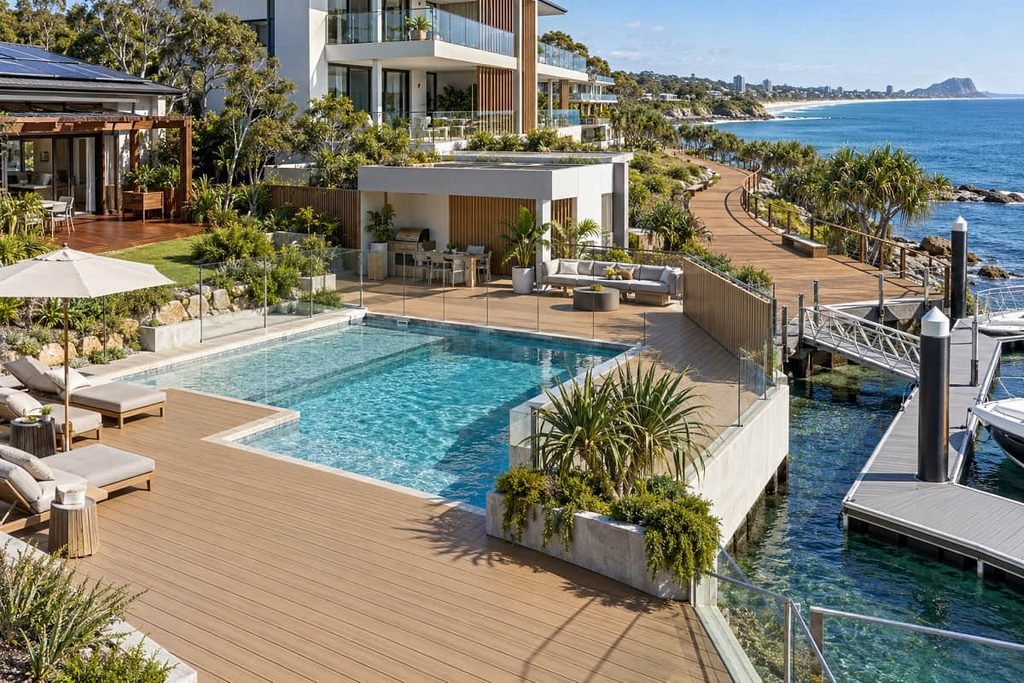
Choose composite if:
- The project is commercial, strata, or multi-residential — where post-handover maintenance is a liability
- Pool surrounds, wet areas, or coastal builds — waterproof, splinter-free, R11 slip-rated
- The client won’t commit to annual oiling — and most won’t
- You need consistent specs across multiple sites or repeat orders
- Custom colours, sizes, or profiles are part of the design
- Sustainability or recycled content criteria appear in the tender
Choose merbau if:
- The client wants authentic timber and accepts the upkeep commitment
- It’s a smaller residential job where entry cost is the deciding factor
- The project is matching or extending an existing merbau structure
Choose spotted gum if:
- Maximum hardness is required — commercial boardwalks, very high-traffic public areas
- Local Australian sourcing is a genuine project requirement
- FSC-certified Australian hardwood is specified in the tender
Choose PVC if:
- Constant water exposure is a hard requirement — marine-adjacent, below waterline
- Zero organic content is specified
- The client accepts a more synthetic look and higher board cost
For most commercial builds, multi-unit developments, and coastal projects in Australia, composite is the stronger specification. It holds up with less upkeep and costs less over its lifespan.
For procurement details — MOQ, lead times, custom specs, and trade pricing — see our trade page or request free samples.
Frequently Asked Questions
Does composite decking get hot in Australian sun?
All dark-coloured outdoor surfaces absorb heat in summer — composite and timber both do this. Lighter composite colours help manage surface temperature. Factor colour choice into the spec for any sun-exposed deck.
Is composite decking termite-proof?
Yes. Composite boards contain HDPE plastic, which termites can’t digest. This makes composite a safer long-term spec in termite-prone areas, where treated timber’s protection breaks down over time.
Can composite boards go over an existing timber subframe?
Often yes — if the existing subframe is structurally sound and joist spacing meets the 300 – 350 mm centre-to-centre spec. Have an installer assess the frame on-site before committing. Custom board lengths are available to match existing deck dimensions.
What does the warranty cover?
The warranty covers surface cracking, edge warping, breakage, and colour fade beyond the contracted range. It applies under normal use and correct installation only. Damage from incorrect install, human error, or misuse is excluded.