

A builder specs a subframe for treated pine, then the client switches to composite. The boards show up heavier than planned. Now the joist spacing is wrong, the footings are borderline, and the job stalls before a single board goes down.
Weight matters more in trade than most guides let on. It sets your subframe spec, your container loading, your freight cost per m², and how your crew handles boards on site. A hollow composite board and a solid one can differ by 45%. Freshly treated pine can weigh 50% more than kiln-dried stock. One generic number per material doesn’t cut it.
This article gives you real kg/m and kg/m² figures — composite and Australian timber side by side — so you can spec, quote, and order with the right numbers.
How Much Heavier Is Composite Decking Than Wood?
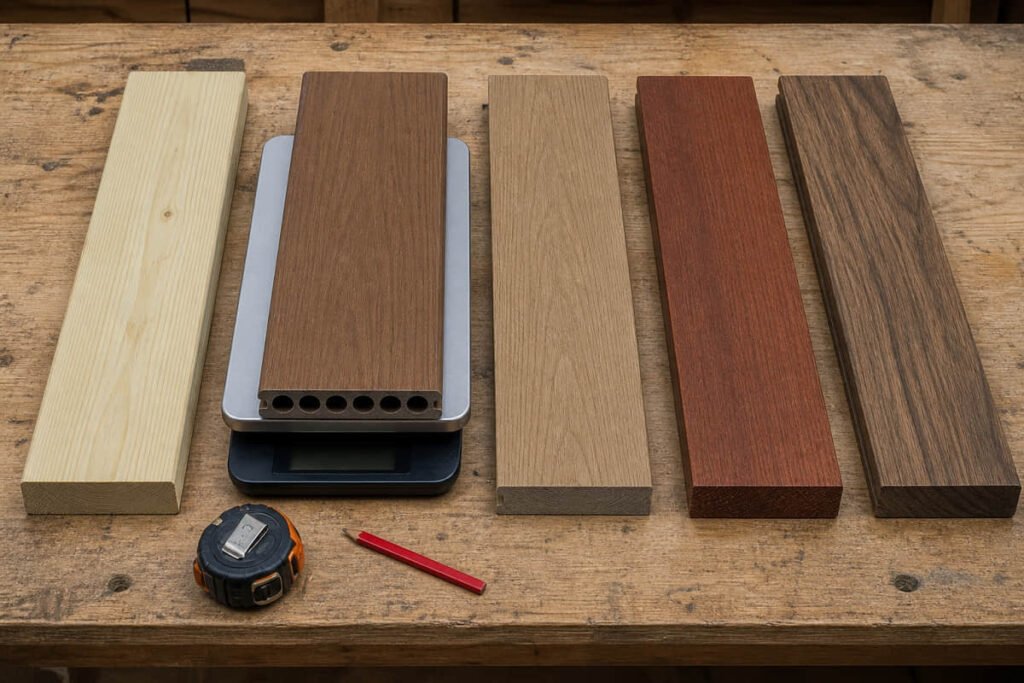
Composite decking ranges from 18 to 30 kg/m², depending on profile. Treated pine sits around 10 kg/m². Australian hardwoods run 16 to 20 kg/m². The real gap depends on four things: board profile (hollow or solid), board dimensions, timber species, and moisture content.
A hollow composite board at 139×22 mm weighs 2.51 kg per linear metre — lighter than spotted gum at 140×19 mm (2.53 kg/m). Switch to a solid composite at 140×23 mm, and the weight jumps to 4.20 kg/m — heavier than any common Australian decking timber.
The point: “composite vs wood” isn’t one comparison. It’s several, and the numbers shift with every variable.
Why Is Composite Decking Heavier?
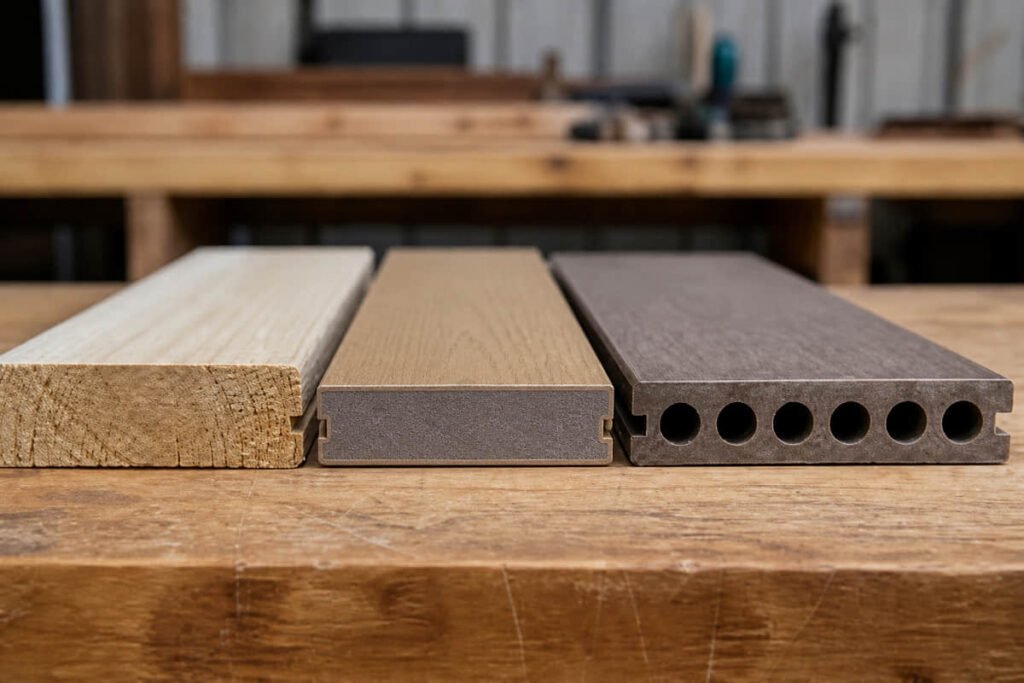
Composite boards blend wood fibre with HDPE plastic. The mix is heated and pressed, which removes the air pockets found in natural wood. Plastic fills gaps that timber leaves open, so the board ends up denser per metre.
A typical capped composite uses hardwood fibre combined with HDPE at around 0.95 g/cm³ density, with recycled content making up about 60% of the mix. The composite board is simply more packed with material than pine.
That density is also what makes composite waterproof and termite-proof. More material per metre means no entry points for moisture or insects.
Real Weights — Composite vs Timber Per Metre
This is where the numbers matter. The table below compares capped composite deck boards against common Australian timber species — in both kg per linear metre (how you buy it) and kg per square metre (how you spec a subframe and calculate dead load).
The kg/m² column uses nominal board face width with no gap allowance. All timber figures assume kiln-dried stock at 12% moisture content.
| Board type | Dimensions (mm) | kg/m | kg/m² |
|---|---|---|---|
| Capped hollow composite | 139 × 22 | 2.51 | 18.1 |
| Capped hollow composite | 139 × 23 | 2.90 | 20.9 |
| Capped solid composite | 139 × 24 | 3.10 | 22.3 |
| Capped solid composite | 140 × 20 | 3.72 | 26.6 |
| Capped solid composite | 140 × 23 | 4.20 | 30.0 |
| Treated pine (radiata) | 140 × 19 | ~1.45 | ~10.4 |
| Merbau | 140 × 19 | ~2.19 | ~15.7 |
| Spotted gum | 140 × 19 | ~2.53 | ~18.1 |
Composite weights are from LastElegance product specifications. Other capped composite brands on the Australian market will fall within a similar range for comparable profiles and dimensions. Timber weights are calculated from published air-dry densities: treated pine at 545 kg/m³ (Business Queensland), merbau at 825 kg/m³ (USDA Wood Handbook), spotted gum at 950 kg/m³ (Business Queensland). Actual timber weights vary by grade, cut, and moisture — always confirm from your supplier’s latest spec sheet.
Three things stand out. Treated pine is the lightest option by a wide margin. A hollow composite board weighs about the same as spotted gum per linear metre. And the gap between hollow composite (18 kg/m²) and solid composite (30 kg/m²) is larger than the gap between treated pine and hardwood.
Need the total weight for a specific project? Our Decking Calculator returns net board weight in kilograms alongside your full material schedule — boards, joists, clips, and waste allowance.
How Board Profile Changes the Number
Compare two composite boards at roughly the same width: a capped hollow profile at 139 mm weighing 2.90 kg/m, vs a capped solid profile at 140 mm weighing 4.20 kg/m. That’s a 45% difference from the profile change alone.
A hollow composite board can weigh less than dense hardwood like spotted gum. A solid composite board will weigh more. Profile matters as much as the material itself when you’re speccing a subframe or costing freight. For a deeper look at the trade-offs — strength, install, and cost — see our Hollow vs Solid Composite Decking guide.
Why Timber Weight Varies on Site
Timber weight changes with species, moisture content, and grade. The species gap is large: treated pine (radiata) sits around 545 kg/m³ kiln-dried, while spotted gum reaches 950 kg/m³. That’s nearly double the density for the same volume.
Moisture is the other variable. Freshly treated pine can hold 50% or more extra water weight compared to kiln-dried stock. Those “light” pine boards off the truck can feel closer to hardwood until they dry out.
Timber doesn’t have a single weight — it has a range, and that range is wide. When you’re planning a subframe, costing freight, or comparing quotes, always ask: which species, and how dry?
How Weight Affects Container Loading and Landed Cost
This is where weight stops being a spec-sheet detail and starts setting your cost per m².
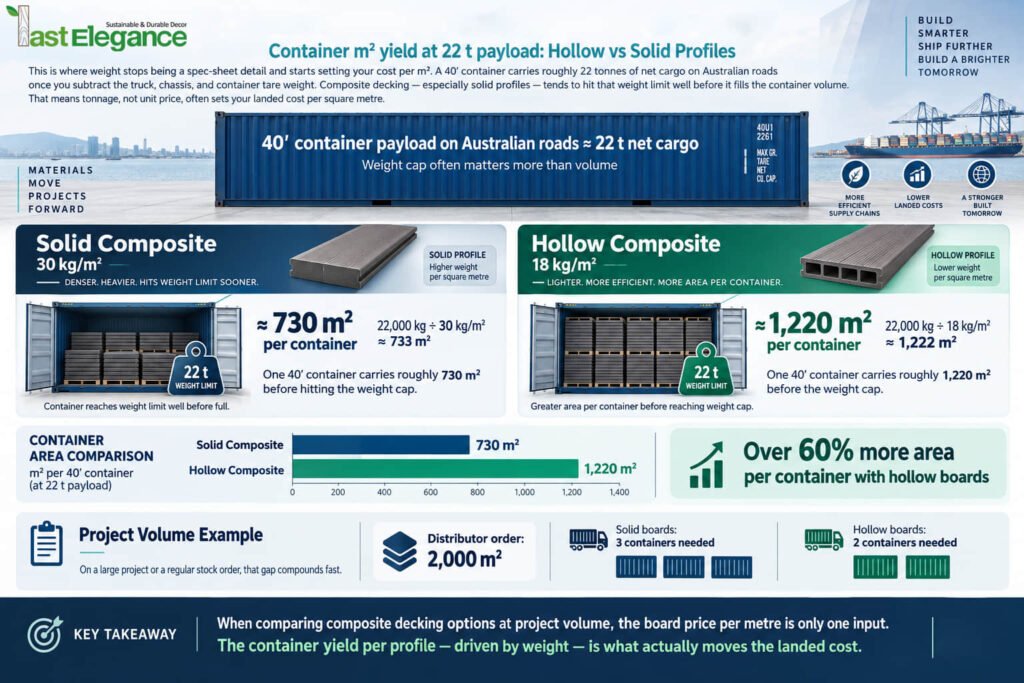
A 40′ container carries roughly 22 tonnes of net cargo on Australian roads once you subtract the truck, chassis, and container tare weight. Composite decking — especially solid profiles — tends to hit that weight limit well before it fills the container volume. That means tonnage, not unit price, often sets your landed cost per square metre.
Run the numbers on two common profile types:
- Solid composite at 30 kg/m²: one 40′ container carries roughly 730 m² before hitting the weight cap.
- Hollow composite at 18 kg/m²: one 40′ container carries roughly 1,220 m² before the weight cap.
That’s over 60% more area per container with hollow boards. On a large project or a regular stock order, that gap compounds fast. A distributor ordering 2,000 m² of solid boards needs three containers. The same area in hollow boards fits in two.
When you’re comparing composite decking options at project volume, the board price per metre is only one input. The container yield per profile — driven by weight — is what actually moves the landed cost. Our Decking Calculator outputs total net board weight for your project, so you can model freight before requesting a quote.
Does the Weight Affect Your Subframe?
Composite decking is heavier per metre than treated pine. But the difference rarely needs a full subframe redesign.
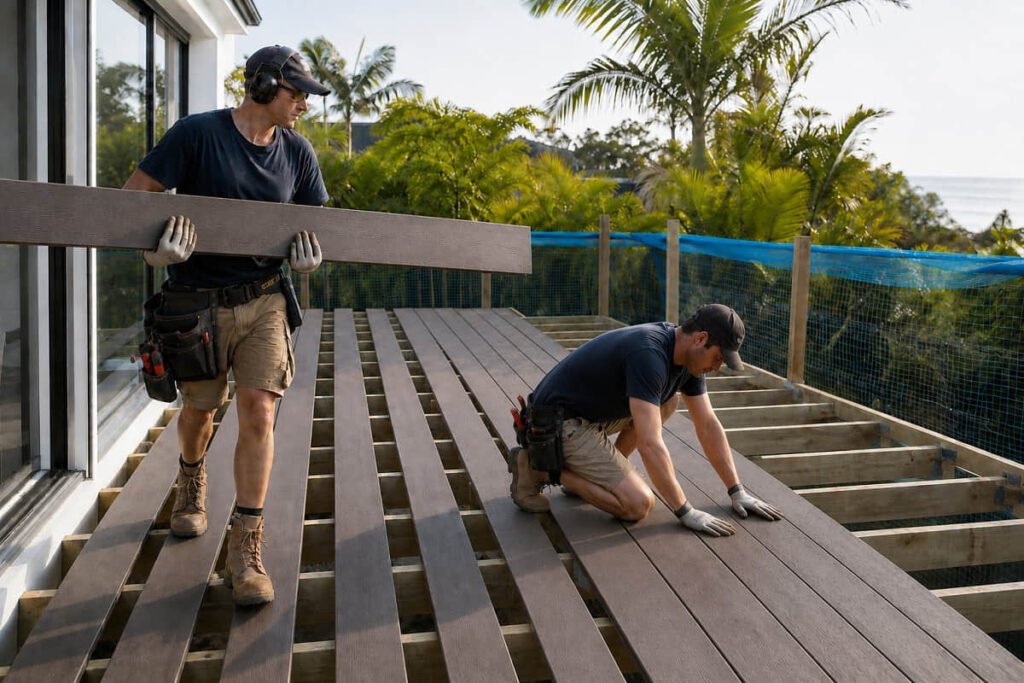
Joist spacing for composite decking runs from 300 to 350 mm, depending on the brand and board profile. Heavier boards and high-traffic areas need the tighter end. Flexural strength on a quality capped composite sits around 26 MPa (tested to EN 15534). Follow the manufacturer’s install guide and the relevant sections of the NCC, and the subframe should handle the load.
The NCC references AS 1170.1 for imposed loads on decks. The standard dead load allowance for timber decking in Queensland span tables is 40 kg/m². Even the heaviest solid composite at 30 kg/m² sits well inside that ceiling. In most cases, a code-compliant timber subframe will also suit composite.
Three things to check before switching a timber spec to composite:
- Joist spacing — check the composite manufacturer’s install guide. Don’t assume existing timber spacing is close enough.
- Bearer and footing capacity — add the weight difference per m² and verify the existing structure can carry it. This matters most on elevated or multi-storey decks.
- Fixing method — composite uses hidden clips, not face screws. Joist tops need to be flat and consistent.
If you’re building from scratch, the subframe design follows the composite spec from the start. The weight difference only becomes a question when you’re changing materials on an existing structure.
What Should You Check Before Reskinning a Timber Deck with Composite?
Reskinning — pulling old timber boards and laying composite on an existing subframe — is a common trade job. Our installers in Western Sydney and South-East Queensland flag three things that cause problems:
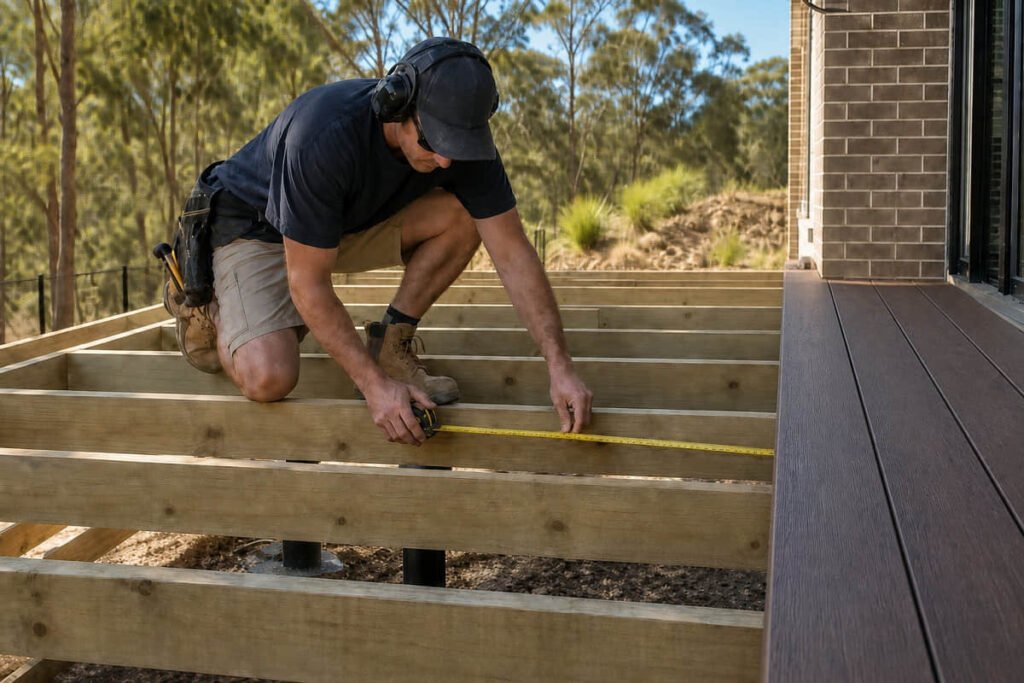
Bearer and footing capacity. On a typical 20 m² deck, switching from treated pine to solid composite could add 400 kg of dead load. Older subframes built to minimum spec may not have the margin. Check bearer spans and footing sizes against the new load before you commit.
Joist condition and flatness. Hidden clips need a flat, consistent joist top to seat properly. Old joists with cupping, crown, or rot on the top edge won’t hold clips. Inspect every joist before you price the job — a few replacements are normal, but a full reframe changes the scope.
Spacing. Existing timber joist spacing is often 450 mm. Most composite products need 300 mm. If the joists are too far apart, you’ll need to add noggins or sister joists — factor that labour into your quote.
Is Composite as Strong as Wood?
Composite and timber have different strength profiles. A quality capped composite board tests around 26 MPa in flexural strength (EN 15534) — strong enough for foot traffic and furniture loads at 300 mm joist spacing.
The honest trade-off: composite has less stiffness than hardwood and flexes more under point loads. But it holds that strength over time — no rot, no warping, no soft spots from water damage. Timber starts strong and gets weaker as it weathers. Composite stays the same. That’s why joist spacing matters more than raw board strength.
Handling Weight and Install Speed
Weight on a spec sheet is one thing. Weight in your hands at 7 a.m. on a second-storey job is another.
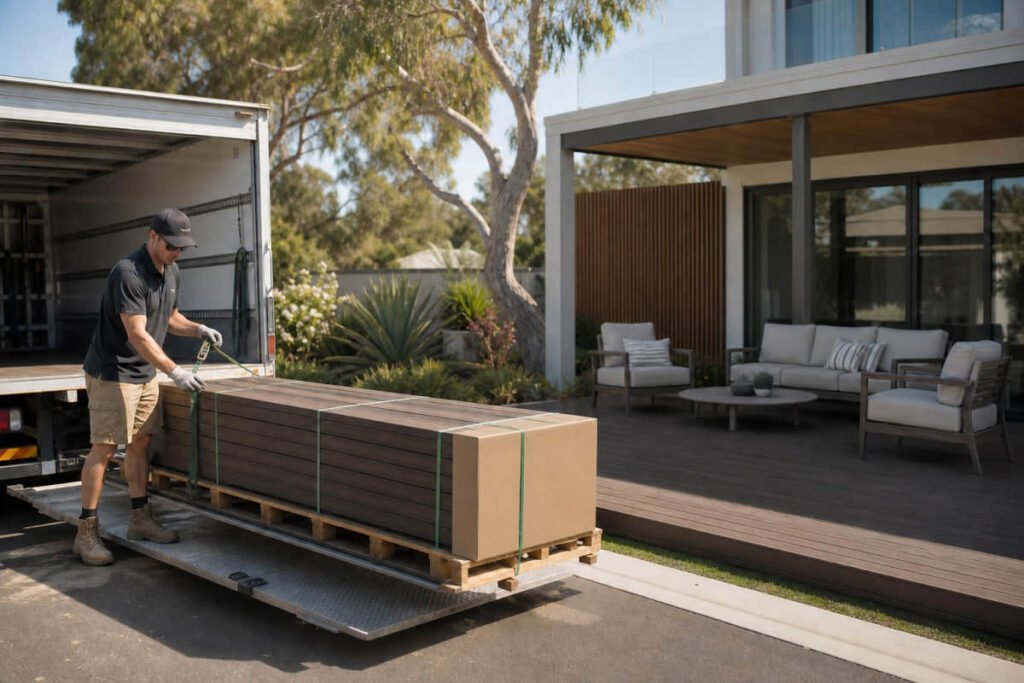
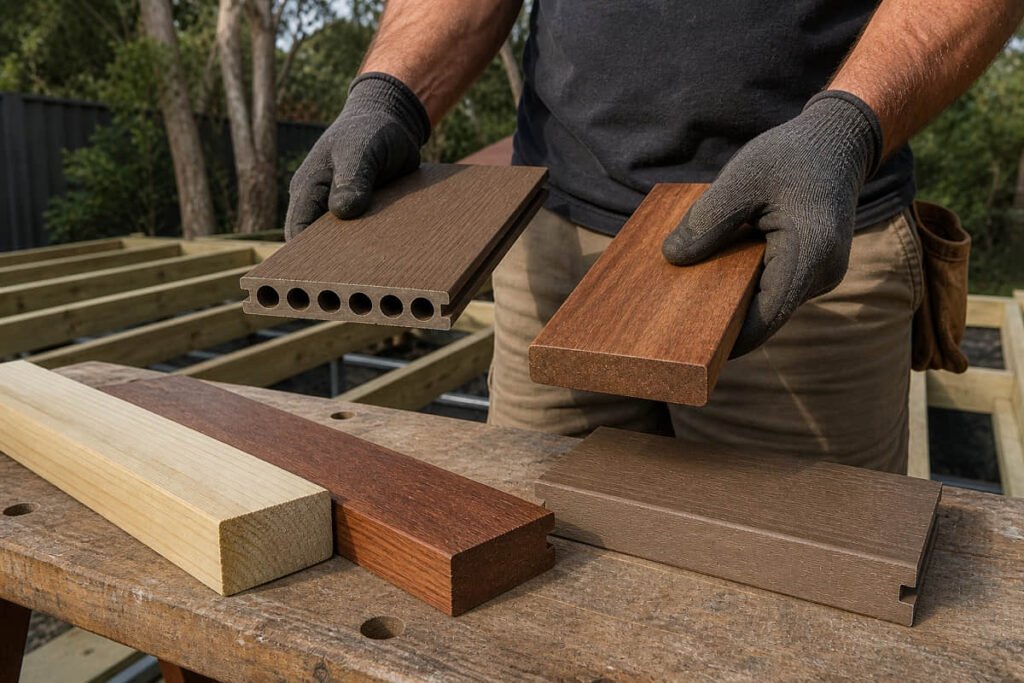
Most capped hollow composite boards on the Australian market weigh between 2.2 and 3.0 kg/m at standard widths. A 2.9 m hollow board in that range weighs roughly 6.4 to 8.7 kg — a comfortable one-person carry. Solid composite boards run heavier. A 2.9 m solid board at 4.20 kg/m comes in at about 12.2 kg — still a one-person lift, but worth planning for across a full day on a second-storey deck.
For context, a 2.9 m spotted gum board at 140×19 mm weighs about 7.3 kg. Merbau at the same size comes in around 6.4 kg. The lighter composite boards sit right in the range of common hardwood decking.
Where composite wins back time is the install. Capped composite systems use hidden clips — stainless steel fasteners that slot into board grooves and clip onto the joist. No pre-drilling. No face screws. The next board slides in and you move on. Builders in coastal Queensland tell us the clip system is what sells the switch for their crews. On a typical project, that speed gain offsets any extra handling weight.
Frequently Asked Questions
Does the NCC treat composite and timber dead loads differently?
No — the NCC doesn’t prescribe different dead load rules by decking material. It references AS 1170.1 for imposed loads and leaves dead load to the designer’s calculation. The standard assumption in Queensland span tables is a maximum decking mass of 40 kg/m². All common capped composite profiles fall within that ceiling. For elevated or high-load decks, confirm with the manufacturer’s install guide and check with a structural engineer.
Does board weight tell you anything about lifespan?
Not directly — but it reflects density, and density tracks with wear resistance. Heavier solid profiles use more material and typically carry longer warranties — up to 25 or 30 years with some brands. Lighter hollow profiles are usually rated at 15 to 20 years. The weight difference maps to the product tier, not a quality defect.
How much does composite decking cost vs wood over time?
Composite has a higher upfront cost but needs far less upkeep — no oiling, staining, or sanding. Over 10–15 years, total cost of ownership often favours composite once you factor in annual maintenance labour and materials. Warranty periods across the industry range from 15 to 30 years depending on profile type — a useful signal of how long the manufacturer expects the product to last.
How do heat and cold affect a composite deck vs wood?
Composite expands and contracts slightly with temperature. Any quality install guide accounts for this with recommended expansion gaps. Timber also moves, but mostly with moisture changes rather than heat. Neither issue is related to board weight — it’s a separate installation detail.
Will replacing a timber deck with composite boards increase the total deck weight much?
On a typical 20 m² deck, switching from treated pine to composite adds roughly 150 to 400 kg depending on the profile you choose. Hollow boards add the least; solid boards add the most. That’s usually within the capacity of an existing code-compliant subframe — but always check bearer and footing specs before starting, especially on older structures.
What is the typical weight per square metre for composite deck boards?
Capped composite ranges from about 18 to 30 kg/m² depending on profile type. Hollow boards sit at the lighter end (18–21 kg/m²), solid boards at the heavier end (22–30 kg/m²). Most manufacturers publish kg/m figures on their spec sheets — divide by the board face width in metres to get kg/m², or use a decking calculator that outputs the weight directly.