
Wrong composite decking slip rating on a pool surround or commercial ramp: certifier rejection, pulled boards, relaid labour you can’t recover.
Most specifiers know slip resistance is a compliance requirement. Fewer know which test applies to which project type — or that NCC 2025 accepts both R and P ratings as valid.
This is the reference you reach for before writing the spec.
Key Takeaways
- P4 = R11. NCC 2025 accepts either for exposed outdoor decking in wet conditions — different tests, same minimum
- P ratings come from the Wet Pendulum Test. R ratings come from the ramp test. Both are valid NCC compliance pathways.
- A product with only an R11 hasn’t been Wet Pendulum tested — matters when a certifier asks for P rating documentation specifically
- Ramps steeper than 1:14: minimum P5 or R12 in wet conditions
- Pool surrounds: the Wet Barefoot Inclining Platform test produces A/B/C classifications, not P ratings — it’s a separate test, not covered by the Wet Pendulum result
- Test reports must name AS/NZS 4586:2013, the exact test method, the specific product model, and the testing lab
What Governs Slip Ratings in Australia?
AS/NZS 4586:2013 defines how pedestrian surfaces in Australia are tested and classified for slip resistance. It covers the test methods, the rating scales, and the conditions under which each applies. The National Construction Code — NCC 2025 edition — then references those classifications as minimum requirements for specific building classes and application types.
A product can claim any rating it likes. What matters is the test report behind it. That report must name AS/NZS 4586:2013 as the governing standard. The result must meet the NCC 2025 minimum for the specific application — outdoor decking, a ramp, pool surrounds, or a barefoot area.
These two documents do different jobs. AS/NZS 4586:2013 is the testing and classification standard. NCC 2025 is what requires you to reach a specific classification on a given project. Conflating the two is where most specification errors start.
R Ratings vs P Ratings Explained
Two rating scales exist under AS/NZS 4586:2013. Both are valid NCC 2025 compliance pathways for outdoor composite decking. For standard outdoor decking exposed to wet weather, the NCC 2025 accepts either P4 or R11 as the minimum — both ratings meet the requirement.
Some competitor content implies R ratings aren’t accepted by the NCC for outdoor decking. That’s not accurate. Both systems are valid. What matters is the test method that produced the rating — and that distinction determines whether the rating on a product’s data sheet covers the application you’re specifying.
What Does the R Rating Scale Mean?
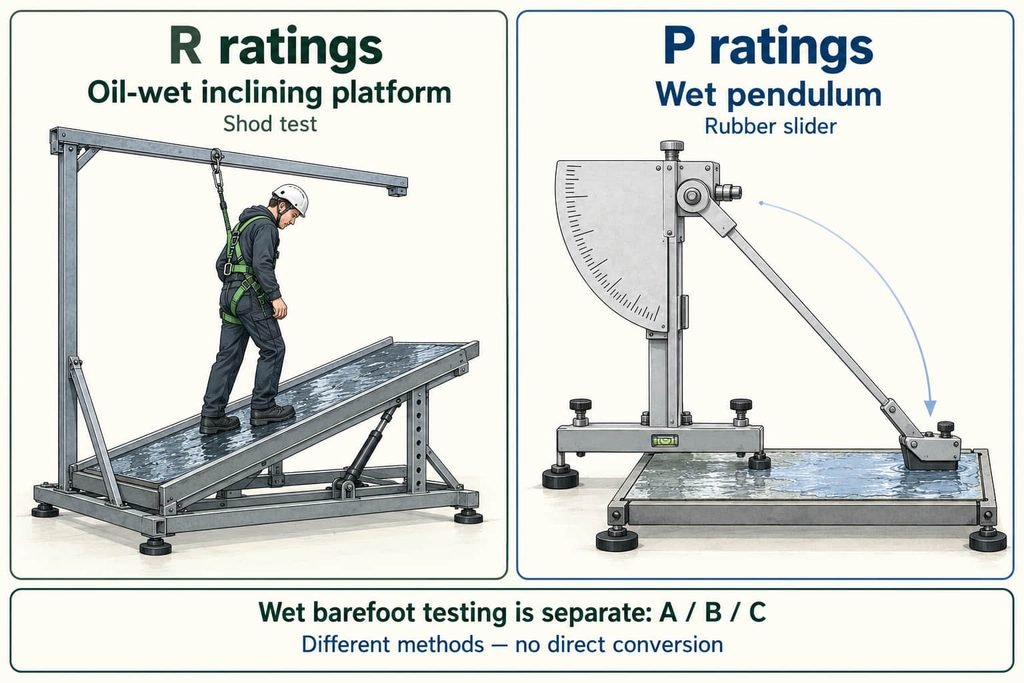
The R rating (R9–R13) comes from the Oil Wet Inclining Platform test — the ramp test. It’s governed by DIN 51130, referenced in AS/NZS 4586:2013.
The method: a tester in shoes walks on an oil-coated ramp at increasing angles. The angle at which they slip sets the R classification. The oil medium is more aggressive than rain. An R11 result in this environment is a conservative indicator for wet weather performance on outdoor surfaces.
| R Rating | Performance Level | Typical Application |
|---|---|---|
| R9 | Low wet-area traction | Low-risk indoor areas |
| R10 | Moderate traction | Covered outdoor areas, light wet exposure |
| R11 | Good wet-area traction | Commercial outdoor decking, walkways |
| R12 | High traction | Ramps, steeper gradients, high-contamination surfaces |
| R13 | Very high traction | Steep ramps, industrial surfaces |
For most commercial outdoor composite decking, R11 is the NCC 2025 minimum for wet pedestrian surfaces.
What Does the P Rating Scale Mean?
The P rating (P0–P5) comes from the Wet Pendulum Test under AS/NZS 4586:2013. A pendulum with a rubber foot swings across a wet surface. The less it swings back, the higher the grip.
This test simulates a heel striking a wet floor. That’s why certifiers often ask for P rating documentation as their first reference on outdoor decking projects.
| P Rating | Typical Application |
|---|---|
| P3 | Protected outdoor areas with lower wet exposure |
| P4 | Exposed outdoor decking — NCC 2025 minimum for wet conditions |
| P5 | Ramps steeper than 1:14 |
A key distinction for pool projects: The Wet Pendulum Test and the Wet Barefoot Inclining Platform test are not the same thing. The Wet Barefoot Inclining Platform test produces A, B, or C classifications — not P ratings. For pool surrounds and wet barefoot areas, both results may be required. Confirm with your project certifier before specifying.
A product rated R11 has not been Wet Pendulum tested. If a certifier asks specifically for P rating documentation, an R11 result alone won’t satisfy that request.
Minimum Slip Ratings by Project Type
For most exposed outdoor composite decking in Australia, R11 or P4 is the rating you need. The table below shows when requirements go higher.
| Application Type | Dry Conditions | Wet Conditions |
|---|---|---|
| General outdoor decking (weather-exposed) | P3 / R10 | P4 / R11 |
| Tread and landing surfaces | P3 / R10 | P4 / R11 |
| Ramps, 1:20 to 1:14 gradient | P3 / R10 | P4 / R11 |
| Ramps steeper than 1:14 | P4 / R11 | P5 / R12 |
The table reflects NCC 2025 minimums. Local council requirements can exceed these. For pool surrounds and barefoot areas, a separate Wet Barefoot Inclining Platform result may also be required — check with the project certifier.
Download our composite decking spec sheets to compare product test data against these requirements.
Is Composite More Slip-Resistant Than Timber?
In wet conditions, capped composite decking tends to hold its grip better than timber decking over time. That’s a material behaviour difference, not a marketing claim.
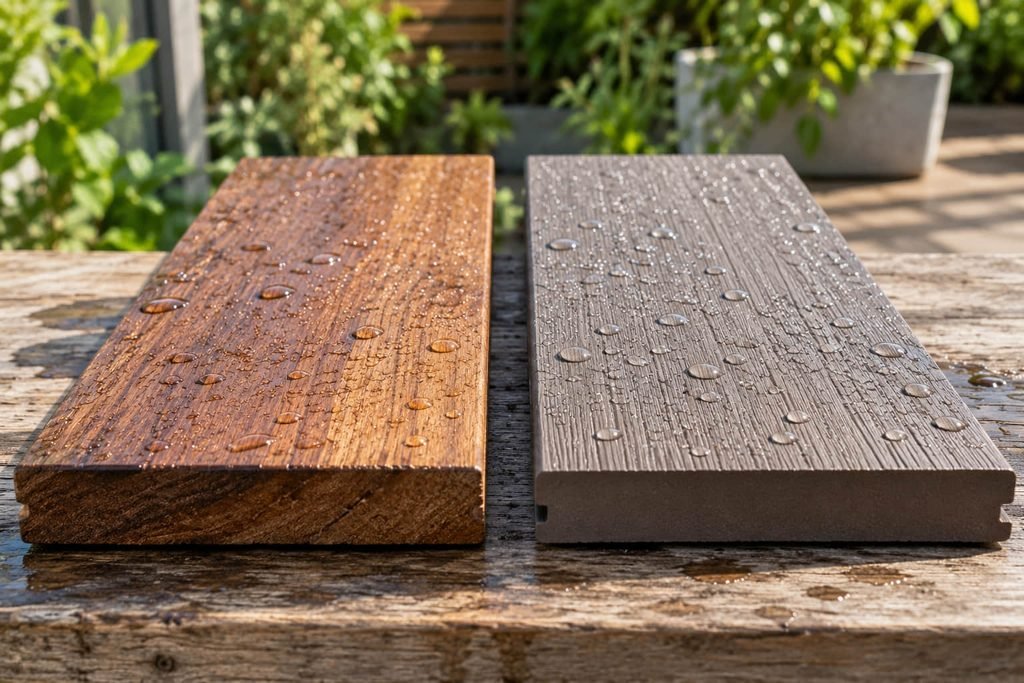
Timber absorbs moisture. As it ages, the surface picks up organic matter — algae, mould, leaf debris. Each of these reduces traction on a surface that may have passed its original slip check at installation. Weathering and oiling cycles add further wear. A timber deck’s R or P rating can fall below NCC minimums within a few seasons.
Capped composite boards with textured surfaces behave differently. The cap layer doesn’t absorb water. Textured profiles maintain their grip because they don’t break down the same way. Capped composite also needs less maintenance to hold its slip resistance rating — no re-oiling, no periodic sanding, no treatment schedule.
That said, not all composite boards are equal. An untextured or smooth composite surface can still be slippery. The textured surface profile drives the slip rating — not the material category.
If a client or principal asks, give them the honest answer. Rated capped composite with a textured surface usually outperforms aged timber in wet conditions. But the test result on the specific board matters more than the material description.
Request free samples to check the surface texture and grip before specifying at volume.
LastElegance Composite Decking Slip Ratings
All LastElegance composite decking boards carry an R11 slip resistance rating per DIN 51130 and AS/NZS 4586:2013. This meets the NCC 2025 minimum for wet exposed outdoor pedestrian surfaces. The rating covers all three product lines:
- Renew — available in 139 × 22 mm and 139 × 23 mm profiles
- VerdeLife — 139 × 24 mm profile
- TimberLuxe — available in 140 × 20 mm and 140 × 23 mm profiles
SGS test reports are available on request — before you commit to volume. That’s a standard supplier qualification step, and we expect it.
For projects where a certifier asks for P rating documentation, or where the application involves pool surrounds or barefoot access areas, contact our sales team to confirm which test data applies. Because we’re a manufacturer, documentation comes straight from the source. No reseller gap, no chasing through a supply chain.
What to Ask a Supplier Before You Order
A marketing claim is not a test report. Request documentation before you commit — for any composite decking supplier, not just us.
A credible slip resistance test report should include:
- The governing standard: AS/NZS 4586:2013, named clearly
- The test method: Wet Pendulum Test, Oil Wet Inclining Platform (ramp test), or Wet Barefoot Inclining Platform test — stated specifically
- The product model and surface finish tested — not just the product range or brand name
- The result: P or R classification (or A/B/C for barefoot testing)
- The testing lab and its accreditation: NATA-accredited labs are the Australian benchmark; SGS and TUV are internationally recognised
- The test date: Confirm it reflects the current product formulation
If the test date is old and the product has been reformulated since, the report may not cover what you’re buying. Ask.
The chain matters too. A reseller often doesn’t hold original test reports and has to chase them back to source — that adds time, and sometimes the report never arrives. Buying direct from a manufacturer cuts that out. You’re talking to whoever made the product, not whoever stocked it.
Contact our sales team to request test documentation with your next trade enquiry.
FAQ
What is the highest slip rating for composite decking?
Under AS/NZS 4586:2013, the highest P rating is P5 (Wet Pendulum Test) and the highest R rating is R13. For most commercial outdoor composite decking in Australia, R11 or P4 is the NCC 2025 minimum for wet exposed conditions. P5 and R12 apply to ramps steeper than 1:14.
Is P4 better than R11 for outdoor decking?
Neither is better — they represent equivalent compliance levels produced by two different test methods. NCC 2025 accepts either P4 or R11 as the minimum for standard exposed outdoor decking in wet conditions. The difference is the test method and which documentation a certifier may request, not the level of compliance each represents.
Is composite more slip-resistant than timber when wet?
In most cases, capped composite boards with textured surfaces maintain better grip than timber in wet conditions. They don’t absorb moisture or build up organic matter the way timber does. But the rating of the specific board matters more than the material category — always verify the R or P rating on the product being specified, not just the material type.
Can I get test reports before placing a bulk order?
Yes — and you should request them before committing, not after. A credible report names the test standard (AS/NZS 4586:2013), the test method, the specific product model tested, and the accredited lab that ran it. Sourcing directly from the manufacturer is the fastest way to get original test documentation — no waiting for a reseller to chase it through the chain.
Does the NCC set slip requirements for commercial outdoor decking?
Yes. NCC 2025 sets minimum slip resistance requirements for all outdoor pedestrian surfaces, including commercial decking, ramps, and stairs. The minimum depends on the application type, the gradient, and whether the surface is likely to be used barefoot or in wet conditions. Confirm the specific requirements for your project type with a licensed building certifier before specifying a product.