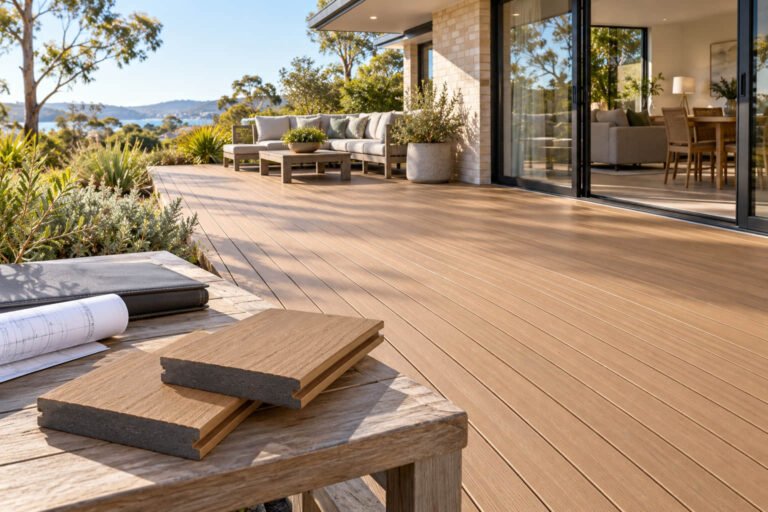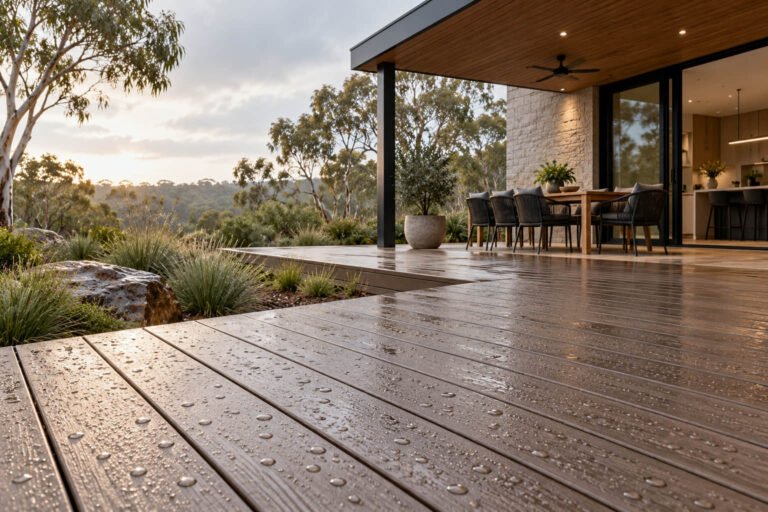

Composite decking expands and contracts with temperature — that’s expected behaviour, not a product fault. Boards typically move 0.1%–0.3% of their length across a full temperature swing. For a standard 2,900mm board, that’s roughly 3–9mm of thermal movement. Unlike timber, composite boards don’t swell from rain or humidity; water absorption sits at 0.2% per ASTM D1037, so temperature is the only driver to plan for. This article covers the numbers, Australian conditions, and what goes wrong when installers skip the gaps.
Key Takeaways
- Composite boards move 0.1%–0.3% of their length across a full temperature swing — on a standard 2,900mm board, that’s 3–9mm per board, and it compounds fast over a long run.
- Australian board surface temps can hit 55–65°C in summer sun — overseas gap tables are written for 20–25°C swings and consistently undersize the allowance for coastal QLD, WA, and inland SA projects.
- Three gap types must be set correctly: end gaps (5–8mm), side gaps (auto-set by the clip system), and perimeter clearance (10mm minimum) at all fixed structures.
- Dark boards run 10–15°C hotter than light ones in the same conditions — factor colour selection into gap planning at spec stage, not after boards go down.
- Gaps set by installation temperature: boards going down below 15°C need 8mm end gaps; above 25°C, 5mm is enough.
- Boards installed in direct sunlight will be pre-expanded — let them reach ambient temperature before cutting.
- Missing or undersized gaps are classified as installation errors under most composite warranties, including LastElegance’s — remediation costs fall on the contractor, not the manufacturer.
Why Does Composite Decking Expand?
Composite — or wood polymer composite (WPC) — boards blend wood fibre with HDPE. Both materials expand when heated and contract when cooled. As temperature rises, the board grows slightly in length. As it drops, the board returns to its resting size.
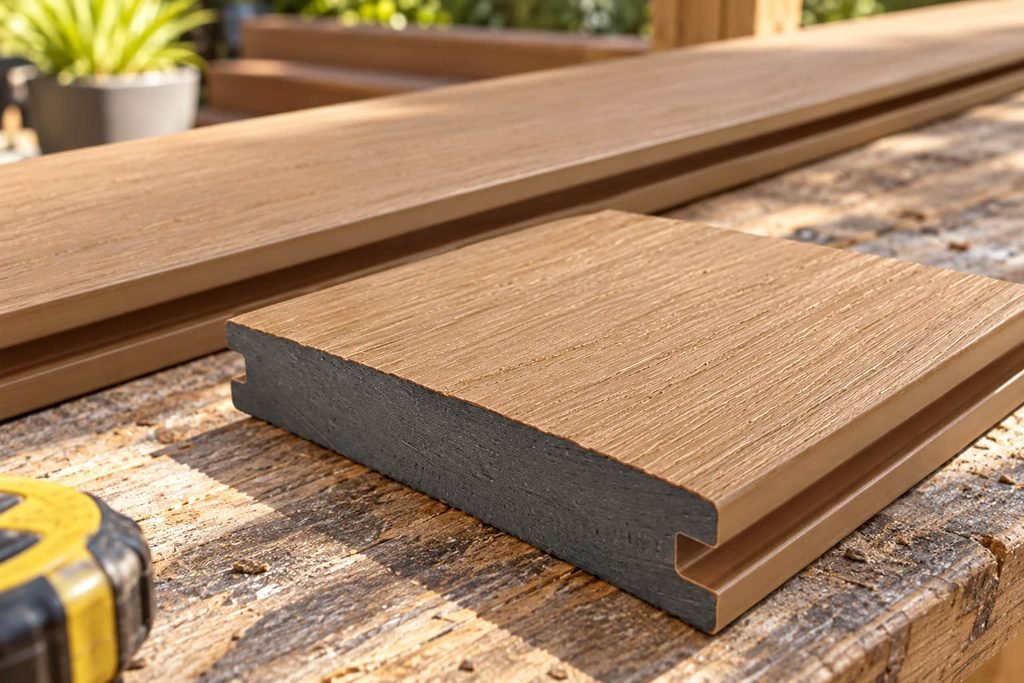
The co-extruded cap layer limits moisture uptake, so rain and humidity don’t cause swelling the way they would in timber. With an HDPE density of 0.95 g/cm³, the board holds its shape under load but still responds to temperature like any HDPE-based material. One variable to plan for, not two.
How Much Do Boards Move in Length?
At 0.1%–0.3% across a full temperature swing, the numbers look small. On a long commercial run, they add up fast.
Composite boards in this format run 2,900mm in length — consistent across the Renew, VerdeLife, and TimberLuxe series. At the midpoint (0.2%), one board moves about 5.8mm. Over a 10-board run butt-joined end to end, that’s close to 58mm of cumulative thermal movement across the whole deck. Without room to expand, boards find their own relief.
| Board Length | Movement at 0.1% | Movement at 0.3% |
|---|---|---|
| 2,900mm (single board) | 2.9mm | 8.7mm |
| 5,800mm (two boards joined) | 5.8mm | 17.4mm |
| 14,500mm (five boards joined) | 14.5mm | 43.5mm |
Most of that movement is longitudinal. Width movement is minimal and handled by the clip system. The critical measurement an installer sets manually is the end gap at each butt joint. Get that right and the rest looks after itself.
Boards are tested to 26.2 MPa flexural strength per EN 15534, so the composite handles repeated expansion cycles without structural fatigue.
Download Product Specs — confirm board dimensions and gap requirements for your project.
Does Board Profile Affect Thermal Movement?
Solid and hollow composite boards expand at the same rate. Thermal movement is governed by the HDPE and wood fibre mix in the core — not the cross-section shape. Wall thickness on hollow profiles is typically 4–6mm, which affects rigidity, not the expansion rate. Both profile types need the same end gaps at installation.
Why Australian Conditions Change the Numbers
Most composite decking expansion content is written for UK or US climates. The temperature swings those gap tables assume — typically 20–25°C — don’t match what Australian boards actually face.
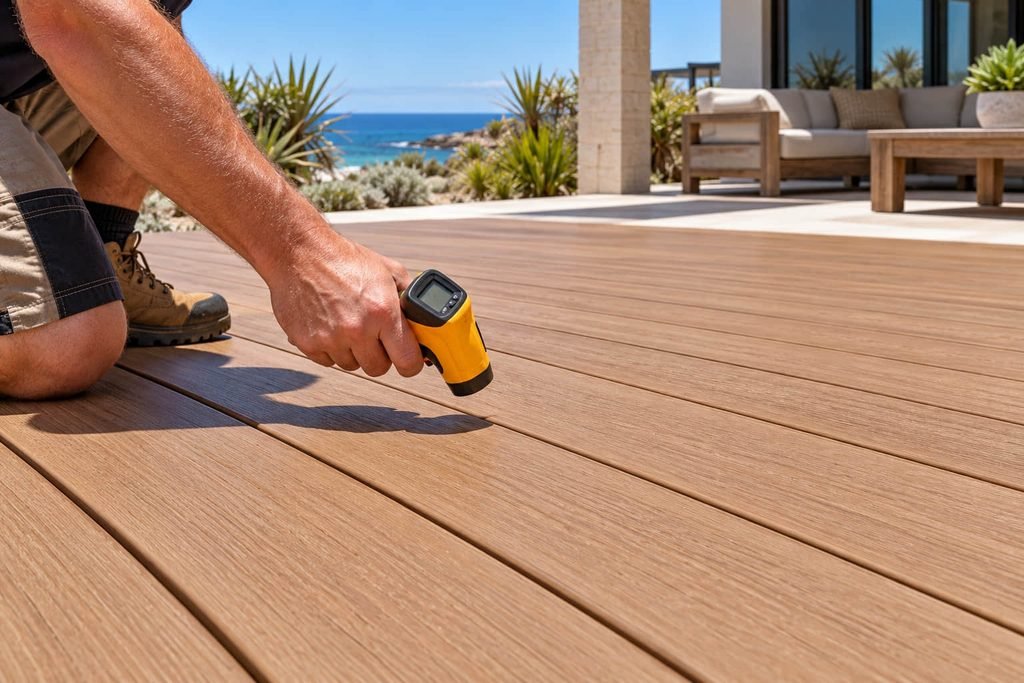
Australian ambient temperatures range from near 0°C in alpine areas to above 45°C in summer. But board surface temperature drives expansion, and that runs much higher. A dark board on a north-facing deck in Queensland or WA can reach 55–65°C in summer, even when air temperature sits at 35°C. The relevant swing for expansion planning in Australia is 40–50°C — not 20°C.
Contractors working on coastal Queensland and WA commercial projects report the same pattern: overseas gap tables consistently undersize the expansion allowance for a Brisbane or Perth summer. Reference points by climate zone:
- Coastal Queensland and WA: High UV, hot summers. Dark boards routinely hit peak surface temps. Use the upper end of gap recommendations.
- Inland NSW and SA: Wide daily swings — cold nights, hot days — mean more total thermal movement across the year.
- Temperate VIC and TAS: Smaller swings, more moderate surface temps. Standard gap tables are closer to accurate here.
- Tropical NT: High year-round heat with smaller seasonal variation. Use warm-weather gap specs year-round rather than adjusting seasonally.
Always confirm gap requirements with the manufacturer for your climate zone and board colour.
Does Board Colour Affect How Much It Expands?
Darker boards absorb more solar radiation. In the same conditions, a dark board can run 10–15°C hotter than a light one. That temperature difference translates directly into more expansion.
On a north-facing commercial project in Queensland or WA, colour selection is a practical specification decision. Contractors working on exposed coastal projects raise it at spec stage — not for aesthetics, but for thermal performance. Factor board colour into gap planning and subframe design before the job starts.
Quality composite boards are tested to ΔE ≤ 4–5 colour difference after 3,000 hours of QUV accelerated aging using a HALS + UV absorber system — confirm test results from the manufacturer’s data sheet for the specific product you’re specifying. UV stability means colour holds, but a darker board in full sun still runs hotter than a light one. Account for it at spec stage.
Request Free Samples — compare colour options and surface textures before specifying.
What Expansion Gaps Are Required?
Three gap types matter on every composite decking installation. Get all three right.
| Gap Type | Recommended Measurement | What Controls It |
|---|---|---|
| Board-end gap (butt joints) | 5–8mm | Installation temperature |
| Side gap between boards | Auto-set by clip system | Hidden fastener design |
| Perimeter clearance (walls, posts, stairs) | Minimum 10mm | Contact with fixed structures |
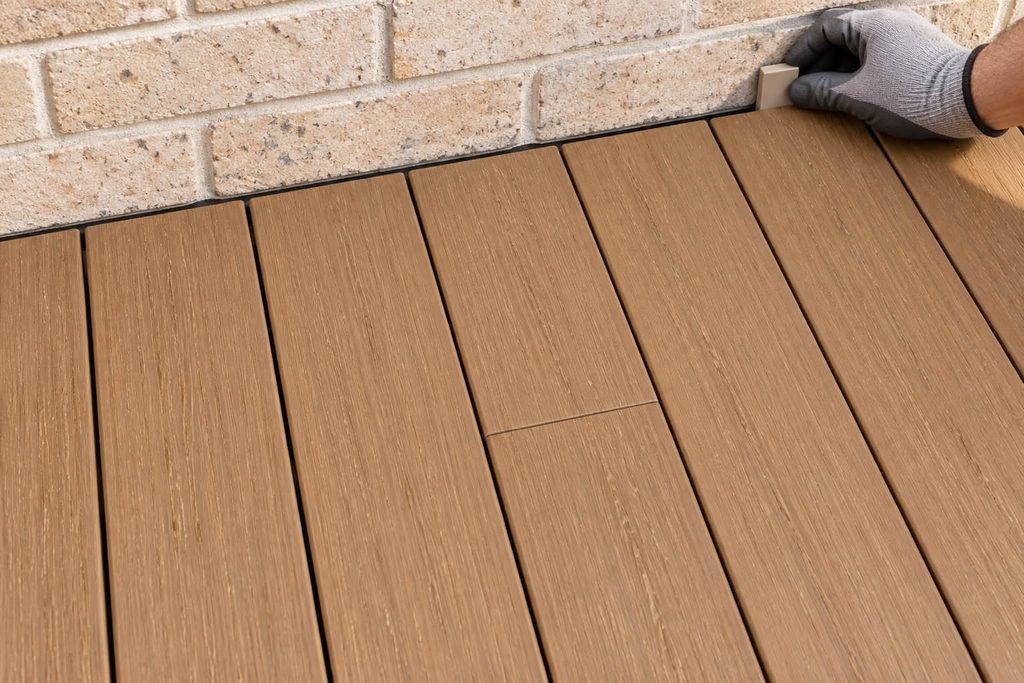
Exact gap values vary by product — always check the installation guide for your specific product series. Gap requirements apply to every element that expands: fascia boards, step risers, and built-in seating all move and need the same treatment.
How Installation Temperature Changes the Gap
The cooler the installation day, the bigger the end gap you need. Boards installed below 15°C will expand more as temperatures rise — leave a gap closer to 8mm at the board ends. Boards installed above 25°C are already near their expanded state — 5mm is enough.
Boards left in direct sunlight before installation will be pre-expanded. Let them reach ambient temperature before cutting and fixing. Always confirm exact values in the manufacturer’s installation guide for your product series — gap tables from overseas sources won’t reflect Australian temperature swings.
What Clearance Is Needed at Fixed Structures?
Board-to-board end gaps and perimeter clearance are two different requirements. At any fixed structure — wall, post base, stair stringer, door threshold — leave a minimum 10mm gap.
On enclosed decks with fascia boards, check that the fascia detail doesn’t pin the run. Fascia expands too and must be gapped at corners.
This is the most common gap missed on commercial installations. It’s also the most likely cause of buckling after the first summer — and it’s exactly the type of installation error that voids most composite decking warranties. Fix it before the boards go down, not after.
How the Hidden Fastener System Manages Movement
The stainless steel hidden clip system does more than keep the deck surface clean. It manages side-gap compliance automatically across the full run.
Clips slot into the board groove and fasten onto the joist. The next board slides into the same clip, which sets a consistent side gap — no manual spacing, no variation across a large installation. On a commercial project covering hundreds of m², that removes one variable from the crew’s job and cuts the risk of boards binding sideways on a hot day.
The clip connection also allows small longitudinal movement at the joist support point, rather than locking the board rigidly. No face screws means no penetrations through the cap layer that could restrict movement or create stress points at the fix. Correct clip spacing also lets water drain between boards, which reduces moisture pooling on commercial and pool-area decks.
For coastal and pool-area projects, stainless steel matters. Standard fasteners degrade fast in salt air and pool chemical exposure. Stainless holds up.
Contact our sales team to confirm the right installation system for your commercial project.
What Happens Without the Right Expansion Gap?
Skipping the gap is a short-term decision with first-summer consequences.
At butt joints, boards with nowhere to go will ridge, lift, or buckle across the surface. At fixed structures, boards pinned between a wall and a joist bow outward or crack at the fixing point. Both are safety issues and defect items on project handover.
The commercial cost matters most. A board that buckles from a missing gap isn’t a product failure — it’s an installation error. Most composite decking warranties explicitly exclude it; ours states: “damage resulting from incorrect installation, human error, or misuse” is not covered. The remediation cost lands on the contractor.
Correct gaps at installation are the cheapest risk management on any composite deck job.
How Composite Compares to Timber on Thermal Movement
Timber responds to two drivers: temperature and moisture. It swells when wet, shrinks when dry, and the two effects combine through Australian wet-dry cycles in ways that are hard to predict. Over time, timber boards warp, cup, and split.
Composite boards experience natural movement from temperature only. The 0.8mm cap layer limits water absorption to 0.2% per ASTM D1037, so rain and humidity don’t affect board dimensions. The movement is predictable — one variable, known rate, no seasonal swelling.
For specifiers writing material comparisons or preparing project proposals: composite needs one type of movement management. Timber needs thermal and moisture management, plus ongoing upkeep — oiling, sealing, and board replacement as the years pass.
Composite also resists termites. On both residential and commercial projects across most of Australia, that’s a relevant durability point worth including in any material comparison.
FAQ
Do composite decking boards expand and contract?
Yes. Composite boards expand with heat and contract when they cool. The typical range is 0.1%–0.3% of board length across a full temperature swing. Correct expansion gaps at installation prevent any problems.
What is the coefficient of thermal expansion for composite decking?
The coefficient of thermal expansion measures the rate of length change per degree of temperature change. For wood polymer composites, it typically sits around 2.5–4.0 × 10⁻⁵ per °C. The exact value varies by product formulation and density — confirm from the manufacturer’s data sheet for the specific product you’re specifying.
Does composite decking get hot in direct sunlight?
Yes. Board surface temperature can run well above air temperature in direct sun. Dark boards on a north-facing Australian deck can reach 55–65°C in summer, even when air temperature sits at 35°C. Lighter colours stay cooler and expand less in the same conditions.
What temperature should I install composite decking?
The installation temperature determines the correct end gap at board joints. Below 15°C, leave a gap closer to 8mm at the board ends. Above 25°C, 5mm is enough. Confirm exact values in the installation guide for your specific product series.
Can thermal expansion void a composite decking warranty?
Yes. If incorrect gaps lead to buckling or joint failure, the damage is typically classed as an installation error and falls outside warranty coverage. Installing correct gaps from day one is the straightforward way to keep cover intact — check the warranty terms for your specific product before the job starts.
How does composite decking compare to timber on thermal expansion?
Composite boards experience natural movement from temperature only; timber responds to both temperature and moisture. That makes composite more predictable — one variable, known rate. Composite boards hold their profile through Australian wet-dry cycles without the warping or cupping that affects timber over time.