

Two identical composite siding boards — same thickness, same cap layer, same color — can differ by $3 to $5 per sq ft depending on how they reach your job site. On a 5,000 sq ft project, that’s $15,000–$25,000 left on the table.
The difference isn’t the product. It’s the supply chain. Every distributor and wholesaler between the manufacturer and the buyer adds margin — without adding value to the board itself.
This guide breaks down composite siding pricing for U.S. builders, contractors, and distributors. You’ll see where the real costs sit, how composite stacks up against fiber cement, vinyl, cedar, and engineered wood, and how manufacturer-direct sourcing changes the math on your next project.
What Does Composite Siding Cost in 2026?
Composite siding costs $3 to $10 per sq ft for materials and $5 to $15 per sq ft installed in the U.S. market. Actual cost depends on board profile, cap layer quality, order volume, and whether you buy through retail distribution or direct from the manufacturer.
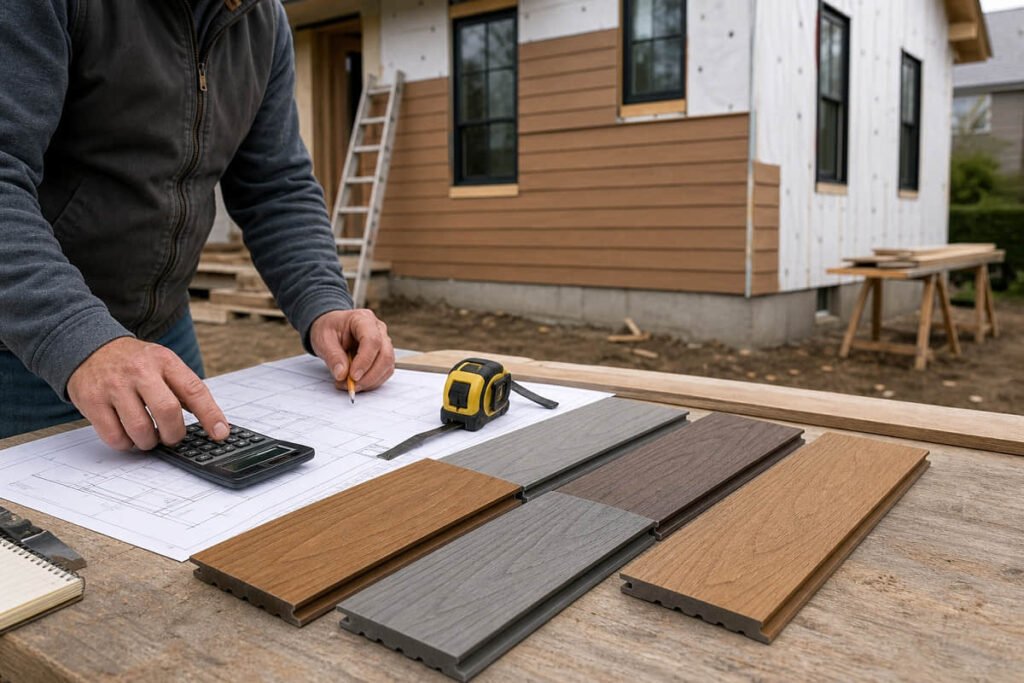
Those ranges are broad — and for good reason. A premium retail brand can push installed prices to $20+ per sq ft. A manufacturer-direct order for the same core product can land well below $10. The board specs may be similar. The supply chain is what moves the price.
That difference is the core of this article. If you’re speccing composite siding for a project — or stocking it for your customers — where you source matters as much as what you buy.
Manufacturer-Direct vs Retail — Where the Price Gap Comes From
Most composite siding in the U.S. moves through a retail chain with three or four stops between the production line and the buyer. Each stop adds margin. None of them change the product.
Here’s what a typical path looks like:
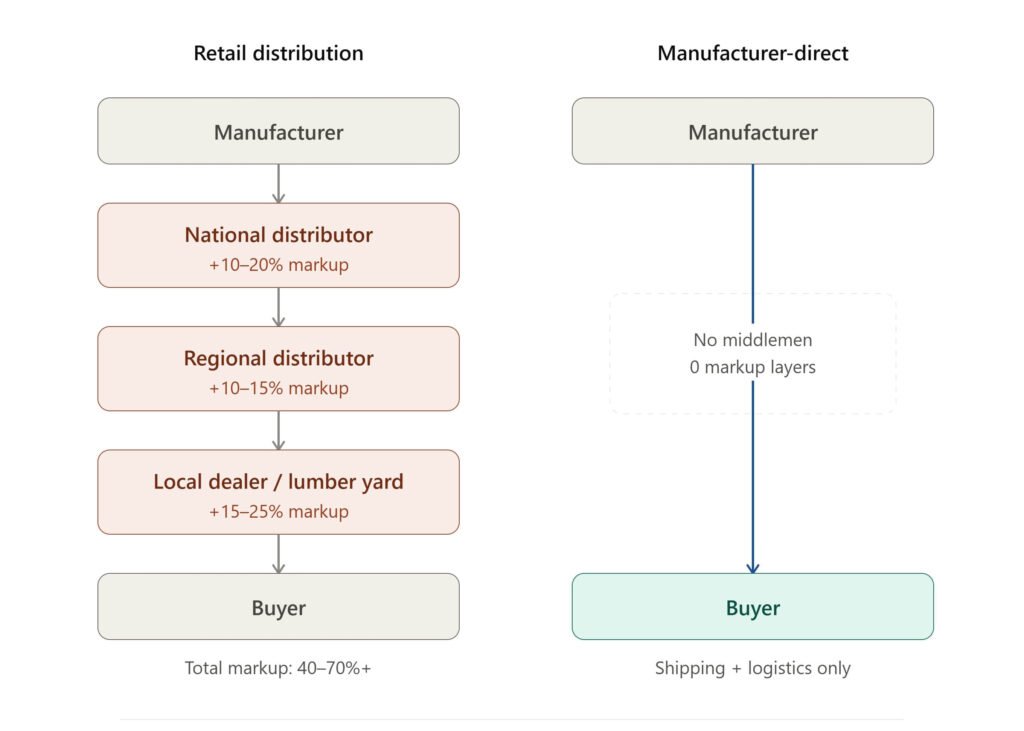
The board at each stage is identical. Same material, same cap layer, same specs. The only thing that changes is the price.
When you buy direct from the manufacturer, you’re paying for production and logistics. Not for three middlemen. Ocean freight, customs, and last-mile trucking are real costs — but they’re a fraction of the stacked markup in a retail chain.
The trade-off is time. Manufacturer-direct orders take about 6–8 weeks from order to U.S. port — roughly 15–20 days production plus 24–42 days ocean freight, depending on the route. That’s not next-day delivery. But for planned projects and stocking orders, the cost savings make the planning window worth it.
For builders and distributors buying at volume, that gap adds up fast. On a 5,000 sq ft siding job, even a $2/sq ft savings is $10,000 — either back in your pocket or margin you can pass on to win the bid.
Want to see the price difference on your next project? Contact our sales team for project-specific pricing.
What’s Included in the “Per Sq Ft” Price?
When you get a siding quote, ask what’s actually in the number. “Per sq ft” can mean three very different things.
Material only covers the boards themselves. That’s the $3–$10 range for composite. It doesn’t include anything else you need to put them on a wall.
Installed cost adds labor — and sometimes fasteners and basic trim. This is the $5–$15 range most sources quote.
Total project cost is the real number. It includes the subframe (steel battens at 12″–16″ on center for composite siding), weather-resistive barrier (house wrap), corner and window trim, fastener clips, and all labor. This can add $3–$6 per sq ft on top of the installed board cost.
Our siding uses a male-female interlocking clip system — no face-nailing, no exposed fasteners. That speeds up install and cuts labor hours. But the clip system, battens, and trim still need to be in your budget.
The bottom line: always compare quotes on the same basis. Ask every supplier what’s included and what’s extra. An “installed” quote that leaves out the subframe and house wrap isn’t cheaper — it’s just incomplete.
How Order Size Affects Your Price
Volume changes the math when you source from a manufacturer. Here’s how.
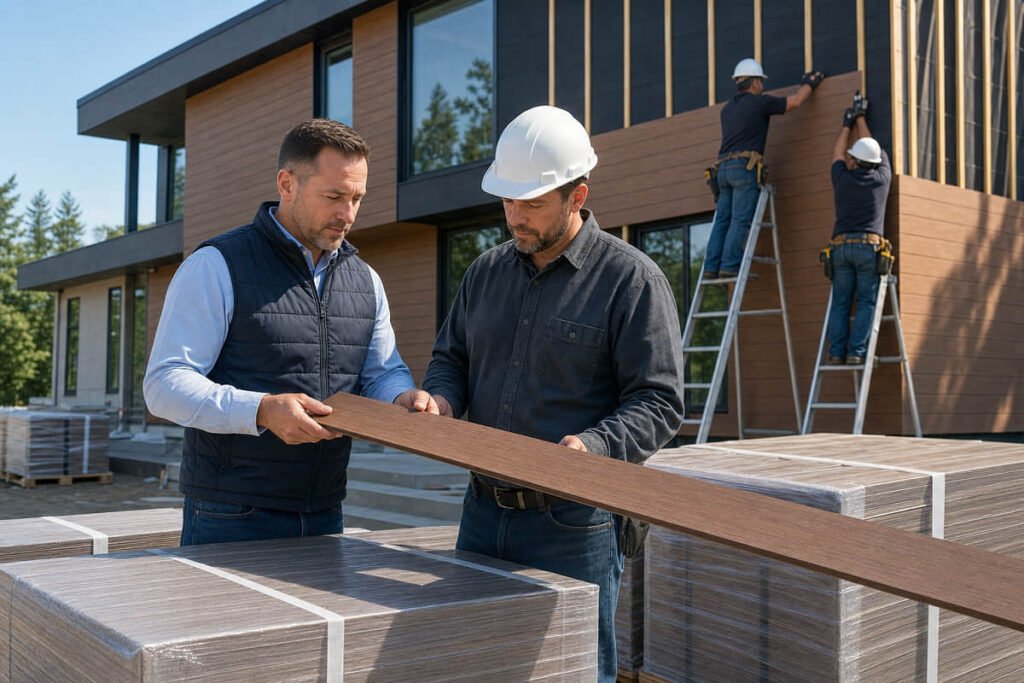
Manufacturers price by container. A 20-foot container holds a set quantity of boards; a 40-foot container holds more. The more you order, the lower your cost per sq ft — because production setup, packing, and shipping costs spread across more material.
Our standard minimum order is 100 square meters (about 1,076 sq ft). That’s enough for a mid-size project or a solid test run. Per-unit cost drops as you move from the minimum up to full container loads.
For first-time buyers, we offer flexible trial-order quantities — a way to test the product on a real project before scaling up. Sample boards and color swatches are also available at no cost.
If you’re a distributor stocking multiple product lines, there’s another angle worth knowing. Our siding and decking lines share the same color palette, so you can bundle orders, hit higher volumes, and get better pricing across both ranges.
Ready to see volume pricing for your order size? Request a quote — include your estimated square footage and we’ll send project-specific numbers.
How Region Affects Your Installed Cost
Labor rates vary across the U.S. — and that shifts the installed price of any siding material, not just composite.
The Northeast and West Coast tend to run higher. Union labor markets, higher cost of living, and tighter permitting all push prices up. In the South and Midwest, labor rates are lower, and installed costs often sit at the bottom end of the $5–$15 range.
For manufacturer-direct buyers, the port of entry also matters. West Coast ports (Long Beach, Oakland) offer shorter transit times from Asian factories — roughly 24–32 days express. East Coast and Gulf delivery adds time and may add cost. Factor your freight route into your landed cost when comparing quotes.
Composite Siding vs Other Materials — Cost Comparison
Sticker price is only part of the story. A cheap material that needs repainting every seven years isn’t cheap over two decades. Here’s how composite stacks up against the four siding types U.S. buyers compare most often.
| Siding Type | Material Cost (per sq ft) | Installed Cost (per sq ft) | Expected Lifespan | 20-Year Upkeep Cost (per sq ft) |
|---|---|---|---|---|
| Vinyl | $1.50–$5 | $3–$12 | 20–30 years | Low — occasional cleaning; may warp or crack |
| Fiber Cement (James Hardie) | $2.50–$6.50 | $5–$14 | 30–50 years | Moderate — repaint every 7–10 years |
| Engineered Wood (LP SmartSide) | $2.50–$6.75 | $4.50–$12 | 30–40 years | Low-Moderate — repaint every 10–15 years |
| Cedar / Redwood | $4–$8 | $6–$14 | 20–40 years (with upkeep) | High — stain/seal every 3–5 years |
| Composite (Capped) | $3–$10 | $5–$15 | 25–30+ years | Very low — wash periodically; no painting or staining |
Pricing data compiled from HomeGuide, Modernize, Angi, SidingCosts.com, and Fixr.com (2025–2026 estimates). Composite ranges span from manufacturer-direct pricing at the low end to premium retail brands at the high end. Actual costs vary by region, project size, and product grade.
Vinyl wins on upfront cost — no question. But it can warp in extreme heat, crack in deep cold, and it doesn’t look or feel like wood. For mid-range and above projects, that matters to your clients.
Fiber cement is durable, but it’s heavy, needs special cutting tools (which create silica dust), and most profiles need field painting after install. That adds labor time and cost that doesn’t show up in the material price.
Cedar looks great on day one. By year five, it needs staining again. SidingCosts.com estimates cedar maintenance at $1.50–$3.00 per sq ft every 3–5 years — which adds $6,000–$18,000+ over 20 years on a 2,000 sq ft home.
Composite’s upfront cost sits in the middle of the pack. Its long-term cost is where it pulls ahead.
The Hidden Costs Most Quotes Leave Out
Four costs hit project budgets hard — and none of them show up in a per-sq-ft material quote.
Cutting and waste. Fiber cement boards are dense and brittle. Cutting them releases silica dust, which means respirators, special saw blades, and slower cuts. Composite cuts with standard tools. No dust risk, less waste, faster progress on site.
Field painting. Fiber cement siding often arrives primed but unfinished. That means painting on site — adding a day or more of labor, plus paint cost. Capped composite siding comes with color built in through the co-extrusion process. No field painting. Ever.
Long-term upkeep. Cedar needs staining or sealing every 3–5 years. Fiber cement needs repainting every 7–10 years. Our composite siding absorbs just 0.2% water (tested per ASTM D1037) and shows no detectable formaldehyde (EN 717-1). It doesn’t rot, doesn’t swell, and doesn’t need refinishing. Wash it once or twice a year and move on.
Repair and replacement. Wood siding boards cup, split, and decay over time. Replacing a single board means matching an old stain color — often impossible after a few years of weathering. Composite holds its color, so a replacement board blends right in.
When you add these hidden costs to the sticker price, composite often comes in lower than fiber cement or cedar over the life of the building.
What Drives the Price of Composite Siding?
Not all composite boards cost the same. Here’s what moves the price up or down — and why each factor matters for the job.
Board profile and thickness. A thicker, wider board uses more material and costs more. Our Oakling siding (140 × 12 mm / 5.5″ × 0.47″) is a slimmer profile — lighter and more budget-friendly. The DecoGroove siding (219 × 20 mm / 8-5/8″ × 25/32″) is wider and thicker, with a bolder look and a higher per-board price.
Cap layer quality — capped vs uncapped. This is the biggest driver of long-term value. Capped composite wraps all four sides in a co-extruded protective layer. Uncapped composite covers fewer surfaces — or none at all. The cap is what blocks UV, sheds moisture, and resists stains. Without it, the wood-fiber core sits exposed and wears down faster.
We use a 0.8 mm (31.5 mil) co-extruded cap on all four sides — the same protection approach used by major U.S. brands. After 3,000 hours of QUV accelerated aging (ASTM G154), color shift stays within ΔE ≤ 4–5. That’s strong fade resistance, even in Sun Belt states like Florida, Texas, and Arizona.
Capped boards cost more upfront. But for any project with a 15+ year outlook, capped is the only smart spec. When comparing quotes, always ask: is the board capped on all four sides, or just the top? A board capped only on the face can still absorb moisture through the back and edges.
Color and texture. Standard colors cost less than custom ones. A manufacturer-direct relationship opens up custom colors, textures, and profiles — something domestic brands with fixed product lines can’t offer. Custom orders need a minimum volume, but they let you create a product range that’s yours alone.
Raw material mix. Our boards use 60% recycled content (recycled HDPE + recycled wood fiber). The remaining 40% is virgin material to keep quality, color, and structure consistent across production runs. A higher recycled ratio can lower material cost but may affect consistency — it’s a trade-off worth understanding.
How to Get the Best Price on Your Project
Smart buying starts before you pick a product. Here are the moves that stretch your siding budget the furthest.
Source from the manufacturer when you can. Fewer markups, lower landed cost, same product quality. For volume buyers, the savings are real and repeatable.
Order at container-load volumes. Per-sq-ft cost drops as order size grows. If your project or stocking plan can fill a 20′ or 40′ container, you’ll hit the best price tier.
Spec custom lengths to cut waste. Standard-length boards mean cuts and offcuts on every wall. We can produce custom lengths to order, so your boards match your wall dimensions more closely. Less cutting means less waste, less labor, and less material in the dumpster.
Bundle siding and decking from one source. When your siding and decking share the same color palette and surface textures, you get design continuity across the project — and stronger volume pricing from a single manufacturer.
Get full-scope quotes. Always ask for quotes that include subframe, battens, house wrap, trim, clips, and labor. That’s the only way to compare suppliers fairly.
What to Check Before You Order
If you’re sourcing from a manufacturer for the first time, a few practical steps are worth taking before you commit to a large order.
Start with samples. Colors look different on screen than in hand. Request full-size sample boards and color swatches so you can see the texture, weight, and finish before ordering. We provide these at no cost.
Ask for test reports and warranty terms. Any serious manufacturer should share third-party test data and written warranty details upfront. This is standard due diligence — not a special request.
We’ve put together a full supplier vetting framework — including the specific certifications, test results, and questions to ask — in our composite siding supplier selection guide. If you’re evaluating any manufacturer for the first time, it’s worth reading before you place a volume order.
Run a trial order first. We offer flexible quantities for first-time buyers. Test the product on a real project before scaling up. That’s the low-risk way to validate quality, color accuracy, and install performance.
Want to start with samples? Request free samples — we’ll include full product specs and third-party test data with your shipment.
FAQs
Is composite siding cheaper than fiber cement?
Material costs are similar — both run $3–$10 per sq ft depending on brand and profile. But composite is faster to install (clip system, no special tools, no silica dust, no field painting), which cuts labor cost. Over 20 years, composite’s near-zero maintenance often makes it cheaper overall.
How much does it cost to install composite siding per sq ft?
Installed costs range from $5 to $15 per sq ft in most U.S. markets, depending on wall complexity, region, and labor rates. Clip-based interlocking systems install faster than nail-up or screw-through methods, which can lower your labor bill.
Can I order composite siding in custom sizes?
Yes. Manufacturers who sell direct — rather than through fixed retail lines — can offer custom colors, lengths, textures, and profiles. Custom orders typically require a minimum quantity (around 1,076 sq ft). Custom lengths reduce on-site waste and help you match exact project specs.
What warranty should I expect on composite siding?
Warranties vary widely across brands. Our siding carries a 20-year warranty covering surface cracking, warping, breakage, and color fading beyond contract specs. When comparing warranties, look past the headline number — read what’s actually covered, what voids the claim, and whether the warranty is prorated or full.