

A bad composite siding supplier doesn’t just cost you money. It costs you a delayed project, a failed shipment, and a client who won’t call back.
The problem isn’t that good suppliers don’t exist. It’s that most distributors and procurement managers have no reliable way to tell them apart — until something goes wrong.
This guide gives you a clear framework: seven things to check before you place a volume order with any composite siding supplier.
Manufacturer vs. Distributor: What’s the Real Difference in Composite Siding?
A manufacturer makes the product. A distributor moves it. That distinction shapes everything — price, lead time, and how much control you actually have over what you’re buying.
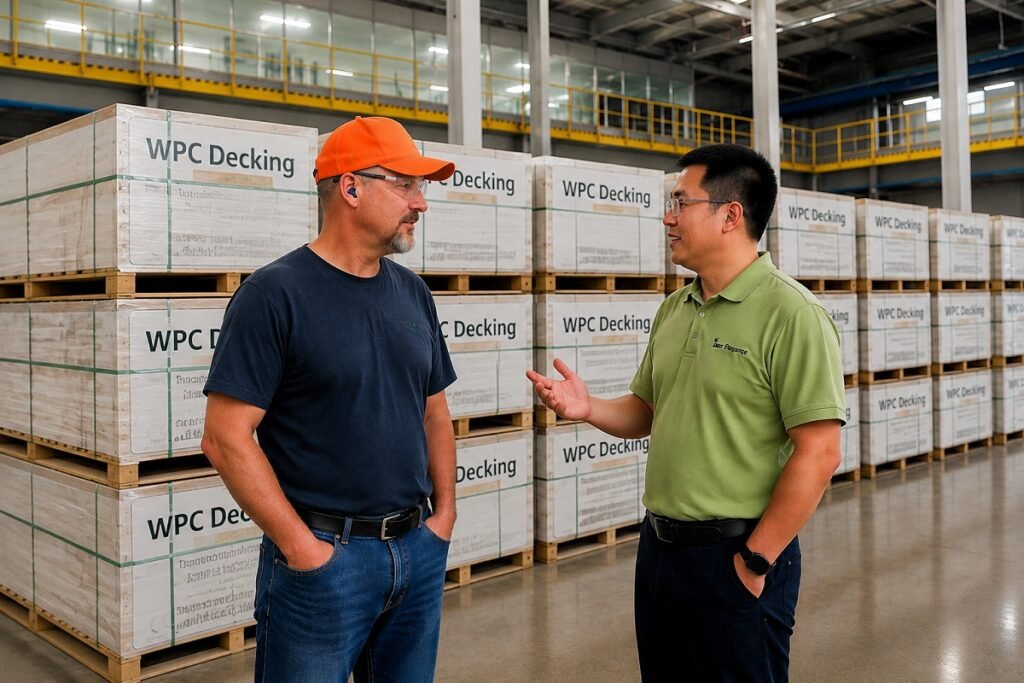
Most composite siding brands in the U.S. sell through tiers. The chain looks like this: manufacturer → importer → regional distributor → dealer → you. Each step adds margin and lead time. By the time the product reaches you, two or three middlemen have already taken their cut.
When you buy direct from a manufacturer, that chain shrinks to one step. You’re talking to the team that controls the molds, the material blend, and the production schedule.
That matters beyond price. A distributor can tell you what’s in stock. A manufacturer can tell you what’s possible — custom colors, modified profiles, specific certifications. Those aren’t the same conversation.
Most U.S. buyers are used to working through distribution. It’s convenient, and domestic stock is fast. But for projects that need custom specs or volume pricing, the manufacturer relationship changes what you can ask for — and what you can get.
7 Things to Check Before You Commit
Most bad supplier decisions start with skipping one of these. Procurement managers who’ve been burned will recognize the pattern. Work through all seven before you place a volume order.

1. Do They Have the Right Certifications?
Start here. A supplier without verifiable test reports is a risk you don’t need.
For composite siding sold in the U.S., ask for these baseline certifications:
- CE, ISO, SGS, RoHS — baseline quality and materials compliance
- ASTM E84 — fire rating; ask for the class (A, B, or C) and the Flame Spread Index number. Class C is fine for most exterior applications, but check your local code — especially on commercial jobs.
- EN 717-1 — formaldehyde emission testing. For California projects or any state following CARB Phase 2, this matters. “Not detected” is the result you want.
One thing worth knowing: “tested to a standard” and “certified to a standard” are not the same thing. Ask for the actual test report, not just a claim on a spec sheet.
LastElegance carries CE, ISO, RoHS, and SGS. EN 717-1 testing shows formaldehyde as not detected — meeting or exceeding CARB Phase 2 thresholds.
2. What’s the Cap Layer — and How Thick Is It?
The cap layer is the outer shell around a composite board. It shields the wood fiber core from UV, moisture, and surface wear. Without a strong cap, a board will fade, stain, and break down within a few years.
Co-extruded composite siding wraps all four sides of the board in a polymer layer during production. That’s what “four-sided co-extruded cap” means — and it’s what you want to specify.
Ask suppliers for the cap thickness in millimeters. A cap of 0.8 mm (31.5 mil) or above is a sign of a well-built board. Thinner caps cost less to make — and they show it over time, especially in high-UV areas like Florida, Texas, and the Southwest.
LastElegance uses a 0.8 mm four-sided co-extruded cap. QUV accelerated aging tests per ASTM G154 show a color delta (ΔE) of 4–5 or less after 3,000 hours. That’s strong UV stability for Sun Belt and coastal markets. Water absorption is 0.2% per ASTM D1037 — well below what causes moisture problems or water damage in real-world installs.
3. How Does It Hold Up Against the Elements?
Climate varies a lot across the U.S. Your buyers in Houston are dealing with different conditions than those in Minneapolis or Portland. Composite siding needs to handle all of it.
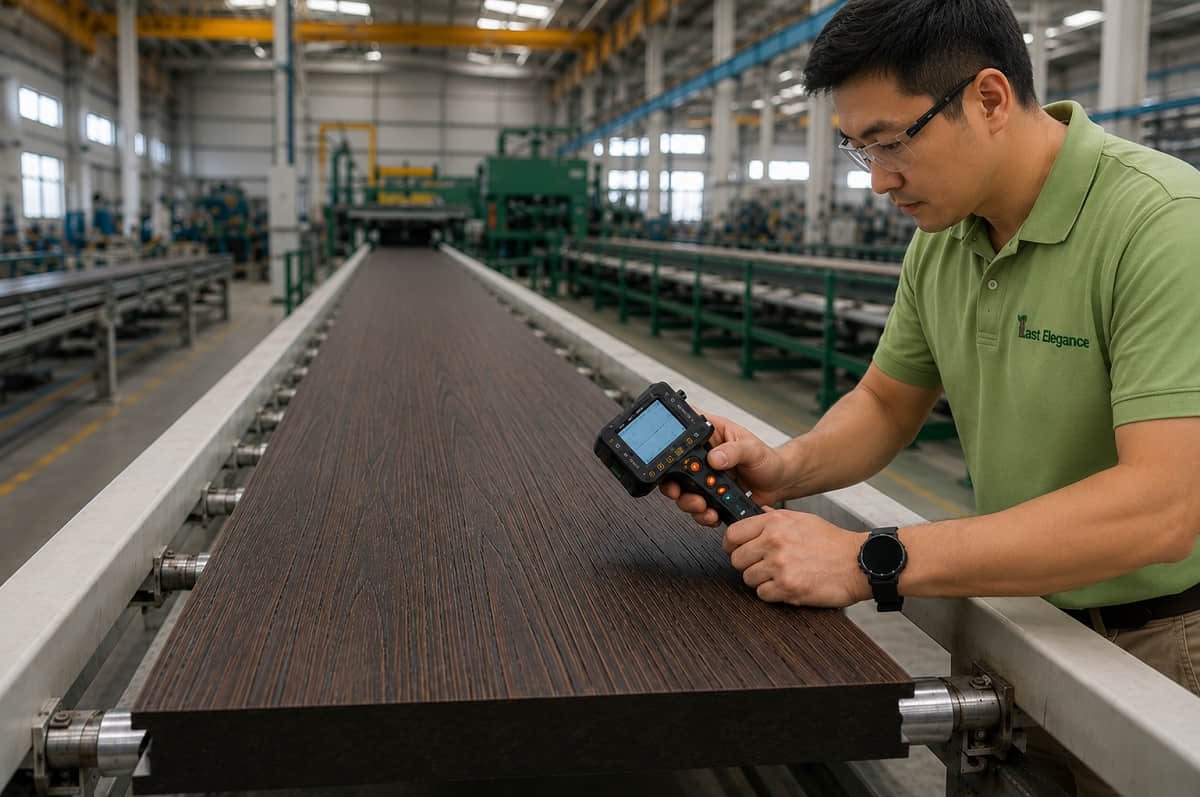
Ask for QUV aging test results (hours and ΔE score), water absorption data, and any cold-weather performance notes.
| Composite Siding | Vinyl Siding | Fiber Cement | |
|---|---|---|---|
| UV resistance | High — tested to 3,000+ hrs (ASTM G154) | Moderate — fades over time | Good — paint-dependent |
| Water absorption | 0.2% (ASTM D1037) | Very low | Moderate — absorbs moisture if paint fails |
| Cold weather | Stable | Can become brittle | Stable |
| Moisture risk | Low | Low | Moderate |
| Pest resistance | Yes | Yes | Yes |
Composite holds its shape in freeze-thaw conditions. Vinyl siding can become brittle in cold climates. Fiber cement siding handles weather well — but if the paint coat cracks or peels, moisture gets in, and that leads to real damage. Composite doesn’t carry that risk.
4. What Customization Can They Actually Deliver?
Fixed product lines work for standard residential and light commercial jobs. But if you’re building your own brand or bidding a spec-driven project, you need flexibility.
Ask the supplier directly:
- Can you match a custom color? What’s the sample lead time?
- Do you offer private-label packaging?
- Can you produce custom lengths or board profiles?
- Are custom surface textures — woodgrain, brushed, smooth — available through custom molds?
- What accessories ship with the order — clips, trim strips, fasteners?
Get answers in writing, not just a verbal “yes.” Ask for a physical sample before any volume commitment.
This is where factory-direct suppliers have a real advantage. Domestic composite siding brands run fixed product lines — what’s on the shelf is what you get. A factory-direct supplier can work with you on color, size, texture, and packaging. LastElegance offers full color matching with a 5–7 day sample lead time, custom lengths, custom textures, and private-label packaging. That level of flexibility lets distributors build a differentiated product range — something the major composite siding brands simply don’t offer. Our Oakling Composite Siding at 140 × 12 mm and DecoGroove Composite Siding at 219 mm wide are two examples — both available with custom color matching and private-label packaging.
5. What Are the Lead Times and MOQs?
Manufacturer-sourced composite siding isn’t stocked in warehouses across the U.S. You need to plan ahead.
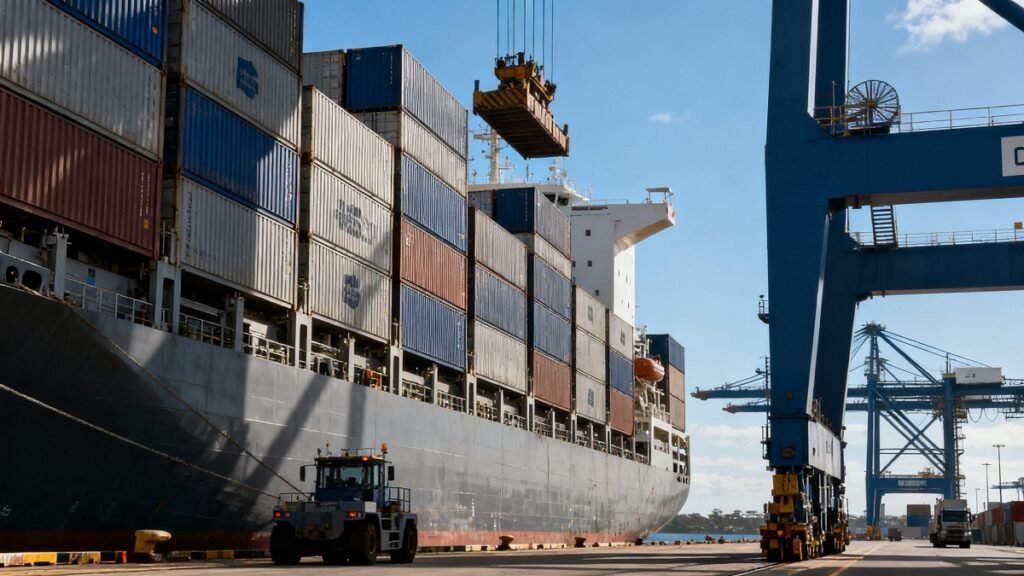
Here’s a realistic lead time breakdown:
| Stage | 40′ FCL | 20′ FCL |
|---|---|---|
| Production | ~15–20 days | ~7–12 days |
| Packing & export prep | ~2–3 days | ~2–3 days |
| Ocean freight — West Coast (LA/Long Beach) | 14–21 days | 14–21 days |
| Ocean freight — East Coast (Savannah/Newark) | 28–38 days | 28–38 days |
| Total — West Coast | ~31–44 days | ~23–36 days |
| Total — East Coast | ~45–61 days | ~37–53 days |
Realistically, plan for 30–60 days from purchase order to U.S. port arrival. Production complexity, vessel schedules, and customs clearance all affect the final timeline. During peak shipping seasons, delays can extend timelines further.
On MOQ: a legitimate factory-direct supplier will give you a clear minimum. A standard MOQ of 100 sq meters (around 1,076 sq ft) per product line is typical. Most suppliers will work with you on a smaller trial order for a first shipment. If a supplier can’t give you a clear MOQ in writing, that’s a problem.
Ask for pricing on both FOB China port and CIF U.S. port terms. That way you can compare the true landed cost for your specific port and project volume.
6. What Does the Warranty Actually Cover?
A long warranty number means nothing if the terms are vague and the remedy is unclear.
Ask the supplier to spell out: Does the warranty cover structural failure? Color fade beyond an agreed range? Edge warping? What does the remedy look like — replacement, credit, or just a follow-up call?
A manufacturer-backed 15-year warranty with clear, written terms is more useful than a vague 30-year claim from an importer who has no direct factory relationship. LastElegance backs a 15-year warranty — a shorter term than some premium domestic brands, but those brands also carry domestic brand pricing. The trade-off is direct and worth knowing.
7. How Good Is Their Sales and Tech Support?
Once a container lands and a crew is on-site, questions come up fast. Can you reach someone who knows the product?
A good supplier should be able to provide:
- Installation guides and technical drawings
- Batten spacing specs (12″–16″ on center is standard for composite siding over a steel subframe)
- Hidden fastener or clip system documentation
- A dedicated account contact — not a general inbox
The clip system should also come with clear specs for insulation and air gap in the wall assembly. The steel batten subframe creates a rain screen gap behind the cladding — that gap supports wall drainage and thermal performance, which matters for energy efficiency in commercial builds and multi-family projects.
LastElegance assigns a dedicated account rep to each client. Installation video and technical guides are available on request. WRB (weather-resistive barrier) requirements and clip installation specs are documented. That kind of support reduces rework and keeps job sites moving.
Composite Siding vs. Vinyl, Fiber Cement, and Wood
Buyers aren’t just vetting suppliers — they’re also selling the product choice to their clients. Here’s an honest comparison.
| Composite | Vinyl | Fiber Cement | Wood | |
|---|---|---|---|---|
| Upfront cost | Mid-range | Lower | Mid-to-high | Varies |
| Maintenance | Very low | Low | Moderate (repainting) | High |
| Lifespan | Long | Moderate | Long | Short without care |
| UV stability | Strong | Moderate | Paint-dependent | Poor |
| Moisture resistance | Excellent | Good | Moderate | Poor |
| Pest/insect resistance | Yes | Yes | Yes | No |
| Install complexity | Clip system, no special tools | Moderate | Requires special cutting tools | Labor-intensive |
| Curb appeal | Natural wood look | Plastic finish | Clean, neutral | Traditional |
A few honest trade-offs: composite siding costs more upfront than vinyl. Fiber cement siding has a long track record in the U.S. market, though it requires cutting tools that produce silica dust and needs field painting after install. Engineered wood siding can swell if its moisture barrier is compromised. Wood needs annual staining or painting and is not pest-resistant without chemical treatment.
Composite avoids all of that. It won’t rot, won’t attract pests, and holds color far better than wood or vinyl over time. It’s also lighter than fiber cement, which saves real labor cost on large jobs. Homeowners value the low upkeep — and contractors value fewer callbacks.
For California commercial projects, verify that any U.S.-specific certifications you need are in place before specifying a factory-direct product. Some factory-direct suppliers are still completing formal CARB Phase 2 or ICC-ES evaluations. That’s worth knowing upfront, not after the spec is locked.
Red Flags to Watch for in Any Supplier
Watch for these warning signs before you commit:
- No verifiable test reports. SGS or TUV reports are a minimum standard, not an optional extra. If a supplier can’t produce them, move on.
- Vague warranty terms. No written remedy, no coverage details, no clear claims contact? That warranty is not worth the paper it’s on.
- No sample program. Any serious supplier will send boards. If they won’t, there’s a reason.
- Can’t confirm cap layer thickness. “Co-extruded” is a marketing term without a number to back it. Ask for millimeters — and get it in the spec sheet.
- No shipping documentation. A legitimate supplier can provide packing lists, bill of lading templates, and trade references.
- Uncapped boards sold as co-extruded. If a board description is vague about which sides the cap covers, ask directly. A four-sided cap is very different from a one- or two-sided cap.
These aren’t unusual requests. A supplier ready to serve U.S. distributors and contractors at volume should handle all six without hesitation.
Why Buying from a Manufacturer Changes the Cost Math
The U.S. distribution chain adds cost at every step. A composite siding board moves from the manufacturer to an importer, then to a regional distributor, then to a dealer. Each hand-off adds margin. By the time the product reaches your job site, you’ve paid for four tiers of handling.
Working direct with a manufacturer removes that chain. You pay production cost plus ocean freight. Nothing else.
Even with freight from China, the landed cost per sq ft is often much lower than buying the same product grade through domestic distribution. That gap grows on large-volume jobs — multi-family builds, hospitality projects, and private-label programs where volume pricing shifts the whole margin picture.
For projects tracking LEED points, LastElegance composite siding boards carry 60% recycled content — value that goes beyond the price.
FAQ
What should I look for in a composite siding supplier?
Check for verifiable certifications (CE, ISO, SGS, ASTM E84), a documented cap layer spec of 0.8 mm or above, UV and moisture test data, and a written warranty with clear remedy terms. The full seven-point checklist above covers everything you need before placing a volume order.
Do composite siding suppliers offer bulk or wholesale pricing?
Manufacturer suppliers typically offer tiered pricing based on container volume — 20′ or 40′ FCL. Request a quote with your destination port included so you can compare the real landed cost per sq ft.
How do composite siding suppliers compare on warranties?
Warranty terms run from 15 to 50 years depending on the supplier and product tier. A manufacturer-backed warranty with written remedy terms is more reliable than a long-term claim from a reseller with no direct factory relationship.
Do composite siding suppliers ship directly to the U.S.?
Yes — manufacturers ship via ocean freight in full containers (FCL) directly to U.S. ports. Transit time from a Chinese port is 28–35 days to the West Coast or 35–42 days to the East Coast.
Do suppliers provide installation support or just materials?
Most composite siding manufacturers provide materials plus technical documentation — installation guides, batten spacing specs, and fastener systems. Some, like LastElegance, also provide installation videos and a dedicated account contact for project-specific questions.
Which composite siding suppliers offer UV-resistant products?
Look for suppliers with QUV accelerated aging results — minimum 2,000 hours, with strong suppliers testing to 3,000+ hours per ASTM G154. Ask for the ΔE score. A result of 4–5 or lower after 3,000 hours indicates strong UV stability for Sun Belt and coastal markets.