

Wrong railing choice costs more than the material. It shows up in client callbacks, change orders, and crews burning time on installs that weren’t right for the site.
Composite, aluminum, and cable each solve a different problem. The right pick depends on project type, climate, budget, and what your client needs to look at every day.
This guide covers all three systems across the factors that drive real purchasing decisions: cost per linear foot, install speed, upkeep, lifespan, weather performance, and code requirements. No filler — just the comparison data you need before the order goes in.
All Three Systems at a Glance
Here’s how the three deck railing systems compare across the five factors that drive most purchasing decisions.
| Composite | Aluminum | Cable | |
|---|---|---|---|
| Installed cost per linear ft | $90–$200 | $80–$150 | $120–$250+ |
| Annual upkeep | Low | Low | Low–Moderate |
| Expected lifespan | 20–30 yrs | 30+ yrs | 25–35 yrs |
| Best climate fit | Most climates; lighter colors preferred in hot regions | All climates; excellent for coastal areas | All climates; 316 SS recommended for coastal |
| Best style match | Traditional, Craftsman, Transitional | Modern, Contemporary, Commercial | Modern, Open-view, Rooftop |
Labor adds $15–$75 per linear foot across all three systems. Cable runs higher — each cable must be tensioned individually, which takes more crew time than clip-based composite or aluminum installs.
Composite Deck Railing — What You Need to Know
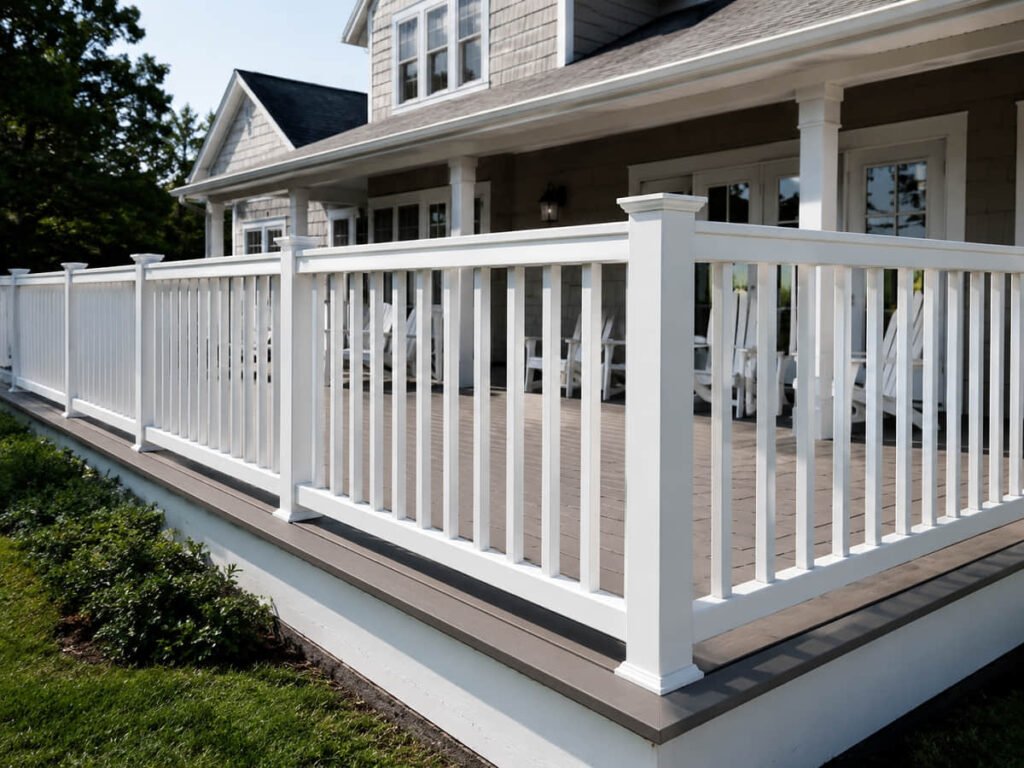
What is composite deck railing made of? Composite railing blends recycled wood fibers and HDPE plastic into shaped profiles. A co-extruded cap layer — typically 0.5–0.8mm thick — wraps the core on all sides, protecting it from UV, moisture, and scratches. Quality composite railing uses around 60% recycled content and HALS UV stabilizers built into the cap.
Where Composite Railing Fits Best
Composite railing suits traditional and transitional-style homes well — craftsman, colonial, farmhouse, and similar builds. The thicker profiles create a solid, substantial look. That’s an advantage when the railing needs to be part of the visual statement, not just a safety requirement.
It’s a strong pick for residential developments and multi-family builds. When you’re specifying a full composite deck, composite railing ties the system together — shared color palettes and matching textures from the boards up through the top rail.
When you’re specifying composite railing alongside a composite deck, lock in the color scheme before finalizing the order. Review decking boards and railing profiles side by side. A coordinated tone across the full deck surface looks intentional — mismatched shades look like a change order waiting to happen.
That matters more than most buyers expect. A deck, a fence, and a wall of siding that all come from the same color system look intentional. Mismatched tones across product categories look like an afterthought — and that’s a hard thing to fix mid-project.
Ask for the full color chart across all three lines before you finalize specs. Review decking boards, fence panels, and siding profiles side by side. Locking in a coordinated scheme at the quoting stage saves you from costly change orders later.
Where Composite Railing Falls Short
Three trade-offs are worth flagging before you commit.
First, dark composite surfaces absorb heat. In full sun, top rails can hit 150°F+ — uncomfortable to grip on a hot Texas or Arizona afternoon. Lighter colors help, but it’s a real factor in Sun Belt states.
Second, composite profiles are thicker than aluminum or cable. They block more of the view. On a deck with a great sightline, that matters to clients.
Third, composite warranties tend to be shorter than aluminum. Many lines carry a 15-year structural warranty. Quality aluminum systems often come with 30+ years. It’s not a dealbreaker — but it’s a real comparison point for commercial and high-end residential projects.
Aluminum Deck Railing — Pros, Cons, and Best Fits
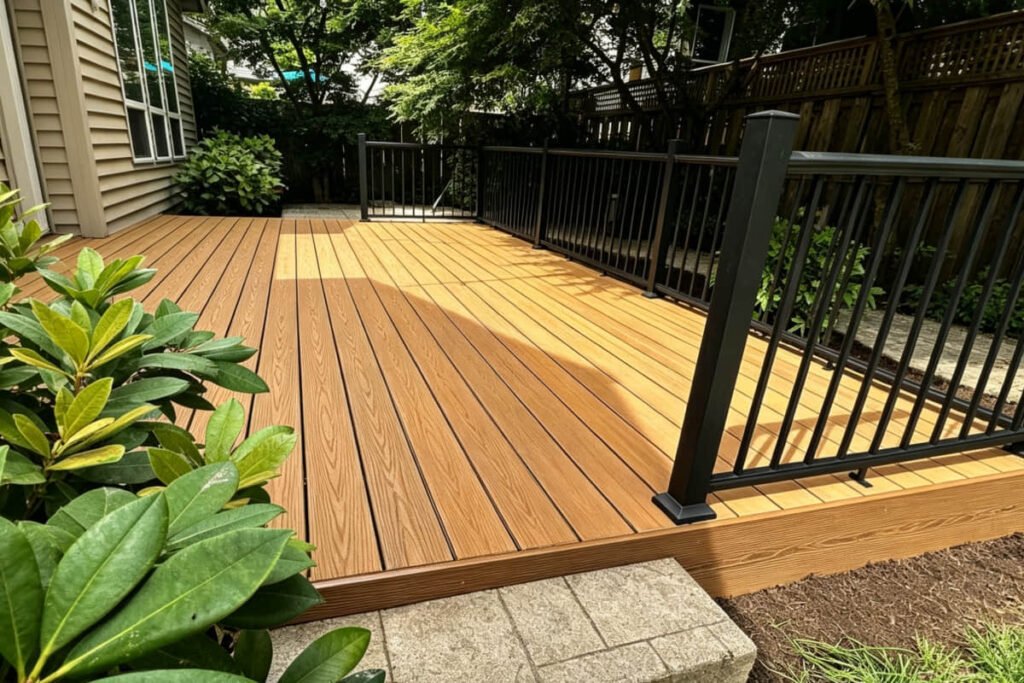
Aluminum is the most widely used railing system on U.S. decks. It’s strong, light, and corrosion-resistant straight from the factory. Powder-coated aluminum holds its finish for decades with minimal upkeep — no painting, no sealing, no annual refinishing.
Key benefits of aluminum deck railing for contractors:
- Light weight — faster handling and install, especially on upper-level or rooftop decks
- Powder coat durability — quality coat is applied at 2–3 mil (50–75 microns) and baked on; holds color without refinishing
- Corrosion resistance — 6000-series aluminum alloy is the standard structural spec; won’t rust like steel
- Range of color options — comes in a wide variety of finishes, baluster styles, and infill configurations
- Fast install — clip and bracket systems let experienced crews move quickly
For coastal projects, make sure posts and hardware use 316-grade stainless steel at connection points. The aluminum frame handles salt air well. Exposed steel hardware is usually the weak link.
Aluminum Railing in Tough Climates
Aluminum handles wide temperature swings well. Its thermal expansion coefficient is roughly 0.000013 in/in/°F — about half that of PVC-based composite, at around 0.000034. That’s a real advantage in northern states with hard freeze-thaw cycles.
In coastal areas, powder-coated aluminum resists salt air far better than bare or galvanized steel. The standard spec for marine environments is 6063-T6 aluminum with quality powder coat and 316-grade stainless hardware at connection points.
One thing to flag with clients: aluminum conducts temperature. Top rails feel cold in winter and warm in summer — more so than composite. In most climates it’s not a problem. In extreme cold, it’s worth a mention.
Cable Railing — Modern Look, Higher Investment
What is cable deck railing? Cable railing uses tensioned stainless steel cables strung horizontally between posts. The cables are nearly invisible against a landscape or view — giving the most open sightlines of any railing type. Posts are typically aluminum or stainless steel. It’s the go-to choice for rooftop decks, elevated decks with scenic views, and modern or industrial-style builds.
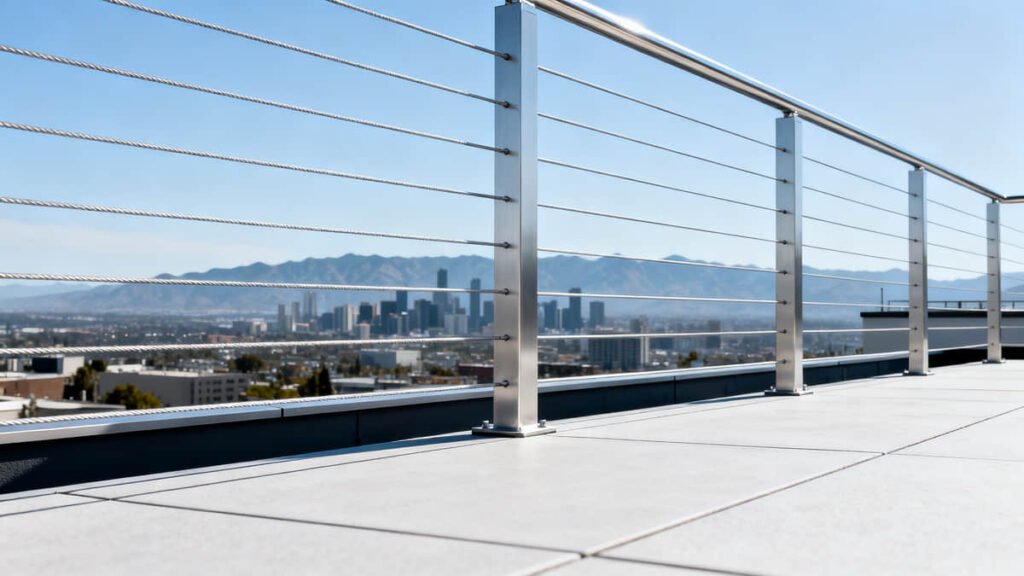
The standard structural spec is 1×19 cable — 19 strands twisted together — in 316-grade stainless steel for coastal and marine projects. For inland outdoor spaces, 304-grade is suitable and lower in cost.
Cable Railing Costs and Installation Facts
Cable railing is the most expensive of the three systems. Expect $120–$250+ per linear foot installed — at the high end, that’s well above composite or aluminum. Material is one part of the cost. Labor is the other.
Material is one part of the cost. Labor is the other. Each cable run must be tensioned and anchored individually, which takes more time than clip-based systems. Cable installation requires a cable pulling tool and a torque wrench — not standard gear for every crew.
Stair sections add complexity and cost to all three systems. For cable, stair runs need angled terminal fittings for each angle change. Budget extra time.
Plan for periodic tension checks too. Cables loosen slightly over time, especially in the first year. Annual checks — plus a re-tension if needed — should be part of the maintenance plan.
Cable Railing and Code Requirements
Cable railing meets IRC and IBC requirements when installed correctly. Spacing is the most commonly misunderstood part.
IRC Section R312.1.3 — the 4-inch sphere rule — requires that infill (cables, balusters, or panels) be spaced no more than 4 inches apart, measured at the widest point under load. This applies to all three railing systems, not just cable.
Some local jurisdictions add climb-resistance rules for horizontal cable runs — often called the “ladder effect” requirement — in areas where young children may be present. Always check local code amendments before specifying a horizontal cable design.
Material Costs by Railing System
Cost depends on the system, the project layout, and how you source materials. Here’s where the numbers land.
| System | Material Only (per linear ft) |
|---|---|
| Composite | $30–$55 |
| Aluminum | $45–$120 |
| Cable | $60–$120 |
Custom colors, corner posts, stair sections, and post spacing all push costs up. Stair sections typically add 20–40% to the cost of a standard run.
One factor most cost guides miss: your railing choice affects how much railing budget you have left. Contractors and procurement teams sourcing composite railing factory-direct — through suppliers like LastElegance — cut out distribution markup. That saving on the decking side frees up budget to spec a higher-end railing system without changing the total project number.
Talk to our team about composite railing volume pricing →
How Much Upkeep Does Each System Need?
All three systems need far less care than wood railing. But low-maintenance doesn’t mean no maintenance.
Composite needs a wash with mild soap and water once or twice a year. Check shaded areas for surface mold. No painting or sealing — the HALS UV stabilizer system handles color protection. Benchmark test: 3,000 hours QUV accelerated aging per ASTM G154.
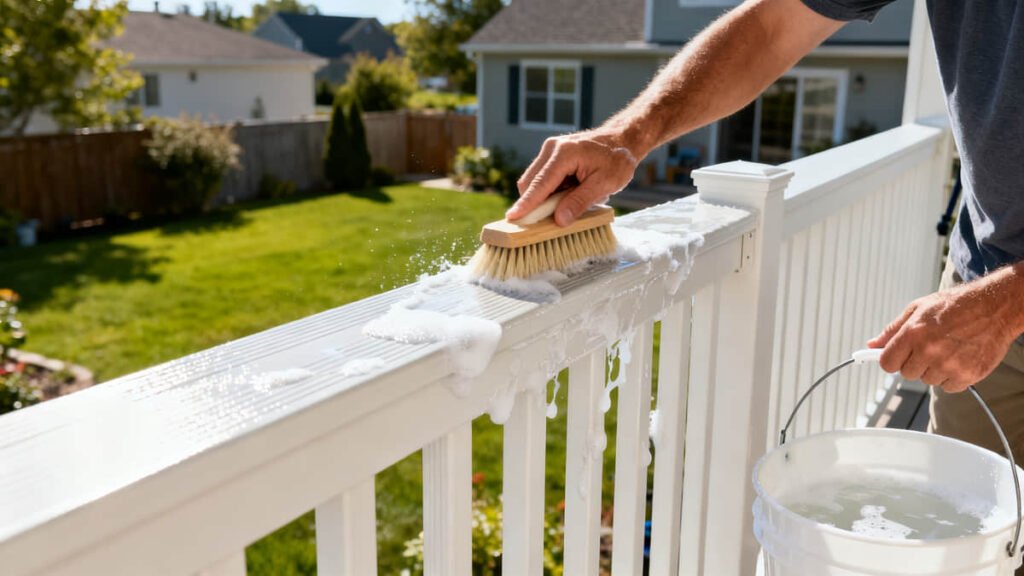
Aluminum needs the same annual wash. The one thing to stay on top of: inspect the powder coat for chips or scratches and touch them up quickly. Exposed edges can oxidize if the coat is broken. Hardware and connection points are worth a check each year too.
Cable requires one extra step the other systems don’t — annual tension checks. Cables loosen slightly over time, especially in the first year or two. Re-tensioning requires a cable tool. Factor that into your client’s maintenance plan from the start.
Wood railing needs painting or staining every 2–3 years and full replacement within 10–15 years. On that baseline, all three systems are a clear step up.
How Each System Holds Up Over Time
Aluminum leads on raw lifespan. Quality aluminum railing lasts 30+ years in most climates. 316 stainless cable is close behind at 25–35 years. Composite ranges from 20–30 years — cap layer quality is the key variable.
For composite, the spec to ask for is a co-extruded cap layer of at least 0.5mm — ideally 0.8mm — with HALS UV stabilizers and UV absorbers in the cap mix. The benchmark test is 3,000 hours of QUV accelerated aging per ASTM G154. A color shift of ΔE ≤ 4–5 after that test signals strong UV stability.
In harsh weather — coastal salt air, freeze-thaw cycles, extreme UV — aluminum and 316 stainless cable hold up best. Quality composite performs well in temperate climates. In high-sun climates, the cap layer spec matters more than the brand name on the box.
Untreated pressure-treated wood railing needs refinishing every 2–3 years and full replacement within 10–15 years. All three systems beat that margin by a lot.
How to Pick the Right Railing for Your Deck
Which railing system is best for…
- Traditional or craftsman homes → Composite. Thicker profiles, warm wood look, coordinates naturally with composite decking boards.
- Modern or industrial builds → Aluminum or cable. Clean lines, slim profiles, wide color range.
- Coastal or marine projects → Powder-coated aluminum with 316 SS hardware, or 316 SS cable. Both resist salt air well.
- Open-view decks or rooftop terraces → Cable. Nothing else matches its sightlines.
- Commercial decks and high-traffic applications → Aluminum. Strong structural performance, long warranty, low upkeep.
- Budget-sensitive projects with volume purchasing → Composite or aluminum. Both offer competitive pricing — especially when decking is sourced factory-direct.
- Multi-family residential builds → Composite or aluminum. Fast to install, holds up well at scale.
Match Your Railing to Your Decking Material
Plan railing and decking together — not in separate conversations. This step gets skipped more often than it should, and it leads to specification changes mid-project.
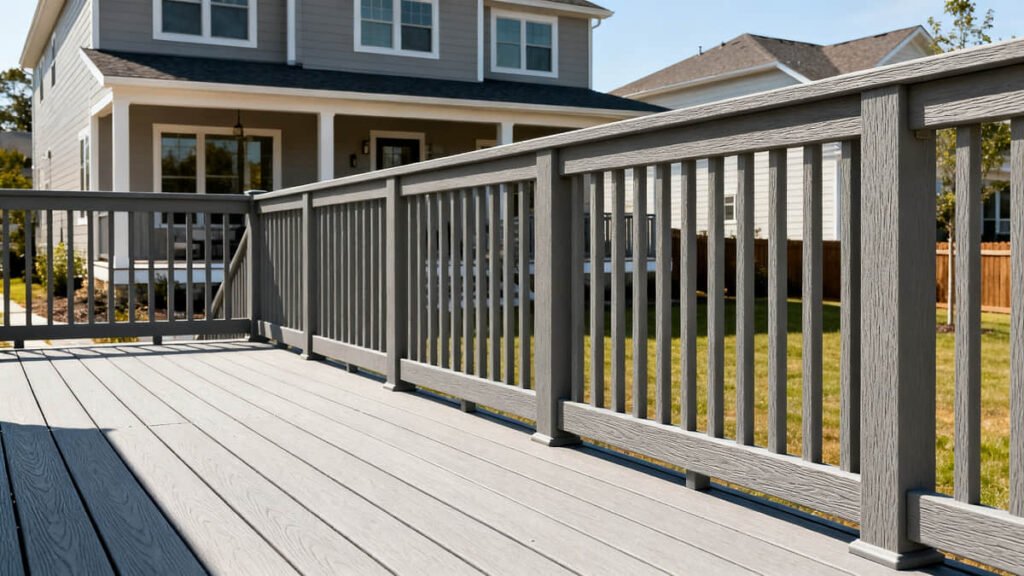
Composite railing pairs naturally with composite decking. Shared color palettes and surface textures make the whole deck look like a designed system. Aluminum railing works with any decking material. Cable looks strongest paired with composite or hardwood decking — the deck surface needs to hold its own against an open railing visually.
Mismatching a heavy composite railing with a light-profile deck board creates visual friction. Clients notice it, even if they can’t name it.
If you’re sourcing composite railing from LastElegance, the Linea is worth considering for projects where a privacy screen or decorative infill ties into the deck design. The slim 1‑3/4″ × 3‑9/16″ (45 × 90 mm) profile sits close in scale to a railing baluster — and shares the same color palette as the decking boards. It’s a fence panel product, not a railing system, but for decks where a screen fence or privacy barrier runs alongside the railing, it keeps the full visual system consistent without mixing manufacturers.
Railing Code Basics Every Builder Should Know
A few IRC and IBC minimums apply regardless of which material you choose.
Under IRC Section R312.1, any deck surface more than 30 inches above grade needs a guardrail at least 36 inches high. For commercial projects, IBC Section 1015 sets the minimum at 42 inches. IRC Section R312.1.3 — the 4-inch sphere rule — requires that no infill gap (cable, baluster, or panel) exceeds 4 inches.
These are minimums. Many jurisdictions adopt stricter local amendments. Always confirm with your local AHJ (Authority Having Jurisdiction) before finalizing a railing spec.
FAQ
Is aluminum better than composite deck railing?
Neither is objectively better — the right choice depends on project type, climate, and visual goals. Aluminum lasts longer and handles harsh weather better, especially near the coast. Composite gives a warmer, more traditional look and coordinates naturally with composite decking boards.
What are deck railing kits?
Deck railing kits are pre-packaged sets that include everything needed to install one railing section — rails, balusters or infill panels, mounting brackets, and hardware. Kits simplify procurement and guarantee part compatibility within the system. Most install without specialty tools.
Can I mix composite and aluminum railing elements?
Yes. Many composite railing systems use aluminum balusters or cable infill between composite top and bottom rails. This combination gives a warmer look from the composite rails while keeping the slim profile of metal or cable infill. Confirm component compatibility with the system supplier before specifying.
Which railing handles coastal salt air best?
Powder-coated aluminum and 316-grade stainless steel cable are the top choices for coastal areas. Both resist salt-air corrosion well. Avoid standard galvanized steel hardware in marine environments — it corrodes faster than expected under continuous salt spray.
Do horizontal cable railings meet building codes?
Yes, when installed per IRC Section R312.1.3 — cables must be spaced no more than 4 inches apart. Some jurisdictions require horizontal cable systems to resist climbing, especially where young children are present. Always verify local code amendments before finalizing a horizontal cable design.
How long does composite railing last?
High-quality co-extruded composite railing typically lasts 20–30 years. Cap layer quality is the main factor — a cap of 0.5mm or more with HALS UV stabilizers resists color fade and surface wear far longer than uncapped composite. Ask for QUV test data (ASTM G154) when comparing products.
Which deck railing system is easiest to install?
Aluminum and composite railing kits with clip or bracket systems are the fastest — an experienced two-person crew can cover 150–200 sq ft per hour on a straightforward layout. Cable railing takes longer because each cable must be tensioned and anchored individually. Complex stair sections add time to all three systems.