

Ten years from now, one of these fences will look nearly the same as it did on install day. The other will have been stained twice, had boards replaced, and is likely headed for a full teardown.
Your clients won’t remember which option cost less upfront. They’ll remember which one caused problems — and whose name was on the invoice.
That’s the real decision behind composite vs. wood privacy fence. This guide covers everything that shapes it for builders, contractors, and distributors: total cost of ownership, install speed, maintenance load, structural performance, supply chain logistics, and long-term client satisfaction.
What Are Composite Fence Panels?
Composite fence panels blend wood fibers and HDPE plastic into a solid board. The plastic shields the wood core from water, UV rays, and insects. Capped composite adds a full polymer layer on all four sides for extra protection. The result is a board that looks like natural wood — but doesn’t behave like it.
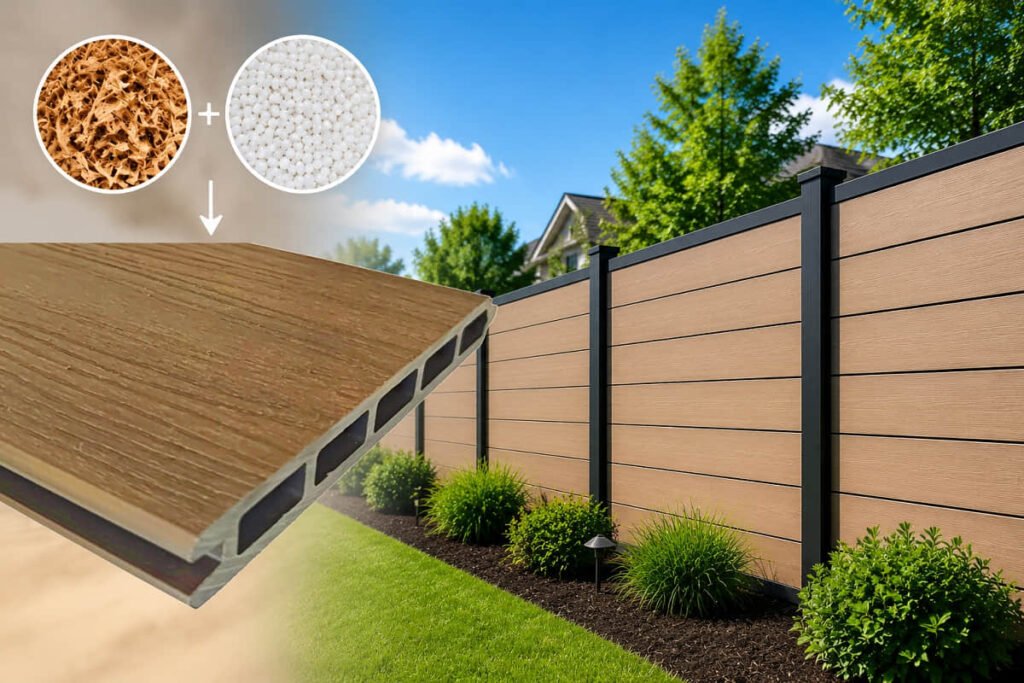
How Do Composite and Wood Privacy Fences Compare?
| Factor | Composite Fencing | Traditional Wood Fence |
|---|---|---|
| Maintenance | Very low — occasional cleaning | High — annual staining/sealing |
| Lifespan | 20–30 years | 10–15 years |
| Upfront cost | Higher initial cost | Lower initial cost |
| Long-term cost | Lower (minimal upkeep) | Higher (repeated treatments) |
| Rot resistance | Yes | No (without treatment) |
| Insect resistance | Yes | No |
| Color retention | Stable over time | Fades and grays without sealing |
| Install speed | Fast — clip system | Slower — individual board nailing |
| Customization | Wide range of colors, widths, profiles | Limited by natural wood grain |
Maintenance — How Much Work Does Each Fence Actually Need?
What does a wood privacy fence need year to year?
Wood fences need work. Plan on staining or sealing every 1–3 years to stop water absorption. Without it, cedar and pressure-treated pine gray out, crack, and warp.
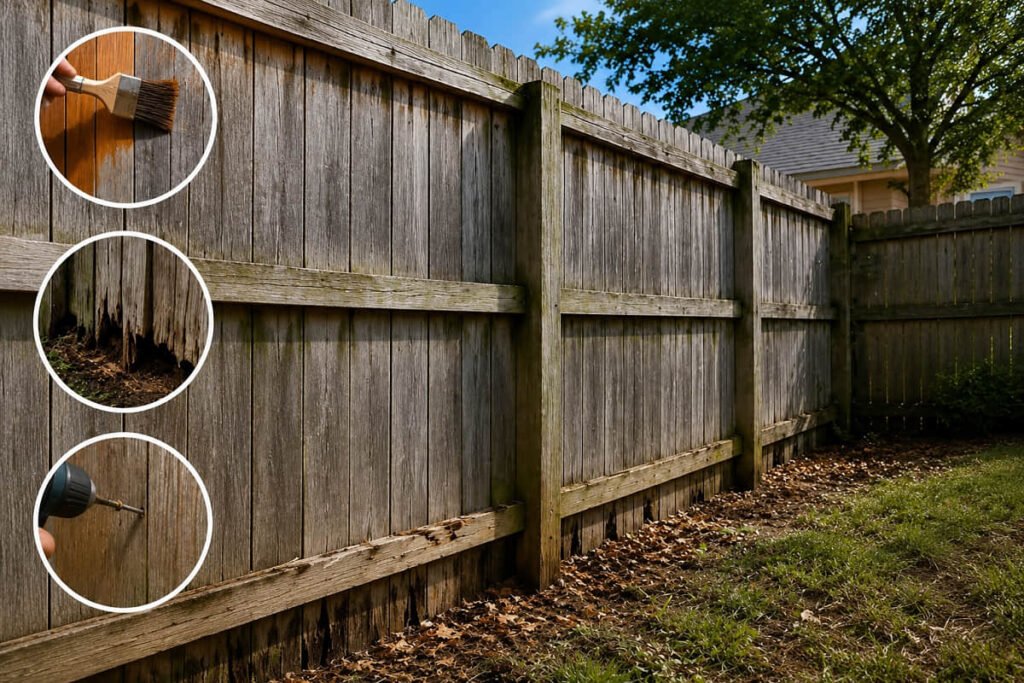
Boards at the base — close to soil — are the first to fail. Rot and insect damage hit these spots hardest. Over a 15-year lifespan, that means real labor and real money on repairs, even before a full replacement.
What maintenance does composite fencing need?
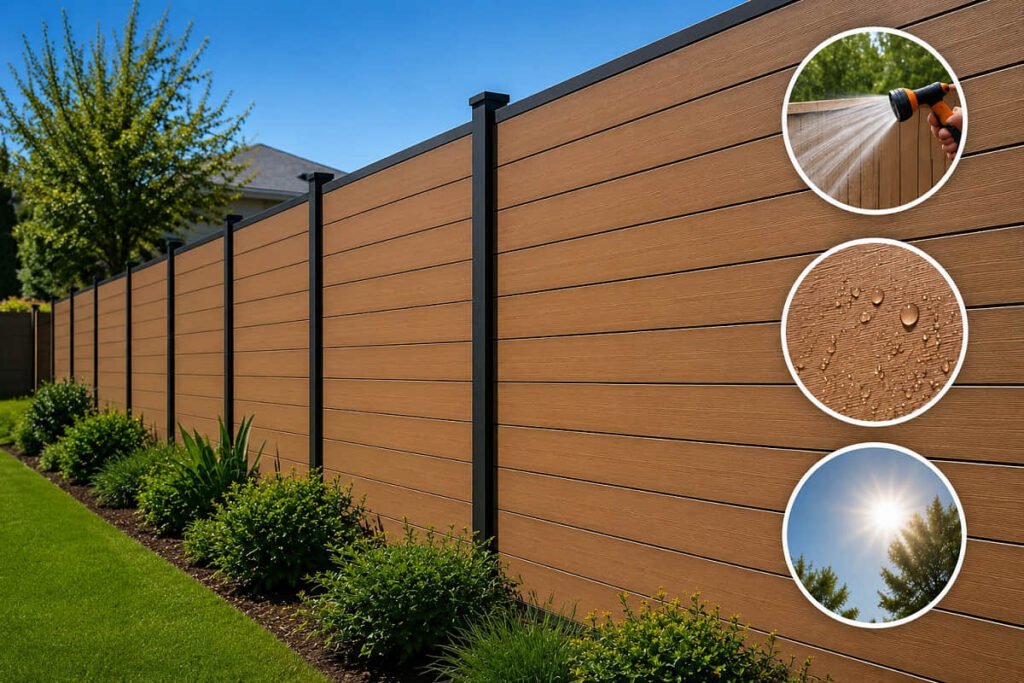
Composite needs almost nothing. Rinse it down once or twice a year. That’s the full maintenance schedule for most installs.
No staining. No sealing. No annual treatment. Composite doesn’t rot, warp from moisture, or attract termites. The co-extruded cap layer on Last Elegance fence panels — 0.8 mm thick — locks out water and UV rays. After 3,000 hours of QUV accelerated aging per ASTM G154, color change stays within ΔE ≤ 4–5. That’s strong color stability, even in high-UV zones like Texas and Florida.
For contractors, that difference matters. Fewer callbacks. Fewer warranty claims. Clients who stay happy well after install day.
Cost — How Do You Frame the Value for Your Clients?
Composite fencing costs more per linear foot than wood. That’s the honest answer — and you should lead with it when a client asks.
But upfront cost is only part of the equation. Wood at a lower material price looks like a deal on day one. Factor in staining every two years, one or two board replacements, and a full teardown at year twelve or fifteen. That labor and material cost adds up fast.
Composite has a higher initial cost. But once it’s in, maintenance costs drop close to zero. Over twenty years, total cost often comes out lower than wood.
For distributors pricing multi-family or commercial projects, the long-run math matters. A product your client won’t call about for fifteen years is a strong selling point — and a strong reason to choose you for the next job.
Last Elegance is the manufacturer — not a reseller. That means no markup layered on top of production cost. On volume orders, the price difference against domestic brands is real.
Want project-specific pricing? Request a quote from our sales team.
How Strong Is a Composite Fence, Really?
This question comes up often — and it’s fair. Composite boards can look like plastic to someone unfamiliar with the material. They’re not fragile.
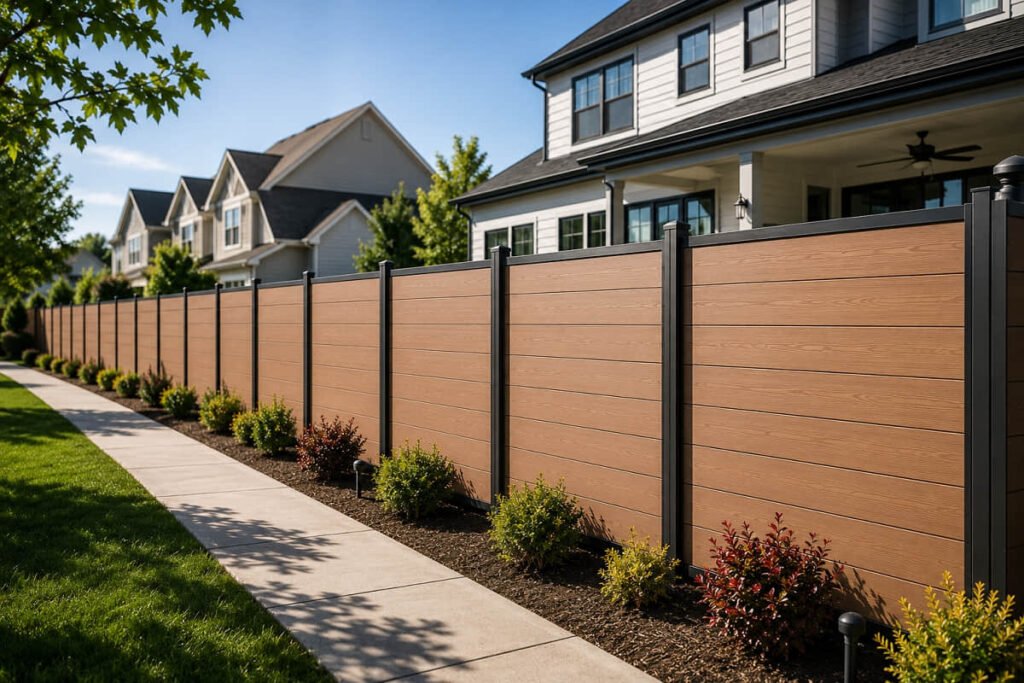
Last Elegance fence panels test at 26.2 MPa (approx. 3,800 psi) flexural strength per EN 15534. Hollow-profile boards have multi-chamber cross-sections with 4–6 mm (approx. 5/32″–1/4″) wall thickness. That adds rigidity without the extra weight of a solid board.
Post spacing drives wind resistance. Set posts 32″–56″ on center for standard conditions. In high-wind zones — the Gulf Coast, Florida, the Great Plains — tighten spacing to 32″–40″ and check local requirements under ASCE 7. Engineering calculations are available on request for specific project configurations.
Wood fences have structural limits too. Cedar and pressure-treated pine can split, crack, or lose strength as they dry and age. Composite boards hold their shape across wide temperature swings — a real advantage in markets with cold winters and hot summers.
The 15-year product warranty is backed directly by the manufacturer — not a domestic distributor in the middle. For contractors who stand behind the product to their own clients, that matters.
How Do You Answer Clients Who Ask About the Look?
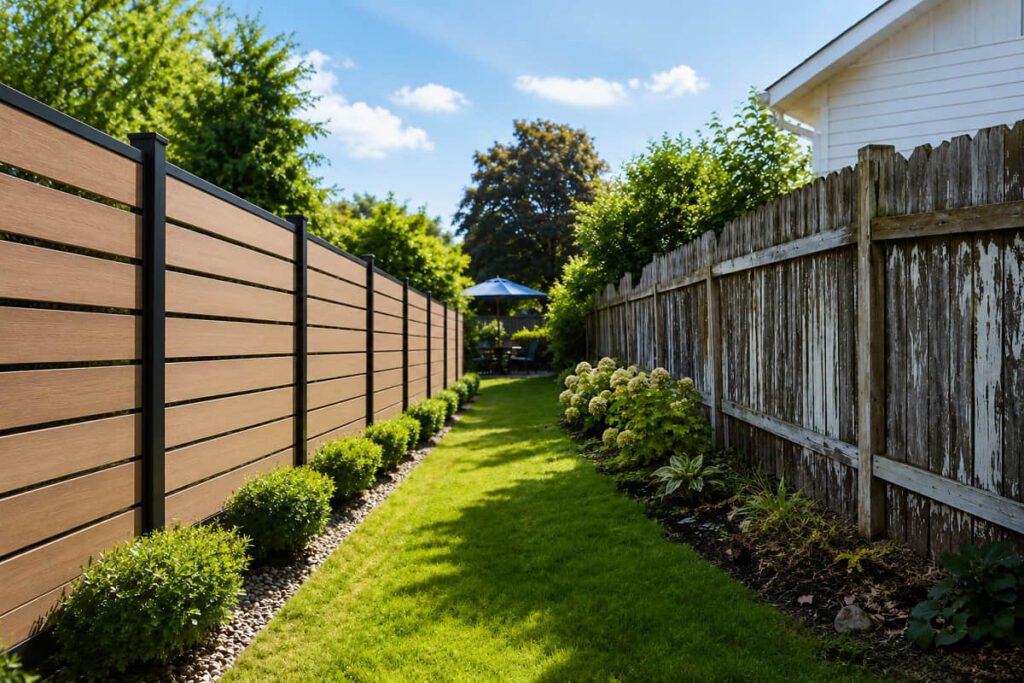
Fresh cedar has warmth and grain that composite can’t fully replicate. If a client wants the organic look of real wood and will commit to regular upkeep, wood is a fair choice for that project. Be honest about that trade-off — it builds trust.
But most clients aren’t really asking about raw aesthetics. They’re asking whether the fence will look good in five years. That’s a different question, and the answer strongly favors composite.
Modern embossed profiles carry a realistic wood-grain texture. Color options go beyond natural wood tones — grays, charcoals, and two-tone finishes that wood can’t match without paint. Last Elegance panels come in three board widths: 3-1/2″ (90 mm), 6-5/16″ (160 mm), and 7-1/16″ (180 mm). That covers full-privacy closed panels, semi-open horizontal slat screens, and open decorative styles — all from the same system.
Fresh cedar looks great on install day. But it grays within a season without sealing. Composite holds its color for years with no treatment. When a client asks “will it still look good?”, that’s your answer.
Which Fence Handles Bad Weather Better?
Wood absorbs water. That’s its biggest weakness in a fence application.
Rain, freeze-thaw cycles, and ground moisture cause boards to swell, warp, and rot — especially at post bases. In humid climates like the Southeast, or cold-wet zones like the Pacific Northwest, a wood fence can show real damage within three to five years without steady upkeep.
Composite doesn’t absorb water. Last Elegance panels test at 0.2% water absorption per ASTM D1037. Freeze-thaw cycles don’t cause swelling. The boards don’t rot from moisture, and they don’t attract termites or other insects.
That makes composite a strong fit for coastal projects, high-humidity markets, and any job where long-term structural integrity matters.
Is Composite Fencing Easier to Install Than Wood?
Yes — and the gap shows up in labor hours.
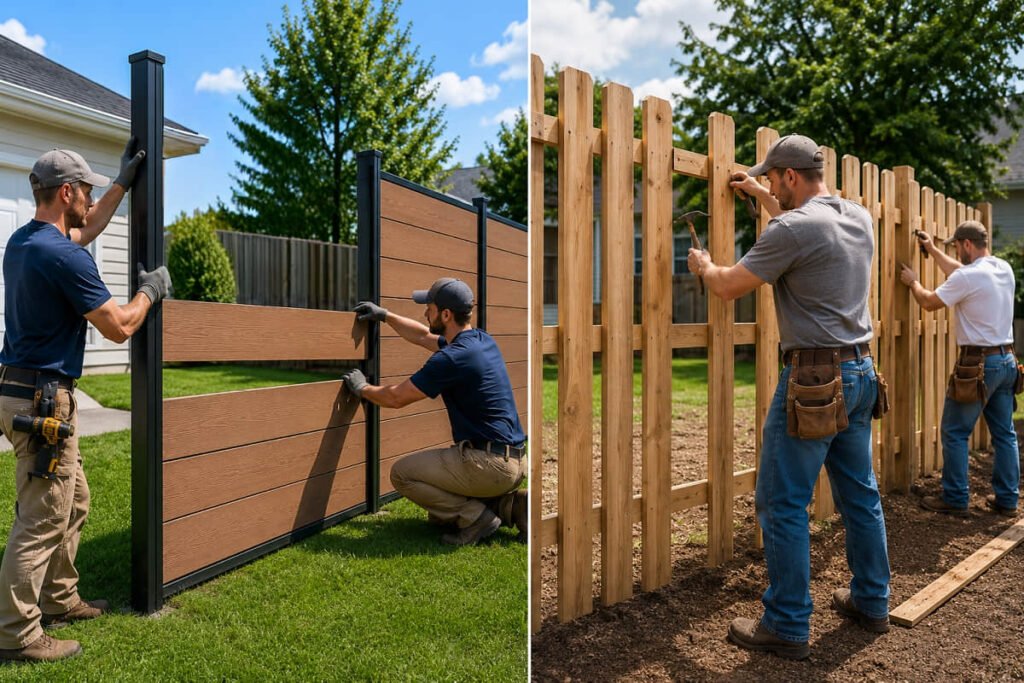
Composite panel systems use a clip-based installation process. Set posts. Slot boards into the clips. Apply trim. A two-person crew can move through the job quickly, with no board-by-board nailing or alignment guesswork.
Last Elegance ships a complete system — aluminum alloy posts, top and bottom trim strips, angle brackets, post caps, and post skirts. No sourcing accessories from three different suppliers.
Traditional wood fencing means individual board nailing, alignment checking, and finishing. It’s slower, and results vary by crew.
Faster installs mean lower labor costs per linear foot. On a 200-linear-ft privacy fence, that difference adds up fast.
Our distributors in the Southeast tell us the same thing every season: the clip system is what crews mention first after their initial install. Setup is clean, alignment stays consistent, and job time drops.
Sustainability — What’s the Real Case?
Wood sourced with FSC certification has a genuine environmental argument. It’s a renewable material with a lower carbon footprint at the point of production.
Composite makes a different case. Last Elegance panels contain 60% recycled content — recycled HDPE and recycled wood fiber — diverting post-industrial plastic from landfill. For projects seeking LEED credits or meeting sustainability reporting requirements, that’s a documentable spec, not just a marketing claim.
The lifespan factor matters too. A fence you replace twice uses twice the raw material. One that lasts 25–30 years uses far less over its life.
Neither material is a clear winner. If FSC certification is a project requirement, wood has merit. If recycled content and long lifespan matter most, composite makes a strong case.
What Does Factory-Direct Supply Actually Mean for Your Business?
For distributors and contractors working at volume, the supply model matters as much as the product spec.
Last Elegance manufactures composite fencing in-house and ships direct to U.S. trade partners. There’s no domestic distribution layer — the cost advantage passes straight to you.
Lead times: A 20′ container runs about 15 days production plus 24–32 days sea freight to the West Coast (express routing). A 40′ container adds roughly five days to production. Plan for 5–7 weeks total from order to U.S. port on most routes.
Minimum order quantity: 100 square meters (approx. 1,076 sq ft) per product line. For first-time buyers, we’re open to discussing trial quantities before a full container commitment. Sample boards and color swatches are available upon request.
Custom orders: Full factory-level customization is available — custom colors, profiles, lengths, and branded packaging with your own label. No domestic composite brand offers this. For distributors building their own product line, that means factory access to a private-label program without the R&D cost.
Interested in a private-label program? Talk to our team about custom options.
Composite vs Wood vs Vinyl — Quick Comparison
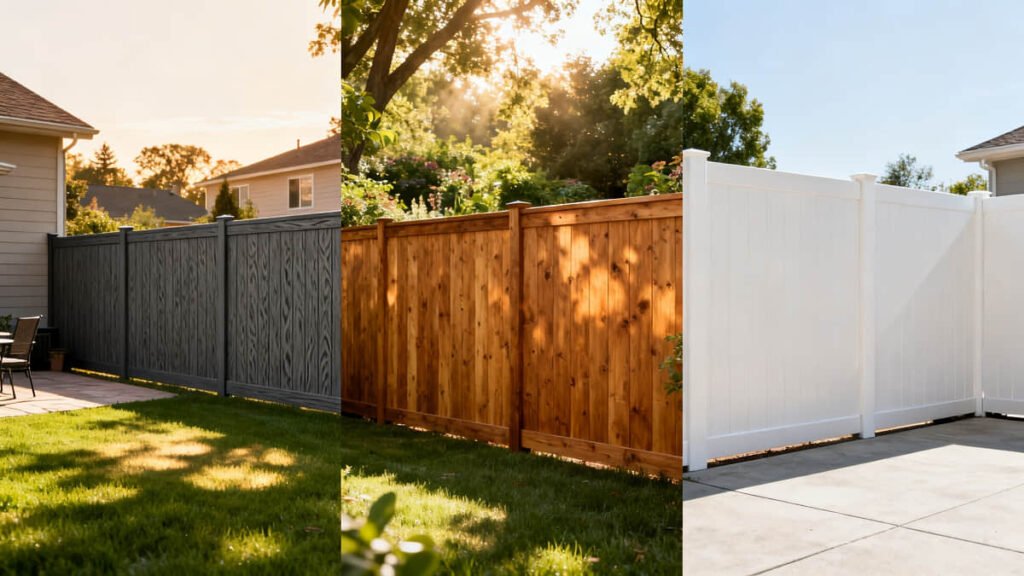
| Factor | Composite | Wood (Cedar/PT Pine) | Vinyl/PVC |
|---|---|---|---|
| Natural appearance | Good | Excellent | Poor |
| Maintenance | Very low | High | Low |
| Lifespan | 20–30 years | 10–15 years | 20–30 years |
| Rot resistance | Yes | No | Yes |
| Insect resistance | Yes | No | Yes |
| Cold weather | Good | Fair | Poor (brittle) |
| Range of colors | Wide | Limited | Moderate |
| Structural rigidity | High | High | Medium |
| Customization | Full | Limited | Limited |
Vinyl wins on price at the low end. But it becomes brittle in hard freezes and carries a “plastic” look that buyers reject at mid-range price points. Composite outperforms vinyl on appearance, rigidity, and cold-weather durability.
Which Fence Offers the Best Long-Term Value for Your Projects?
For most commercial and mid-range residential projects, composite fence panels deliver better long-term value. The initial cost is higher — but total cost over twenty years often comes out lower than wood once you count staining, repairs, and replacement.
The right choice depends on the project:
- Wood makes sense when upfront cost is the main constraint, the site has low moisture exposure, or the client specifically wants natural wood aesthetics and will commit to regular maintenance.
- Composite makes sense for low-maintenance projects, coastal and high-humidity sites, multi-family and commercial applications, and any client who wants a long-term warranty with no annual upkeep.
The 15-year warranty — backed by the manufacturer, not a middleman. When you’re standing behind the product to your own client, that warranty backing is part of what you’re selling.
Talk to our team about pricing, samples, or custom specs.
FAQ
Are composite fence panels good for privacy?
Yes. Full-privacy composite panels close off completely with the solid-board system. Board widths up to 7-1/16″ (180 mm) make solid privacy panels straightforward to build. The clip fastener system keeps boards aligned, so gaps don’t open up the way shrinking wood boards can.
Do composite fences resist pests and rot better than wood?
Composite doesn’t rot and doesn’t attract termites or insects. Wood fences — even treated pine or cedar — are vulnerable to insect damage and rot at post bases and ground-contact points. Composite removes both failure modes from the equation.
Is composite fencing resistant to wind?
Post spacing controls wind resistance. Set posts at 32″–40″ on center for high-wind zones and check local building codes for specific wind load requirements per ASCE 7. Tighter spacing increases panel rigidity and resistance to lateral wind load.
How does composite fencing compare to vinyl?
Composite looks more like natural wood and holds up better in cold climates — vinyl can crack in hard freezes. Composite also has higher structural rigidity and a wider range of colors and textures. Vinyl typically costs less upfront, but has fewer design options and weaker cold-weather performance.
What are the lead times and MOQ for a first order?
Standard lead time from production to U.S. port runs 5–7 weeks, depending on container size and shipping route. MOQ starts at 100 square meters (approx. 1,076 sq ft) per product line. For first-time buyers, we can discuss flexible trial quantities before committing to a full container program. Sample boards are available on request.
Is composite fencing easier to install than wood?
Yes, for most crews. The clip-based system — slot boards into clips, apply trim — is faster than individual board nailing. A complete system with posts, brackets, caps, and trim ships together, so there’s no sourcing accessories separately. Labor time per linear foot drops compared to a traditional wood fence build.