

Privacy screen outdoor projects come from both sides of the fence — literally. Your clients want to block the view in. Their neighbours want to block the view out. Either way, someone’s calling a builder.
The question is whether that job comes back to haunt you. Timber rots, paint peels, and two years later the client rings. That’s a warranty claim you didn’t budget for.
This guide covers 10 privacy screen types, how each performs in Australian conditions, and what to specify for a clean, low-maintenance result.
What to Know Before You Choose a Screen
Before you pick an outdoor privacy screen, three things are worth getting right first: how tall you’re allowed to go, which material suits your conditions, and how you’ll fix it in place. Getting these sorted before you order saves real headaches later.
How High Can a Privacy Screen Be in Australia?
Rules vary by state and local council — so there’s no single national answer. In NSW, exempt development rules commonly allow:
- Freestanding privacy screens up to 2.5 m above existing ground level
- A maximum screen length of 5 m
- A minimum setback of 900 mm from each lot boundary
- Installation without development consent where all exempt development requirements are met
Additional approvals may be required depending on your state, local council controls, heritage restrictions, bushfire requirements, and site-specific planning conditions. There is no single Australia-wide height limit for privacy screens, so always check the requirements that apply in your area before installation.
Which Material Holds Up Best Outdoors?
The three main options are composite, timber, and metal. Each has different trade-offs on upkeep, cost, and lifespan.
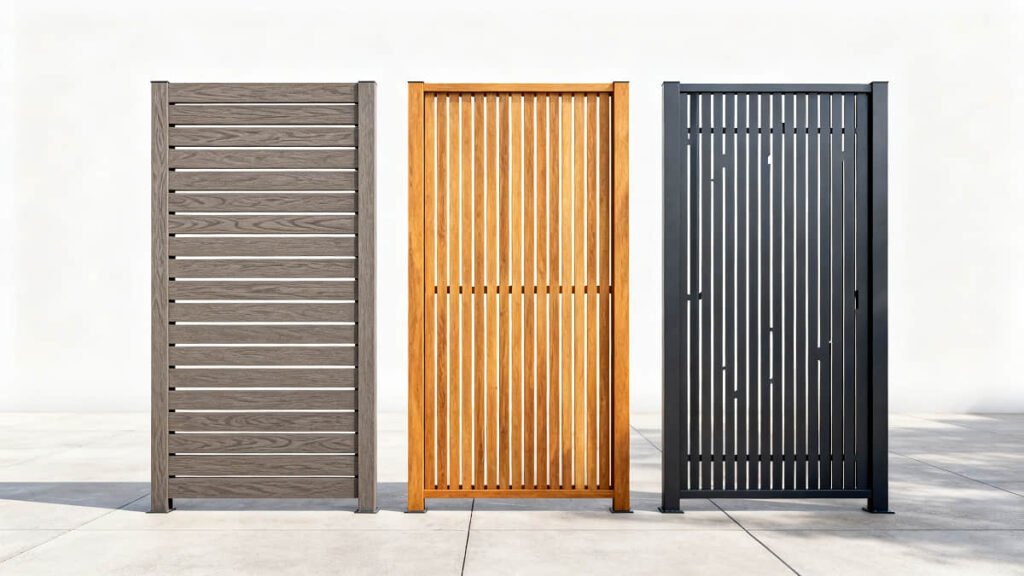
Composite is waterproof, termite-resistant, and needs almost no care. Timber looks warm and natural but needs oiling or painting every one to two years to resist rot. Metal is tough and modern-looking but gets hot in direct Australian sun.
Australia’s high UV index, coastal salt air, and termite exposure make material choice more critical here than in cooler climates. Composite screening with HDPE at 0.95 g/cm³ density is built for exactly these conditions.
Find the Right Privacy Screen for Your Space
Here are 10 ideas that work across different spaces, budgets, and styles.
1. Composite Screening Panels
Composite screening panels are made from wood fibre and HDPE. They don’t rot, warp, crack, or attract termites — and they need no painting or oiling.
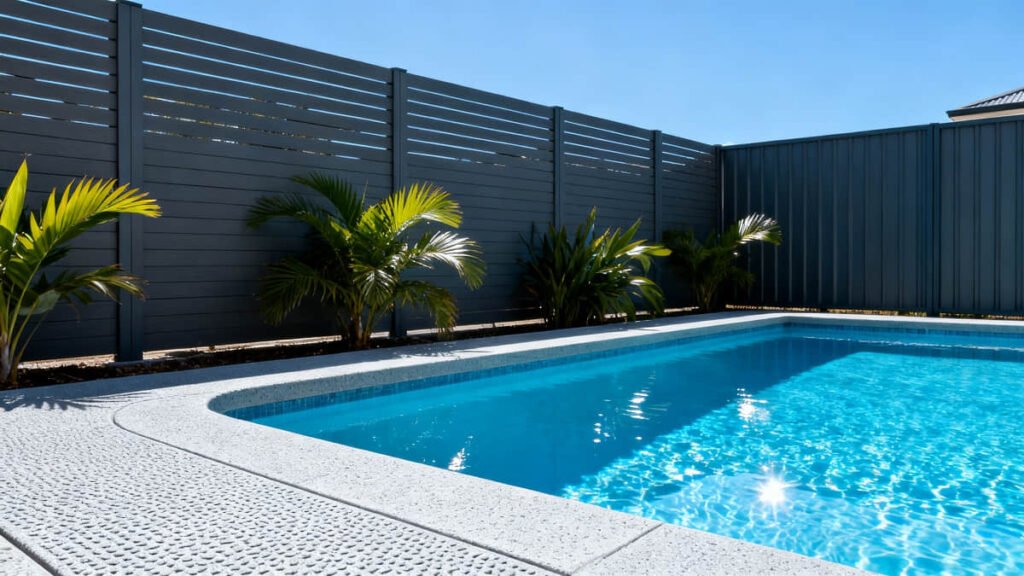
They come in three main formats. A closed solid style delivers full backyard privacy. A semi-open slatted style keeps airflow while blocking sightlines. A wide-board style creates a clean, bold fence line.
LastElegance provides available widths ranging from 90 mm up to 180 mm — the Vista Composite Screening Panels cover all three, while the TwinLine suits a narrower slatted profile at 158×20 mm. If you’re after something more open and decorative, the Linea Composite Fence Panels offer a slim picket style in 45×90 mm and 50×50 mm.
Installation is clip-fixed: boards slot into fasteners that lock onto the posts. No surface screws. Post spacing runs 0.8 to 1.4 m, and the boards are lighter than timber, so two people can move through a standard fence run quickly.
2. Timber Slat Screens
Timber slat screens are a classic — warm, natural, and easy to stain or paint to match a home’s style. Merbau and treated pine (H3 or H4 hazard class for ground contact) are the most common options in Australia.
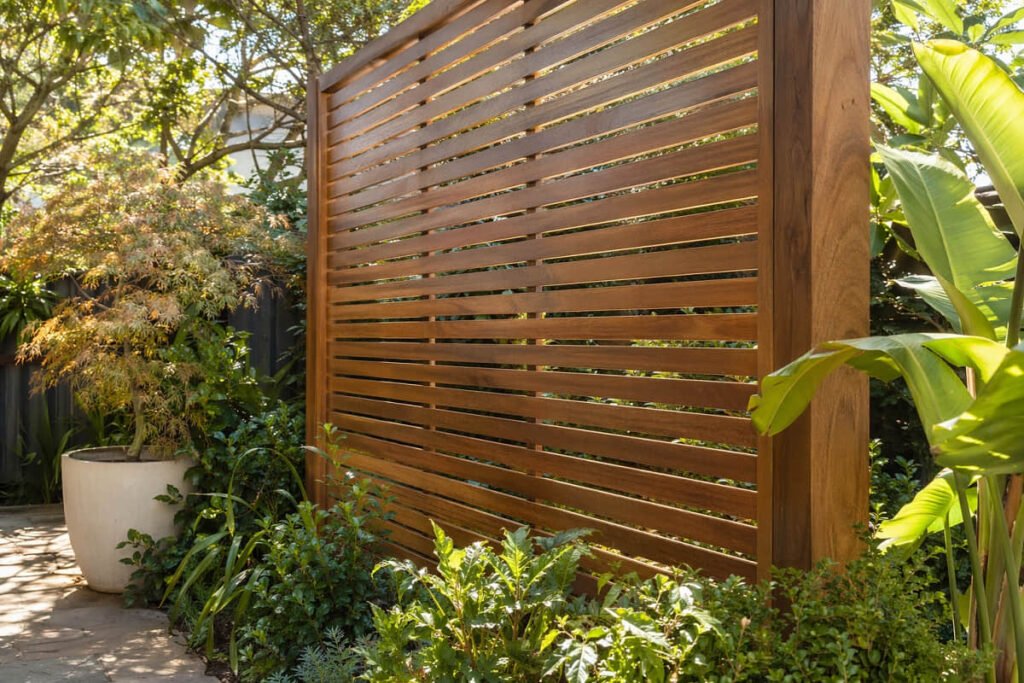
The trade-off is upkeep. Timber needs oiling or sealing every one to two years to hold off rot and insects. In coastal or high-moisture spots, it breaks down much faster. It’s a good DIY option if you’re comfortable with carpentry and committed to regular care — best kept to sheltered garden areas away from direct spray.
3. Laser-Cut and Decorative Metal Screens
Powder-coated steel or aluminium screens suit contemporary homes well. Laser-cut designs give you something decorative — geometric shapes, foliage patterns, or abstract panels that become a real focal point in the outdoor area.
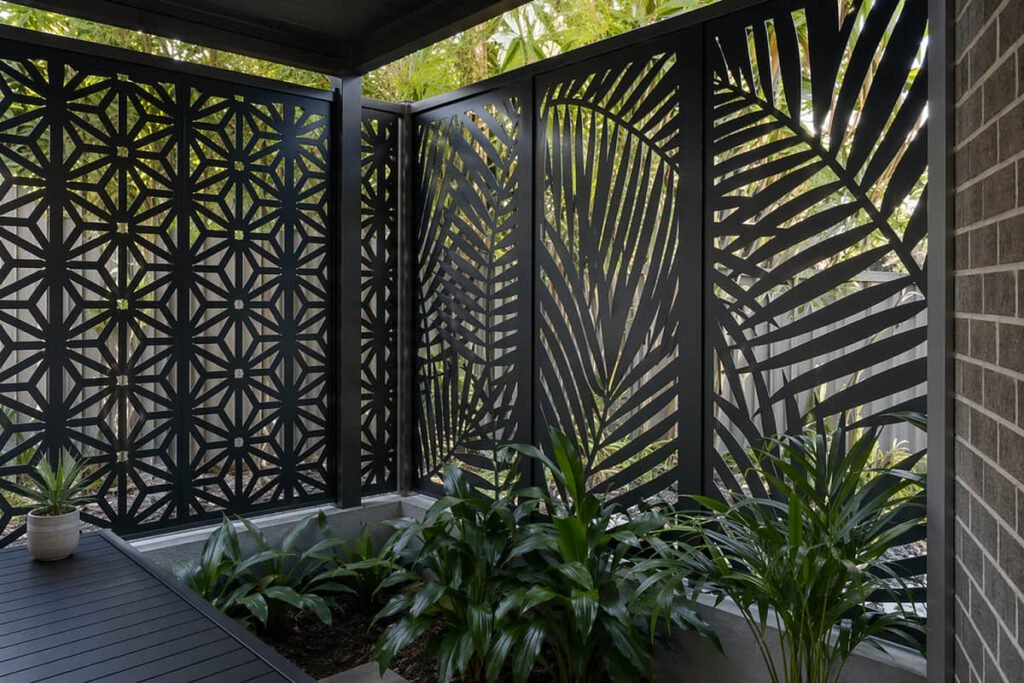
They hold up well over time, and powder coating protects against UV wear. The catch is heat: metal panels in direct Australian sun get very hot to touch. Use them in shaded spots or as a feature panel alongside a structural screen. Aluminium alloy posts are a clean framing match if you’re mixing materials.
4. Lattice Panels With Climbing Plants
Lattice panels are one of the most affordable privacy screen options. On their own, they offer partial coverage — but once a climbing plant fills in, the effect is much stronger. Good climbers for Australian gardens include star jasmine, passionfruit, and wisteria.
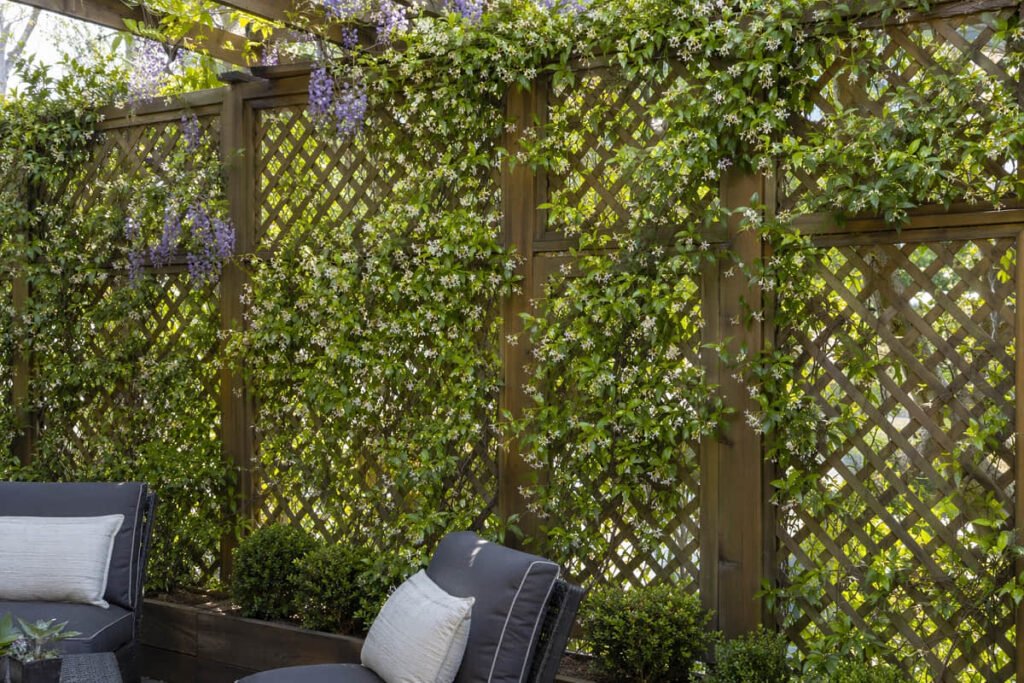
Allow one to two full growing seasons for solid coverage. Use timber or WPC lattice frames for better lifespan than standard PVC. Most lattice panels have 20–30% visual permeability — check your council’s rules on maximum permeability before you install close to a boundary.
5. Bamboo Screens
Natural bamboo gives a strong tropical or Zen feel, and it’s cheap to buy. The problem is longevity — expect three to five years before it starts breaking down in outdoor weather. It soaks up water, swells over time, and needs replacing sooner than most people plan for.
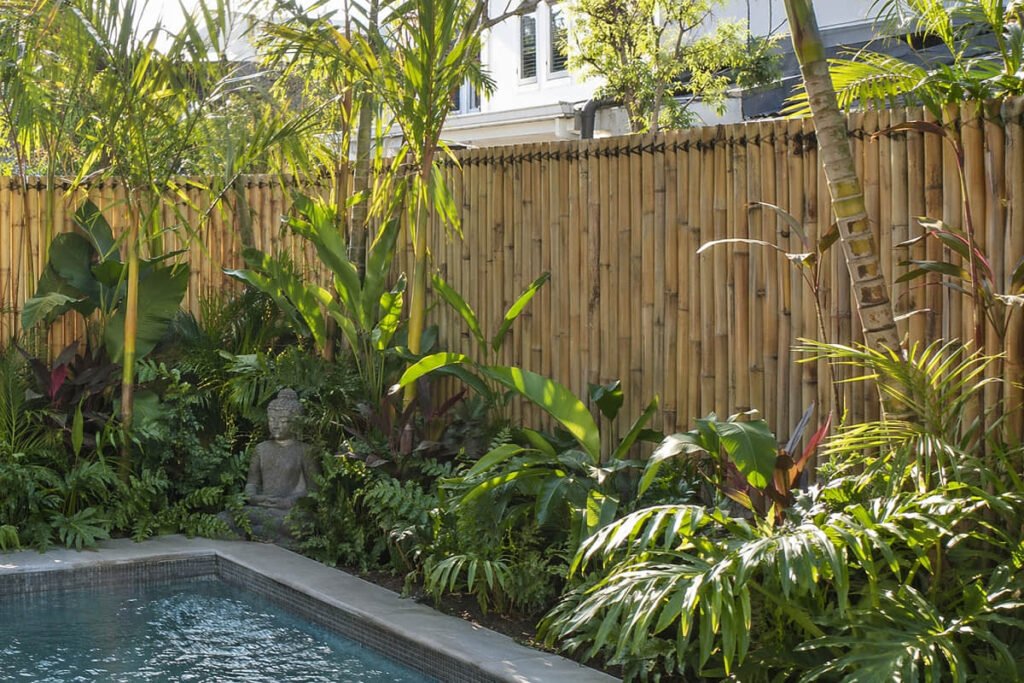
A smarter long-term choice is a bamboo-design composite or powder-coated metal panel. Same look, no upkeep. Natural bamboo works best in sheltered courtyards or as a short-term screen while the garden grows in.
6. Living Walls and Ornamental Grasses
A living wall — plants grown on a trellis or modular planting frame — adds colour, texture, and life to any outdoor space. Ornamental grasses work well for lighter garden screening along pathways or on a balcony, moving with the breeze rather than forming a hard barrier.
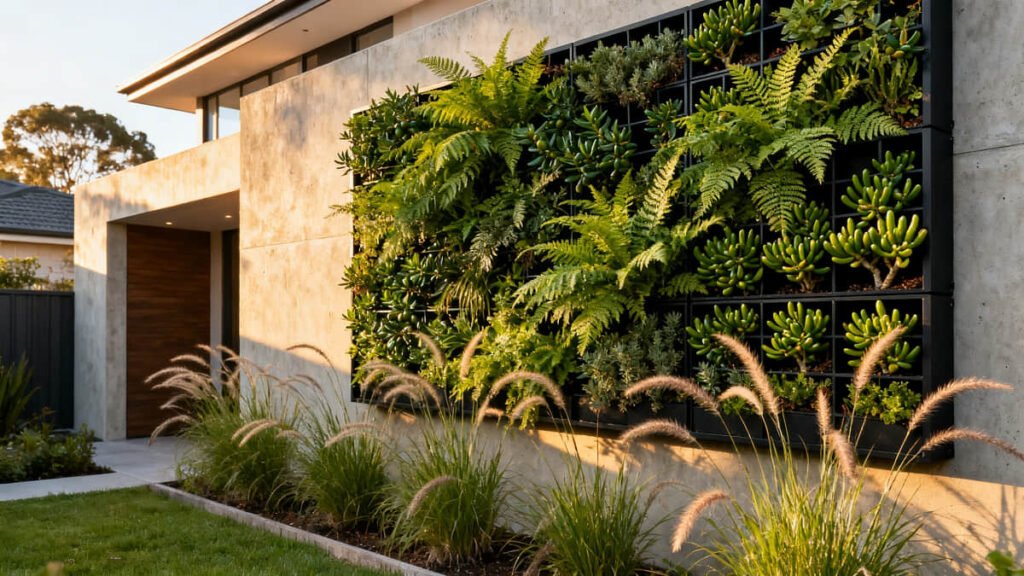
The downside is time and effort. Living screens need regular watering and trimming, and they take time to reach full height. For faster results, pair them with a composite or aluminium frame behind. The frame gives you backyard privacy now — the plants build on it over time.
7. Freestanding Decorative Screens
Freestanding screens are the most flexible option. Move them, reposition them, or take them when you move out. A single large decorative screen panel makes a strong focal point beside a pool or at the back of a patio.
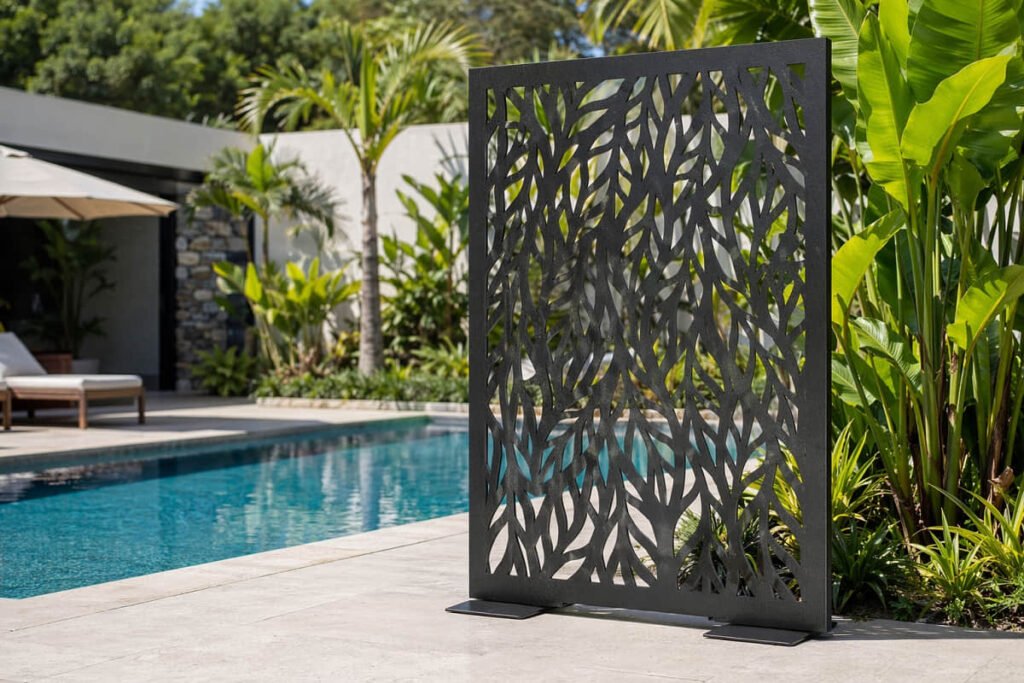
These work well when you need to block a specific sightline rather than build a full fence. Most metal screen panels come in freestanding configurations with base plates or weighted feet.
8. Privacy Screens for Balconies
Balcony privacy screens need to work hard: light enough not to overload the structure, and stable enough to handle wind. That’s a tighter brief than a ground-level fence.
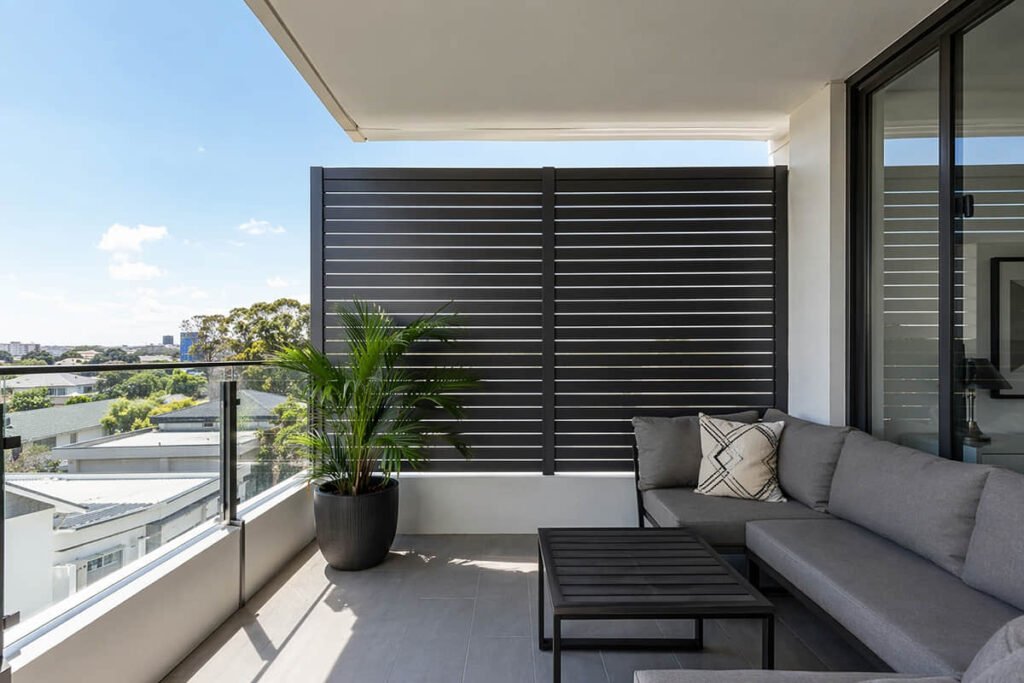
Semi-open slatted composite panels are a strong fit here. They let air through, cut wind load, and still block prying eyes from neighbouring apartments. Keep post spacing at 0.8 to 1.0 m in exposed positions. Vista Composite Screening in 90×20 mm weighs just 1.30 kg per linear metre — a meaningful weight saving over solid timber on a balcony structure.
9. Water Feature Privacy Walls
A solid privacy wall with a built-in water feature is one of the most dramatic outdoor area ideas. It blocks the outside world and adds sound that naturally masks street noise. A steel-framed wall clad in composite panels can serve as a visual centrepiece and a privacy wall at once.
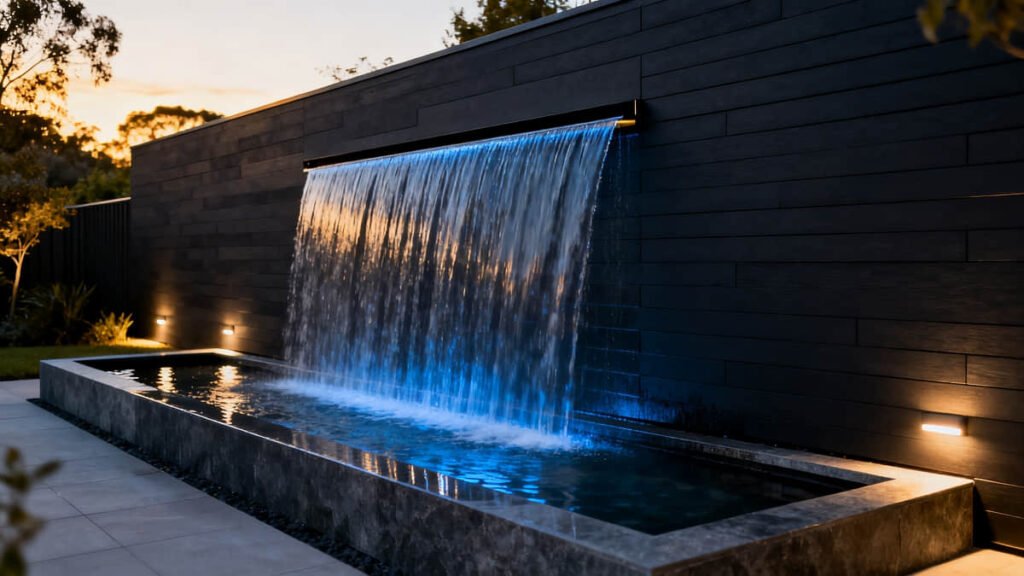
This is a higher-cost option — but it makes a strong impression in both home and commercial projects. For wet environments, composite cladding (e.g., Oakling Cladding, 140×12 mm) is a natural choice: water absorption is just 0.2% (ASTM D1037), so moisture is not a concern at all.
10. Outdoor Curtains and Shade Sails
Outdoor curtains and shade sails are the easiest option to put up. They create a sense of enclosure and add shade to a patio or deck without any structural work.
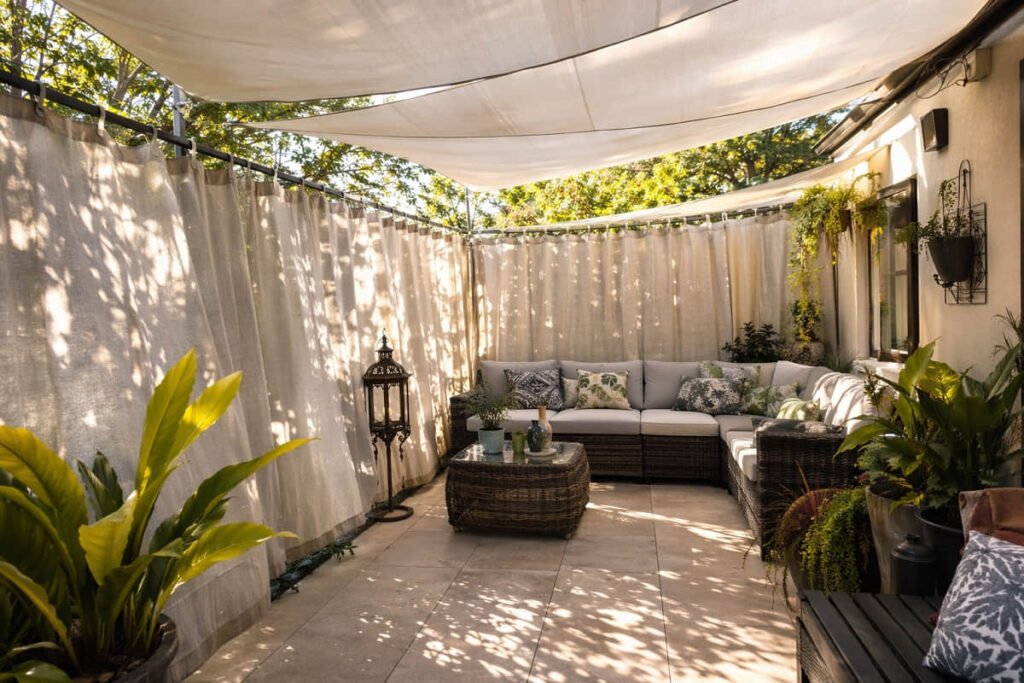
They won’t block a determined sightline. Wind and rain wear them out faster than a hard screen. Best used as a soft layer over a structural screen — or for renters who need temporary privacy without fixing anything permanently.
Composite vs Timber vs Metal — A Quick Comparison
Here’s how the three main materials compare. Composite wins on low maintenance, lifespan, and Australian climate performance. Timber wins on warmth and natural look. Metal suits a contemporary style and handles impact well.
| Material | Lifespan | Upkeep | Termite Resistant | UV Rated | Best For |
|---|---|---|---|---|---|
| Composite | 15+ years (15-yr warranty) | Near-zero — no paint or oil | Yes | Yes — 0.8 mm cap layer; ΔE ≤ 4–5 after 3,000 hrs QUV | Most Australian conditions, pool areas, coastal zones |
| Timber | 5–10 years with care | High — oil or seal every 1–2 years | No | No — bleaches and cracks without treatment | Sheltered gardens, natural-style homes |
| Metal | 15–20 years | Low — check coating for chips | Yes | Moderate — powder coat protects; hot in direct sun | Contemporary homes, shaded feature panels |
Composite screening sourced factory-direct is priced well against locally stocked timber — and without the lifetime maintenance cost stacked on top. For procurement managers and builders costing large runs, that gap adds up fast.
Can You DIY a Backyard Privacy Screen?
Yes — composite screening is designed for DIY install. The process is clean: cut boards to length, fix posts at 0.8–1.4 m centres, slot boards into the clip fasteners, and apply the finishing trim strips. No surface screws. No specialised tools.
Every order comes with complete system accessories — top and bottom trim strips, angle brackets, clip fasteners, post caps, post skirts, and post edge trims. That cuts down on site decisions and extra hardware store trips.
When to call a professional instead: runs over 10 m, uneven ground, or screens that attach to a structural part of the building. For large commercial installs, a trade quote and tech support from your supplier is the smarter way to go.
Installation videos are available, and our sales team can walk through technical specs for any project size. Contact Our Sales Team →
Need a Front Fence Too?
Backyard and front-of-home jobs often call for different specs from the same product range. If the project also includes a street-facing fence, check our guide to front fence ideas for council height limits, gate integration, and street-appeal-focused designs.
FAQ
How do I make a small backyard more private?
In a tight space, a tall composite screen panel adds privacy without eating into your footprint. Semi-open slatted panels let natural light through while still blocking sightlines — a better balance than a solid screen that can make a small outdoor area feel closed in. Ornamental grasses in raised planters add a soft layer if you want to break up the fence line visually.
How do I improve privacy in a shared garden?
A slatted or semi-open screen adds privacy without making a shared space feel divided. If you can’t fix anything to a boundary fence, a freestanding panel screen is the best option — no permanent fixing needed, and it’s easy to reposition.
Are composite privacy screens worth the cost?
The higher upfront cost versus timber is offset by near-zero maintenance over 15+ years — no painting, oiling, or replacing rotted boards. For any project where labour time has a dollar value, that payback is fast.
What is the best outdoor privacy screen for a pool area?
Composite screening is a strong fit: R11 slip resistance (AS/NZS 4586), 0.2% water absorption, and no risk of rot or splinters around barefoot areas. Keep in mind that pool fencing regulations are a separate requirement under Australian Standard AS 1926.1 — a privacy screen doesn’t replace compliant pool fencing.
How far apart should privacy screen posts be?
For composite screening, space posts 0.8 m to 1.4 m apart — never exceeding 1.6 m. On coastal sites or in exposed positions, keep spacing at 0.8 to 1.0 m to handle higher wind loads.
