

Spotted gum decks win the job. Sometimes, they bring the builder back six months later.
A greying board. A splinter complaint. Tannin staining on the client’s new pavers. The deck hasn’t been oiled once — but the call comes to you.
This guide cuts through the material debate. Cost over time, maintenance load, safety ratings, and the project types in which each material earns its place.
Quick Comparison at a Glance
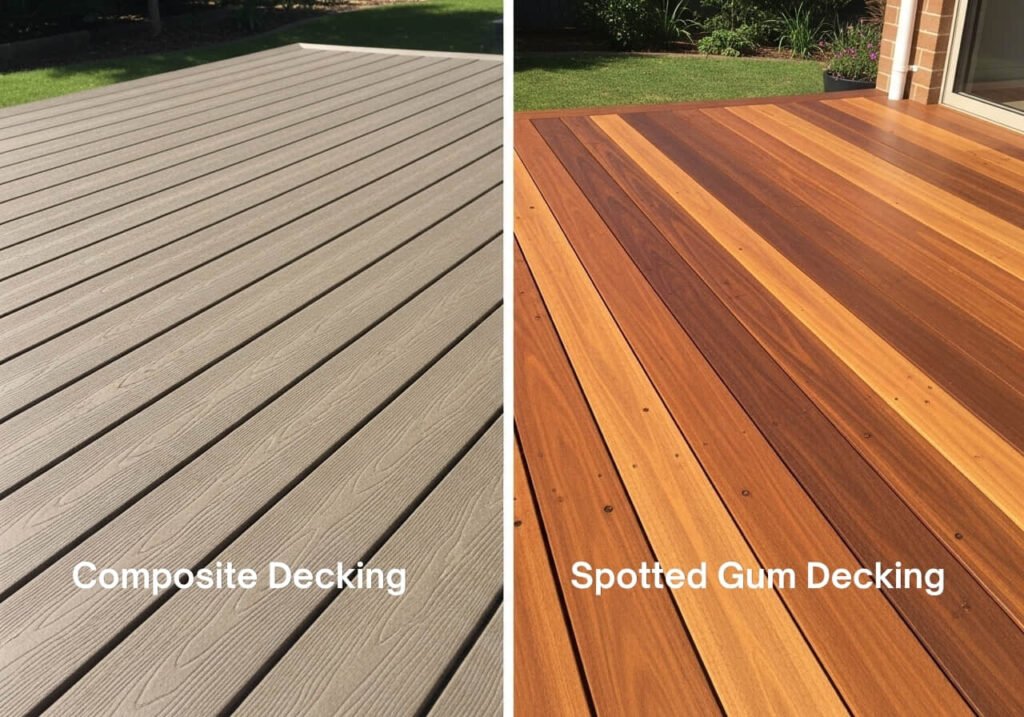
| Factor | Composite Decking | Spotted Gum |
|---|---|---|
| Board cost (per m²) | $100–$190 | $140–$250 |
| Installed cost (per m²) | $250–$450 | $350–$550 |
| Annual maintenance cost | ~$0 (wash only) | $400–$1,000 per 30 m² |
| Lifespan | 25–30+ years | 25–30 years (maintained) |
| Janka hardness | N/A (engineered) | 11.0 kN |
| Slip resistance | R11 (AS/NZS 4586) | Varies with surface oil |
| Termite resistance | Yes (capped composite) | Durability Class 1 |
| Fire testing (ASTM E84) | FSI 85, SDI 300 | Not applicable |
| Cap layer | 0.8 mm capped composite | Oil/sealant required |
| Flexural strength | 26.2 MPa (EN 15534) | High (Janka 11.0 kN) |
| Warranty | 15 years | Varies by supplier |
Figures are indicative. Costs vary by product, project size, and location.
View composite decking specs and product range →
What Is Spotted Gum Decking?
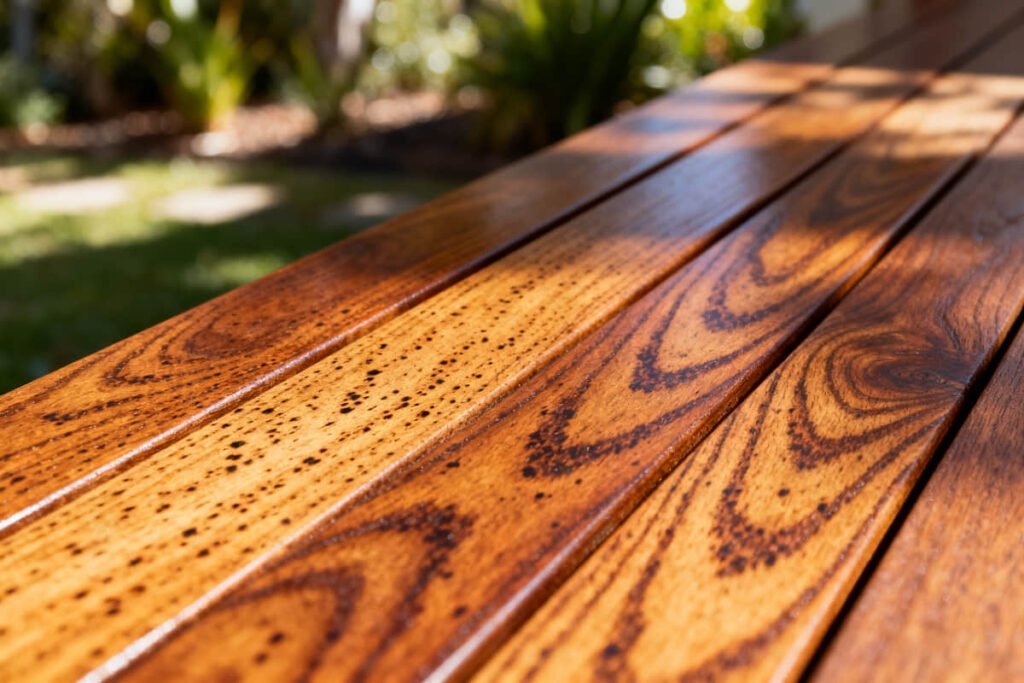
Spotted gum (Corymbia maculata) is a native Australian hardwood. It holds a Durability Class 1 above-ground rating and a Janka hardness of 11.0 kN — one of the toughest decking timbers in the country.
How Do the Costs Compare?
Upfront, spotted gum and composite aren’t worlds apart. Over 20 years, they are.
Spotted gum looks like the premium material at the merchant. But annual oiling, occasional sanding, and re-coating add up fast. For a buyer specifying a 30 m² residential deck or a multi-unit development, those ongoing costs change the total picture.
Board and Installation Cost
Spotted gum boards run roughly $80–$150 per m² in Australia. Installed, expect $250–$550 per m² once labour is included. That hardness is part of the reason: at 11.0 kN Janka, every fastener needs pre-drilling. Blades wear faster. Cuts take longer.
Composite boards range from $100–$190 per m² and install for around $250–$450 per m². LastElegance boards come with stainless steel hidden clip fasteners — no pre-drilling, no surface screws. Two installers can cover more area per day than with spotted gum. For large projects, the labour saving per m² adds up. Custom lengths are also available to match non-standard deck dimensions — useful for retrofits and large-format commercial projects.
Long-Term Cost Over 20 Years
Annual maintenance is where the numbers shift most. Spotted gum needs cleaning, light sanding, and 1–2 coats of quality decking oil — at least once a year in most Australian conditions. For a 30 m² deck, that’s $400–$1,000 per cycle in labour and materials. In coastal or subtropical zones, add more.
Composite needs a wash. That’s it.
| Cost Item | Composite (30 m²) | Spotted Gum (30 m²) |
|---|---|---|
| Installed cost | $7,500–$13,500 | $9,000–$16,500 |
| Annual maintenance | Minimal | $400–$1,000 |
| 20-year maintenance total | Minimal | $8,000–$20,000 |
| 20-year total | $7,500–$15,500 | $17,000–$36,500 |
These are indicative figures. Factory-direct composite supply removes importer and reseller margins — that shifts the upfront comparison further for trade buyers ordering at volume.
Request a quote for your next project →
Maintenance: The Real Day-to-Day Difference
Most buyers underestimate what maintaining spotted gum actually involves.
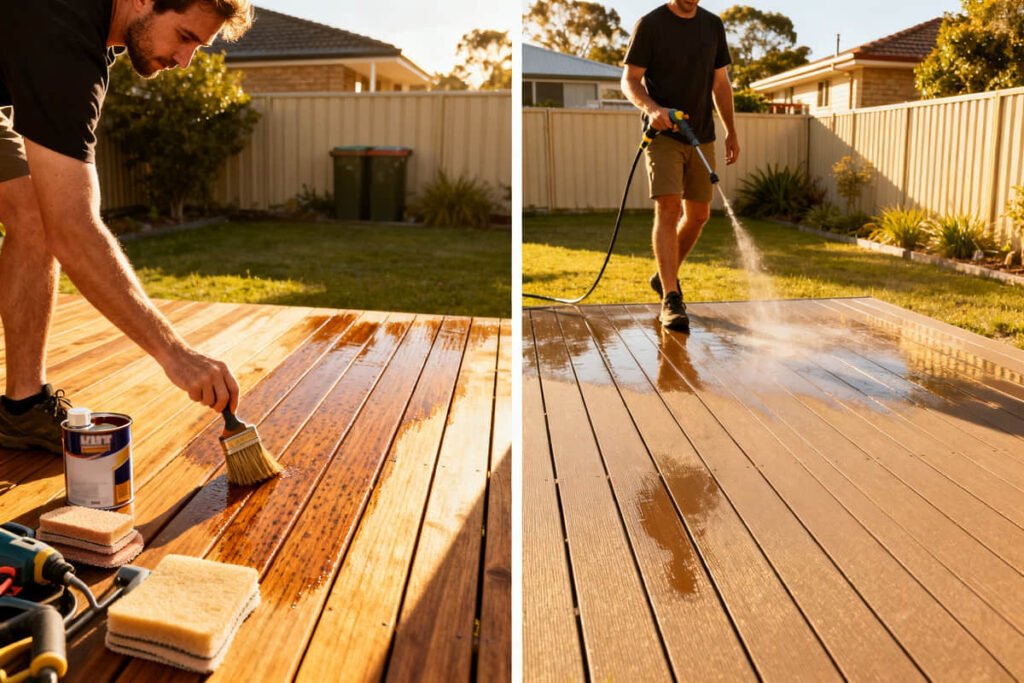
The annual cycle: sweep and clean, sand any raised grain, then apply a quality decking oil in 1–2 coats. In coastal Queensland and northern NSW, that cycle runs more often — strong UV and salt air strip oil faster. Industry estimates put hardwood deck upkeep at 16–32 hours per year for a mid-sized deck.
Composite care is different. Wash it down 2–4 times a year with soapy water. No oiling, no staining, no sanding, no re-coating. For builders handing over a multi-unit project, that’s a meaningful point of difference at handover.
Durability in Australian Conditions
Both materials are durable. But the conditions attached to that durability are very different.
Spotted gum’s toughness is real — but it depends on maintenance. Keep it oiled and protected, and it holds up well. Let upkeep slip, and moisture works into the grain. Surface checking and discolouration follow.
Composite durability is built in. It doesn’t depend on the owner doing anything. LastElegance boards absorb just 0.2% water by weight (ASTM D1037). That’s close to inert. In coastal and subtropical zones, that matters.
Performance Under Heavy Foot Traffic
Spotted gum’s 11.0 kN Janka rating gives it a real edge here. It resists dents and deep scratches better than any engineered board. For commercial boardwalks, high-traffic public spaces, or decks where heavy furniture gets dragged around regularly, that hardness counts.
Composite decking boards — tested at 26.2 MPa flexural strength (EN 15534) — hold up well under normal foot traffic and most commercial use. Deep gouges from sharp impacts are more likely on composite than on spotted gum. That’s an honest trade-off worth raising at the specification stage.
Termites, Lyctus Beetles, and Pest Resistance
Spotted gum is Durability Class 1 for termite resistance — the top rating. But it’s susceptible to lyctus beetles, also called powderpost beetles. These wood-boring insects work through hardwood from the inside, often without visible surface damage until the problem is advanced. In Queensland and northern NSW, lyctus is active and worth taking seriously at the spec stage.
Composite has no biological material in its outer cap layer. There’s nothing for termites or lyctus to consume. It’s fully resistant to both.
For builds in pest-active regions, this is worth raising with the client before the material is locked in.
Appearance: Can Composite Match the Look?
Freshly oiled spotted gum is one of the best-looking decking materials you can buy. The colour range — pale honey to warm chocolate — combined with wavy interlocked grain and distinctive darker flecks, gives each board real character. No composite fully replicates that.
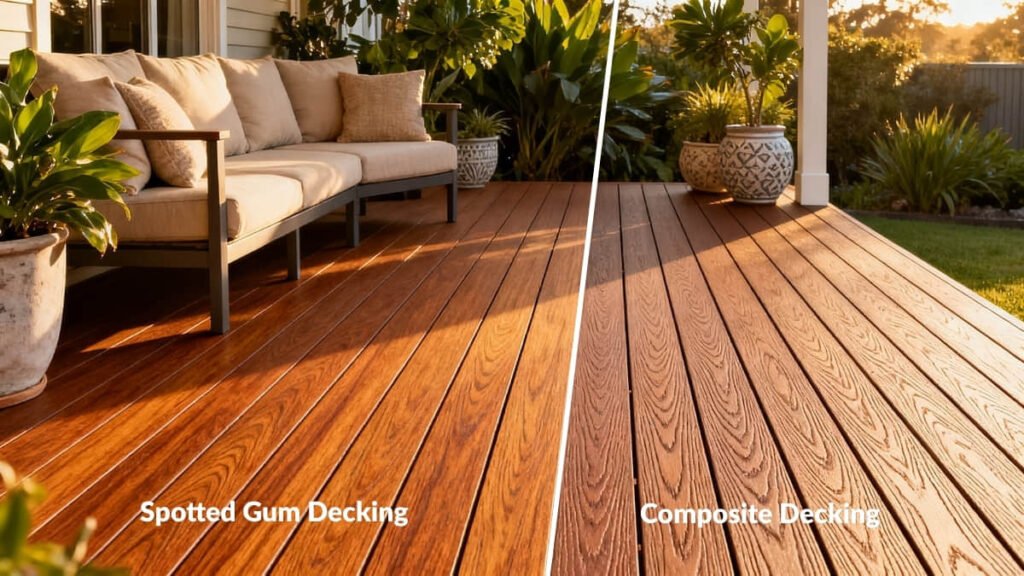
The qualifier: spotted gum only looks that way when freshly maintained. Skip a year of oiling, and it greys. The natural beauty that won the client over at the showroom starts to fade — and so does their satisfaction.
Modern capped composite has closed the visual gap more than most people expect. Multi-tonal colour blending, embossed grain textures, and warm spotted gum–tone colourways mean many buyers, when they hold samples at arm’s length, find the difference smaller than they thought. The colour isn’t grey. It doesn’t need oiling. What you specify is what it looks like in five years.
Is There a Composite Spotted Gum Finish?
Yes. Composite is available in warm honey and light brown colourways with embossed grain textures that reference the look of spotted gum timber. Look for multi-tonal boards with colour variation across the face — not a flat single colour. That’s what makes them read as timber at normal viewing distance.
No composite is identical to the real thing side by side. But viewed from a natural deck distance, most buyers find the resemblance close. After 3,000 hours of QUV accelerated ageing, LastElegance boards hold colour to ΔE ≤ 4–5. The tone you specify holds — no oiling cycle needed.
Request free samples to compare →
Safety — Slip, Splinters, and Fire Ratings
Three safety factors matter most for Australian buyers: slip resistance, splinters, and BAL fire ratings.
Slip resistance: LastElegance composite boards carry an R11 rating under AS/NZS 4586 — wet or dry. Spotted gum’s slip resistance changes as surface oil wears. In commercial and pool settings, a consistent R11 is easier to specify and defend.
Splinters: Composite doesn’t splinter. Spotted gum can, especially as it dries and the surface grain raises. For barefoot areas, family homes, or builds with public liability exposure, splinter-free is worth specifying.
Fire ratings: Spotted gum achieves BAL-29 at 18 mm+ board thickness. LastElegance composite boards are tested to ASTM E84, with a Flame Spread Index of 85 and Smoke Developed Index of 300. These are different standards measuring different things — ASTM E84 tests flame spread and smoke, not bushfire zone exposure. For bushfire-zone projects, contact our sales team to confirm BAL certification for the specific product you’re specifying.
Which Is Better Around Pools?
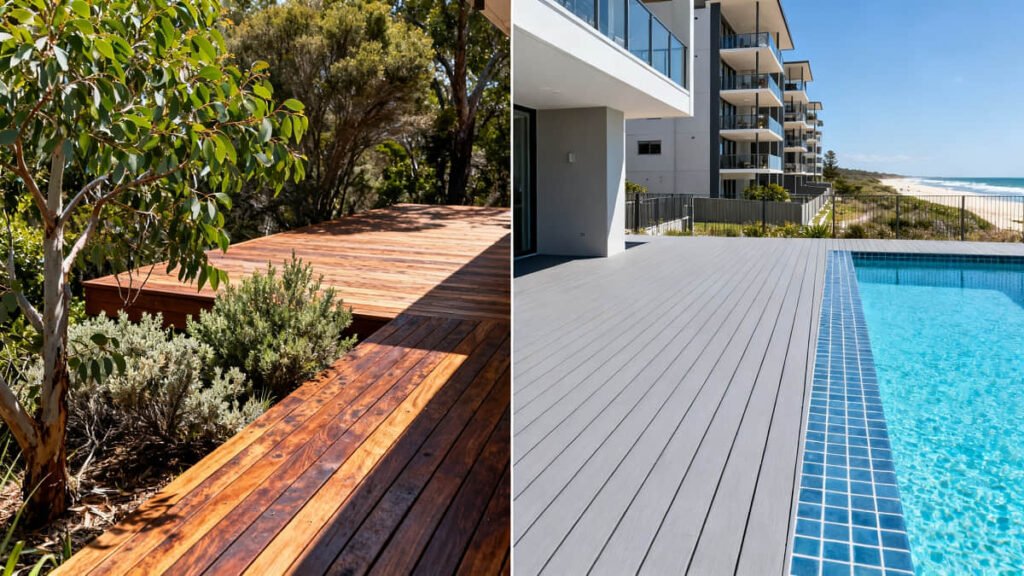
For pool surrounds, composite is the stronger choice. Four reasons:
- Consistent slip resistance — R11 wet or dry, regardless of when it was last oiled
- No tannin bleeding — spotted gum produces moderate tannin runoff that stains pool coping, light-coloured pavers, and rendered walls
- No splinters — important for bare feet on wet decking
- No gum vein weeping — some spotted gum boards weep gum residue near water, especially in the first season
Spotted gum works around pools. But it demands diligent upkeep and careful hardscape management in the first 12 months.
Environmental Impact: The Honest Picture
Neither material is the clear environmental winner. Both have real credentials.
Spotted gum is Australian-grown. When sourced from managed forests, it has a shorter supply chain than most imported timbers. FSC-certified spotted gum is available for projects where certified sourcing is a hard requirement.
Composite uses recycled wood fibre and recycled HDPE — 60% recycled content — diverting waste from landfill and cutting demand for virgin timber. It also produces zero chemical runoff over its life. No oils, stains, or sealers enter the environment.
A deck replaced twice over 25 years uses roughly twice the raw material. One that lasts the distance uses half. That’s a real sustainability advantage.
LastElegance holds CE, ISO, and RoHS certifications. SGS-tested formaldehyde emissions are not detected (EN 717-1).
What Trade Buyers Should Know
This section is for procurement managers, building material distributors, and builders placing volume orders.
Supply reliability: LastElegance is factory-direct. There are no importers or resellers between production and the trade buyer. That means consistent stock, scalable order quantities, and direct access to the factory for custom specs.
Lead times: For a 40-foot container, expect roughly 20 days production, 2 days packing, and 24–32 days sea freight to Australia. For a 20-foot container, production is around 15 days.
MOQ and customisation: The minimum order is 100 m². Custom lengths, colours, surface textures, and OEM packaging are available directly from the factory. No reseller needed to access custom specifications.
Pricing: Factory-direct means no importer margin and no reseller margin. For trade buyers ordering at volume, that difference is real — and passed directly through to project pricing.
Warranty: 15 years, applies under correct installation and normal use.
Contact our sales team or enquire about distribution →
Which Option Fits Your Project?
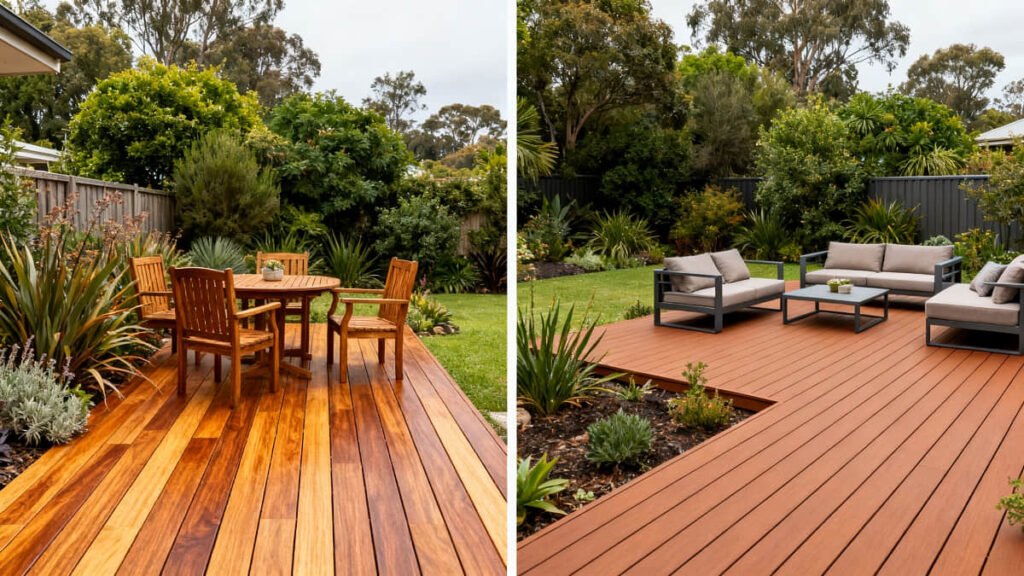
Choose composite if:
- Maintenance freedom matters to the owner, body corporate, or site manager
- The project is near a pool or in a coastal saltwater environment
- You’re specifying for multi-unit residential, where post-handover upkeep is a concern
- Long-term cost is weighted more heavily than upfront material aesthetics
- The project is in a high-UV or high-humidity zone — Queensland, northern NSW coast
- You need a consistent slip resistance certification for a commercial build
Choose spotted gum if:
- The client values authentic natural timber and commits to annual maintenance
- Maximum hardness is required — commercial boardwalks, very high-traffic public areas
- Local Australian sourcing and a shorter supply chain are genuine project requirements
- FSC-certified Australian hardwood is specified
Spotted gum remains an excellent decking material. For clients who value it and will maintain it, it earns its place. For most other projects — especially those with pool proximity, low-maintenance needs, or long-term cost sensitivity — composite is the stronger specification.
Before committing either way, get samples of both in hand. Colours on a screen never tell the full story.
FAQ
Does spotted gum decking go grey?
Yes — without annual oiling, spotted gum turns silver-grey within months. UV exposure at the surface drives the colour change. Regular oiling restores the original tone, but the cycle is ongoing for the life of the deck.
Is composite decking as hard as spotted gum?
No. Spotted gum has a Janka hardness of 11.0 kN, among the highest of any Australian decking timber. Composite is engineered and doesn’t use the Janka scale, but it passes flexural strength testing at 26.2 MPa (EN 15534). For very heavy impact loads, spotted gum’s hardness gives it an edge.
Does spotted gum stain concrete or pavers?
Yes — spotted gum produces moderate tannin bleeding, especially in the first 6–12 months. The reddish-brown runoff stains concrete, pavers, and rendered walls after rain. It’s less severe than merbau but worth planning around if surrounding hardscaping is light-coloured.
Are there environmental benefits to choosing composite?
Composite uses recycled wood fibre and recycled HDPE — about 60% recycled content — diverting waste from landfill and cutting demand for virgin timber. It also produces zero chemical runoff over its life. Spotted gum from managed Australian forests has genuine sustainability credentials too, so neither is a clear winner.
Can I replace spotted gum boards with composite on an existing deck?
Often yes. The existing timber subframe can sometimes be reused if it’s structurally sound and joist spacing meets the composite spec — typically 300–350 mm centre-to-centre for LastElegance boards. A qualified installer should assess the existing structure first. Custom board lengths are available to match existing deck dimensions.
What is the fire rating for composite decking in a BAL zone?
LastElegance composite decking is tested to ASTM E84 — Flame Spread Index 85, Smoke Developed Index 300. Spotted gum achieves BAL-29 at 18 mm+ board thickness. ASTM E84 and BAL ratings test different things and aren’t directly comparable — for bushfire-zone projects, contact our sales team to confirm BAL certification for the specific product before specifying.
