

Australian outdoor spaces used to mean one thing: a deck and a fence. In 2026, they mean a kitchen zone, a fire pit, a feature wall that runs from the facade into the living room — all in one material system.
That shift is reshaping what gets specified. This article covers the five trends driving decking, screening, and cladding specs right now, backed by the weathering data, warranty terms, and install numbers you need for your next quote.
The Outdoor Area Is Now a Room of the House
The biggest outdoor living trend in Australia right now isn’t a product or a colour. It’s an expectation. Homeowners now treat outdoor areas with the same intent as a kitchen or living room — year-round use, considered design, and surfaces that don’t need constant work.
For builders, that expectation carries a direct consequence. The products you specify outdoors now get the same scrutiny as anything inside.
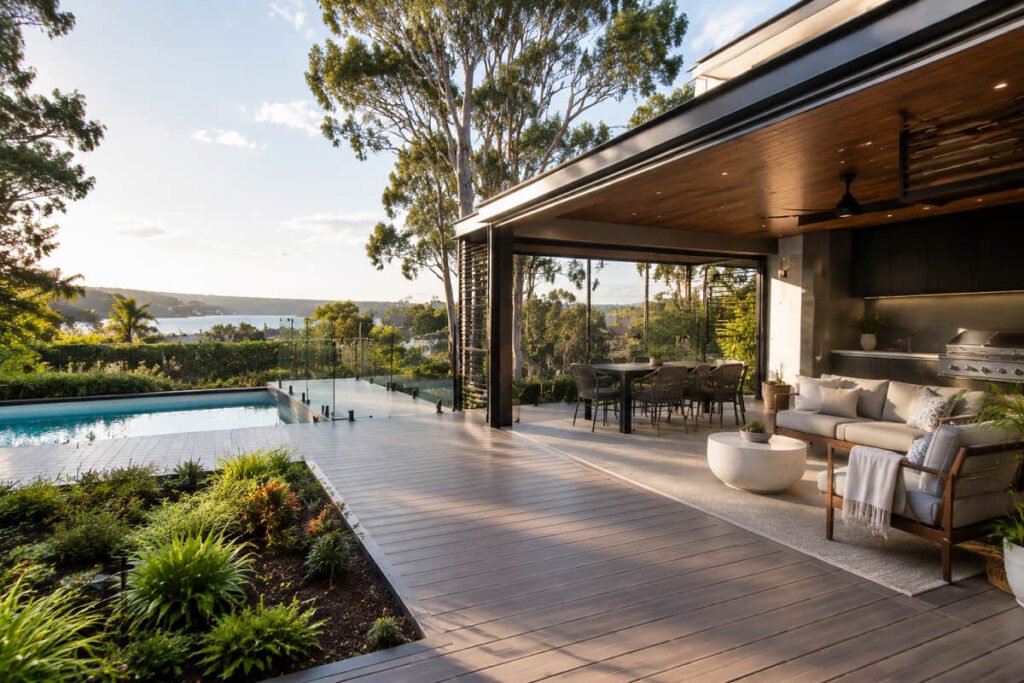
That shift is backed by performance reality. Australia has one of the world’s highest UV indexes. Add coastal humidity across most of eastern Australia, plus termite risk in every state, and the outdoor space faces demands that most materials can’t handle long-term. Material choice outdoors is a structural decision, not a style one.
What is the biggest outdoor living trend in Australia right now? The shift from functional yard to designed outdoor room. Homeowners are specifying distinct zones — cooking, dining, fire, and relaxation — using materials that hold their look for years without repainting or resealing. For builders, this means composite decking, screening, and cladding are moving from optional upgrades to standard specs on most residential and commercial projects.
Multi-Zone Outdoor Spaces Are the New Standard
Single-purpose backyards are out. The current expectation — whether it’s a family home in Brisbane or a development in inner-city Melbourne — is an outdoor area with distinct zones. A kitchen zone. Somewhere to sit. A fire pit area. Increasingly, a quiet wellness corner.
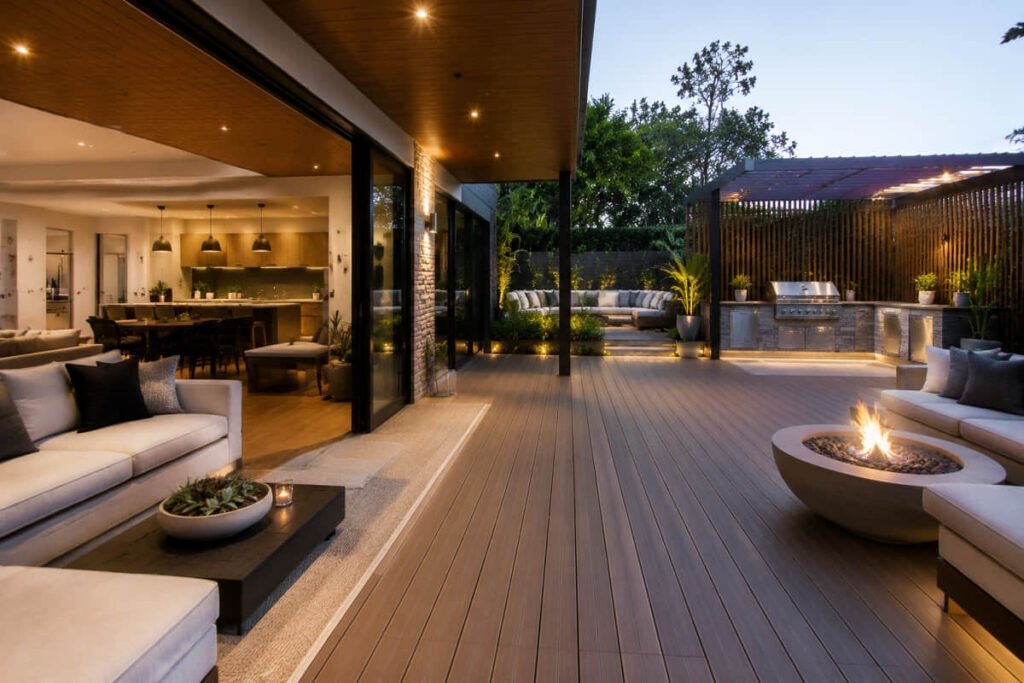
This trend toward multi-zone design is exactly why board specs matter more than ever. A deck that runs across three different zones has to perform consistently in full sun, part shade, and covered areas — all in the one install.
Composite Decking as the Base Layer
The deck holds a multi-zone outdoor space together. It connects the outdoor kitchen to the lounge area, runs around the fire pit, and meets the sliding door back to the house. Composite decking works here because it keeps a consistent finish across zones with very different sun exposure — no warping on the shaded run, no colour drift between the full-sun section and the covered alfresco.
The specs matter for contractors. Board strength is what makes the multi-zone layout possible. Flexural strength tests to 26.2 MPa under the EN 15534 standard — and that number is what supports our recommended joist spacing of 300–350mm across the deck. The hidden fastener system uses stainless steel clips with no surface screws, so large deck areas stay clean-lined and smooth underfoot. On a multi-zone outdoor patio, that finish is what the client notices.
View our full Composite Decking range and profiles
Smart Tech Has a Place in These Zones
App-controlled lighting, retractable awnings, and outdoor audio are turning up on more jobs. But the tech is only as good as the surface it sits on. Composite decking supports concealed cable routing. Composite cladding gives you a flat, stable surface for mounted fixtures. Get the base materials right, and the smart lighting installs faster and lasts longer.
Making Small Outdoor Spaces Work Harder
Compact courtyards and balconies are a growing share of the build mix — especially in inner-city Sydney and Melbourne. Composite decking and vertical screening panels work well in these projects. Wider boards open up the floor plan visually. Screening draws the eye upward and adds a sense of enclosure without boxing the space in. A matched material palette across the deck, fence, and feature wall ties smaller outdoor areas together.
Low-Maintenance Materials Have Taken Over
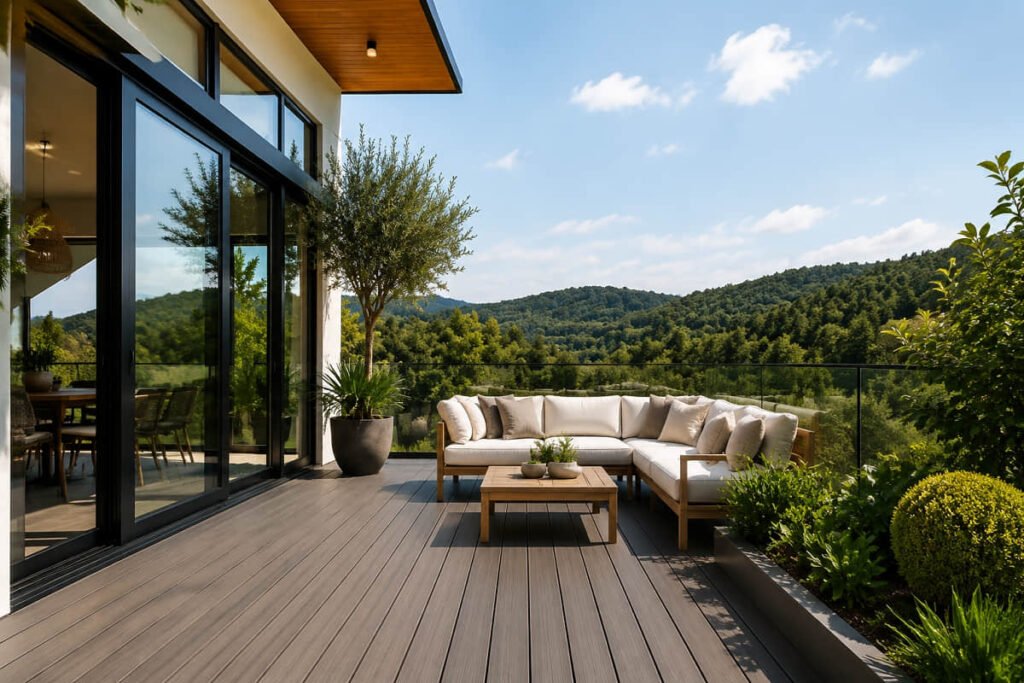
Homeowners have done the maths on treated pine. Two oiling cycles a year. Boards that cup after one hot summer. Replacement in coastal zones every 10–12 years. They’re not interested.
This is the trend reshaping specs across the industry — and for builders and distributors, it’s a direct selling point, but only if the numbers back it up.
| Performance Factor | Composite Decking (Lastelegance) | Treated Pine |
|---|---|---|
| Water absorption | 0.2% (tested to ASTM D1037) | 15–30% typical |
| UV colour stability | ΔE ≤ 4–5 after 3,000hr QUV, per our accelerated weathering test | Fades within 1–2 seasons |
| Sealing required | No | Every 1–2 years |
| Termite resistance | Yes | Chemical treatment only |
| Warranty | Up to 30 years (varies by product line) | Variable, often 5–10 years |
| Certifications | ISO, RoHS, SGS | None standard |
Those numbers turn “low maintenance” from a sales line into something you can put in front of a developer. Early-generation, uncapped composite boards were part of what gave the category a bad name a decade ago — a gap our capped construction is built to close, which is why cap layer thickness is worth asking any supplier to confirm.
What Our Specs Mean for Composite Decking
Our co-extrusion cap layer measures 0.8mm thick — thicker than many comparable products on the market. That cap blocks UV from reaching the wood fibre core and holds colour over time. In our own accelerated weathering test, after 3,000 hours of QUV exposure, the colour difference was controlled to ΔE ≤ 4–5. Boards from a 2021 install and a 2026 install on the same project will look matched.
The R11 slip-resistance rating, tested to the AS/NZS 4586 standard, is now a standard expectation for pool surrounds and wet alfresco zones. That’s not a premium spec — it’s what clients should expect from any board going in around water.
Composite Screening Replacing the Timber Fence
Composite screening panels are one of the fastest-growing specs in the current Australian market. The driver is simple. Timber fencing in our climate needs regular painting or oiling, splits in heat, and generates consistent callbacks from clients. Composite removes that whole category of rework.
Installation is straightforward. Cut boards to length, fix posts, slot in boards, apply trim — two people can complete a standard fence run in a day. The full system includes top and bottom trim strips, angle brackets, clip fasteners, post caps, and post skirts. Post options are aluminium alloy or WPC.
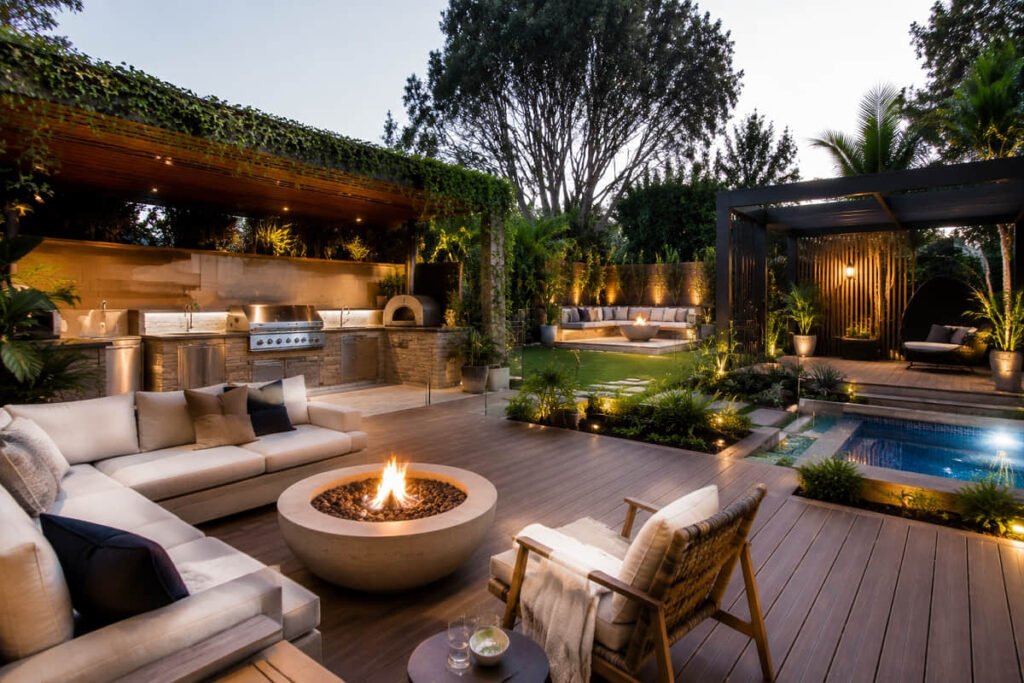
Our recommended post spacing is 0.8m–1.4m, not exceeding 1.6m, based on our own wind load testing. That limit matters on coastal and open sites where wind load is a real performance factor. Profile widths run from 180×20mm for full privacy down to 90×20mm for a more open, design-forward look. Clean lines, natural textures, and three configuration options — closed, semi-open, or open slat.
Explore our Linea and Vista composite screening panels
Composite Cladding on Facades and Feature Walls
Cladding has moved from a specialist finish to a standard spec — on facades, alfresco feature walls, and increasingly interior walls where the same board runs through from outside to inside. The male-female interlocking clip system makes it a fast, clean install for trades. One person can manage the fitting without extra hands.
Profile options include 140×12mm (Oakling) and DecoGroove at 219×26mm and 219×20mm. Our recommended batten spacing is 300–400mm using steel battens. The cladding range shares the same colour palette and surface textures as the decking range — so the same design elements run from the deck up the facade wall without a colour mismatch or profile break.
Colour and Texture Trends for 2026
Earthy tones are leading Australian outdoor palettes this year. Warm charcoals, timber greys, weathered browns, and muted greens. These colours connect the outdoor space to the surrounding environment and tie in with interior finishes. They’re also forgiving in strong sun — neutral tones don’t bleach as visibly as lighter boards.
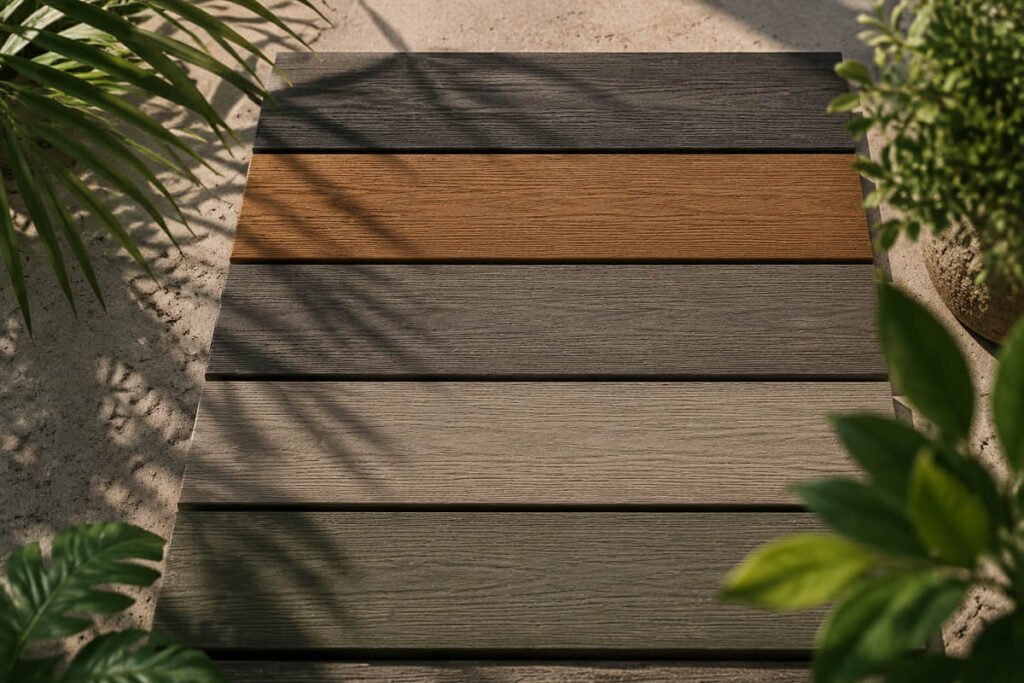
What colours are trending for outdoor areas in Australia in 2026?
- Warm charcoal — the most-specified composite colour right now; clean, contemporary, holds its tone in direct sun
- Timber grey — a weathered natural look without the upkeep of real timber
- Warm brown / cedar tone — popular on family homes and Queensland builds; adds warmth without competing with garden beds
- Muted green / sage — growing fast on alfresco feature walls and garden-facing screening
- Off-white/pale stone — rising on coastal builds as a clean foil to natural textures
Colour retention is where this trend either holds up or falls apart. The weathering data covered earlier is what backs the “holds its colour” claim — and with Australia’s UV index, it’s worth asking any supplier for that number before you spec a product.
Bringing Indoors and Outdoors Together
One of the strongest design threads in 2026 is continuity — the same board profile on the exterior facade continuing as a feature wall in the living room. The same palette across the deck and the internal floor. It’s a design trend, but for builders it’s a specification decision.
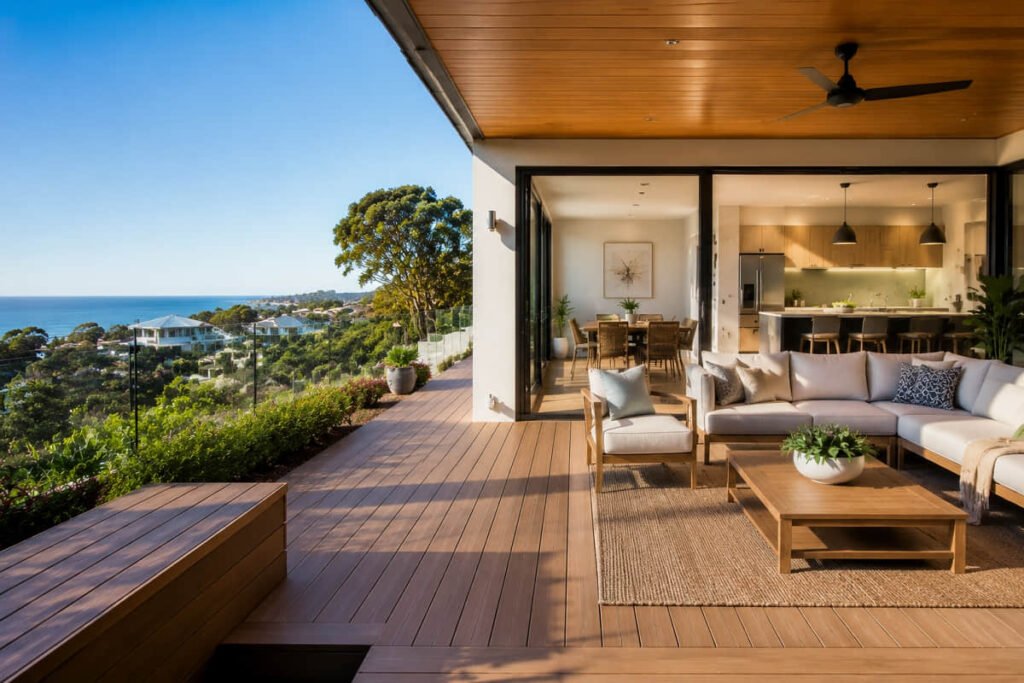
Composite cladding makes this work because it’s one product system, not two. The same profile and colour run from the exterior facade through a glass door to an interior feature wall — no seam, no mismatch, no separate finish to source.
For builders, that means one supplier and one install crew handling both sides of the wall. Lighter, thinner boards than solid timber cladding also make the interior fixing easier, where wall depth is often tighter than it is outside.
Request samples for indoor-outdoor specification
Why Now Is the Right Time to Specify Composite
Demand for low-maintenance, design-forward outdoor materials is accelerating. Clients are arriving at builder and distributor conversations already informed. They’ve seen composite projects, and they’re asking for it by name. Outdoor living trends in 2026 are pointing in one direction.
For trade buyers, specifying composite across decking, screening, and cladding means delivering on every major trend in one consistent material system. One supplier, one colour palette, one install ecosystem.
We supply directly as a manufacturer — no intermediary — so volume buyers get verifiable specs and certifications without an extra cost layer. Our certification stack covers ISO, RoHS, and SGS. Our Warranty terms run up to 30 years, depending on the product line, covering surface cracking, edge warping, breakage, and colour fade. Our MOQ is 100 m², with custom lengths, colours, textures, and packaging to meet project-specific requirements.
Ready to spec composite on your next project? Request a Quote and get pricing built around your exact specs — not a generic price list.
Frequently Asked Questions
What are the most popular outdoor entertaining features right now?
The five most-requested features in 2026 are a composite deck as the base layer, an outdoor kitchen zone, a fire pit area, composite privacy screening, and a feature wall with composite cladding. Most clients want all five linked by a single material palette.
Are there any standout designs for alfresco dining spaces in 2026?
Composite decking and cladding paired together are leading alfresco dining design this year. Boards run from the deck floor up a feature wall behind the dining table, in the same colour and texture. This gives the space a built-in, considered look — without needing a separate finish for the wall.
Is composite decking safe to use around pool areas?
Yes. Our composite decking carries an R11 slip resistance rating under the AS/NZS 4586 standard — the benchmark for wet areas including pool surrounds. In our own testing, water absorption came in at just 0.2% (tested to ASTM D1037), so boards won’t swell or lift in constant wet conditions.
Can composite cladding be used inside the house as well as outside?
Yes. Our cladding is tested to the EN 717-1 standard, with a formaldehyde result of not detected, which makes it suitable for interior wall cladding and ceiling applications. The same board profile runs from an exterior facade through to an interior feature wall in the same install.
What is the minimum order quantity for composite decking and cladding?
Our MOQ is 100m². Custom lengths, colours, surface textures, and packaging are available for project-specific requirements.
How does composite screening compare to Colorbond steel fencing?
Composite screening gives you a natural timber look that steel can’t match, with no painting cycle and far more design flexibility — closed, semi-open, or open slat configurations available. Colorbond wins on upfront cost in budget-only decisions, but composite holds more value over the fence’s full lifespan.
