

Every timber deck that rots or warps early ends up in landfill. Multiply that across thousands of Australian builds each year, and the waste adds up fast.
Composite decking, cladding, and screening take a different path. They’re made from recycled HDPE and wood fibre — materials that would otherwise end up as plastic waste or fresh-cut timber.
This guide breaks down what actually makes composite sustainable. That means the recycled content, the test data behind it, and how it holds up against timber over a building’s full life.
What Are Sustainable Building Materials?
Sustainable building materials are products that reduce environmental impact throughout their entire life cycle — not just at the point of sale. That means recycled content, a long service life, low upkeep, and less waste heading to landfill.
A material earns that label through three things: what it’s made from, how long it lasts, and how much maintenance it needs to keep working. A product that lasts 25 years with no chemical treatment beats one that needs replacing every decade, even if the second one sounds “more natural” on paper.
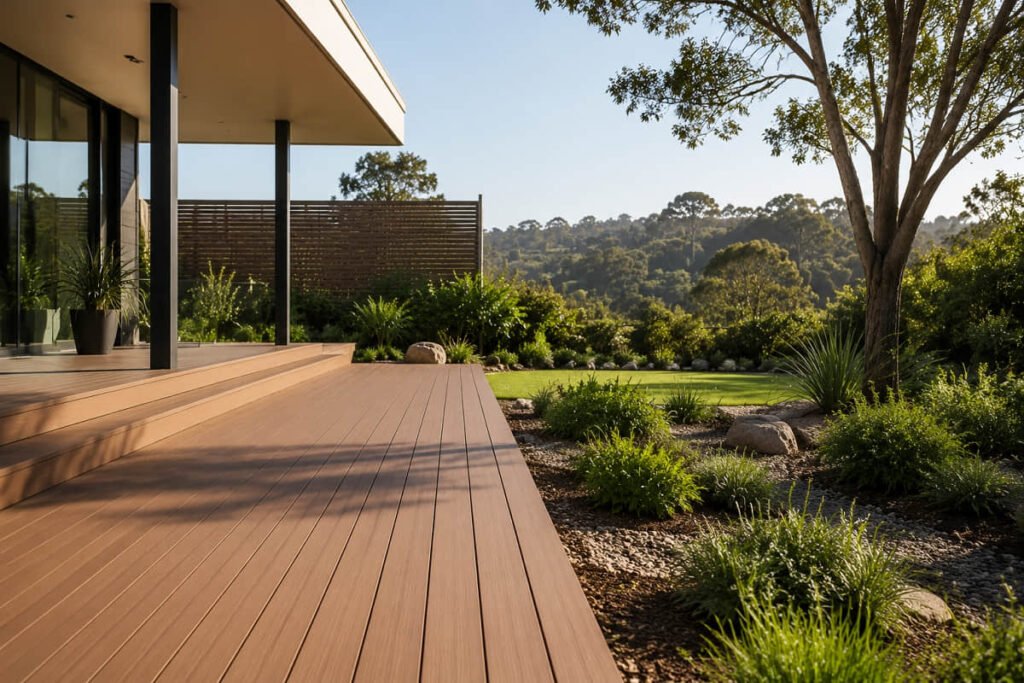
For builders and distributors, sustainable construction now sits on real standards. AS/NZS and ISO/RoHS certifications are the benchmark that separates a genuine sustainability claim from a marketing line. Composite decking, cladding, and screening are built around these principles from the ground up.
Why Composite Materials Are a Sustainable Choice
Composite building materials are made by blending recycled HDPE plastic with wood fibre, then pressing them into boards. At LastElegance, that mix runs 60% recycled content to 40% virgin material — a ratio you can check against any spec sheet we send out.
The wood fibre comes from hardwood sourced in Guangxi, and the HDPE runs at 0.95 g/cm³ density. That’s a mid-to-high density grade, which matters for board strength and how well the material resists moisture over time.
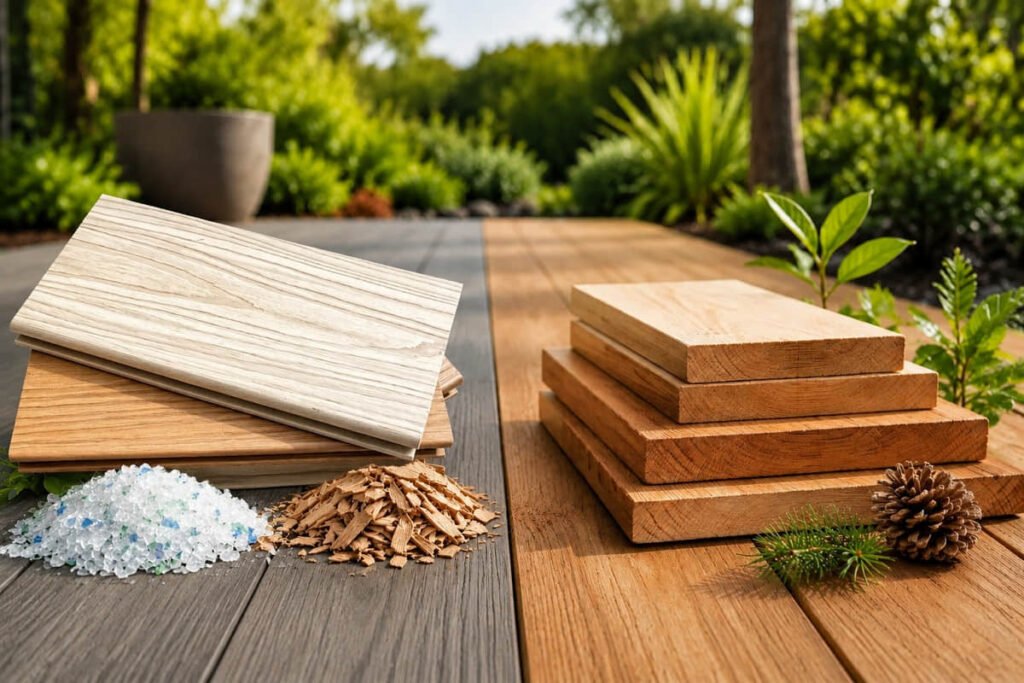
Here’s what that raw material mix actually saves:
- Less new timber harvested — recycled wood fibre replaces fresh-cut hardwood in every board
- Less plastic waste in landfill — recycled HDPE gets a second life instead of sitting in the ground for decades
- Fewer natural resources are drawn down per project — one board does the job that would otherwise need ongoing timber replacement
This is where composite materials pull ahead of most traditional building materials. You’re not choosing between “recycled” and “high-performing” — the recycled content is what makes the product perform.
How Do Composite Products Cut Environmental Impact?
Composite cuts environmental impact across the full life of the product, not just at manufacturing. Three things drive this: less water and pesticide use, no ongoing chemical treatment, and a longer service life.
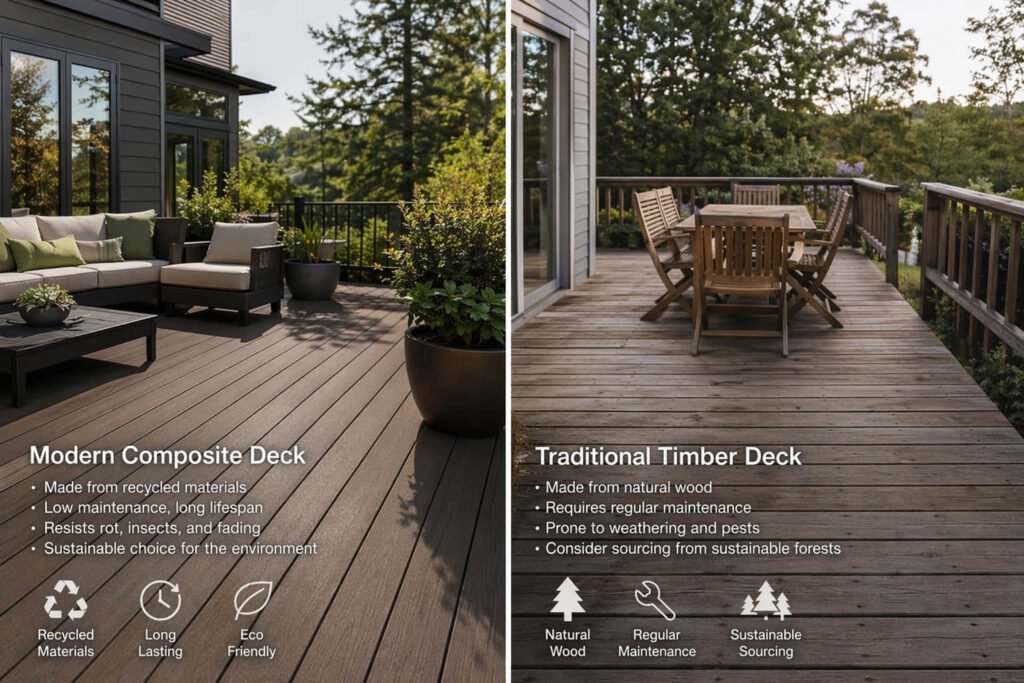
Growing new timber for decking or fencing needs water, pesticides, and years of growth before harvest. Composite skips that step entirely — the wood fibre in each board is already recycled, so there’s no fresh growing cycle behind it.
Timber decking usually needs oiling, staining, or chemical treatment every year or two to fight rot and insects. Composite doesn’t need any of that. No ongoing chemical inputs mean less energy consumption and fewer products going into the ground around your site.
Then there’s lifespan. LastElegance composite decking carries warranties up to 30 years — 15 years for Renew, 20 years for VerdeLife, and 30 years for TimberLuxe — against structural issues like cracking, warping, and excess colour fade. Composite screening carries a 15-year warranty, and composite cladding carries a 20-year warranty. A timber deck replaced twice over 20 years uses roughly double the raw material of one composite installation that lasts the distance.
That’s the real environmental impact story: fewer replacements, less material consumed, and a lower footprint per square metre over the life of a building.
Composite vs Traditional Timber: Which Is More Sustainable?
Both have a case — but composite wins on lifespan, upkeep, and consistency, while FSC-certified timber remains a valid choice if renewable sourcing is your top priority.
Composite doesn’t need oiling, staining, or pest treatment. It resists termites out of the box and holds its colour better in the strong Australian sun. Timber, even treated pine or hardwood like merbau or spotted gum, needs regular maintenance to stay structurally sound and looking good.
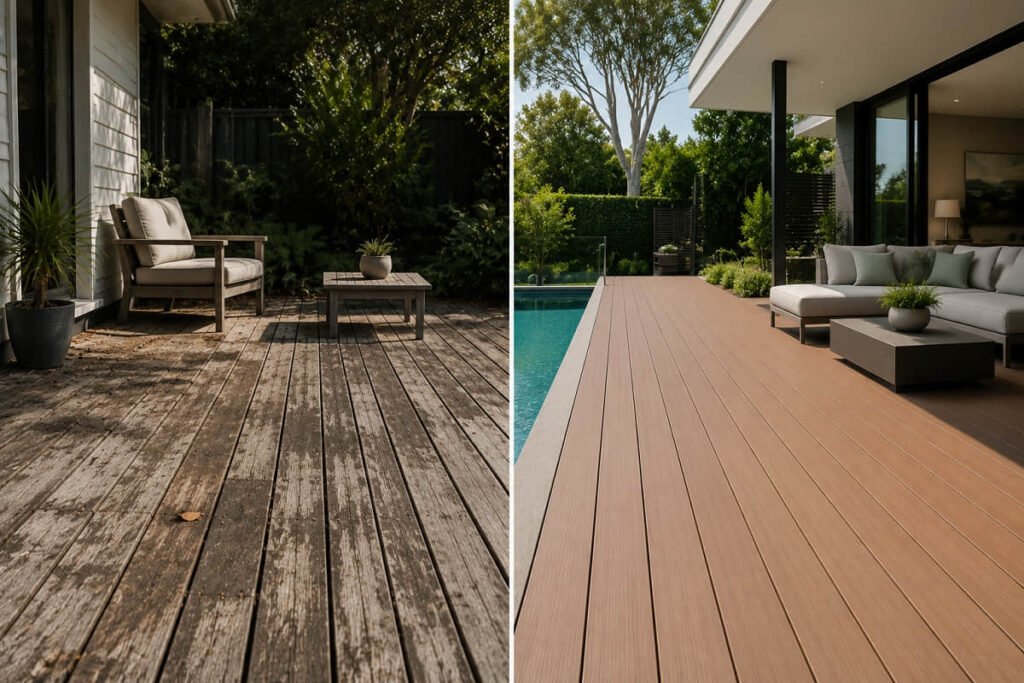
Here’s how the two stack up:
| Factor | Composite | Traditional Timber |
|---|---|---|
| Maintenance | Low — occasional clean, no treatment | High — annual oiling or staining |
| Lifespan | Up to 30 years (varies by range, warranted) | 8–15 years, varies by species and care |
| Pest resistance | Termite-resistant by design | Needs chemical treatment |
| Material source | 60% recycled HDPE + recycled wood fibre | Renewable if FSC-certified, but needs new growth |
| Design flexibility | Custom sizes, colours, textures | Limited to available timber sizes and grades |
| Colour stability | UV-stabilised, ΔE ≤ 4–5 after 3,000hrs QUV testing | Bleaches and greys without regular treatment |
Timber still has strengths worth naming. It’s a genuinely renewable resource when FSC-certified, and some clients want that natural grain look that no composite fully replicates. If a project calls for certified timber, that’s a legitimate sustainable building materials choice too.
But for most trade and commercial builds, composite’s low maintenance and long lifespan make it the stronger pick on total environmental cost.
Not sure which fits your project? Request Free Samples and compare the finish yourself.
Are Composite Products Certified for Australian Standards?
Yes — LastElegance composite products are tested against fire, slip resistance, water absorption, and UV standards relevant to Australian conditions.
Here’s what the certifications actually mean for your project, not just the code names:
| Test | Result | What it means for you |
|---|---|---|
| Fire resistance (ASTM E84) | Flame Spread Index: 85; Smoke Developed Index: 300 | Standard performance for fire-rated zones |
| Slip resistance (AS 4586 / DIN 51130) | R11 | Safe for pool decks and wet-area installs |
| Water absorption (ASTM D1037) | 0.2% | Boards resist swelling and rot from moisture |
| General certification | ISO, RoHS, SGS | Verified against international manufacturing and safety benchmarks |
These numbers sit at standard industry benchmarks across the board — nothing inflated, nothing understated. That’s the point. A buyer checking structural integrity or maintenance requirements against a spec sheet should see numbers that match independent test reports, not just a sales claim.
Does Buying Direct From the Manufacturer Support Sustainability?
Yes. Buying straight from the manufacturer cuts out extra freight legs, middleman markups, and the waste that comes from over-ordering to hit a distributor’s minimum.
LastElegance is a manufacturer, not a reseller — we make our own composite decking, cladding, and screening in-house. That means we control the specs, the recycled content ratio, and the batch consistency from raw material to finished board. It also means fewer supply chain steps between production and your site.
One practical example: custom lengths. Because we manufacture in-house, we can cut boards to the length your project actually needs. That cuts down on offcut waste on site — a real saving for construction industry buyers running tight material budgets.
For distributors and volume buyers, that same in-house control supports consistent supply without the stock gaps that come from relying on a middleman’s inventory. Sustainable construction practices aren’t just about the material — they’re about how much of it ends up wasted before it’s even installed.
Interested in a direct supply relationship? Become a Distributor and see how our manufacturing model works for your business.
Where Are Composite Materials Used in Construction?
Composite decking, cladding, and screening cover most outdoor building applications where timber traditionally struggled with weather and upkeep.
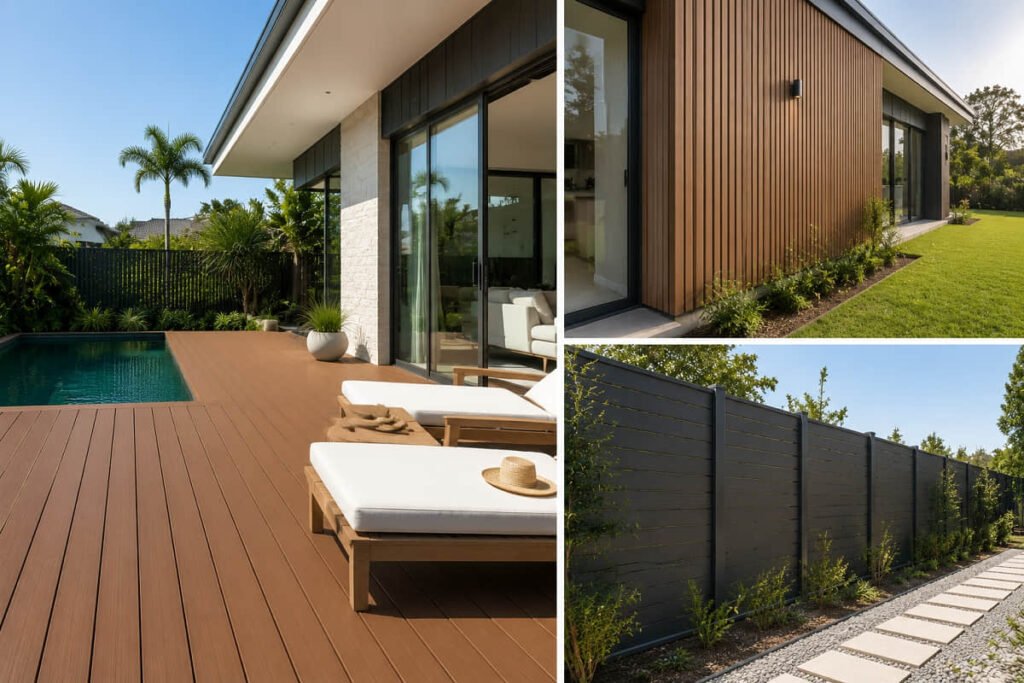
- Decking — pool surrounds, alfresco areas, and commercial walkways. Recommended joist spacing sits at 300–350mm for full support.
- Cladding — exterior facades and interior feature walls, using a male-female interlocking clip system for a clean, fast install.
- Screening — privacy fencing, pool safety barriers, and decorative panels. Recommended post spacing runs 0.8m to 1.4m, and shouldn’t exceed 1.6m for wind resistance.
Pool areas are a common thread across all three. Our decking carries an R11 slip rating, which meets wet-area rules for pool decks and commercial walkways under AS 4586.
Both residential and commercial projects use all three product lines, often across the same build — matching decking, screening, and cladding in one colour palette for a consistent look.
How Much Do Composite Materials Cost vs Traditional Materials?
Composite costs more upfront than treated pine, but the total cost drops below timber once you factor in a decade or more of upkeep.
| Cost Factor | Composite | Treated Pine |
|---|---|---|
| Upfront material cost | Higher | Lower |
| Annual maintenance | Minimal | Oiling/staining, most years |
| Labour costs over 10 years | Lower — no re-treatment call-outs | Higher — repeat maintenance visits |
| Replacement likelihood (10yr) | Low | Moderate to high |
That upfront gap narrows when you buy direct — no distributor markup added to the base cost. Add a 100m² MOQ and a clear lead time — 15–20 days production plus 24–32 days sea freight for a full container — and trade buyers get steady pricing without the guesswork.
Over 10+ years, low maintenance is where composite earns back that higher starting price. Fewer call-outs, no re-staining, and a 20-year structural warranty behind it.
Ready to see the numbers for your project? Request a Quote and compare it against your current timber costs.
Frequently Asked Questions
What are some examples of sustainable composite materials?
Composite decking, composite cladding, and composite screening are all made from a blend of recycled HDPE and wood fibre. Each product line uses the same core material — just shaped differently for its application.
What makes eco-friendly composites different from regular composites?
The real difference is the recycled content ratio and certified test results — not the marketing on the box. Look for a stated recycled content percentage (LastElegance runs 60%) and independent test data like ASTM or AS/NZS certification.
Are sustainable composite materials cost-effective for builders?
Yes, with context — composite costs more upfront than treated pine but far less over 10+ years thanks to low maintenance. Buying manufacturer-direct also helps close that upfront price gap.
How can my company benefit from using composite materials?
Lower maintenance costs, custom sizing that cuts on-site waste, and a 30-year warranty all add up to a stronger long-term value case. For distributors, in-house manufacturing also means more consistent supply and fewer stock gaps.