

A backyard deck should do more than sit there. It should fit how you live — entertaining, lounging by the pool, or hiding from the kids after work.
Too many decks end up as a flat, boring rectangle. And Australian weather doesn’t make it easy — harsh sun, sudden rain, and pool edges that need to stay safe when wet.
Composite gives you more room to design than timber ever did. These 12 ideas solve real backyard problems — sloped blocks, small spaces, pool zones, and more — so your deck looks good and holds up.
1. Multi-Level Deck for Sloped Yards
A sloped or split-level yard doesn’t have to sit unused. A raised deck or multi-level design turns the drop into extra outdoor living space. Think dining up top and a lounge area below, linked by a few steps.
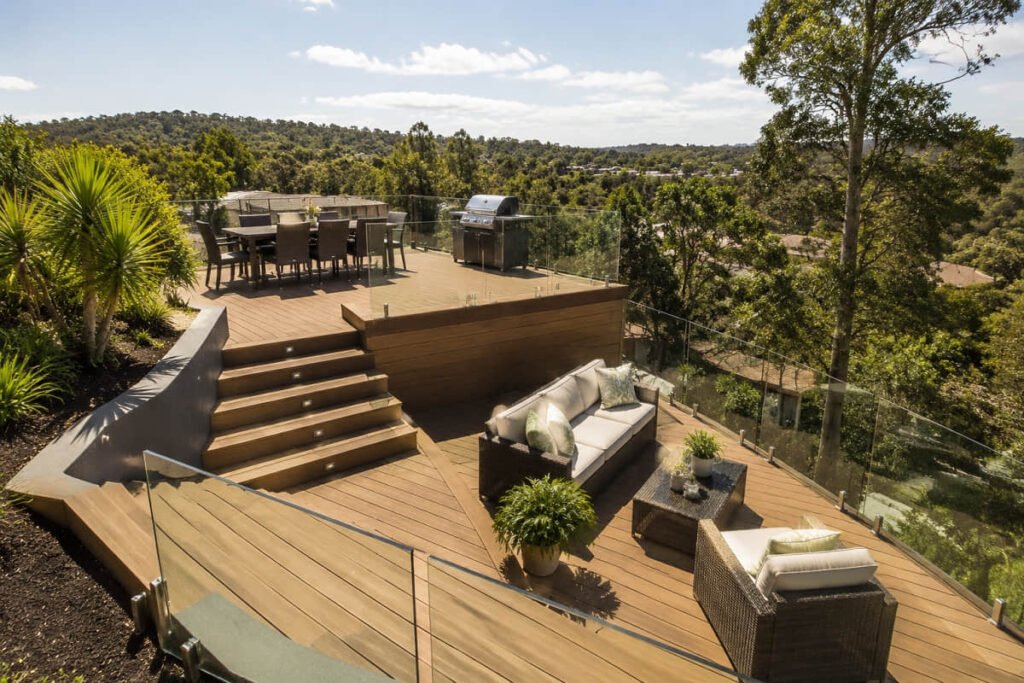
Safety comes first on any raised deck. Get the railing height right. Keep step spacing even, so the deck feels natural to walk, not awkward.
Here’s the part that’s easy to miss: load-bearing matters more on a raised deck than a ground-level one. The boards need the right joist spacing underneath — not just a good-looking surface on top. The same rule applies to a rooftop deck, where wind load adds another factor to plan around.
| Deck Type | Recommended Joist Spacing | Why It Matters |
|---|---|---|
| Ground-level deck | 400–450 mm | Lower load, more flex tolerance |
| Raised or multi-level deck | 300–350 mm | Tighter spacing cuts deflection under load |
| Rooftop deck | 300 mm (confirm with an engineer) | Higher wind and point-load exposure |
LastElegance decking is tested to EN 15534, with a flexural strength of 26.2 MPa. That number carries more weight on a raised deck, where the boards do more structural work.
2. Small Deck Ideas for Tight Spaces
A small deck can still feel generous if the layout earns its space. These deck design ideas work because they fix the footprint problem first — styling comes second.
Built-in bench seating along the edges frees up floor area. Add a table or sun lounges without eating into the yard. Lighter board tones make a tight backyard deck feel more open — dark boards can make a small footprint feel boxed in.
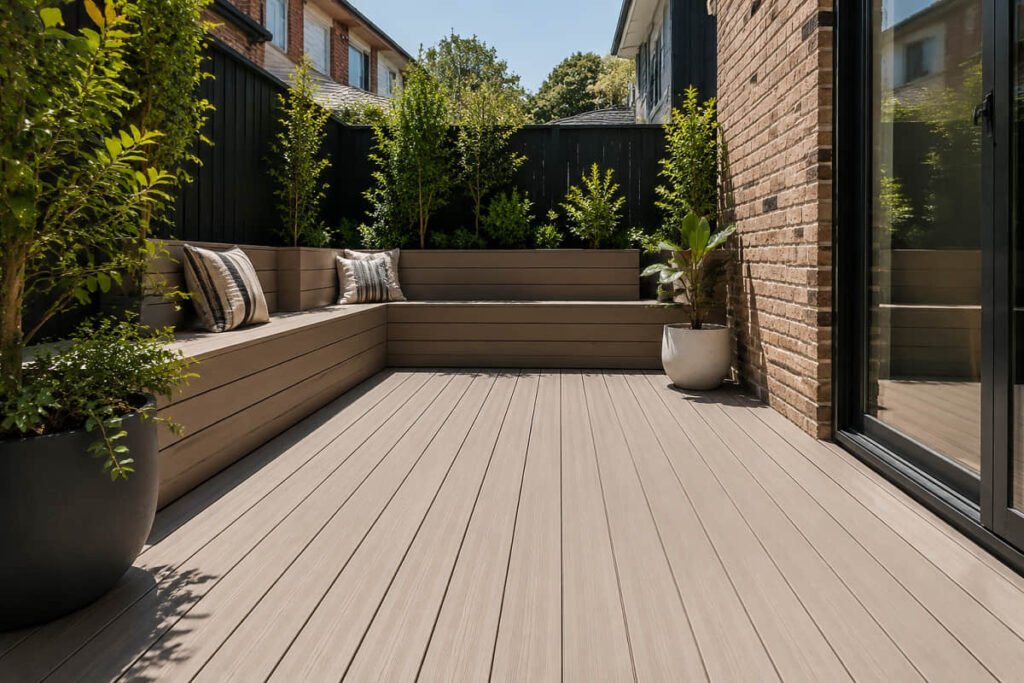
Custom-length boards are one of the best tricks for small or odd-shaped sites. Fewer joins mean less waste, a cleaner finish, and fewer fixing points to plan around.
5 tips for small deck layouts:
- Use built-in bench seating to save floor space.
- Choose lighter board tones to open up the area.
- Run boards toward the main view, not across it.
- Order custom-length boards to cut joins and waste.
- Keep furniture scaled to the deck, not the room it replaced.
3. Anti-Slip Decking for Pool Areas
A pool deck is one of the highest-risk zones in any outdoor space. The slip rating isn’t optional here. Wet feet, sunscreen, and pool chemicals all cut grip. The surface has to perform wet, not just look grippy dry.
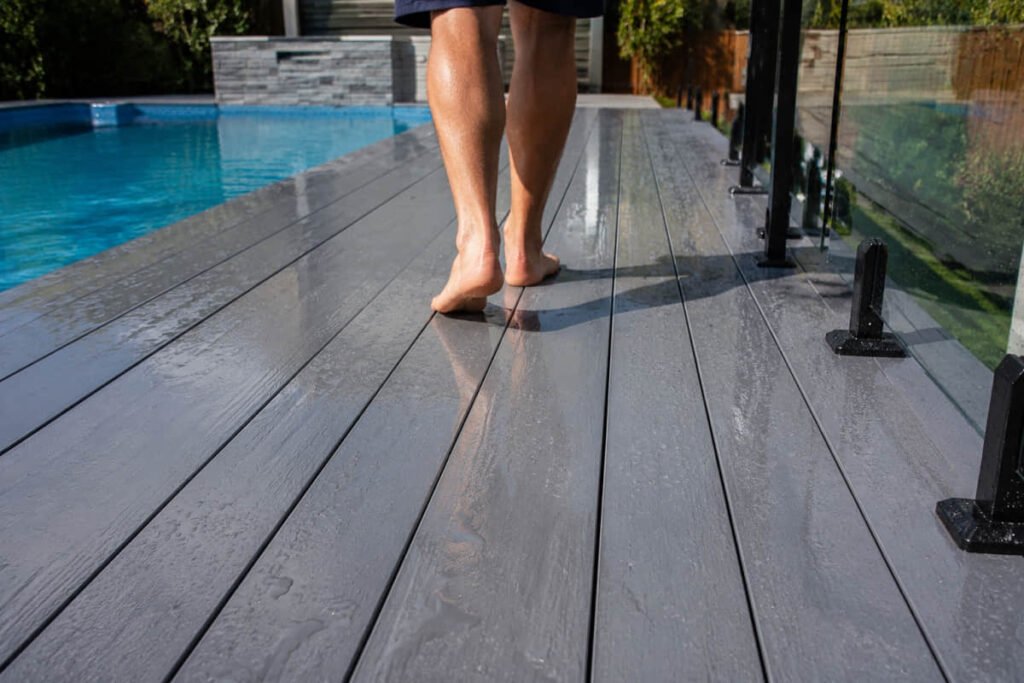
Capped composite holds up better than raw timber or pavers around a pool. The cap layer sheds water fast and stays cooler underfoot in direct sun. Timber can splinter, and pavers can turn slick with algae over time — losing both grip and visual interest.
| Rating | Typical Surface | Suitability for Pool Areas |
|---|---|---|
| R10 | Smooth composite or tile | Lower grip — not ideal for constant wet zones |
| R11 | Textured capped composite | Suited to pool decking and outdoor wet areas |
| R12 | Heavy-grade industrial surfaces | Common in commercial wet-process areas |
LastElegance decking carries an AS 4586 R11 slip rating, with water absorption of just 0.2% under ASTM D1037 testing. Our trade partners on the Gold Coast see the same pattern often. Pool deck call-backs drop once a client switches to a properly rated capped composite board.
Request free samples and test the grip yourself before you specify a board for a wet-area job.
This is the kind of safety data most “deck idea” articles skip. It’s the difference between a deck that looks good in photos and one that’s safe to walk on wet, every day.
4. Outdoor Kitchen and Dining Deck
An outdoor kitchen deck works when the zones are planned, not squeezed in. Give the BBQ at least 900 mm of clearance on each side. Keep the dining area far enough back, so smoke and heat don’t sit over the table.
Composite handles the day-to-day mess of an outdoor kitchen better than raw timber. Oil splatters, wine spills, and hot pans all mark untreated timber. Composite’s cap layer resists staining and heat marks far better.
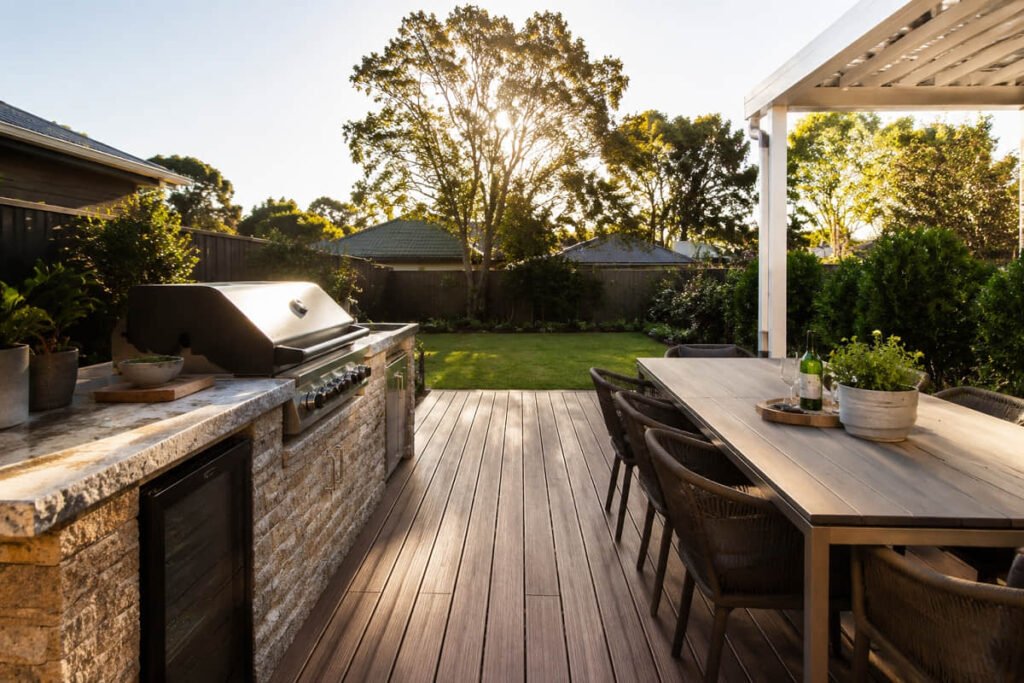
Must-have features for an outdoor kitchen deck zone:
- Heat-resistant board surface near the BBQ and cooktop
- At least 900 mm clearance around appliances
- A separate, levelled space for outdoor dining and outdoor furniture
- Board strength rated for appliance and furniture point loads
- Easy-clean surface for spills and grease
Our cap layer is 0.8 mm thick — thicker than many boards on the market. That’s exactly what an outdoor kitchen deck needs. It’s the layer doing the work every time something hot or oily hits the surface.
5. Fire Pit Deck Safety and Design
Yes, a fire pit can go on composite decking. But the right clearance and a fire-rated zone matter more than the fire pit itself.
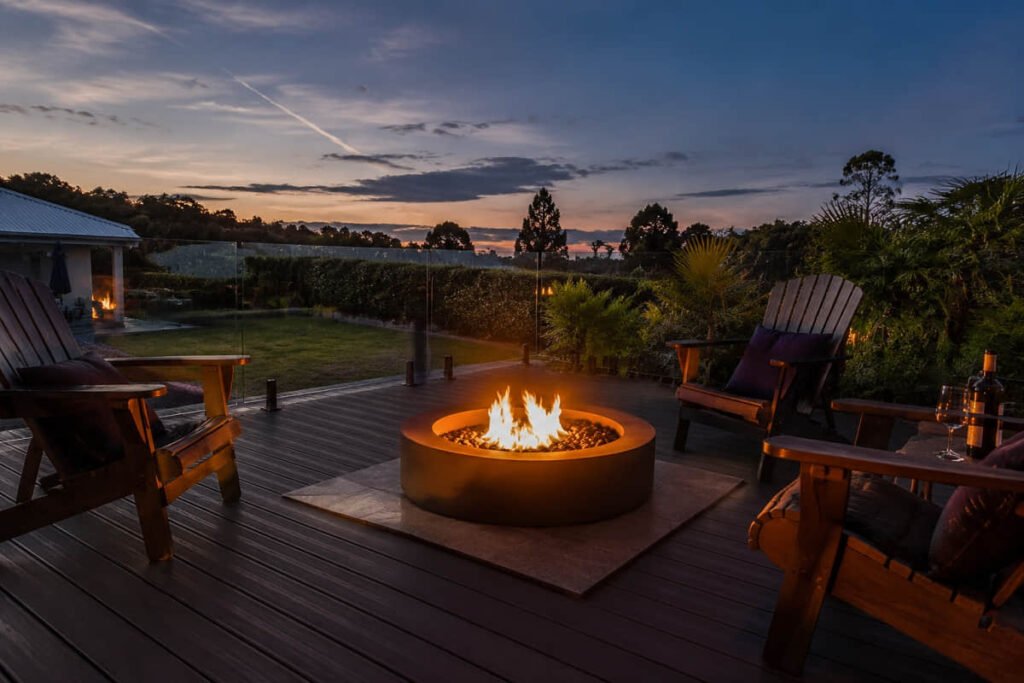
LastElegance composite is tested to ASTM E84, with a Flame Spread Index of 85 and a Smoke Developed Index of 300. That gives you a documented fire performance figure to check against, rather than guessing.
A simple rule of thumb: keep any open flame at least 1 metre from the deck edge. Use a heat-proof pad or fire pit base under the unit, even on a fire-rated board. Composite won’t ignite from radiant heat the way raw timber can, but direct flame contact will still damage any surface.
A fire pit is one of the easiest ways to extend outdoor living into the cooler months. It turns a deck into a genuine backyard retreat, instead of a fair-weather space.
6. Low-Maintenance Deck Design Ideas
Low-maintenance, in practice, means no oiling, no sanding, and no re-staining — ever. Composite doesn’t need the yearly upkeep cycle that timber decks demand to stay safe and good-looking.
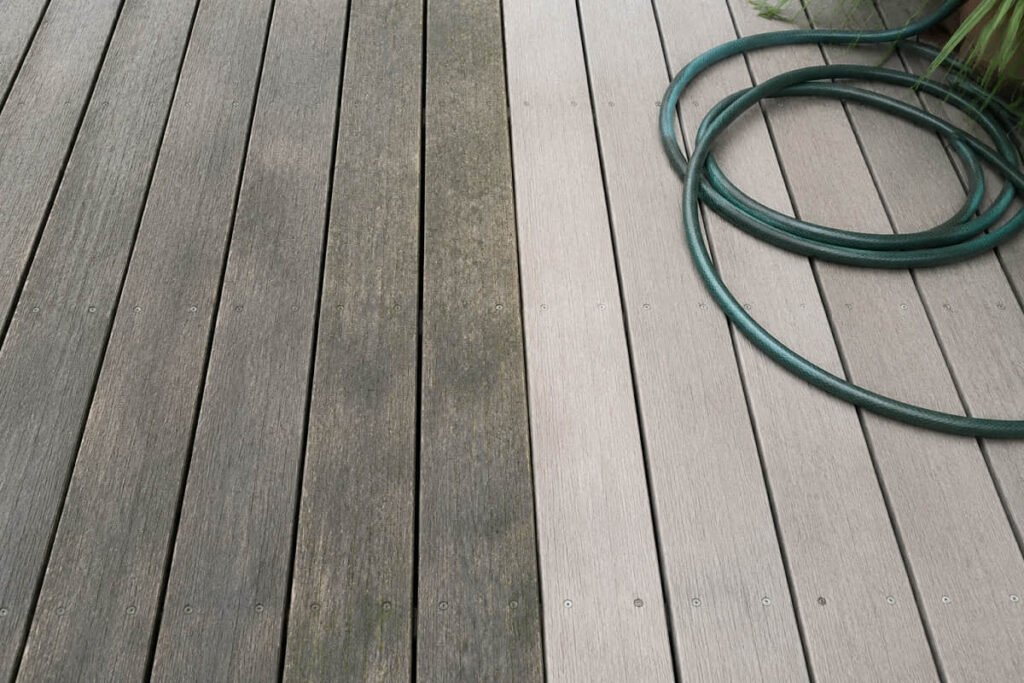
Termite resistance is the other half of the equation. Composite’s HDPE and wood-fibre blend doesn’t give termites the food source raw timber does. That matters almost anywhere in Australia.
Timber upkeep vs. composite upkeep:
| Task | Timber Decking | Composite Decking |
|---|---|---|
| Annual oiling or staining | Required | Not required |
| Sanding splinters or rough boards | Periodic | Not required |
| Termite treatment | Often required | Not required |
| Re-painting faded boards | Every few years | Not required |
| Pressure washing | Recommended | Recommended |
A LastElegance deck carries a warranty of 15 to 30 years, depending on the product series. It covers surface cracking, edge warping, breakage, and colour fade beyond the agreed range. Our distributors tell us this is the single biggest reason trade clients switch from timber on repeat projects.
There’s a trade-off worth naming: timber has a warmth composite can’t copy fresh out of the box. But composite holds that natural beauty far longer, without the upkeep bill attached. That’s a great way to get a timber-look deck that doesn’t ask for a weekend every spring. Warranty terms and board grades are worth comparing closely before you commit to a low-maintenance deck design.
7. Covered Deck Ideas for All Weather
Yes, a covered deck still needs UV-stable boards. Shade cuts direct sun, but it doesn’t stop the temperature swings or reflected UV. Both still fade and stress a deck surface over a full year.
A pergola, roof, or shade sail extends a covered deck’s use across the seasons. You get shelter from rain and harsh sun, without losing the outdoor feel that makes a deck worth building.
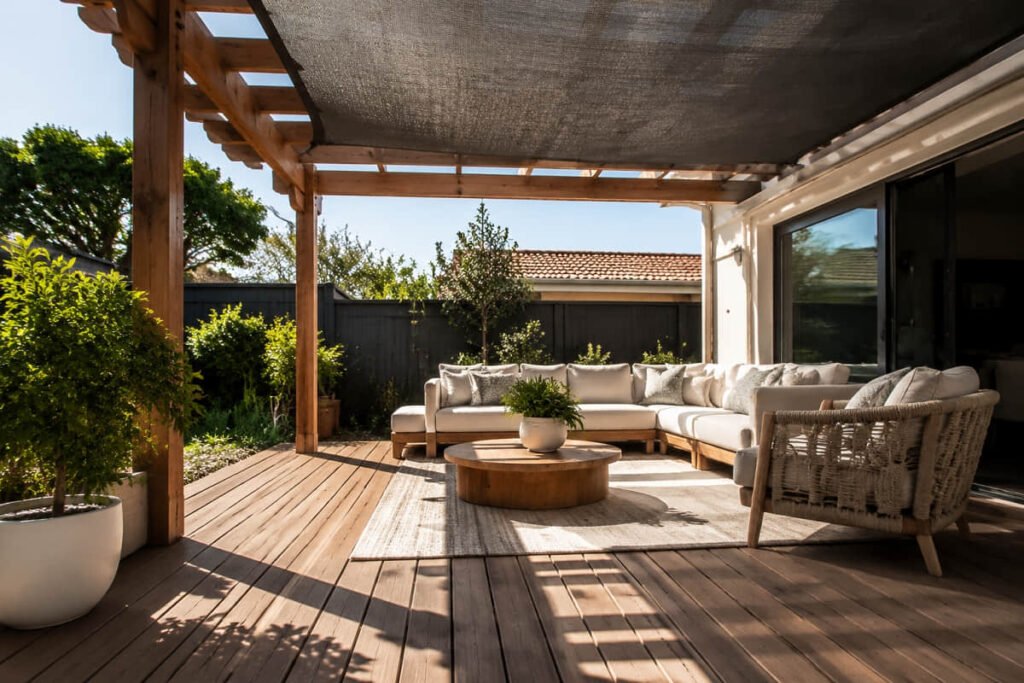
LastElegance boards use a combined HALS and UV absorber stabiliser system. After 3,000 hours of accelerated UV testing, colour fade is held to a ΔE of 4–5 or less, depending on the colour. That number matters just as much under a roof as it does in full sun. Shaded boards still face daily heat and light cycles.
A well-built covered deck adds one of the most flexible outdoor living spaces to any backyard. It’s useable in light rain, full sun, or a cool evening with the right lighting.
8. Deck and Privacy Screen Combos
Pairing a deck with matching composite screening solves privacy without blocking light or airflow the way a solid fence does. You get a private outdoor living area that still feels open.
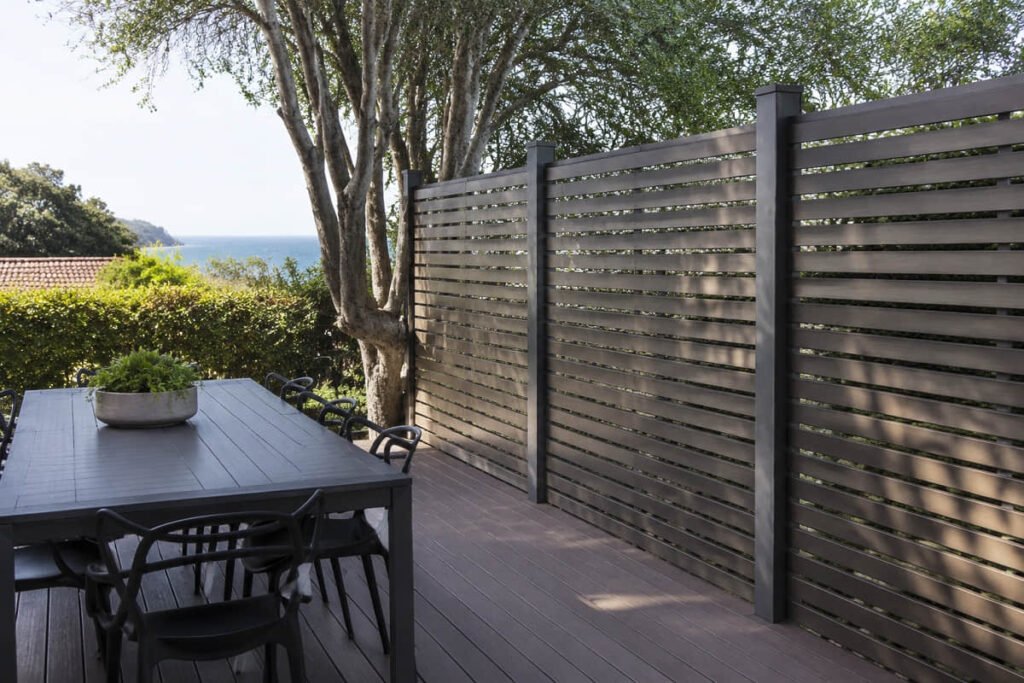
The system is simple: boards, posts, top caps, and trims. Posts come in aluminium alloy or WPC. The whole system slots or clips together, so it’s no harder to plan than the deck itself.
Components of a deck + screen system:
- Composite screening boards
- Aluminium or WPC posts
- Post caps and post skirts
- Top and bottom trim strips
- Spaced clip fasteners and angle brackets
Wind load is one factor that a lot of people miss with screening. We recommend post spacing of 0.8 m to 1.4 m, and never more than 1.6 m. That keeps a screen standing through a coastal wind event.
Matching the deck and screen colour ties the whole backyard together. It’s straightforward, since both ranges share the same colour palette. That visual interest comes from consistency, not contrast.
This deck space combo is one of the most requested builds from our trade partners doing backyard renovations near the coast.
9. Custom Colours and Textures for Decks
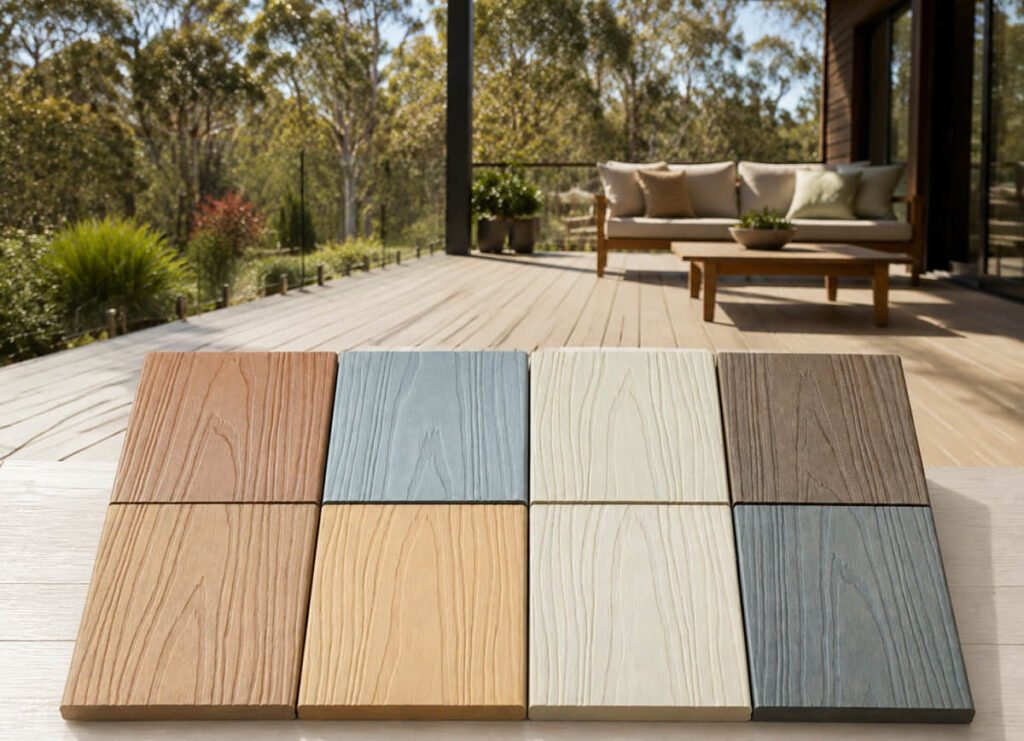
Composite isn’t a one-look material. Boards come in different colours, textures, and grades. That means you can match a deck to a home’s exterior, instead of working around whatever’s in stock.
Because we manufacture our own boards in-house, custom colour and texture runs are available for larger trade orders. That goes beyond the standard catalogue range. It’s a level of customisation a reseller can’t offer, since they’re not the ones making the board.
| Customisation Option | Standard Range | Custom Trade Orders |
|---|---|---|
| Size | Fixed lengths | Custom lengths available |
| Colour | Catalogue colours | Custom colour matching |
| Texture | Standard grooved or smooth | Custom surface textures |
| Grade | Standard grade | Project-specific grades |
| Material or shape | Standard profiles | Custom moulds available |
Sampling is worth the short wait. We’ve tested over 200 colour samples in real Australian conditions. We’d recommend the same step before any large trade order — confirm the colour and texture in person, not just on a screen.
A custom-matched deck gives a home a personalised look that a stock colour can’t match. It still keeps the natural beauty and modern look composite is known for.
Enquire about custom manufacturing if you’re speccing a trade-volume project that needs a colour run outside our standard catalogue.
10. Herringbone and Chevron Deck Patterns
An angled board layout is one of the easiest ways to add visual interest and a modern look. You don’t have to change materials at all. Herringbone and chevron patterns turn a standard deck into a feature, just by changing the direction of the boards.
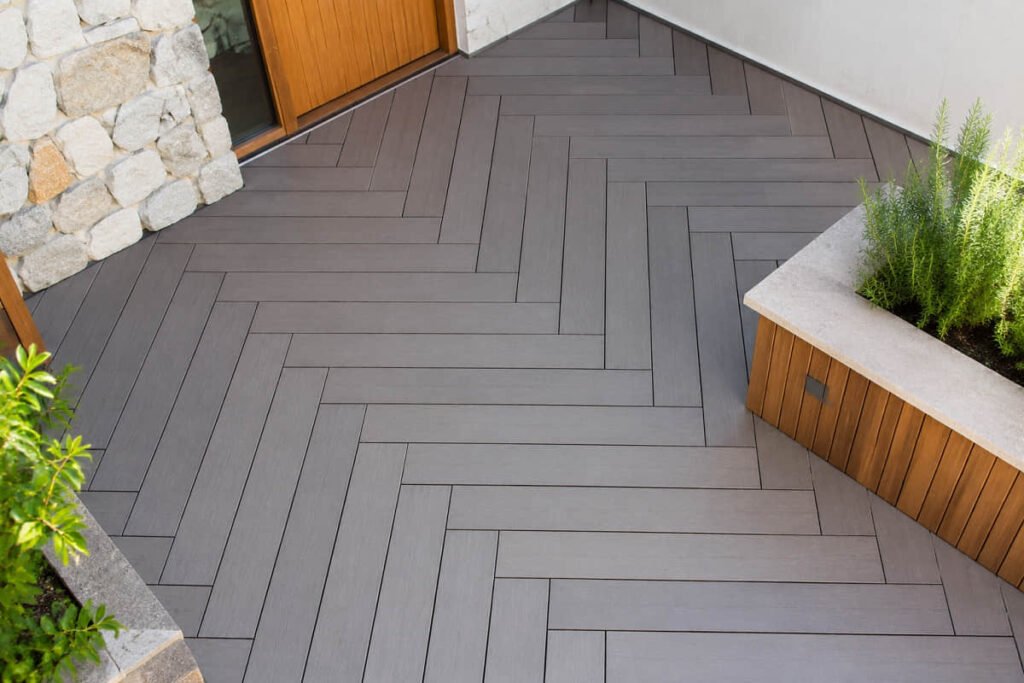
Popular deck board layout patterns:
- Straight lay — the standard, fastest, and most budget-friendly layout
- Herringbone — angled boards crossing at 90°, a strong choice for entry decks and feature zones
- Chevron — angled boards meeting at a point, ideal for a clear sightline or focal area
- Diagonal — boards run at 45° across the whole deck for a simple visual lift
Pattern layouts need more planning around board length and fixing points than a straight lay. It’s worth talking to your supplier or installer before you order, so the cut lengths match the pattern from the start.
Custom board length options cut down on offcuts and joins in angled layouts. That matters more here than in any other deck design. Every angled cut either uses an offcut well, or wastes it.
11. Deck Lighting for Night Entertaining
Good deck lighting changes how a backyard deck gets used after dark. It turns a daytime feature into a space for proper night entertaining.
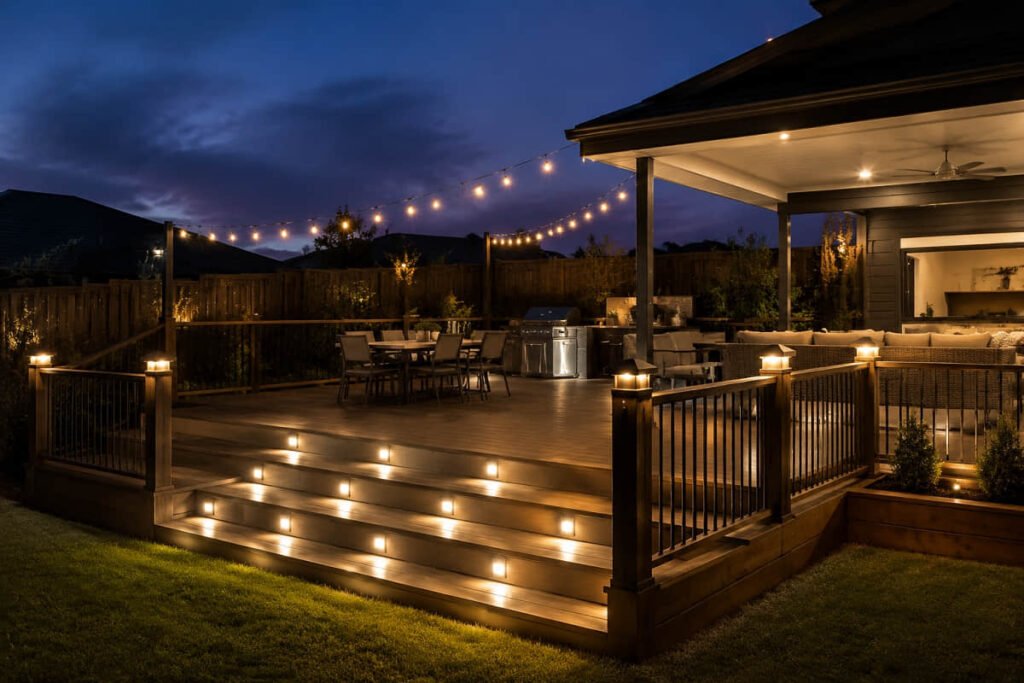
5 places to add deck lighting:
- Under-board step lights, for safety on stairs and level changes
- Post-cap lights, for a clean, built-in glow along screening or rails
- String lights overhead, for a relaxed, low-cost entertaining feel
- Strip lighting under bench seating, for ambient light without glare
- Low-voltage path lights, to guide movement around the deck edge
Most of these options work with standard board and post-cap fittings. That means adding lighting later doesn’t mean ripping anything up. It’s worth planning the wiring path while the deck is still open, even if the lights come later.
String lights remain the simplest upgrade for outdoor lighting on a budget. They’re low-cost, easy to install, and they suit almost any backyard deck style.
12. Hot Tub Deck Design Ideas
Before you put a hot tub on a deck, check two things. First, the local point load the boards can carry. Second, a slip-safe surface around the wet edges where people get in and out.
A full hot tub adds serious weight in one fixed spot. That’s a different load pattern from foot traffic spread across a whole deck. Confirm the flexural strength rating of your boards, and check with a builder on what extra support the structure below needs.
The edges around a hot tub get wet constantly. An R11 slip rating matters just as much here as it does on a pool deck. A textured capped composite surface keeps grip even with wet feet and pooled water nearby.
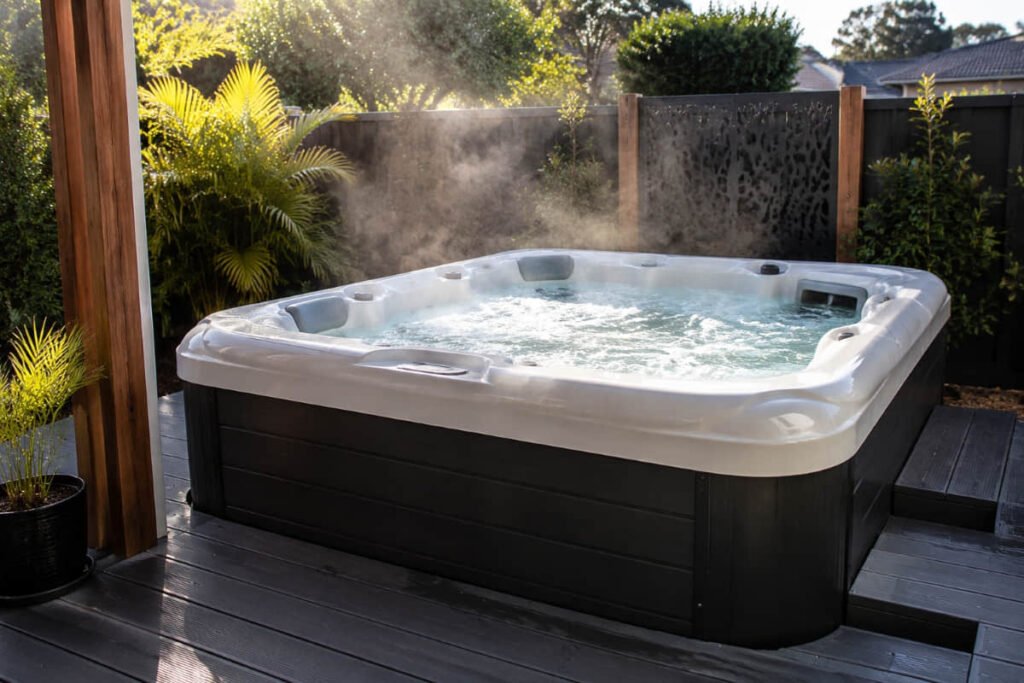
This is a smaller search idea on the list, but it rounds things out. It’s also one of the easiest specs to get wrong. Skip the load and slip rating checks, and it shows fast. That matters even more in a compact outdoor space, where the hot tub takes up a big share of the deck.
Choosing the Right Composite Decking
Once you’ve picked a design from this list, the board you choose decides how it performs. The right board makes every idea above hold up; the wrong one undoes it within a year or two.
Ask any supplier three things before you buy: cap layer thickness, recycled content, and warranty terms. These three numbers tell you more about a board’s real-world lifespan than any photo on a website.
| Check | What to Ask | Why It Matters |
|---|---|---|
| Cap layer thickness | How many mm, and what’s it tested to? | Thicker caps mean better UV and stain resistance |
| Recycled content | What % is recycled HDPE vs. virgin material? | Higher recycled content often means tighter quality control |
| Warranty terms | Structural vs. appearance — what’s actually covered? | Defines what you’re protected against, and for how long |
| Slip rating | Is it tested to AS 4586? | Confirms real wet-area safety, not just a textured look |
LastElegance decking uses 60% recycled HDPE content and carries a warranty of 15 to 30 years, depending on the series. Because we manufacture our own composite decking in-house, we control the specs at every stage. Cap thickness, colour batches, and board grade stay consistent, order to order. That’s a real advantage for trade and wholesale buyers who can’t afford inconsistent stock between deliveries.
Going direct to the manufacturer also keeps customisation realistic for volume orders. Sizes, colours, and textures move faster without a middleman adding a markup or a delay.
Request a quote for your next composite decking project. Or become a distributor if you’re looking to stock LastElegance decking boards and custom deck ranges across your trade network.
FAQ
What’s trending in deck design for 2026?
Mixed-tone boards, built-in lighting, and deck-plus-screen combos for privacy are leading the trends in Australian backyards right now. Builders are also leaning into multi-zone layouts — dining, lounge, and fire pit areas on one deck.
Is composite decking slippery when wet?
No — capped composite with an R11 rating under AS 4586 stays grippier wet than raw timber or polished tiles. The textured cap layer holds grip even with pooled water on the surface.
How much does composite decking cost per square metre in Australia?
Price depends on the board profile, customisation level, and order volume, so a flat number isn’t accurate. Talk to a manufacturer directly for a quote based on your exact decking ideas and project size.
Can composite decking be custom-matched to my home’s colours?
Yes — custom colour and texture runs are available for trade-volume orders. We recommend ordering a sample first, since colour can look slightly different in full sun versus on a screen.
How do I make a small deck look bigger?
Use lighter board tones, and cut down on joins with custom-length boards. Run the boards toward your main view instead of across it. All three tricks open up a small deck without adding a single square metre.
