
Colour disputes on composite decking jobs almost always start the same way. The boards don’t match — and no one can agree whether it’s a product fault or just how composite behaves. Most of the time, the problem is simpler: UV fading and batch colour variation are getting mixed up. They look alike on site. But the causes are different, the responses are different, and confusing them costs money. This guide splits them apart, explains what drives each one, and gives trade buyers a clear protocol for ordering and installation.
Key Takeaways
- UV fading and batch colour variation are separate issues — each needs a different response
- All composite decking boards go through an initial weathering period after installation; this is normal, not a defect
- The most reliable way to control batch consistency is at the order stage, before freight is dispatched
- Capped boards with a 0.8 mm cap layer and HALS + UV absorbers outperform uncapped alternatives in Australian UV conditions
- Flexural strength, slip resistance, and water absorption are unaffected by batch colour variation
Is Colour Fading the Same as Batch Variation?
No — and the difference determines how you respond.
UV fading and batch colour variation in composite decking are not the same thing. UV fading is a predictable, gradual shift that affects all boards after installation — it’s a material characteristic, not a defect. Batch variation is a difference in base colour between boards made in separate production runs. They look similar on site but have different causes and require different responses.
Builders who know the difference can tell whether they’re looking at a normal product characteristic or a supply issue. That distinction protects you from raising false defect claims — and from missing real ones.
UV stability is measurable. The ΔE colour difference index tracks how much a board’s colour shifts under UV load. Reputable manufacturers can provide QUV accelerated aging test data — a ΔE result after 3,000 test hours tells you exactly how stable a product is. That’s the number to ask for, not a vague “UV resistant” claim.
Why Do Composite Decking Batches Vary in Colour?
Composite decking boards are made from wood fibres and HDPE. The colour of each production batch depends on how consistent those raw materials are. Several variables can shift slightly between runs — even under controlled conditions. Understanding the causes helps procurement managers ask better questions and write tighter order specs.
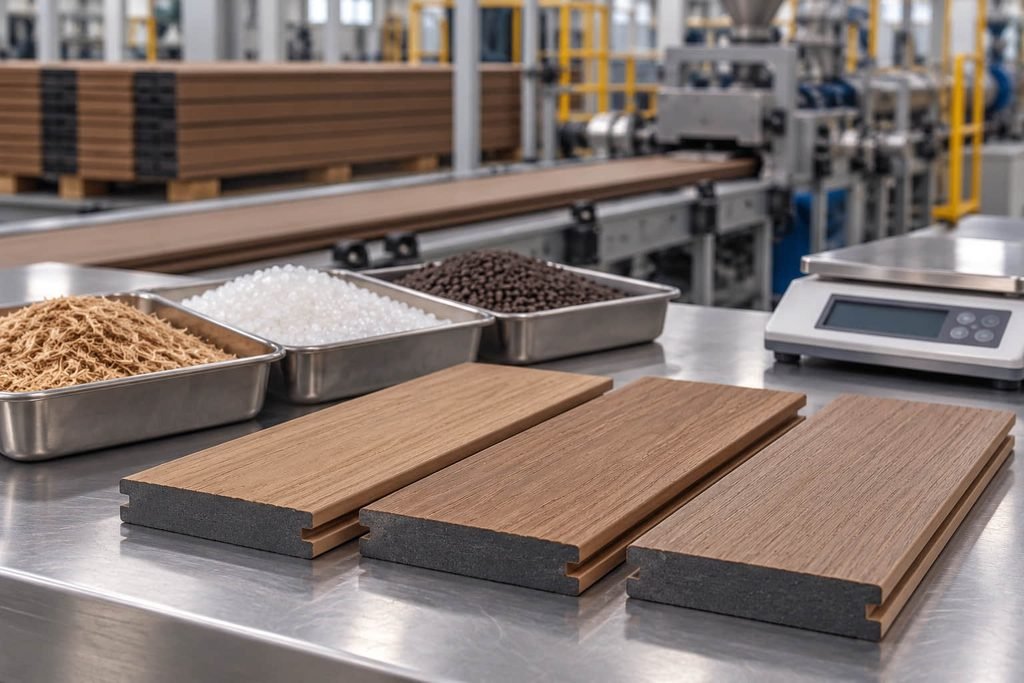
The main contributors to batch colour differences:
- Natural variation in wood fibres — tannin content, density, and moisture levels shift between fibre lots, even from the same region and species
- Pigment ratio differences — small deviations in pigment batching can produce visible tonal shifts when boards from two runs sit side by side
- Processing conditions — extrusion temperature, humidity, and line speed at manufacture all influence the final colour outcome
Wood Fibres and Natural Raw Material Differences
Wood fibres carry natural variation in tannin content, density, and moisture — even between lots from the same region. When those fibres go into composite boards, the variation can shift the final colour. In uncapped boards, the wood core sits closer to the surface, so fibre-driven differences show up more clearly.
LastElegance uses hardwood fibre, combined with HDPE at 0.95 g/cm³. Even with a controlled material spec, natural fibres carry some variation between lots. That’s a characteristic of composite materials — not a manufacturing shortcut.
Pigment Ratios Between Production Runs
Pigment batching is tightly controlled, but small differences — below what’s detectable in a single board — can produce a visible tonal shift when boards from two production runs sit side by side. Darker colours tend to show more variance than lighter neutrals. If you’re specifying a dark composite deck for a large project, factor this into your ordering approach.
Processing Conditions During Manufacture
Extrusion temperature, humidity, and line speed all influence the final colour outcome. Manufacturers control these variables but can’t eliminate minor variation entirely. Buying direct from the manufacturer — rather than from a distributor holding multiple stock batches — gives buyers better access to batch records and production timelines.
LastElegance produces to order. Buyers placing a 20′ container order have a clear production window and can request batch confirmation before freight is dispatched.
How UV Exposure Changes Composite Decking Colour
UV exposure causes all composite decking boards to fade gradually after installation. This is a predictable characteristic of wood-fibre composite materials. The rate and total fading depend on the cap layer type and the UV stabiliser system used. Capped boards with HALS and UV absorbers fade more slowly and more evenly than uncapped alternatives.
This happens to all boards — including premium capped products. What varies is how fast the shift happens, how much total fading occurs, and how evenly it settles across the deck.
The Initial Weathering Period — What to Expect
Boards are often manufactured with a slightly deeper colour than their long-term settled tone. In the first 3–6 months, sun and rain gradually bring the colour to its stable final shade. Boards in full sun will fade faster than those in shade during this period — which can make colour variance look more pronounced before it evens out after months of outdoor exposure.
Builders who understand this can set clear client expectations at handover. That’s one fewer call to field six months into a project.
Capped vs Uncapped Boards and UV Performance
Uncapped composite boards have a wood-fibre surface exposed directly to UV. They fade faster, and in wet conditions they can show tannin leaching — organic oils from the wood core washing to the surface after heavy rain. This leaves brown streaking on boards or on adjacent surfaces like concrete and paving. It’s not a structural issue, but it needs to be briefed at handover on projects with light-coloured surfaces beneath the deck.
Capped boards have a polymer outer shell that shields the core from both UV and moisture. Cap layer thickness matters — a 0.8 mm cap layer provides stronger protection than thinner alternatives. Capped boards also fade more evenly over time, which makes batch variance less visible once the deck has settled.
LastElegance capped composite boards use a combined HALS (Hindered Amine Light Stabilisers) and UV absorber system. After 3,000 hours of QUV accelerated aging, colour difference is controlled to ΔE ≤ 4–5. That’s the benchmark to ask for when specifying for Australian projects.
Distributors can use this data to support capped product recommendations to clients weighing price against a 15–30 year warranty period. The performance gap between capped and uncapped widens with every Australian summer.
Why UV Stability Matters More in Australia
Australia’s summer UV index runs 11–14 across most of the country. Northern Europe rarely breaks 8. Most composite decking test data is produced for European conditions. Products that pass those benchmarks are working much harder on Australian projects — particularly in Queensland and northern NSW.
Specifying the right composite decking boards for Australian conditions starts with UV test data, not marketing claims. Ask for QUV test hours and a ΔE result. Most supplier content doesn’t publish this figure. The ones that do give you something concrete to take into a product comparison.
Does Batch Colour Difference Affect Board Performance?
No. Batch colour variation is cosmetic only.
Batch colour variation does not affect the structural performance of composite decking boards. A board from a different production batch carries the same flexural strength, slip resistance, and water resistance as any other board in the range. Colour variation is a cosmetic characteristic of wood-fibre composite materials, not a structural defect.
The numbers: EN 15534 flexural strength is 26.2 MPa. Slip resistance per AS/NZS 4586 is R11. Water absorption per ASTM D1037 is 0.2%. These results are set by the composite material formulation — the batch colour outcome doesn’t change them.
This matters when working out whether a colour difference warrants a defect claim. In most cases it doesn’t — but knowing the specs lets you make that call with data, not guesswork. LastElegance’s warranty covers colour fade that exceeds the contractual tolerance. That ΔE benchmark gives buyers a concrete reference point to write into project specifications and supply agreements.
How to Order Composite Decking for Colour Consistency
The most effective way to manage batch colour consistency is at the order stage. Once boards are on site, your options narrow fast. Build these four steps into every project order.
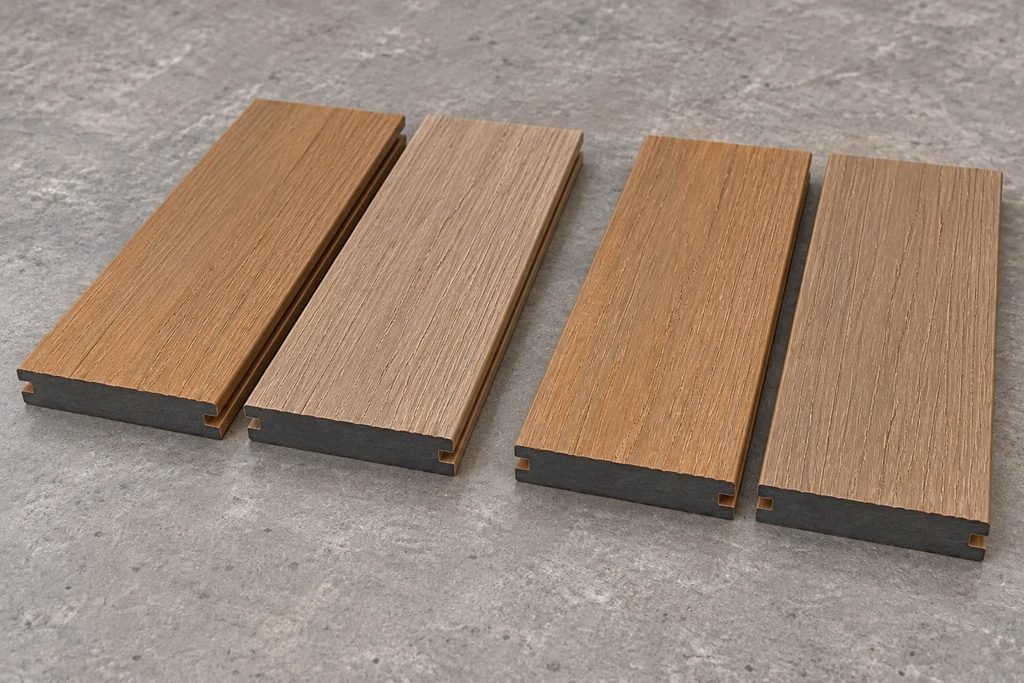
For colour consistency on large projects:
- Order the full project quantity from one production run
- Confirm batch numbers in writing before freight is dispatched
- For phased deliveries, agree in writing that all boards come from the same batch
- Request physical samples from a recent production run before committing to volume
Order the Full Project Quantity in One Run
The simplest way to control batch colour consistency is to order all decking boards at the same time. Split orders — even placed weeks apart with the same supplier — can draw from different production batches. A 40′ container covers most residential developments in a single run. A 20′ container works for smaller builds. Production lead time is roughly 15–20 days, plus 24–32 days sea freight. Plan the full volume upfront and lock in the production window before mobilisation.
Ask for Batch Numbers in Writing
Get batch numbers confirmed in writing before freight leaves the factory. Keep those records on file. If you need top-up boards or replacements later, the batch number lets you specify matching stock. Not all suppliers track this at the customer level — it’s worth asking before you commit to a supply relationship.
Manufacturer-direct supply gives buyers direct access to production data. Distributor-held stock often draws from multiple batches across intake cycles, with no easy way to confirm which batch a given pallet came from.
Managing Phased Deliveries on Large Projects
Large builds often need materials in stages. Each separate delivery carries a batch consistency risk if it draws from a different production run. Agree in writing — before signing off on the supply agreement — that all boards for the project come from the same batch, even if delivery is staggered. Not all suppliers can guarantee this. Make it a standard qualification question on every RFQ.
Request Samples Before Committing to Volume
Physical samples are the most reliable way to confirm a colour before ordering at scale. Digital references — screens, printed swatches, brochures — don’t show how a board colour reads in direct Australian sun. Request sample boards and check them under the same conditions as the project site: full sun, overcast, and shade. For colour-critical jobs, ask for samples from a recent production run, not from display stock. Display stock can sit for months and may not match what comes off the line.
How Installers Manage Colour Variance On Site
Even within the same batch, minor tonal differences between individual boards are normal. Professional crews manage this before a single board is fixed — not after.
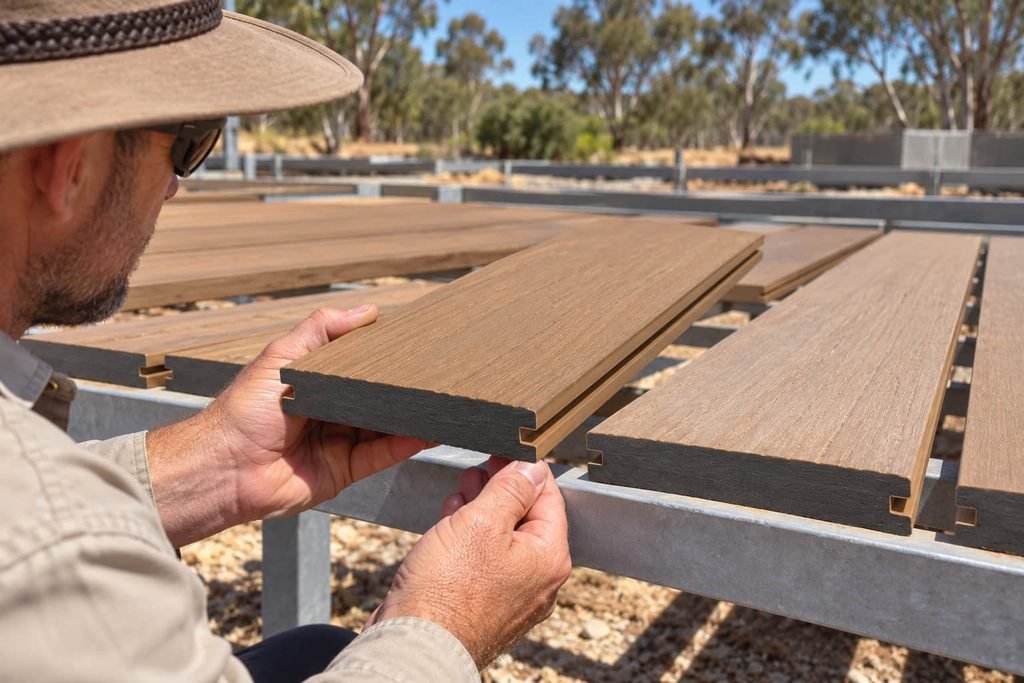
Steps to manage on-site colour variance:
- Unpack all boards and lay them loose across the subframe before fixing
- Check for tonal differences under natural light — not site lighting
- Group boards by shade and plan the full layout before installation begins
- Alternate board grain direction to blend variation across the deck
The hidden fastener system — stainless steel clips, groove-fixed — allows boards to be sorted and repositioned freely before any are locked in. Traditional timber decking doesn’t give you this option. At 300 mm joist spacing, there’s enough flexibility to sort the full deck layout and get the blend right before fixing starts. A pre-lay check costs a couple of hours. Relaying a section costs much more.
FAQ
Is colour variation between composite decking batches normal?
Yes — minor variation between production batches is a known characteristic of wood-fibre composite materials. It does not indicate a manufacturing defect. The key is managing it at the ordering and installation stage, not treating it as a product failure.
What should I do if my order shows visible colour differences?
First, work out whether the variation is batch-related or UV weathering — they have different causes. If boards show different base colours before outdoor exposure, check batch numbers on the packaging and contact your supplier. If boards arrived the same colour and have since faded differently, that’s UV weathering — which typically evens out over the first 3–6 months.
Do all composite decking products have the same batch colour consistency?
No. Products with a thicker cap layer and a HALS + UV absorber system show less tonal variance between batches and lower overall fading over time. Ask suppliers for QUV test hours and ΔE colour difference results before specifying — those are the numbers that show how a product actually performs under UV load.
Does batch colour difference affect the structural performance of the boards?
No — batch colour variation is cosmetic only. It has no effect on flexural strength, slip resistance, or water absorption. Those specs are set by the material formulation, not the batch colour outcome.
Do composite screening and cladding share the same batch consistency issues?
Yes. They use the same raw materials, wood fibres, and pigment systems as composite decking boards. For projects combining decking, screening, or cladding in the same colour palette, order all product types at the same time — from the same production run — for the best colour match across a single delivery.
Batch colour consistency comes down to two things: knowing what you’re dealing with, and managing it at the right stage. Whether you’re placing a full container order or specifying for a phased commercial build, the steps above give you a clear protocol. To confirm batch supply, request samples, or discuss your next project, Contact Our Sales Team; we’ll get back to you directly.