
Compare composite cladding and fibre cement on board price, and fibre cement often wins. Compare them over 10 years — installation labour, maintenance cycles, scaffold hire — and the answer changes on most projects.
There’s one exception that comes before any of that. If the project sits in a BAL-40 or BAL-FZ zone, the material choice may already be made. Fibre cement is non-combustible under AS 1530.1 — on NCC-compliant builds in those zones, that’s usually the end of the conversation.
For everything else, composite cladding delivers lower maintenance, faster installation, and colour that holds without repainting. The right call depends on fire zone, project type, and total installed cost over 10 years. The board price is only part of that story.
Key Takeaways
- Start with the BAL zone, not the board price. For BAL-40 and BAL-FZ, fibre cement is the default compliance path under AS 3959. The material choice may already be made before you open a price list.
- The full cost runs over 10 years. Composite costs more per board. It typically costs less per m² once installation labour, maintenance cycles, and scaffold hire are in the model.
- Composite handles coastal sites without surface treatment. UV performance is tested: colour change stays at ΔE ≤ 4–5 after 3,000 hours of QUV accelerated aging. Fibre cement holds well too — but depends on intact paint.
- Fibre cement carries a repainting obligation. Every 10–15 years, budget for scaffold hire, labour, and materials. This is the line most procurement comparisons skip.
- Never accept a verbal fire rating. For BAL-12.5 and BAL-19, composite may be acceptable — but confirm against AS 3959 and the written fire test report before specifying.
| Factor | Composite Cladding | Fibre Cement |
|---|---|---|
| Composition | Wood fibre + HDPE (co-extruded) | Cement + cellulose fibres + sand |
| Board weight (example) | 1.77–2.41 kg/lm | Higher — varies by profile |
| Maintenance | Wash only — no painting | Repaint every 10–15 years |
| Fire compliance | ASTM E84 FSI 85 / SDI 300 | Non-combustible (AS 1530.1) |
| High BAL suitability | Confirm per product | Suitable for BAL-40 / BAL-FZ |
| Installation system | Clip/interlocking | Fastener + seal + cut |
| Warranty | 20 years | Varies by brand |
| Indoor/outdoor | Both | Both |
Always check the manufacturer’s product data sheet against the project’s BAL zone before specifying.
What Each Material Is Made Of
What is composite cladding made of?
Composite cladding (WPC) blends hardwood wood fibre with HDPE, co-extruded with a protective cap layer. The boards we supply use 60% recycled content — hardwood fibre and recycled HDPE — with 40% virgin material at an HDPE density of 0.95 g/cm³. The cap layer is 0.8 mm thick, thicker than many products on the market. That extra thickness drives UV protection and colour hold.
What is fibre cement made of?
Fibre cement is a dense blend of cement, sand, and cellulose fibres. It’s inert and non-combustible under AS 1530.1. That material profile is why it’s the default for high BAL zones — the raw material itself won’t burn.
These differences in material composition and manufacturing process drive every performance and maintenance outcome that follows.
How Each Material Handles Australian Conditions
Australia puts cladding under real stress. Intense UV, coastal salt air, and temperature swings from below 0°C in alpine zones to 40°C-plus in summer. Both materials cope with these conditions. The difference is how they fail when they’re spec’d wrong.
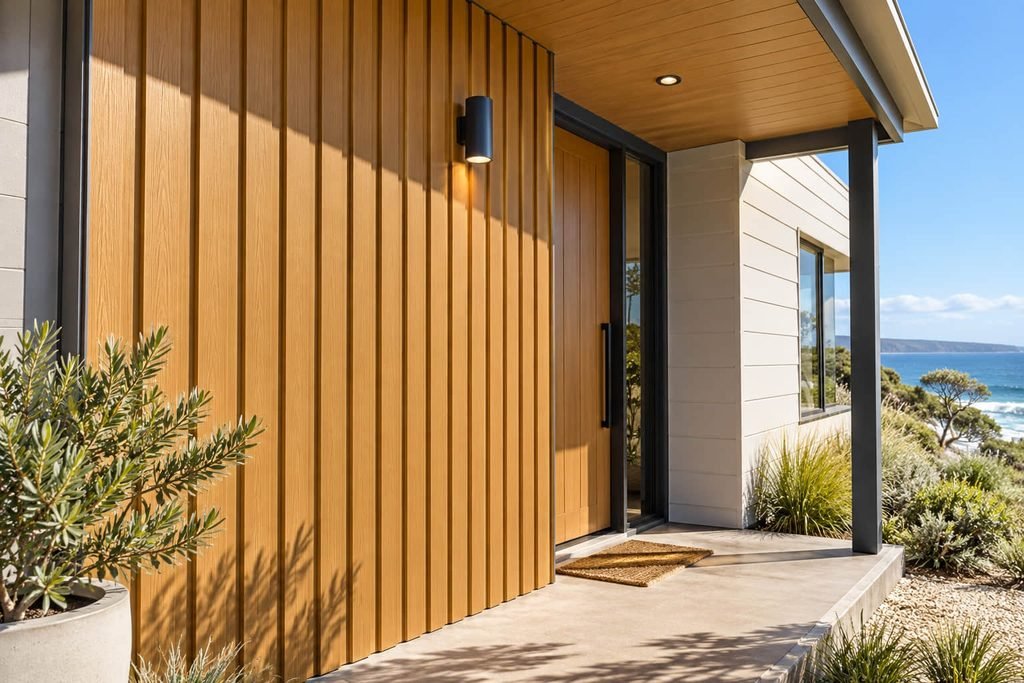
Composite doesn’t swell or rot. Water absorption is 0.2% (ASTM D1037) — the co-extrusion cap keeps the wood fibre core sealed. Fibre cement is stable in most conditions, but it depends on an intact paint coat. Any coating failure and moisture gets in.
Coastal Sites and High-UV Zones
Composite holds up on coastal sites without surface treatment. No corrosion. No swelling. The co-extrusion cap isolates the wood fibre core — that’s why composite doesn’t behave like unprotected timber near the water.
UV performance matters more in Australia than in most other markets. Dark boards in full sun can reach surface temperatures above 60°C. A combined HALS and UV absorber system holds colour to ΔE ≤ 4–5 after 3,000 hours of QUV accelerated aging — a variation that’s hard to detect in the field.
Trade partners supplying coastal Queensland projects report the same pattern — painted fibre cement needs monitoring after salt exposure. Composite doesn’t.
Fibre cement handles coastal sites well when painted and sealed correctly. But any crack in the coating lets moisture in. In high-rainfall or coastal zones, paint failure is the main weakness.
BAL Ratings and Fire Compliance
Fibre cement has a clear compliance advantage in high BAL zones. It’s worth stating that directly.
Fibre cement is non-combustible under AS 1530.1. That makes it the safer, simpler default for BAL-40 and BAL-FZ on NCC-compliant builds. If you’re specifying in those zones, start with fibre cement unless written fire test data says another product qualifies.
Composite boards are tested to ASTM E84 — Flame Spread Index (FSI) 85, Smoke Developed Index (SDI) 300. FSI measures how fast flame spreads: lower is slower, zero is non-combustible. FSI 85 works for many build types. It does not meet the non-combustible standard for BAL-40 or BAL-FZ.
For BAL-12.5 and BAL-19 zones, composite may be acceptable. Confirm the zone under AS 3959 and request the written fire test report before specifying. A verbal fire rating is not enough.
Fibre cement also offers better impact resistance — useful on industrial facades or commercial ground-level applications with heavy foot or vehicle traffic.
Maintenance — The Real Cost Over Time
Composite cladding maintenance is simple: wash with mild detergent when it looks dirty. No painting. No sealing. No oiling.
Fibre cement with a painted finish needs recoating every 10–15 years. On a 500 m² commercial facade, that means scaffold hire, labour, and materials. It’s a real budget line — one that project managers need to model before specifying, not after.

Composite cladding maintenance:
- Wash with mild detergent as needed
- No painting, sealing, or oiling required
- No surface treatment between washes
Fibre cement maintenance:
- Repaint every 10–15 years
- Inspect and touch up cuts and joints after installation
- Scaffold hire required on multi-storey facades
A 20-year product warranty covers surface cracking, edge lifting, warping, breakage, and colour fade beyond the contracted range. Incorrect installation isn’t covered — and that risk is real on complex facades with either material. Installer quality matters.
Installation — Weight, Labour, and System Design
Fibre cement is a heavier product. That affects handling on site, structural load on the wall, and labour cost per m².
Composite boards are lighter. The Oakling Shiplap runs 1.77 kg per linear metre (140×12×2900 mm); the DecoGroove Castellated runs 2.41 kg (219×20×2900 mm). Installation is a male-female interlocking clip on a steel batten subframe at 300–400 mm spacing. No surface screws. No sealants. Clean finish.
Fibre cement needs carbide cutting tools, edge sealing, joint detailing, and correct fastener patterns per the manufacturer’s guide. More steps per m² — each one costs time on site.
How to install composite cladding boards:
- Fix steel battens at 300–400 mm centres
- Fix the first board and engage the clip system
- Slot each board into the previous clip and lock
- Repeat along the facade
- Apply finishing trim
For contractors quoting facade work, installation efficiency can shift the labour margin on a project.
Request Free Samples to assess board weight and the clip system before committing to a project specification.
What Each Material Costs Per m²
Material price per m² is one input, not the full picture.
Total project cost includes subframe, fixings, labour, finishing, and maintenance over the building’s life. Composite tends to carry a higher material cost but lower installation labour and near-zero upkeep. Fibre cement costs less per board but carries higher installation labour and a repainting cycle every 10–15 years.
On a 500 m² commercial facade, that repainting cycle — scaffold, labour, materials — adds up fast.
| Cost Category | Composite Cladding | Fibre Cement |
|---|---|---|
| Material cost per m² | Higher | Lower |
| Installation labour | Lower | Higher |
| Maintenance cycle | None required | Repaint every 10–15 years |
| Scaffold cost (10-year) | Nil | At least one cycle |
| Estimated 10-year cost | Lower | Higher |
We supply trade partners direct — no reseller margin in the board price. That’s a real cost lever on volume orders. Fibre cement from major brands carries competitive board pricing. The composite advantage sits in the installation and maintenance columns, not always in the board price.
Request Trade Pricing to build a full cost model for your next project.
Sustainability and Recycled Content
The sustainability case for composite is specific. Recycled content is 60% — hardwood fibre and recycled HDPE. Formaldehyde not detected under EN 717-1. Certifications: ISO, RoHS, SGS.
Fibre cement uses cellulose fibres, often sourced from sustainable forestry programs. But cement production carries higher embodied carbon than composite wood cladding boards. If a supplier claims “sustainable forestry” sourcing, ask for FSC certification or equivalent — a claim without paperwork won’t hold up with a green building assessor.
Neither material needs ongoing chemical treatments, unlike some timber cladding products. That lowers the environmental impact over the life of the building.
For projects targeting Green Star, NABERS, or similar ratings, composite’s recycled content and low-emission profile needs to be documented. Request the EN 717-1 test report and SGS certification for your project files.
Profiles, Colours, and Surface Textures
Two profiles are available:
- Oakling Shiplap — 140×12×2900 mm, 1.77 kg/lm. Clean shiplap profile with a natural wood-grain surface and natural hues.
- DecoGroove Castellated — 219×20×2900 mm, 2.41 kg/lm. Castellated profile for commercial feature facades.
Both share the same colour palette and surface textures as the decking range. That makes coordinated facade and deck finishes practical on the same project. Both suit indoor and outdoor use — formaldehyde not detected (EN 717-1) — so composite is also viable for interior wall cladding and ceiling applications where indoor air quality is a specification requirement.
Colour is co-extruded into the cap layer and won’t peel or chip. For large commercial facades, batch colour consistency holds across orders — re-supply matches the original run.
The range of styles covers standard colours, wood-grain textures, and modern finishes. Fibre cement is paintable to any colour, which suits projects with strict brand colour requirements. That flexibility comes with the repainting obligation.
Custom lengths, colours, and surface textures are available on volume orders.
Which Cladding Fits Your Build?
Three things decide it: fire zone (BAL), maintenance budget, and what the project requires aesthetically.
| Use Composite Cladding When… | Consider Fibre Cement When… |
|---|---|
| BAL zone is BAL-12.5 or BAL-19 (confirm per product) | Project is in BAL-40 or BAL-FZ zone |
| Low maintenance is a client priority | Client wants a paintable surface for colour changes |
| Faster installation reduces labour cost | Design specifies a weatherboard-only profile |
| Indoor/outdoor application on one project | Budget favours lower material cost |
| Timber-look finish without repainting | NCC requires non-combustible wall cladding |
| Volume supply with batch colour consistency | Established fibre cement brand specified by architect |
Fibre cement is also the stronger choice where impact resistance matters — industrial facades, busy commercial ground floors, or any site with high physical exposure.
Oakling Shiplap suits most BAL-12.5 and BAL-19 residential shiplap projects. DecoGroove Castellated is the option for commercial feature facades. Custom lengths, colours, and surface textures are available for volume orders.
In BAL-40 and BAL-FZ zones, non-combustible external cladding is the cleaner compliance path. That means fibre cement.
FAQ
Can composite cladding be used in coastal areas?
Yes — composite resists moisture, salt air, and UV without surface treatment. Testing to 3,000 hours QUV shows colour change at ΔE ≤ 4–5. That weather resistance holds across coastal Queensland and New South Wales projects.
What are the main drawbacks of fibre cement cladding?
Fibre cement is a heavier product, which increases installation labour and demands careful handling — rough handling on site can crack boards. It also needs regular painting to maintain performance; if the coating fails, moisture gets in. For projects where low upkeep cost is the priority, composite is the more practical choice.
Can composite cladding meet BAL requirements in Australia?
It depends on the BAL zone. For BAL-12.5 and BAL-19, some composite products are acceptable — confirm against AS 3959 and the product’s written fire test report. For BAL-40 and BAL-FZ, non-combustible materials tested under AS 1530.1 are the standard specification. Always request written test data; don’t accept verbal assurances.
Which is better for commercial projects — composite or fibre cement?
Composite suits most commercial building applications where BAL compliance isn’t the constraint. It offers minimal maintenance, faster installation, and consistent appearance across large facades. Fibre cement is the better choice for fire-rated commercial projects or where a paintable surface is required for brand colour matching. Run the total installed cost model for your specific project before deciding.
What is the MOQ for trade orders of composite cladding?
The minimum order quantity is 500 m². Production lead time is 15-20 days (20-foot container) or 20-25 days (40-foot container), and 24–32 days for sea freight to Australia. Factor the full timeline into your project programme — custom colours or profiles may need additional sampling time.
Does composite cladding need a moisture barrier or breathable membrane?
Membrane and wall cavity requirements depend on the wall build-up, the NCC provisions for the wall type, and the manufacturer’s installation guide. Steel battens at 300–400 mm spacing are the recommended subframe for composite cladding. Always follow the manufacturer’s installation documentation and the relevant NCC Volume provisions — don’t default to a generic installation method.