
A late container can leave a distributor short of stock or a builder waiting for materials. Unexpected shipping and import costs can also cut into profit margins.
For Australian businesses buying composite decking from China, factory production is only part of the timeline. Sea freight, customs clearance, and local delivery all affect when an order arrives. Custom colours and profiles may also add time before production starts.
This guide explains how to estimate lead times, calculate landed costs, and avoid common shipping delays. You’ll also learn how to plan orders around stock needs or project deadlines.
Key Takeaways
- Total Import Lead Time: Allow 50–80 days from order confirmation to delivery in Australia, plus a 7–14 day buffer for potential shipping delays.
- Production & Container Shipping: Standard 20ft containers take 15–20 days to produce and pack, while 40ft containers require 20–25 days. Sea freight typically takes another 24–32 days.
- Customs & Biosecurity Clearance: Australian imports require accurate shipping documents, correct HS code classification, and ABF/BICON compliance. Allow 2–10 business days for clearance.
- Total Landed Costs: Budget beyond the FOB price. Include sea freight, insurance, applicable import duties, 10% GST, customs fees, port charges, and domestic delivery.
- Avoiding Costly Delays: Finalise product specifications before production, allow extra time for custom colours or profiles, and plan around Chinese factory holidays and vessel schedules.
How Long Does Production Take per Container?
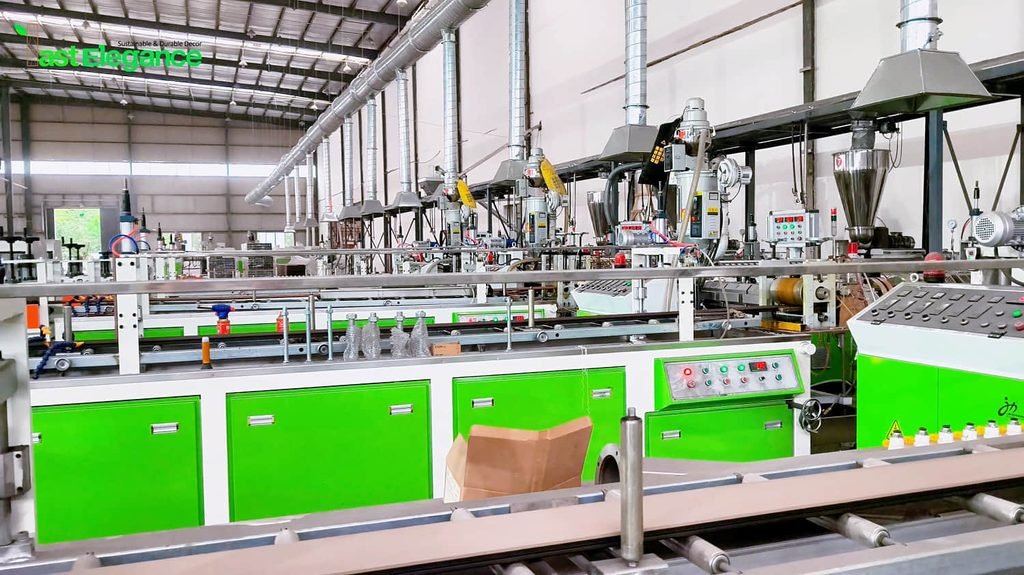
Production time depends on container size. These figures cover production and packing combined, for standard profiles and colours:
| Container size | Production + packing | Sea freight to Australia |
|---|---|---|
| 20ft | 15–20 days | 24–32 days |
| 40ft | 20–25 days | 24–32 days |
The gap between a 20ft and 40ft order can reach ten days on production alone. A 40ft order needs more cutting and conditioning runs — that’s what drives the extra time. Custom orders run to a different clock.
As a rough guide, a 20ft container holds about 850–900 m² of standard decking boards; a 40ft holds about 1,000–1,100 m². Use this to size your container before you quote.
Have your m² requirement and container size ready? Submit it for a confirmed production slot. → Request a Quote
Does a Custom Profile or Colour Add to Lead Time?
Yes — and the extra time sits before production starts, not inside it.
Standard colours and board sizes run on existing schedules. The clock starts when your order and deposit are confirmed. Custom colours or non-standard profiles work differently: before production begins, you need to sign off a colour sample or confirm mould specs. That approval stage sits outside the standard production window.
How long it takes depends on the brief and how many revision rounds you need. If you’re specifying a project-specific colour, confirm sample approval lead time at the quoting stage. Build it into your programme before the production clock starts.
LastElegance supports custom lengths, colours, packaging, and surface textures — including custom moulds. Sampling lead time is confirmed per order.
What Stages Make Up the Import Timeline?
For a standard order in stock colours, expect 50–80 days from order confirmation to delivery at your warehouse or site. Here’s how that time breaks down — and who controls each stage.
| Stage | Typical duration | Who controls it |
|---|---|---|
| Order confirmation and specification lock | 1–3 days | You |
| Production and packing | 15–25 days | Manufacturer |
| Export customs and container loading | 3–5 days | Freight forwarder |
| Sea freight to Australia | 24–32 days | Shipping line |
| Biosecurity and customs clearance (ABF + BICON) | 2–10 business days | Customs broker |
| Domestic delivery to site | 3–7 days | Freight carrier |
Notice that production is not always the longest stage. Sea freight and the Australian clearance steps together often take longer. And the first stage — specification lock — is the one most buyers lose time on without realising it.
Port-to-port time is not delivery-to-site time. The sea freight window ends when the vessel berths at an Australian port. From that point, biosecurity screening, ABF clearance, and domestic freight all add days before boards reach site.
What Does Australian Customs Clearance Involve?
This is the stage first-time importers most often underestimate.
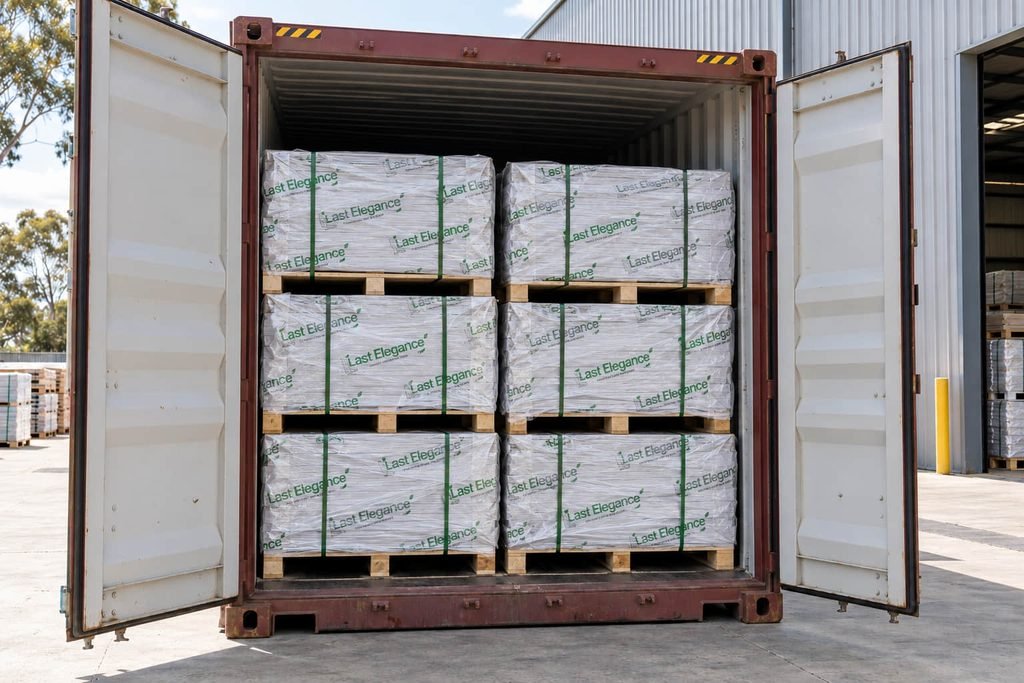
The Australian Border Force (ABF) handles the import declaration, duties, and GST. The Department of Agriculture handles biosecurity screening through BICON. Wood fibre content in WPC decking puts it in scope under those rules.
A licensed customs broker manages both processes. With correct documents in hand, clearance takes 2–10 business days. Missing or incorrect documents are the most common cause of delays — and delays compound fast once a vessel is at berth. Port storage charges start accumulating from day one.
Brief your freight forwarder before the container ships, not after it arrives.
Ask for the document checklist we use for every container to Australia. → Contact Our Sales Team
What Documents Must Travel with the Shipment?
Confirm these are in order before the vessel departs:
- Commercial invoice — must describe the goods correctly, including wood fibre content
- Packing list — itemised by board size, quantity, and weight
- Bill of lading — issued by the shipping line; confirms the contract of carriage
- Certificate of origin — needed for duty assessment and tariff rate determination
- Correct HS code classification — misclassification is a common trigger for re-examination delays
For WPC composite products, the HS code must be accurate. A customs broker can advise on phytosanitary requirements for wood-content goods. Confirm the full document set with your broker before the vessel leaves.
What Does the Total Landed Cost Include?
The FOB price is only the starting point. Importers who budget on FOB alone often end up short. Here’s what builds the full landed cost for a composite decking container:
| Cost component | Who pays | Basis |
|---|---|---|
| FOB price | Buyer | Per m² × volume, as quoted |
| Sea freight | Buyer | Per container (20ft or 40ft) |
| Marine insurance | Buyer | % of cargo value |
| Import duties | Buyer | Depends on HS code — confirm with broker |
| GST (10%) | Buyer | Applied to customs value plus freight |
| Customs broker fees | Buyer | Fixed or % — varies by broker |
| Port and handling charges | Buyer | Per container, varies by port |
| Domestic freight to site | Buyer | Per delivery, based on distance |
GST at 10% applies to the customs value of the goods plus sea freight — not the FOB price alone. Import duty rates depend on the specific HS code for WPC products. Confirm the current rate with a customs broker before you quote. Rates can change, and the wrong assumption costs you margin.
Get an FOB price per m² for your volume — we’ll walk through landed cost components with you. → Request Trade Pricing
Is Air Freight Worth It for Composite Decking?
For project-scale orders, no. The weight-to-value ratio makes it uneconomical.
Composite decking boards are heavy. The TimberLuxe 140×23 profile runs at 4.20 kg per linear metre. Even the Linea Batten 50×50 screen batten weighs 1.10 kg/lm. Air freight rates per kilogram run 10–15 times higher than sea freight — costs quickly exceed product value for anything beyond a small consignment.
Air freight makes sense for two things: urgent sample confirmation before a bulk order, or a small replacement shipment to resolve a site defect. For any full project order, sea freight is the only practical route.
If you’re looking at air freight because a project is running behind, the better fix is buffer stock or earlier order placement.
When Should You Order Against Your Site Date?
Work backwards from your site start date. Add each stage in reverse:
- Domestic delivery to site: 3–7 days
- Australian customs clearance (ABF + BICON): 2–10 business days
- Sea freight: 24–32 days
- Export clearance and container loading: 3–5 days
- Production and packing: 15–20 days (20ft) or 20–25 days (40ft)
That’s roughly 50–80 days from order placement to boards on site. Add at least 7–14 days buffer for vessel schedule gaps and port congestion.
Vessels on major China–Australia routes run weekly or bi-weekly — not daily. A missed sailing adds a week or two. Port congestion at busy periods can add more.
Worked example — 40ft container, boards needed on site by 1 March:
Working back:
- Allow 7 days domestic delivery → port despatch by 22 February
- Allow 7 days customs clearance → vessel arrival by 15 February
- Allow 32 days sea freight → container departs China by 14 January
- Allow 5 days export clearance and loading → 9 January
- Allow 25 days production and packing → place order by 15 December
For a 1 March site start, the order deadline is mid-December — not late January. That gap catches most builders off guard the first time they run the numbers.
For custom colours or profiles, add sample approval time before production begins.
We see this pattern across orders every season — teams that run the reverse timeline early avoid the crunch. Teams that don’t end up paying for air freight on replacement boards.
Tell us your site start date and m² requirement — we’ll confirm the order deadline and a production slot. → Request a Quote
Where Do Delays Actually Come From?
Most composite decking orders that run late don’t fail at production. They fail at three other points that are easy to plan around — once you know where they are.
Vessel frequency on China–Australia routes. Direct services from major Chinese ports to Sydney, Melbourne, and Brisbane run weekly or bi-weekly. Miss a vessel by one day and you wait 7–14 days for the next departure. That’s before any weather or port congestion adds to the count. A container that misses its planned sailing by a single day can land two weeks later.
The Chinese production calendar. Two annual shutdowns affect ordering windows. Chinese New Year typically falls between late January and mid-February — factories wind down for 2–3 weeks around it, and the month before is the most congested of the year. The October Golden Week (1–7 October) causes a shorter but still real slowdown. Orders confirmed well ahead of these dates clear without issue. Orders confirmed in mid-January or late September almost certainly won’t.
Documentation errors at the Australian border. WPC composite decking triggers biosecurity screening under BICON rules because it contains natural wood fibre. The checks themselves are routine when paperwork is correct. A wrong HS code, a vague product description, or a packing list that doesn’t match the invoice is enough to hold a container at port while storage charges build. This type of delay is entirely preventable.
Specification changes after the deposit. A colour swap or length change requested after extrusion begins is not a minor adjustment — it’s often a partial restart. Once production is running, changing the spec is the most expensive thing a buyer can do to their own timeline. Lock the full bill of materials before the deposit is paid.
How Do You Speed Up the Timeline?
Five things give you the most control over lead time — none of them requires rushing production or paying for air freight.
- Lock the full specification before paying the deposit. Board profile, colour, length, surface texture — and accessories. Clips, fasteners, and end caps ordered after the fact often ship separately, arrive late, and delay site installation.
- Choose standard profiles and colours where the design allows. This is the biggest lever. Standard profiles skip the sample approval stage entirely. That saves 10 days or more on the total timeline.
- Ask your supplier to book the vessel slot when production starts, not when goods are ready. Vessel bookings on China–Australia routes fill early in peak periods. Waiting for a ready-to-ship confirmation before booking risks a rolled container and a 7–14 day delay.
- Have your customs broker briefed before the container ships. Send the commercial invoice, packing list, and HS code classification for review before the vessel departs. A document error caught at the supplier’s end costs nothing to fix. The same error caught at an Australian port costs storage fees and time.
- Plan around the Chinese production calendar. For any project with a fixed site date, check whether your order window overlaps with Chinese New Year or Golden Week. For Chinese New Year, confirm your order by early December to clear the shutdown. Don’t count on a mid-January order making it through on schedule.
FAQ
Is sea freight time the same as delivery to site?
No. Sea freight covers port-to-port only. After arrival, add Australian biosecurity and customs clearance (2–10 business days) and domestic freight from the port to your warehouse or site. Door-to-door runs 7–17 days longer than the sea freight window alone.
Do I pay duties and GST on composite decking from China?
GST at 10% applies to the customs value of the goods plus sea freight. Import duty rates depend on the HS code classification for WPC composite products — confirm the current rate with a licensed customs broker before your first order. Don’t assume duty-free status without checking.
Are there shipping restrictions on composite decking from China into Australia?
There’s no blanket ban. Composite boards containing natural wood fibre are subject to biosecurity screening under BICON rules, administered by the Department of Agriculture. Correct documentation avoids hold-ups at the Australian border.
Can composite decking, screening, and cladding share a container?
Yes. Products from all three categories can share one container. A mixed load may affect packing efficiency and total volume. Confirm the combination fits at the quoting stage and ask for a packing plan with the quotation.
Do payment terms affect when production starts?
Yes. Most manufacturers start production after the deposit is confirmed — typically 30% of the order value, with the balance paid before shipment. The production clock starts from deposit confirmation, not from the date you issue the purchase order. Factor that step into your full timeline.