

A low siding price can win the bid and still hurt your margin. The loss often shows up later through slow installs, change orders, or replacement panels that no longer match.
Vinyl and capped composite manage these risks in different ways. The better choice isn’t always the cheaper panel—or the product with the stronger sales claim.
It’s the system that fits your crew, job site, and supply plan. This guide helps you find that fit before the purchase order goes out.
What Are Composite and Vinyl Siding Made From?
The material mix affects strength, movement, care, and how each panel looks. In this guide, composite means a capped wood-fiber and plastic board. Vinyl siding means a formed PVC panel, with or without foam backing.
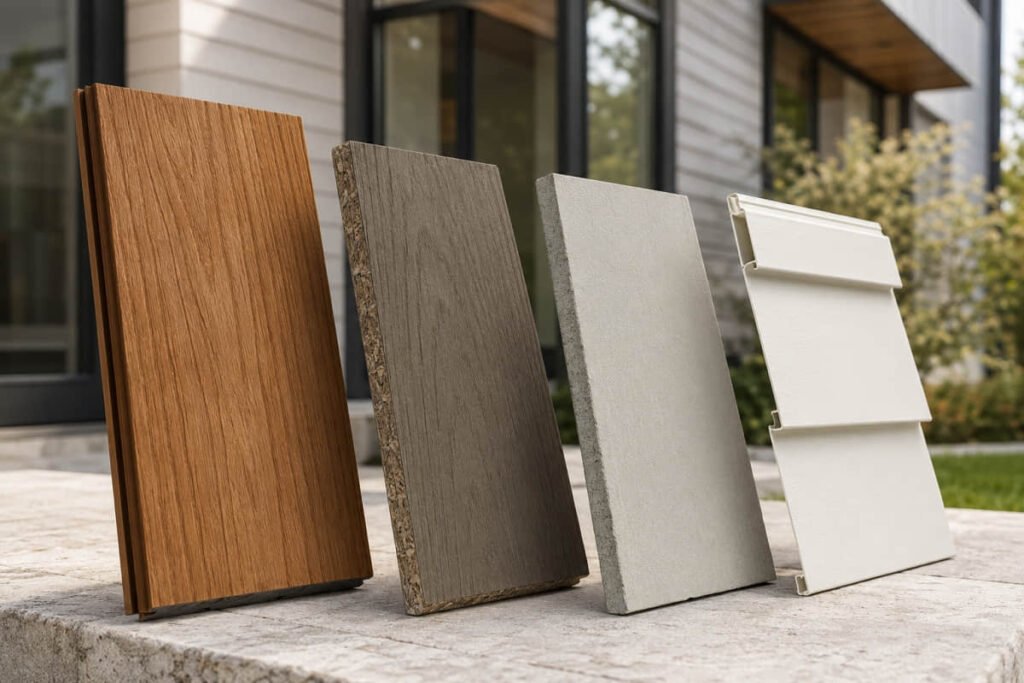
That sounds simple, but the details still matter. Check the core, cap, panel thickness, and test data before you compare products.
| Product | Main material | Outer layer or backing |
|---|---|---|
| Capped composite siding | Wood fibers and plastic | Co-extruded plastic cap |
| Traditional vinyl siding | Polyvinyl chloride (PVC) | Color runs through the panel |
| Insulated vinyl siding | Polyvinyl chloride (PVC) | Fitted foam backing |
What Is Composite Siding?
Composite siding blends two or more materials into one board. A common type mixes wood fiber with plastic. You get a wood-style finish without the staining schedule that comes with lumber.
Formulas and manufacturing methods vary by product. LastElegance uses recycled HDPE and wood fiber with a four-sided co-extruded cap. Current material and test reports are available on request.
Engineered wood uses a different core and finish system. See our engineered wood siding vs composite siding guide for that comparison.
What Is Vinyl Siding?
Vinyl siding is made mainly from polyvinyl chloride, or PVC. Traditional vinyl siding uses thin, formed panels that overlap and hang from fasteners.
Insulated vinyl siding adds fitted foam behind the panel. This backing can add stiffness and thermal value. The 2024 IRC requires labeled insulated vinyl to meet ASTM D7793. Compare panel thickness and R-value on the named product sheet.
What About Recycled Content?
Recycled content tells only part of the story. Freight, job-site waste, service life, and disposal also shape the final impact. If carbon matters to the project, ask for an Environmental Product Declaration, or EPD.
LastElegance reports 60% recycled content in its material mix. Ask our team for the current supporting report.
Which Costs Less: Composite Siding vs Vinyl Siding?
Vinyl often costs less at the start. Familiar install methods can help keep labor and freight costs down.
Composite prices vary by profile, finish, order size, and fastening system. Use local bids for early planning, then compare a matched project scope.
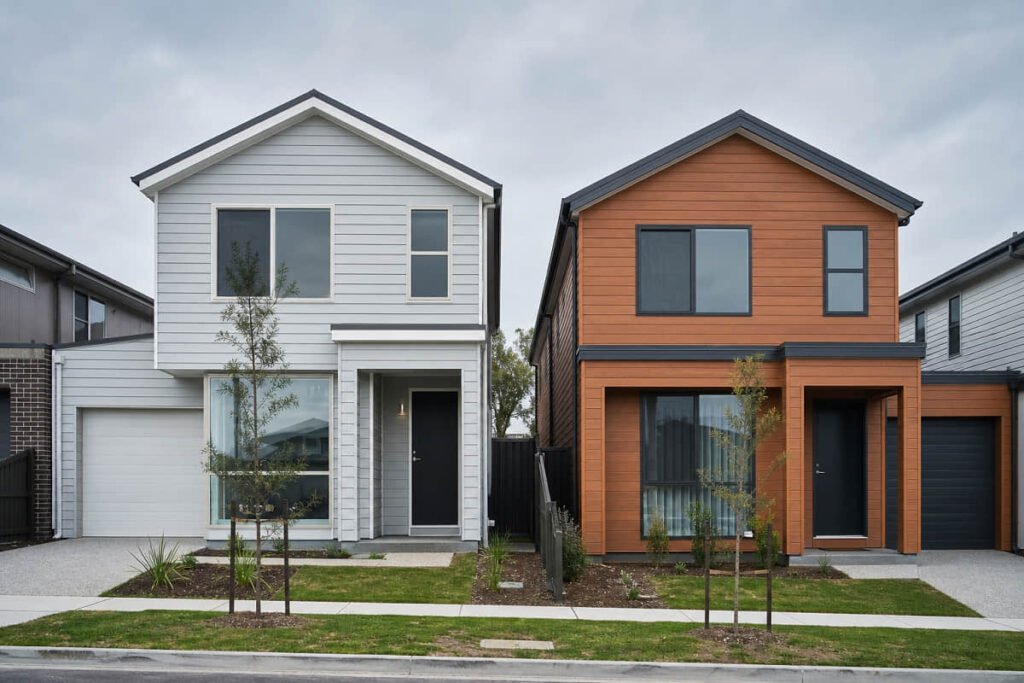
| Cost view | Vinyl siding | Composite siding |
|---|---|---|
| First budget | Often lower | Often higher |
| Labor | Common system may cut crew time | Clips and battens may add steps |
| Freight | Local stock often helps | Import or special-order freight may apply |
| Long-term cost | Allow for repairs and color matching | Allow for cleaning, repairs, and finish needs |
Compare Upfront Cost
Before you compare totals, make sure both bids cover the same work. Include panels, trim, fasteners, WRB work, labor, freight, tear-off, disposal, permits, and sheathing repairs.
Wall height, corners, openings, and small cuts raise labor. Dark colors, premium profiles, and insulated panels can also lift vinyl’s price. Always compare the same scope.
Compare Cost Over Time
A simple 20-year worksheet gives you a fairer view than the opening price alone. Keep the repair and labor assumptions clear, or the payback claim means little.
| 20-year item | Sample assumption | What to price |
|---|---|---|
| Cleaning | Once each year | Labor, mild soap, and access gear |
| Inspection | Once each year and after storms | Crew time and lift rental |
| Repair reserve | Project-specific | Panels, trim, freight, and labor |
| Repainting | Only if the named product requires it | Prep, coating, access, and labor |
| Replacement stock | Hold attic or warehouse stock | Storage and tied-up cash |
Add the installed cost and expected care, then spread that total across 20 years. This gives you a useful annual cost per square foot. A longer lifespan helps only when the product suits the site.
For a project-specific check, request a quote with wall area, drawings, target schedule, and project location.
Does Direct Buying Cut Cost?
Manufacturer-direct buying can remove a layer of markup on volume orders. It doesn’t remove freight, duties, storage, or local service costs.
Direct pricing can look attractive, but the product price is only one line. Add clips, trim, packing, freight, tax, duties, waste, MOQ, and lead time. LastElegance makes products in-house, so trade partners can request custom colors, textures, sizes, and profiles.
Which Siding Holds Up Better?
Composite often provides a stiffer face and better impact resistance. Vinyl can shed rain well. Neither material is damage-proof.
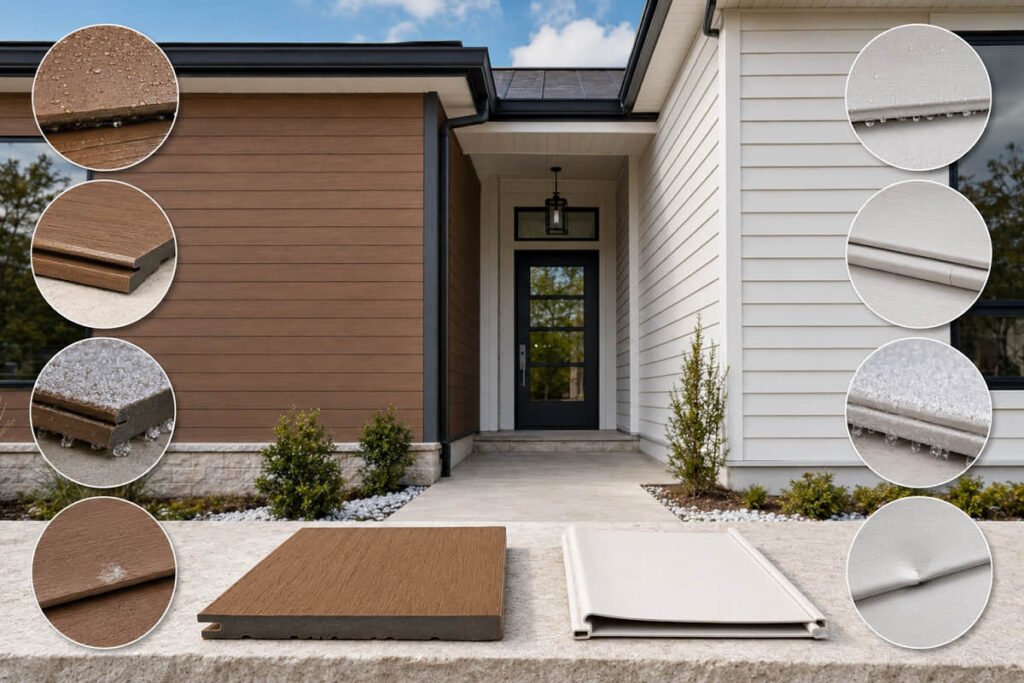
| Exposure | Composite risk to check | Vinyl risk to check |
|---|---|---|
| Rain | Cut edges, joints, and trapped water | Leaks behind loose trim and openings |
| Heat | Thermal movement and dark-color heat | Buckling from tight nailing |
| Cold | Product-specific impact strength | Brittle impact damage |
| UV | Cap and color test results | Fade and surface change by grade |
| Wind | Full-system fastener test | Nail slots, panel lock, and edge details |
| Hail | Dent or break data | Crack or puncture data |
In a composite siding vs vinyl siding comparison, the material name tells you only so much. Panel quality and crew work matter just as much. Compare reports for the exact profile and fastener system.
Rain and Moisture
Both products need a sound wall behind them. Siding is not the water control layer by itself.
IRC Section R703 requires a water-resistive barrier and a path for drainage. In practice, that means careful flashing at every opening and joint. Your local code may add more rules.
LastElegance reports 0.2% water absorption under ASTM D1037. Ask our team for the test report and product scope. Good drainage also cuts mold, rot, and insect damage in the wall.
Heat, Cold, and Sun
All plastic-based siding moves with heat. Crews must leave the gaps shown in the install guide. Tight fasteners can trap vinyl and cause waves or buckles.
Cold weather can raise crack risk after an impact. Strong sun can heat dark panels and test color stability. LastElegance reports 3,000 hours of ASTM G154 weathering. Ask our team for the current report.
Wind, Hail, and Impacts
Rigid composite boards may resist everyday knocks better than thin vinyl panels. Yet wind performance depends on the whole assembly. Fastener type, edge distance, batten spacing, sheathing, and building height all matter.
For windy sites, ask for data on the full wall system. ASTM E330 may apply to some tested assemblies. A strong impact result does not prove a wind-speed rating. Keep spare boards where storms or hail make repairs more likely.
Which Siding Needs Less Care?
Both can be low maintenance when the finish suits the site. The exact composite formula still matters. Some types need paint, while capped boards may only need washing.
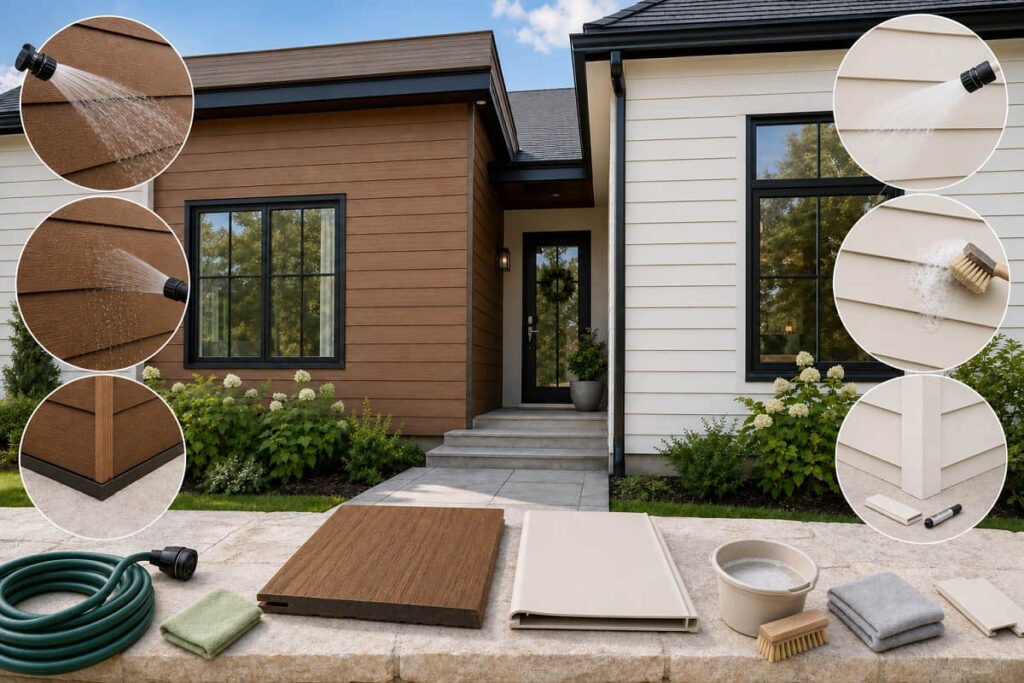
Use this yearly care list:
- Check panels, locks, clips, trim, sealant, and flashing.
- Clear leaves and soil from drainage points.
- Wash with a hose and mild soap when the maker allows it.
- Replace broken parts before water gets behind them.
Never assume pressure washing is safe. Follow the product care guide and keep the nozzle limits in writing. That little upkeep helps protect both the finish and warranty.
Which Siding Looks More Real?
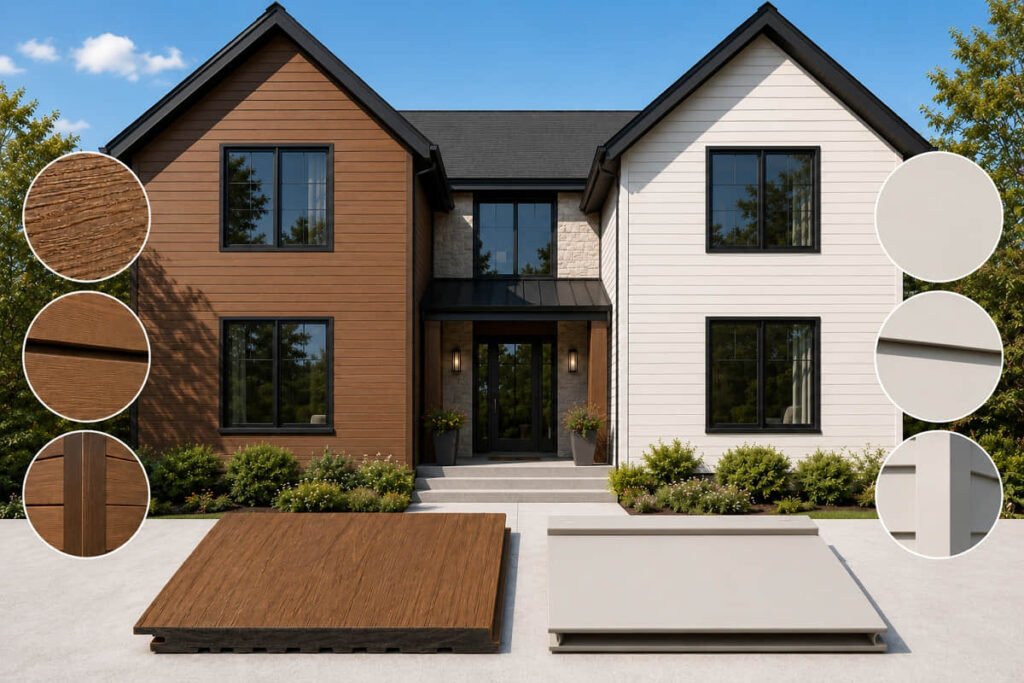
Composite often gets closer to the look of real wood. Its thicker face can hold deeper grain and sharper shadow lines. Vinyl offers a wide range of colors.
| Detail | Composite siding | Vinyl siding |
|---|---|---|
| Grain | Often deeper and less uniform | Molded grain varies by grade |
| Seams | Profile and layout control the result | Overlaps can show in side light |
| Corners | Custom trim can create a firm edge | Stock corner posts speed fitting |
| Color | Custom color may be available | Broad stock range of colors |
| Styles | Boards, slats, and groove profiles | Lap, shake, and board-and-batten looks |
Judge curb appeal with full-size samples. View them in sun, shade, and side light. For a fair test, place both samples at the same wall distance.
LastElegance offers Oakling and DecoGroove profiles, plus custom texture and color orders. Request free samples before approving a large facade.
Which Siding Saves More Energy?
Siding alone will not make a wall energy efficient. Cavity insulation, continuous insulation, and air sealing do more of the work. Insulated vinyl can add some tested R-value, but the gain varies by product.
The U.S. Department of Energy advises choosing insulation around climate, wall type, and needed R-value. Air sealing, thermal bridges, and WRB details also affect the full wall.
Compare the tested R-value for the whole wall, not just the outer panel. Be careful with utility-bill promises. Windows, roofing, HVAC, and air leaks may have a much larger effect.
How Does Installation Differ?
Vinyl panels are light and common crews know the system. Installers hang them through nail slots and lock each course. They must leave room for movement.
Some composite siding uses clips on steel battens or furring strips. Boards may weigh more, but hidden fasteners can create clean lines.
| Install step | Composite siding | Vinyl siding |
|---|---|---|
| Cutting | Standard tools may work; follow dust rules | Light cutting tools |
| Fastening | Clips or screws by profile | Nails through slots |
| Support | Battens may form a rainscreen | Often fastens over flat sheathing |
| Trim | System or custom trim | Broad stock accessory range |
| Main error risk | Wrong spacing or blocked drainage | Tight nailing or poor panel lock |
Your crew, wall prep, and site access will shape labor time. Build a small trial wall before you promise a daily production rate.
What Goes Behind the Siding?
If the job uses a rainscreen, the wall will often follow this order:
- Framing and cavity insulation.
- Structural sheathing where the design calls for it.
- A continuous WRB with sealed flashing.
- Steel battens or furring strips.
- A clear drainage and air gap.
- Clips, trim, and exterior siding.
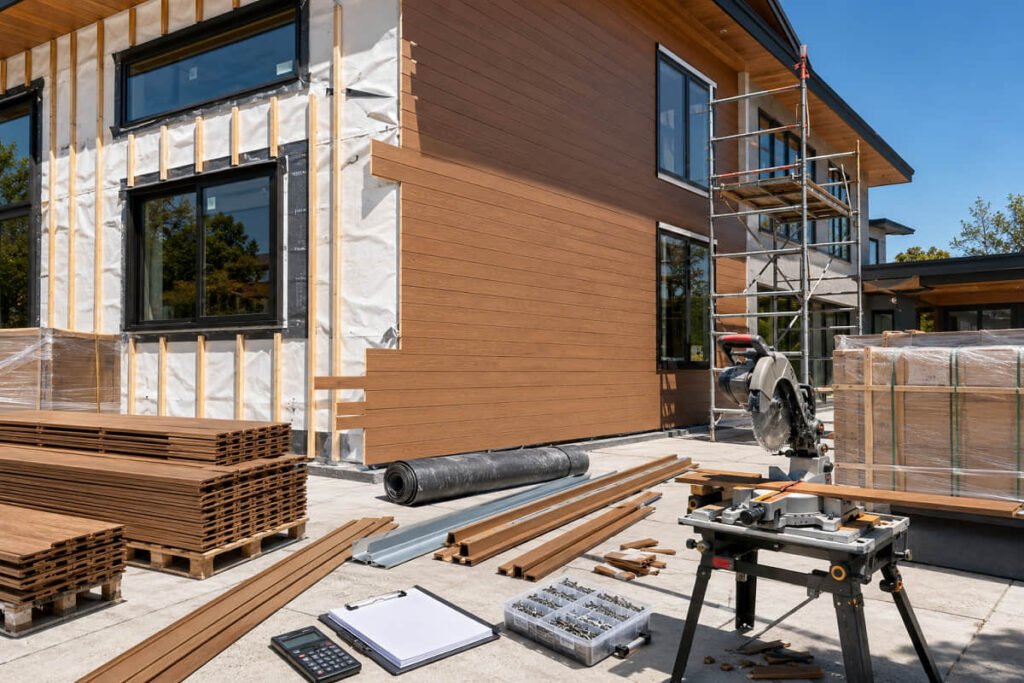
The local IRC or IBC still sets the rules. On higher-risk jobs, let the architect or engineer set the fire, wind, and weather details.
How Do Clip Systems Work?
LastElegance boards use a male-female interlock with hidden clips. The basic process is simple:
- Set straight battens over the flashed WRB.
- Fix the starter trim and first board.
- Secure each clip to the batten.
- Lock the next board into the prior edge.
- Check level, gaps, corners, and vents as work moves up.
The clips hide fasteners and help keep joints even. Batten spacing varies by profile, so verify the current drawing before takeoff.
Oakling boards measure 5.5 by 0.47 inches (140 by 12 mm). DecoGroove profiles measure 8.6 inches wide and 0.79 or 1 inch thick. Confirm the current profile drawing before ordering.
Which Siding Fits Your Project?
Vinyl fits many fast, budget-led jobs with short lead times. Composite can suit custom work, wood-look designs, and walls that face routine impact.
| Project need | Likely fit | Why |
|---|---|---|
| Entry-level residential build | Vinyl | Low first cost and local stock |
| Multifamily accent walls | Composite | Repeatable grain and custom profile options |
| Quick repair program | Vinyl | Common parts and trained local crews |
| Branded commercial facade | Composite | Custom color, texture, and shape |
| Energy-led retrofit | Tested full wall | Insulation and air sealing decide the result |
| Storm-prone site | Tested full wall | Wind approval matters more than material name |
Start with the budget, design, code, and service plan. A product that wins on one feature can still be the wrong fit for the wall.
What Should Trade Buyers Check?
Before you place a volume order, work through these points with the supplier:
- Landed cost, payment terms, MOQ, and delivery window
- Residential or commercial warranty coverage and claim steps
- ASTM D3679 or ASTM D7793 records for the selected vinyl product
- Fire, wind, water, UV, and impact reports for the exact wall system
- Flame Spread Index, Smoke Developed Index, and code evaluation documents
- Custom mold cost and color-control limits
- Approved fasteners, clips, battens, and trim
- Replacement stock and future color matching
- Technical data sheets, install guides, samples, and shop drawings
- Mockup review, a trial order, and batch color controls
LastElegance lists a standard MOQ of about 1,076 sq ft, and trial orders may be available. Before you buy, confirm the lead time, freight, warranty, and test scope with our sales team.
FAQs
Is Composite Siding Better Than Vinyl?
Composite siding may be better for deeper wood grain, rigid boards, and custom specs. Vinyl siding may fit a low first budget and quick local supply.
Is Composite More Costly Than Vinyl?
Composite siding often costs more upfront than vinyl siding. Compare the same installed scope, freight, repair plan, and overall cost per square foot.
Does Composite Last Longer Than Vinyl?
Both can last for decades when crews install them well. Compare exact warranties, weather tests, and repair records instead of broad lifespan claims.
Do Contractors Prefer Vinyl or Composite?
Crew skill, local stock, labor time, design, and budget shape the choice. The right siding also needs reliable replacement supply.
What Siding Needs the Least Care?
Both can need little upkeep. The finish, local weather, and ease of repair decide which stays low maintenance on your project.