

Choosing between composite fencing and wood fencing used to be simple. Wood was cheaper. End of discussion.
It’s not that simple anymore. Wood’s upfront price still wins on the bid sheet. But factor in stain cycles, board replacements, and a crew going back to re-set a leaning post — all unbilled — and the math flips. Over 15 years, a wood fence can cost twice as much as composite when you account for labor and materials.
This article breaks down composite fencing vs wood fencing on the numbers that drive your margins: installed cost, crew hours, lifecycle spend, and callback risk.
How the Materials Differ
Composite fencing blends recycled HDPE and wood fibers into boards through a co-extrusion process. Wood fencing is natural lumber — cedar, redwood, or pressure-treated pine — cut and milled into boards.
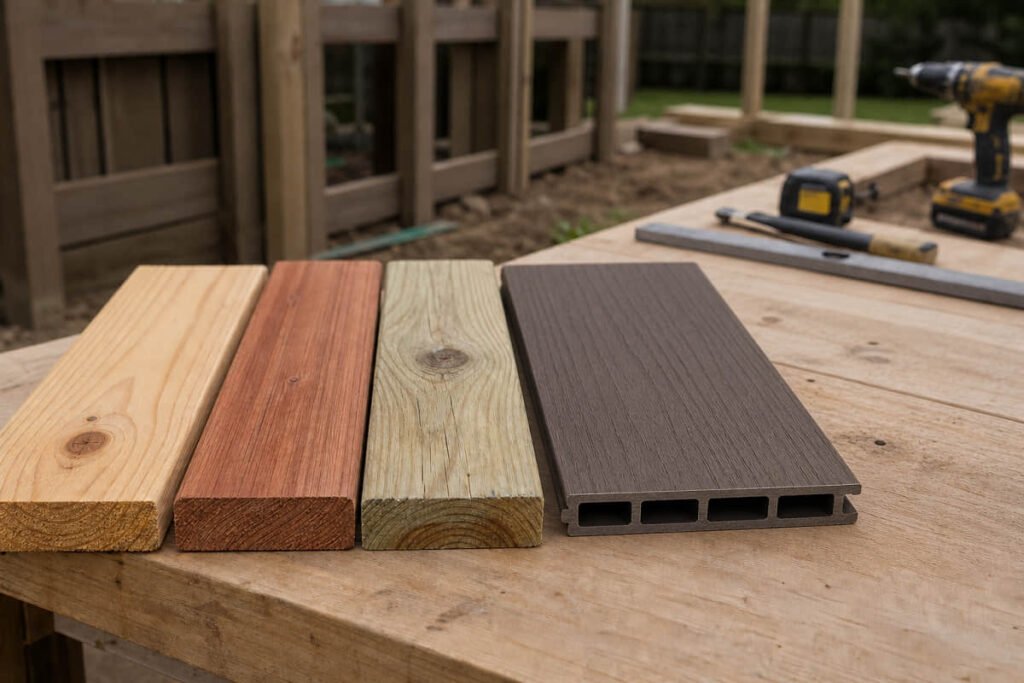
The key difference is protection. Capped composite wraps every board in a co-extruded cap layer on all four sides. On LastElegance boards, that cap is 0.8 mm (31.5 mils) thick — sealing the wood fiber core against moisture, UV, and insects. Traditional wood relies on surface treatments — stain, sealant, paint — that wear off every few years and need reapplying.
Not all composite is equal. Capped composite (four-sided protection) outperforms uncapped composite, which leaves some sides exposed. When comparing fencing materials, always ask whether the boards are fully capped. It’s a spec that drives long-term performance.
Our composite fence boards use HDPE at 0.95 g/cm³ density, with 60% recycled content (recycled HDPE + recycled wood fibers). The rest is virgin material to keep quality and color consistent across batches.
For a closer look at how composite fence boards are made, see our full guide to composite fencing.
How Wood Fencing Holds Up Over Time
Wood fences are popular for good reason. Cedar and redwood have a natural beauty that’s hard to match. Here’s what each type brings to the table:
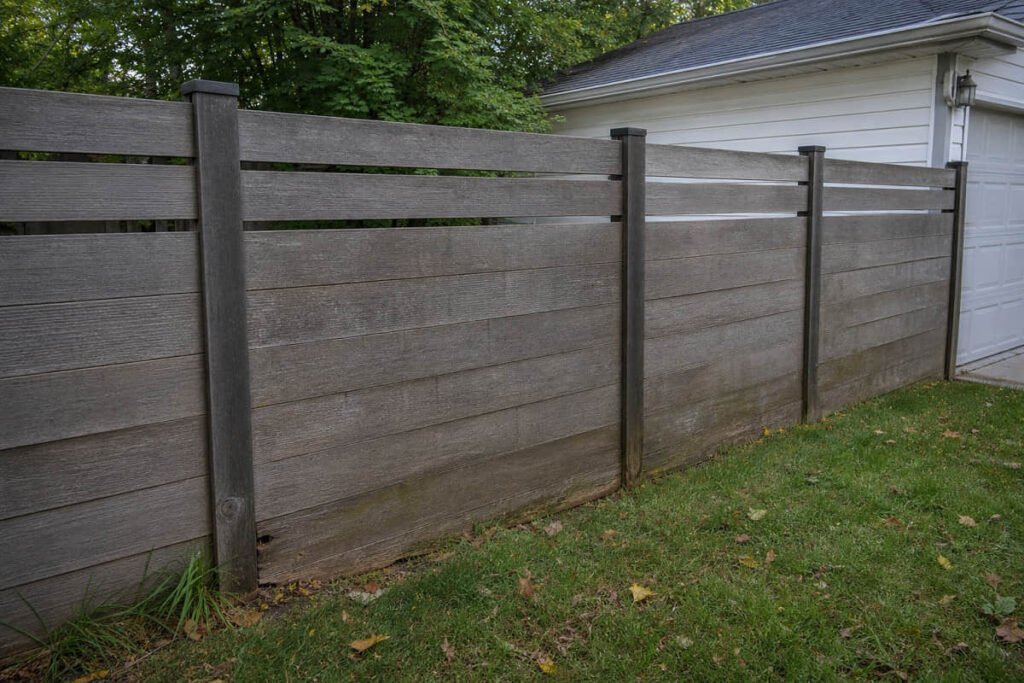
- Cedar — natural rot and insect resistance, rich color, pleasant scent. Still needs staining or sealing every 2–3 years.
- Redwood — similar resistance, tight grain, striking color. More expensive and harder to source in volume.
- Pressure-treated pine — the budget option. Chemical preservatives protect against rot and pests, but those chemicals raise concerns near gardens, play areas, or water features.
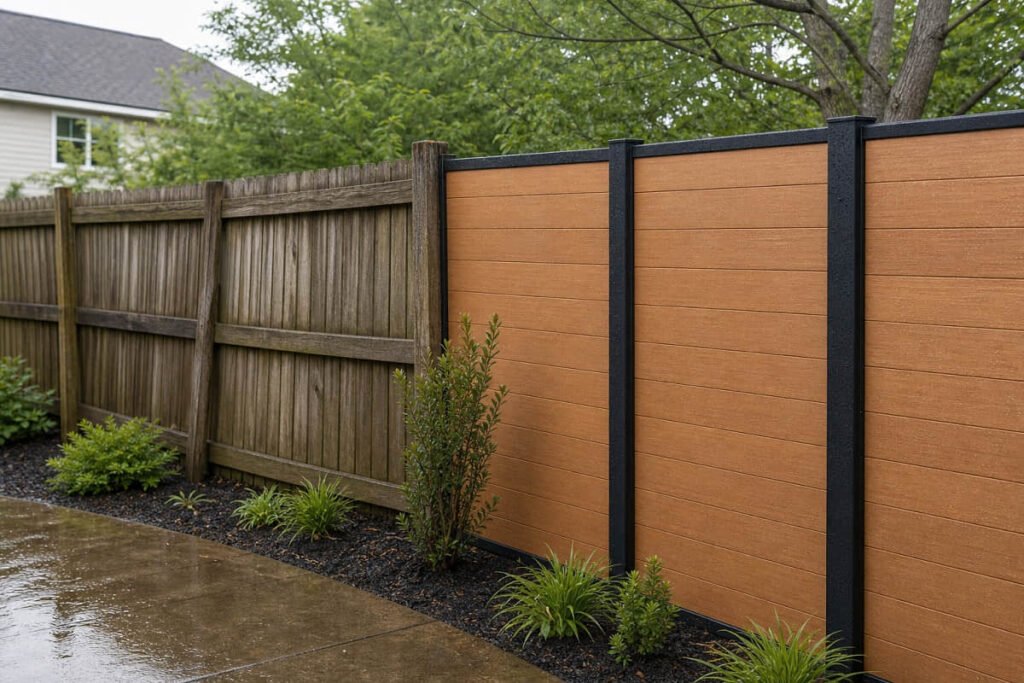
The trade-offs are real. All wood fences face rot, warping, and insect damage over time. Cedar and redwood resist these better than pine, but none are immune. Termites, carpenter ants, and moisture find weak points — especially at the post base, where ground contact is constant.
Durability: Which Fence Lasts Longer?
Composite fencing lasts longer than wood in nearly every category. Here’s how they compare side by side.
| Durability Factor | Composite Fencing | Wood Fencing |
|---|---|---|
| Lifespan | 20–30+ years, minimal upkeep | 10–20 years (depends on species and care) |
| Rot | Won’t rot — sealed cap layer blocks moisture | Rots over time, especially at post base |
| Moisture | Very low water absorption | Absorbs water, swells, and splits |
| UV | Holds color long term | Fades, grays, and bleaches without stain |
| Pests | Immune to termites and carpenter ants | Vulnerable — even treated wood gets hit |
| Mold and mildew | Resists growth on sealed surface | Prone in damp and shaded areas |
| Freeze-thaw | No cracking or splitting | Cracks as trapped moisture expands |
| Warping | Stays flat and straight | Warps and cups as boards dry unevenly |
A few numbers put this in context. Our composite boards tested at just 0.2% water absorption per ASTM D1037 — meaning moisture barely gets in. On UV, they hold to a color shift of ΔE ≤ 4–5 after 3,000 hours of QUV accelerated aging. In plain terms, the color you install is close to the color you’ll see years later.
Our distributors in the Gulf Coast and Sun Belt states see this play out every season. Composite fences hold up through hurricane rains and 100°F+ summers with no warping or rot. Wood fences in the same areas need constant attention. The Midwest freeze-thaw cycle is just as tough — trapped moisture expands inside the grain and splits boards from the inside out.
For commercial projects where fire compliance matters, our boards are rated Class C per ASTM E84 (Flame Spread Index: 85, Smoke Developed Index: 300). Check your local building code for specific needs — full test data is in our product spec sheets.
Our composite fencing carries a 15-year warranty covering surface cracking, warping, breakage, and color fading beyond spec.
Want to see and feel the difference? Request free samples →
Upkeep: Composite vs Wood Fencing
What does a composite fence need? Here’s the full list:
- Wash with soap and water once or twice a year.
- Rinse off dirt or debris as needed.
That’s it. No staining, no sealing, no painting. Composite fencing is low maintenance by design — the co-extruded cap layer protects the core, so there’s nothing to recoat.
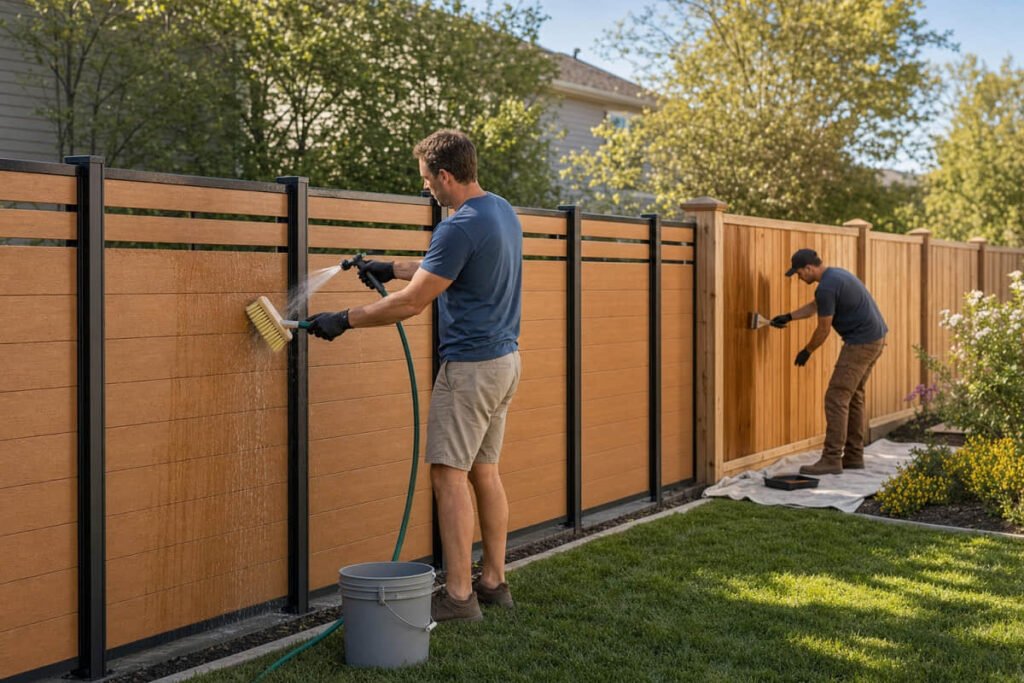
Wood fencing is a different story. The regular maintenance cycle looks like this:
- Staining or painting every 2–3 years
- Annual inspection for rot, mold, and pest damage
- Spot repairs for warped, cracked, or broken boards
- Post replacement when ground-level rot sets in
For builders and contractors, this matters beyond the install. A wood fence that needs a lot of upkeep means callbacks, warranty claims, and time spent on rework instead of new jobs. Composite cuts that cycle out. Install it, hand over the keys, and move on.
Over 15 years, staining alone can run $3–$5 per linear foot per cycle on a wood fence. Add repairs and board replacements, and it’s real money your client didn’t budget for. That’s why total cost of ownership — not just the sticker price — should drive the material choice.
Cost Per Linear Foot: Breaking It Down
Composite fencing costs more upfront. That’s a fact, and there’s no point hiding it.
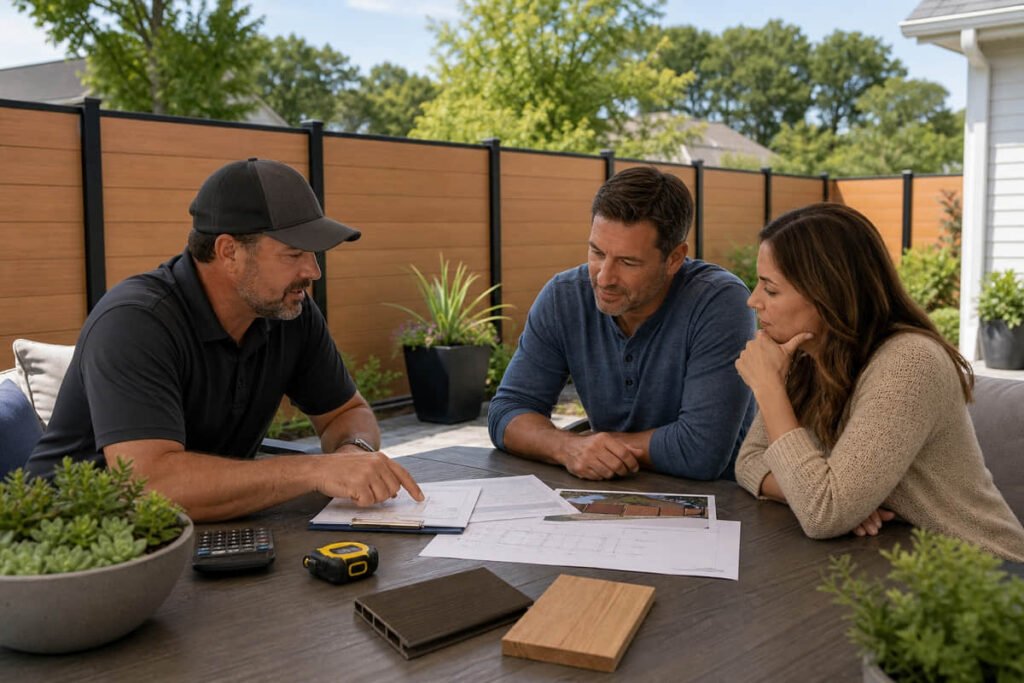
Here are general installed cost ranges based on U.S. market averages (prices vary by region, wood species, and project scale):
- Wood fencing: roughly $15–$25 per linear foot installed
- Composite fencing: roughly $25–$45 per linear foot installed
The gap narrows when you look at total cost of ownership (TCO). Here’s a rough scenario: 100 linear feet of fence over 15 years.
| Cost Factor | Wood Fence | Composite Fence |
|---|---|---|
| Initial install | $1,500–$2,500 | $2,500–$4,500 |
| Staining/sealing (every 2–3 years) | $1,500–$2,500 | $0 |
| Repairs and board replacement | $500–$1,500 | $0–$200 |
| Full replacement (year 12–15) | $1,500–$2,500 | $0 |
| 15-year total | $5,000–$9,000 | $2,500–$4,700 |
Note: These are estimates based on U.S. market averages. Actual costs depend on your region, project scope, and material choices.
Over 15 years, wood often costs more. Over 20 years, it almost always does — because you’re likely paying for a full replacement plus a second round of maintenance on the new fence.
A well-kept fence can also add 2–5% to a property’s curb appeal and resale value. Composite’s lasting look — no fading, no warping, no patchy stain jobs — holds that value without ongoing spending.
For distributors and volume buyers, the upfront gap can shrink further. Manufacturer-direct sourcing — buying straight from the factory instead of through layers of distribution — brings composite fencing costs down. That’s a real edge for large-scale builders pricing competitive bids.
Style and Design Options
Wood fences offer natural beauty and the freedom to paint or stain any color you want. You can cut picket tops, arch a gate, or shape a custom profile on site. For homeowners who want a specific look, wood gives the most hands-on control.
Composite fencing takes a different approach. Colors and textures are set at the factory, which means every board matches — and stays matched. No fading, no uneven weathering, no patchy stain jobs.
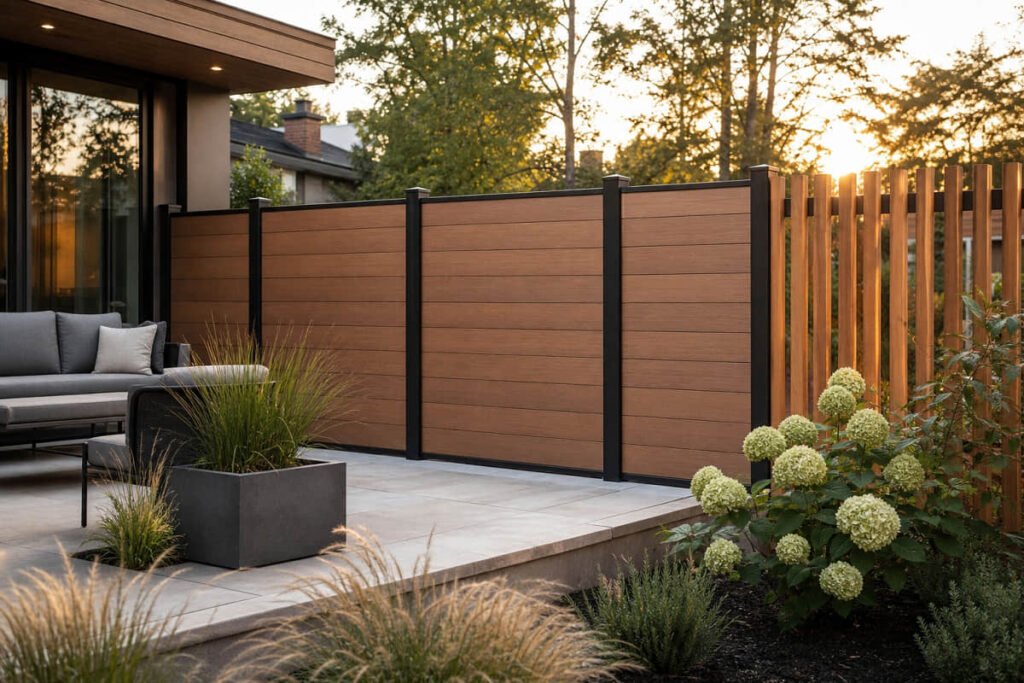
Composite works well for privacy fence designs, horizontal slat screens, and semi-privacy styles. Our fencing range includes board widths from 3.5″ to 8.6″, giving designers real flexibility in spacing and pattern. Because the color is locked in by the UV-resistant cap layer, what you install is what your client sees years later.
There’s also a practical edge on repair jobs. Replace a composite board five years in, and the new piece matches the old ones. Replace a weathered wood board, and you get a visible patch that stands out against the grayed-out neighbors. For builders whose name is on the project, that consistency matters.
The trade-off is on-site shaping. You can’t cut an arched top or a decorative picket into a composite board the way you can with wood. But for clean-line modern designs, composite gives you more consistent results with less labor.
For distributors building their own product lines, LastElegance offers custom colors, textures, profiles, and lengths — all produced to your specs. That lets you create a branded fencing line without the R&D cost. Add volume pricing with no middle-layer markup, and you’ve got an offer that off-the-shelf brands can’t match. Contact our team to discuss white-label and private-label programs.
See our color and texture options — Order free samples →
How Installation Compares on Site
The installation process is where composite saves real labor hours.
Composite fencing uses a clip-based slot-in system. Set the posts, slide boards into place, and apply trim strips. No nailing each board one by one. No pre-drilling. No field-finishing. A two-person crew can move through a job fast with fewer tools.
Our system uses aluminum alloy posts or WPC (wood-plastic composite) posts — both resist rot and rust. We recommend post spacing of 32″–56″ on center, depending on wind exposure and fence height.
Wood fencing means attaching each board to rails, aligning, leveling, and often applying a coat of stain or preservative after install. It’s slower, and the finish work adds time.
Here’s the thing most people overlook: wood posts are the weak link in any fence. Most rot starts at the post, right at ground level. Aluminum and WPC posts remove that failure point entirely.
Composite boards are also lighter per linear foot than most wood boards, which speeds up handling and cuts crew fatigue on long runs. The hidden fasteners keep the face clean — no visible screws or nail heads.
Wind and Weather Performance
This is where most comparisons stop short. Wind load matters — especially in Florida, the Gulf Coast, the Carolinas, and the high-wind plains states.
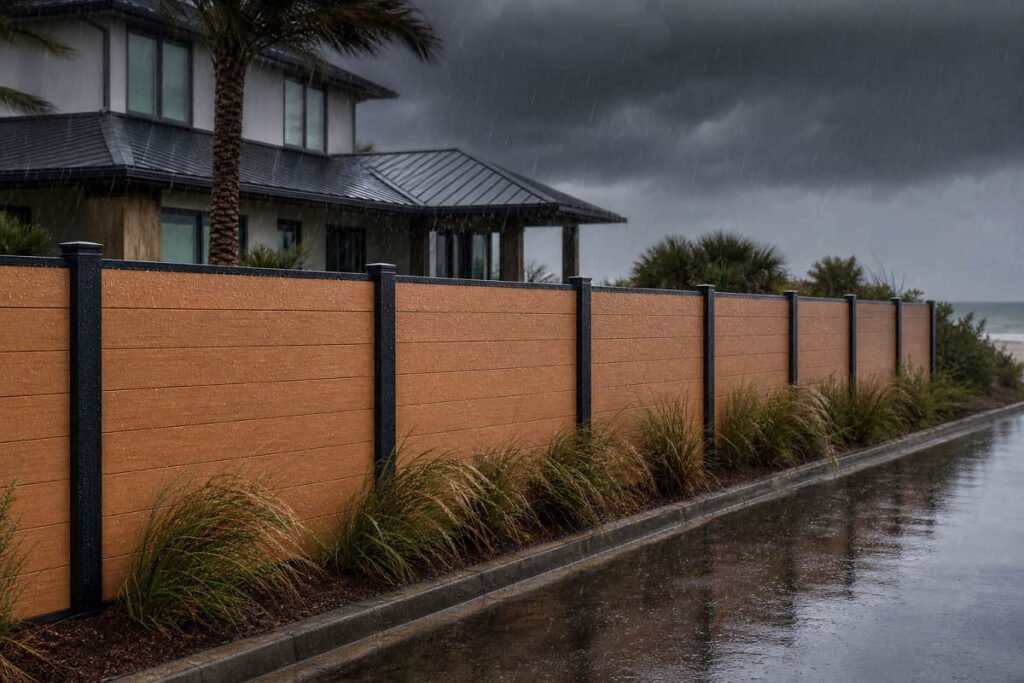
Post spacing is the main factor in wind resistance. Tighter spacing means a stronger fence:
- High-wind zones (hurricane-prone, coastal): 32″–40″ on center
- Standard areas: 40″–56″ on center
- Maximum spacing (sheltered sites only): 63″ on center
These are our recommended spacings. For projects that need formal wind load analysis, we can provide engineering data per ASCE 7 standards on request.
That low water absorption rate (0.2% per ASTM D1037) pays off here too. The boards don’t swell, warp, or split — even after heavy rain or weeks of high humidity. The fence keeps its shape through storm after storm.
Wood boards soak up water. They swell, then dry and shrink. Over cycles of heavy rain and sun, they crack, cup, and warp. The damage adds up fastest at the post base, where ground moisture is constant.
Which Is Better for the Planet?
Composite fencing gives recycled materials a second life. Our boards are made from recycled HDPE and wood fibers — 60% recycled content overall. That’s plastic and wood fiber diverted from landfills.
Composite also needs no paint, stain, or chemical treatments over its lifespan. Fewer chemicals going into the ground and the air over 20+ years is a real benefit.
Wood is a natural, renewable resource — but sourcing matters. Pressure-treated lumber puts chemical preservatives into the soil at the post base. FSC-certified wood is the cleaner option, yet it’s still the exception in most fencing supply chains. And every wood fence that rots out and gets replaced means more trees cut for the next one.
A fence you replace twice uses twice the raw material. One that lasts 25+ years uses half. That math works in composite’s favor.
Our composite products hold ISO, RoHS, and SGS certifications. Formaldehyde testing per EN 717-1 shows levels as “not detected.”
Neither material is perfect. But composite’s recycled content, long lifespan, and zero chemical upkeep give it an edge on overall impact.
Composite vs Wood vs Vinyl: Quick Look
Many buyers weigh all three fencing materials before deciding. Here’s how they stack up:
| Factor | Composite | Wood | Vinyl |
|---|---|---|---|
| Look and feel | Natural wood-grain texture | Real wood — the most natural | Smooth plastic appearance |
| Durability | 20–30+ years | 10–20 years | 15–25 years |
| Maintenance | Soap and water only | Staining, sealing, repairs | Low — but cracks in cold |
| Cold weather | Stays stable | Cracks from freeze-thaw | Brittle — can shatter on impact |
| Color options | Wide range, fade-resistant | Any color (with stain/paint) | Limited factory colors |
| Structural rigidity | High | High when new, drops with age | Lower — flexes in wind |
| Post type | Aluminum or WPC (rot-proof) | Wood posts (rot-prone) | Wood posts (rot-prone) |
Vinyl fencing is low maintenance, but it has clear limits. It turns brittle in cold climates, looks plastic up close, and still relies on wood posts — which rot. Composite gives you a more natural appearance with greater rigidity and better color retention than vinyl.
Wood remains a popular choice for its natural beauty and on-site flexibility, but the upkeep costs put it at a disadvantage over the long run.
How to Choose the Right Material
The right fencing material depends on what matters most for your project.
Choose composite if you need low maintenance, long lifespan, and consistent looks — for both home and commercial projects. It’s the stronger long-term value, especially when ongoing upkeep costs are a concern.
Choose wood if budget is the top priority and you’re willing to commit to regular maintenance. Wood is still a solid option for projects where the natural look is worth the extra care.
If you’re a distributor or large-scale builder, look at manufacturer-direct composite suppliers. Custom colors, profiles, and lengths — plus volume pricing without layers of markup — make it easier to build a competitive product line. For volume orders, lead times on manufacturer-direct composite typically run 6–8 weeks to U.S. ports. Plan ahead on large projects, and the cost savings more than offset the wait.
Before ordering materials, check your local building codes and any HOA CC&Rs. Some homeowners associations restrict material types or fence heights. Composite fencing is accepted in most cases, but confirming early avoids delays on-site.
The best fencing material is the one that fits your project’s budget, timeline, and long-term goals. For most commercial and residential projects where lifespan and low upkeep matter, composite fencing is the stronger pick.
Ready to talk specs and pricing? Contact our sales team →
FAQs
What are the downsides of composite fencing?
Composite costs more upfront than wood. You can’t cut custom shapes like picket tops or arched gates on site. Color options are factory-set — though manufacturers like LastElegance offer custom colors on bulk orders.
Does composite fencing offer better privacy than wood fencing?
Both materials can deliver full privacy. The difference shows up over time: composite boards keep a tight, even fit because they don’t warp or shrink. Wood boards gap as they dry, which can reduce privacy within a few seasons.
Why is composite fencing more expensive than timber?
The production process costs more — blending recycled plastics and wood fibers through co-extrusion is more complex than sawing and treating lumber. But the long-term savings on maintenance, repairs, and early replacement offset that higher upfront cost for most projects.
Can you paint or stain a composite fence?
You generally don’t need to — the color is built into the cap layer and resists fading for years. Some composite boards can be painted if you want a color change, but doing so adds a maintenance step and removes the “zero upkeep” benefit.
Is composite fencing good for high-wind areas?
Yes — with the right post spacing. For hurricane-prone and coastal zones, we recommend 32″–40″ on center. Standard areas can go up to 56″. Engineering data per ASCE 7 is available on request for projects that need formal wind load analysis.
Does composite fencing need a building permit?
Most local jurisdictions require fence permits regardless of material type. Height limits, setback rules, and HOA restrictions can all apply. Always check your local building codes and any CC&Rs before starting a project.
Can composite fence boards be cut to custom lengths?
Yes. Composite boards can be cut on site with standard tools. For bulk orders, we produce boards to custom lengths at the factory — saving on-site labor and cutting waste.