

A customer asks for composite decking. Then they ask if you mean HDPE, PVC, or PP.
If you sell or install composite decking materials, you’ve probably gotten that question. Each resin has real trade-offs — in cost, lifespan, and how it handles heat. There’s no single right answer. The best fit depends on the project, the climate, and the budget you’re working with.
This guide breaks down HDPE, PVC, and PP side by side, so you can match the right material to the right job — and explain the choice with confidence.
What’s the Difference Between HDPE, PVC, and PP Decking?
HDPE composite blends wood fibers with recycled HDPE plastic. It’s the most common type of composite decking on the market today.
PVC decking skips wood fiber entirely. It’s a fully synthetic, vinyl-based board — sometimes called wood-free decking.
PP decking uses polypropylene, a lighter and less common plastic blend. You’ll mostly find it in lighter-duty or budget-driven boards.
Here’s how the three compare on the specs that matter most:
| Feature | HDPE Composite | PVC | PP |
|---|---|---|---|
| Wood content | Yes — wood fiber + HDPE | None — fully synthetic | Low or none |
| Typical density | 0.95–1.1 g/cm³ | 1.3–1.5 g/cm³ | 0.9–0.95 g/cm³ |
| Weight | Medium-heavy | Heaviest | Lightest |
| Best general use | Most residential and commercial decks | Pool decks, high-end builds | Light-duty, budget projects |
Still deciding whether composite is the right call before you pick a resin? Our guide to composite building materials compares composite against wood, vinyl, and fiber cement as a category.
Which Decking Material Lasts the Longest?
PVC tends to have the edge on raw lifespan, since it has zero wood-fiber decay risk. HDPE composite comes close, but its long-term performance depends on the cap layer doing its job.
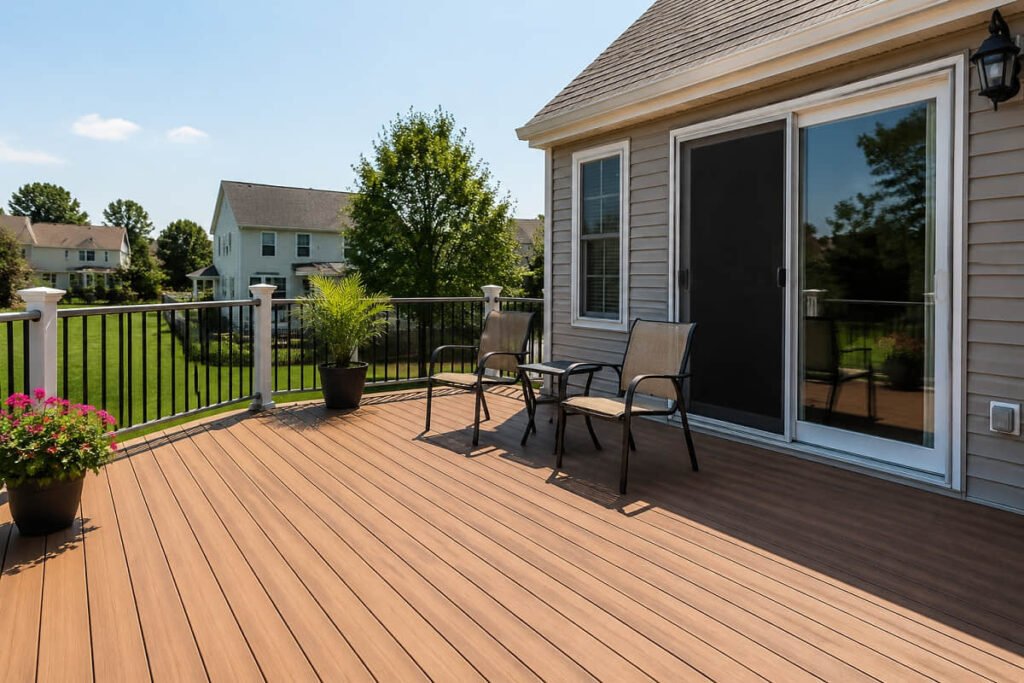
A capped HDPE board wraps a protective polymer shell around the wood-fiber core. That shell — not the wood fiber — takes the UV and weather exposure. LastElegance tests its cap layer through 3,000 hours of QUV accelerated aging under ASTM G154, with color shift held to a ΔE of 4–5 or better. That’s a strong result for a wood-fiber product.
PP boards are the wild card here. They’re newer to the market and used less, so there’s less long-term field data to point to. If a supplier can’t show you weathering test results for their PP line, treat that as a gap — not a guarantee of poor performance, just an unknown.
Bottom line: PVC and well-capped HDPE composite both deliver decades of service. PP is the least proven of the three.
How Much More Does PVC Decking Cost Than Composite?
PVC usually costs the most of the three. PP tends to be cheapest. HDPE composite sits in the middle.
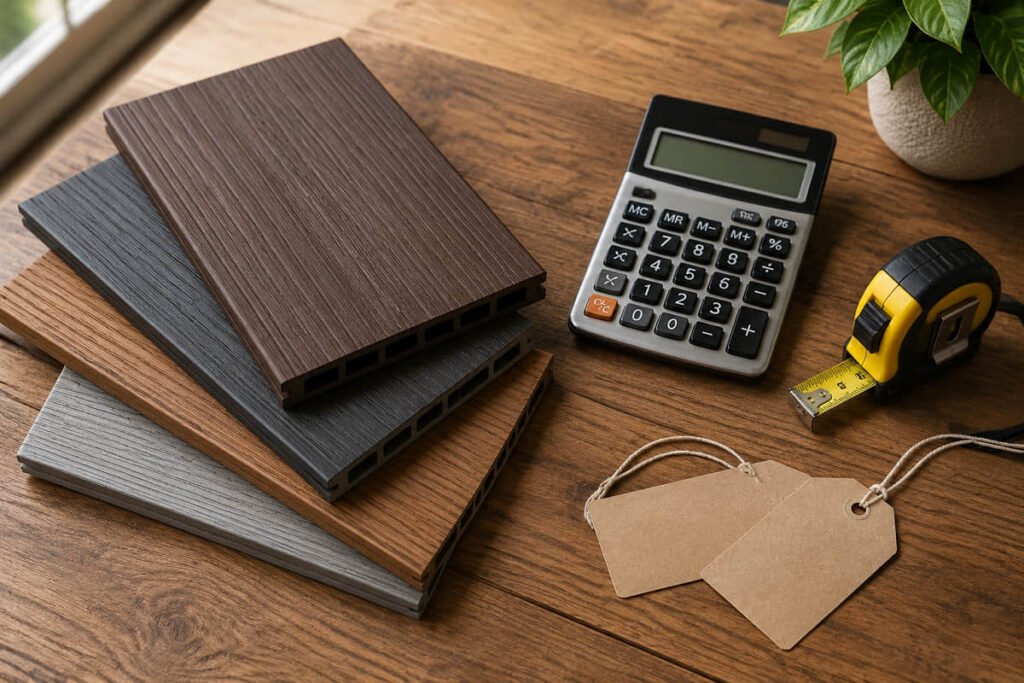
The gap comes down to materials and process. PVC requires more synthetic resin per board and a different extrusion setup, which raises the manufacturing cost. HDPE composite uses recycled content alongside wood fiber, which helps control raw material cost without cutting performance.
| Factor | PP | HDPE Composite | PVC |
|---|---|---|---|
| Material cost | Lowest | Mid-range | Highest |
| Typical price per sq ft | $ | $$ | $$$ |
| Labor cost to install | Similar across all three | Similar across all three | Similar across all three |
| Lifecycle cost over 20+ years | Varies — depends on brand quality | Often the best balance | Lower upkeep, higher upfront |
Labor costs don’t shift much by material — install speed is closer across all three than buyers expect. The real cost story is lifecycle cost: a cheaper PP board that needs early replacement can cost more over 20 years than a mid-priced HDPE composite board.
For buyers comparing landed cost, sourcing model matters too. Manufacturer-direct production — where one company controls the resin blend, the cap layer, and the finishing — removes a layer of markup that distributors usually pass through. That’s one factor in total cost, not the only one.
How Do HDPE, PVC, and PP Hold Up in Heat and Direct Sun?
All three materials get hot in direct sun, and all three expand and contract with temperature changes. That’s true for both composite and PVC decking — it’s physics, not a manufacturing flaw.
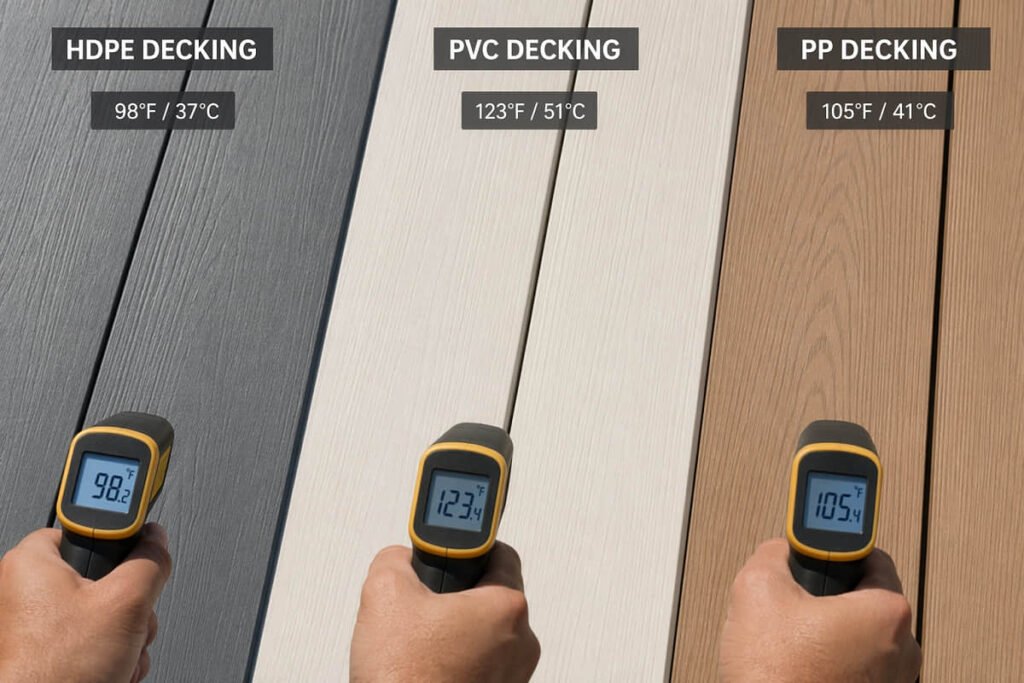
PVC formulations vary. Some run cooler underfoot than composite, but PVC can also soften more in extreme heat compared to HDPE composite. HDPE composite holds its color well when the UV stabilizer system is solid — LastElegance uses a combined HALS (Hindered Amine Light Stabilizer) and UV absorber system, backed by the ΔE 4–5 result mentioned above.
PP has the least published heat-performance data of the three. If you’re specifying for a high-heat region — Texas, Arizona, Florida — ask your PP supplier directly for fade and softening test results.
Yes, gapping matters for both composite and PVC. Boards need room to move with temperature swings. LastElegance recommends a 5–8 mm (about 3/16″–5/16″) end-to-end gap on HDPE composite, adjusted for board length and climate. Always check your supplier’s gapping spec before install — it’s not the same across every brand.
Coastal and high-UV jobs benefit from materials with documented weathering data. Direct sun exposure over years is where the cheaper options tend to show their age first.
Which Material Needs the Least Maintenance?
Here’s the quick ranking, from least to most upkeep:
- PVC — needs almost no maintenance, since there’s no organic content to protect or treat.
- HDPE composite — needs an occasional wash but no staining or sealing, thanks to the cap layer.
- PP — varies widely by manufacturer quality; some lines need more frequent cleaning to avoid mildew growth on lower-grade boards.
The real upkeep savings show up over time, not on day one. None of these materials need the recoating cycle that wood decking requires every two to three years. That’s a real labor-cost savings for any contractor managing multiple properties or a distributor selling to property managers.
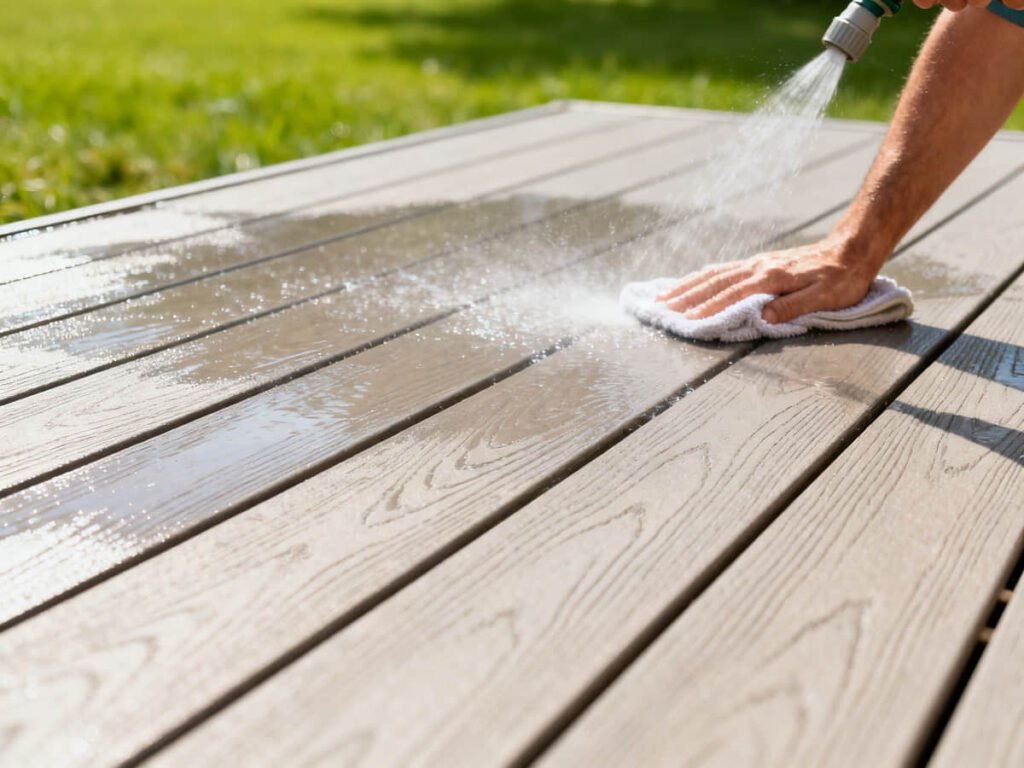
Minimal maintenance is the headline. But “minimal” still depends on board quality, not just resin type — a poorly capped HDPE board can underperform a well-made one.
Best Decking Material for a Pool Deck
For pool decks, prioritize slip resistance and moisture handling over anything else. Both matter more here than on a standard backyard deck.
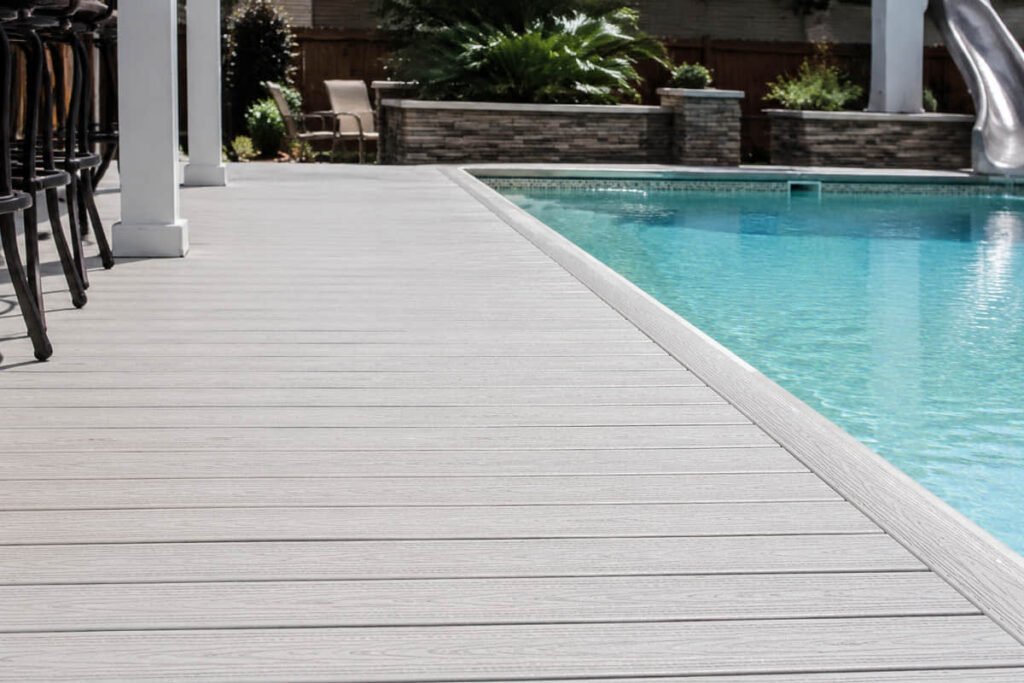
PVC’s fully synthetic build resists moisture absorption well, which makes sense for a surface that’s wet often. HDPE composite can perform just as well around pools, but only with a verified slip-resistance rating — don’t assume every composite board qualifies. LastElegance decking is rated R11 under DIN 51130, with results consistent with ASTM C1028 expectations for wet, barefoot traffic areas.
PP’s pool-deck performance is the least documented of the three. If a supplier pitches PP for a pool job, ask for slip-resistance test data before specifying it.
Whatever material you choose, ask every supplier for their slip-resistance test results — by name, not just a marketing claim. A rated R11 board and an untested board can look identical on a spec sheet until someone slips.
Which Material Do Contractors Prefer — and Why?
Preference comes down to job type more than brand loyalty.
Our distributors report a clear pattern: PVC gets specified for high-end builds and pool-adjacent projects, where the fully synthetic build is the selling point. HDPE composite wins the projects balancing cost and performance — it’s the default pick for most residential and mixed-use jobs. PP shows up mostly in lighter-duty or budget-constrained work.
Install crews give HDPE composite high marks for workability — it cuts and fastens similarly to traditional wood decking, with no extra tools needed. That’s a real time-savings on job sites used to working with lumber.
Common callback patterns also differ by material. Heavy-traffic commercial decks tend to favor solid-core HDPE composite for added rigidity. Outdoor living spaces with lighter foot traffic have more flexibility on board choice. This varies by region and project type, so treat it as a general pattern, not a fixed rule.
What Makes a Good HDPE Composite Board?
If you’ve already chosen HDPE, the next step is judging board quality — not picking between materials anymore. Here’s a checklist of specs worth verifying with any supplier:
- Cap layer thickness: Look for at least 0.8 mm (about 31.5 mils) of full four-side encapsulation. LastElegance boards meet this benchmark.
- Recycled content ratio: Ask for the exact split between recycled and virgin HDPE. LastElegance uses a 60% recycled content blend.
- UV stabilizer system: Confirm whether the board uses HALS, UV absorbers, or both — this drives long-term color retention.
- Fire rating: Request the ASTM E84 classification. LastElegance composite decking tests at FSI 85 / SDI 300, rated Class C.
- Water absorption data: Ask for ASTM D1037 results. Lower numbers mean better resistance to soaking up water over time.
These specs tell you whether a board is built to last — not just priced to sell. View our full composite decking product.
Picking a good board is only half the job. Once you know what to look for in the material itself, the next step is vetting the manufacturer behind it. Our guide to vetting a composite decking supplier walks through exactly that.
FAQ
Is HDPE the same as composite decking?
No. Composite decking is the broader category — boards made from wood fiber and plastic. HDPE is just one resin option used inside that category, alongside PVC and PP.
Is composite or PVC decking better?
It depends on your budget, climate, and project type. Use the comparison sections above to match your priorities — cost, lifespan, or maintenance — to the right material.
Is PVC decking worth the extra cost over composite?
For buyers who want zero organic content and the most stable long-term color, yes. For budget-sensitive or large-volume residential projects, HDPE composite delivers strong performance for less.
Are there environmental advantages to HDPE, PVC, or PP decking?
HDPE composite typically uses the highest recycled content of the three — LastElegance’s blend runs 60% recycled material. That figure matters for buyers tracking LEED documentation.
Does the appearance of HDPE, PVC, and PP decking differ?
Yes. HDPE composite generally has a more natural wood-grain look and texture. PVC tends to look more uniform and synthetic. PP appearance varies more by brand, since quality control differs widely across suppliers.
Need board-level specs before you decide? Request a custom quote to compare HDPE composite options side by side.