

Wood rots, warps, and needs repainting. Composite building materials solve all three problems — across three product categories that matter to every contractor and distributor: decking, siding, and fencing. This guide gives you the specs, comparisons, and sourcing facts you need to make the right buying decision.
What Are Composite Building Materials?
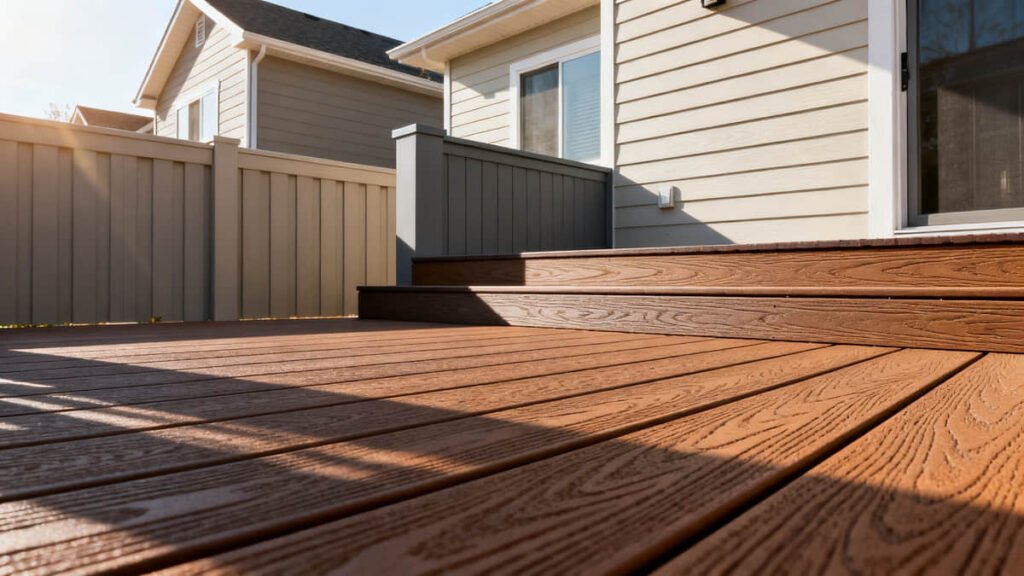
Composite building materials combine two or more materials to outperform either one alone. Wood-plastic composite (WPC) is the most common type for exterior use. It blends wood fibers with recycled HDPE plastic, compressed into boards under heat and pressure.
A co-extrusion process then wraps the wood-fiber core in a 0.8 mm (31.5 mil) polymer cap layer on all four sides. That cap blocks moisture, UV radiation, and insects before they reach the core. Our boards use hardwood fiber sourced from Guangxi, China, HDPE at a density of 0.95 g/cm³, and a 60% recycled content ratio. The other 40% is virgin material — added to keep color and quality consistent across every production batch.
The result is a board that holds up outdoors like plastic — and looks like natural wood.
Where Can You Use Composite Materials?
Composite building materials cover three main exterior applications:
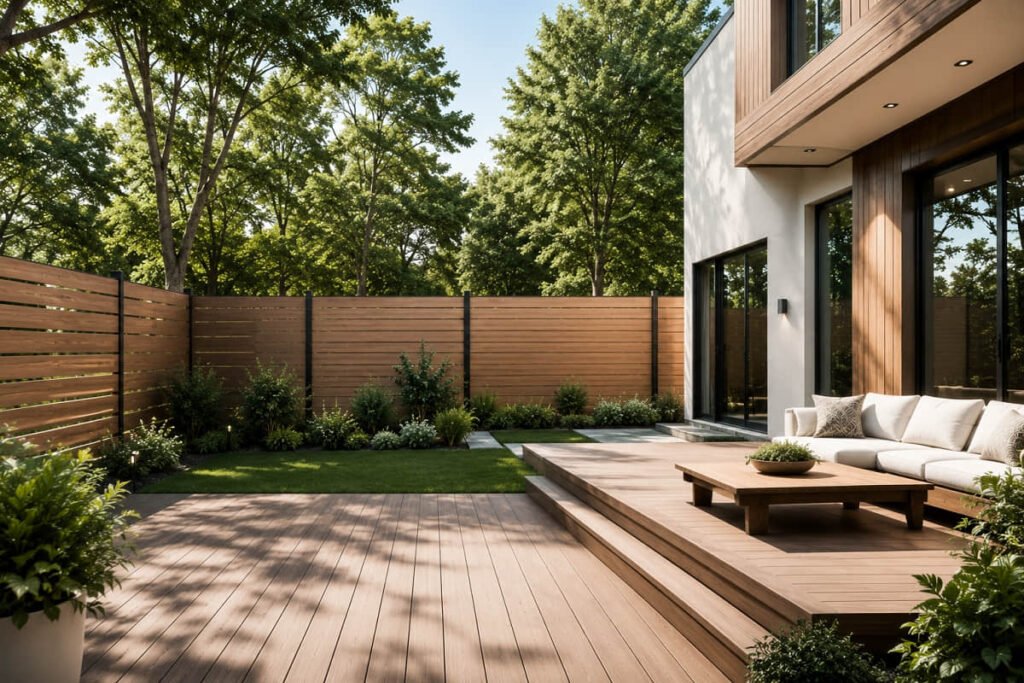
- Composite decking — surface boards for outdoor floors and platforms
- Composite siding and wall cladding — exterior wall finish systems for new builds and retrofits
- Composite fencing and privacy screens — privacy panels, screen systems, and perimeter fencing
All three categories use the same core WPC technology. The profiles and installation methods differ.
Composite Decking: Boards, Profiles, and Spans
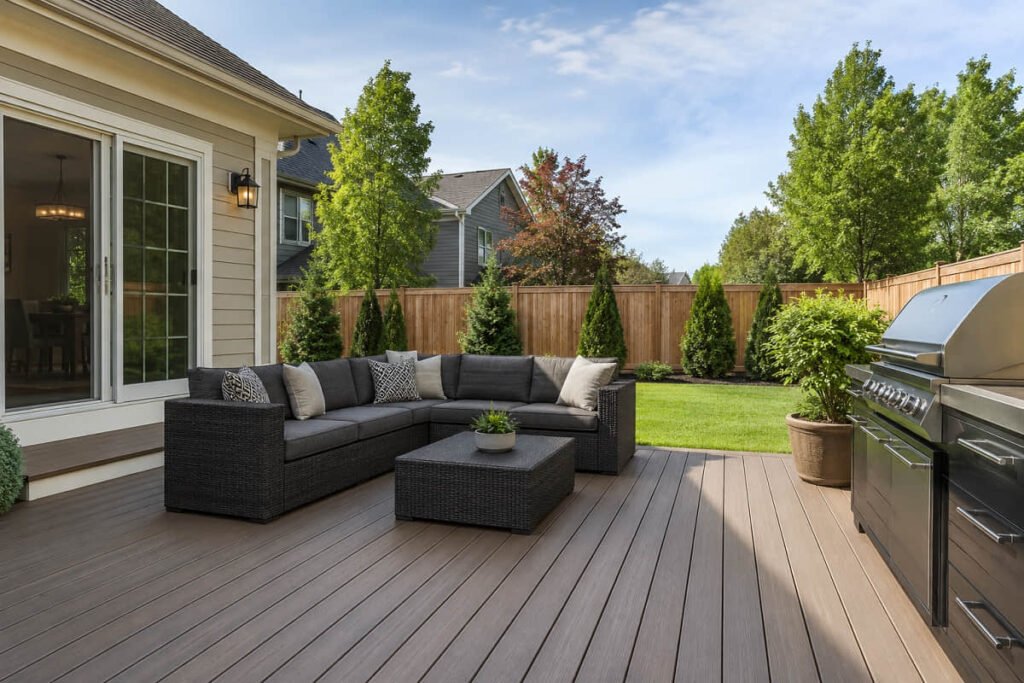
Board widths run from 5.4″ to 5.9″ (138–150 mm). Thicknesses range from 0.79″ to 0.98″ (20–25 mm). Both solid and hollow profiles are available. Solid boards are the right call for high-traffic commercial builds. Hollow profiles are lighter — a good fit for residential decks where load requirements are lower.
Flexural strength is 26.2 MPa (~3,800 psi) per EN 15534. Recommended joist spacing is 12″–14″ on center (300–350 mm) per IRC guidance. All installations should comply with local building codes and the IRC or IBC as applicable.
The standard install uses a hidden clip fastener system. Clips slot into the board’s side grooves and secure to the joists. The next board slides in, locks the clips, and leaves no visible screws on the surface. An experienced crew typically runs 150–200 sq ft per hour, depending on deck layout.
Labor costs are a real part of every project budget. That installation speed matters.
Composite Siding: Cladding Your Exterior Walls
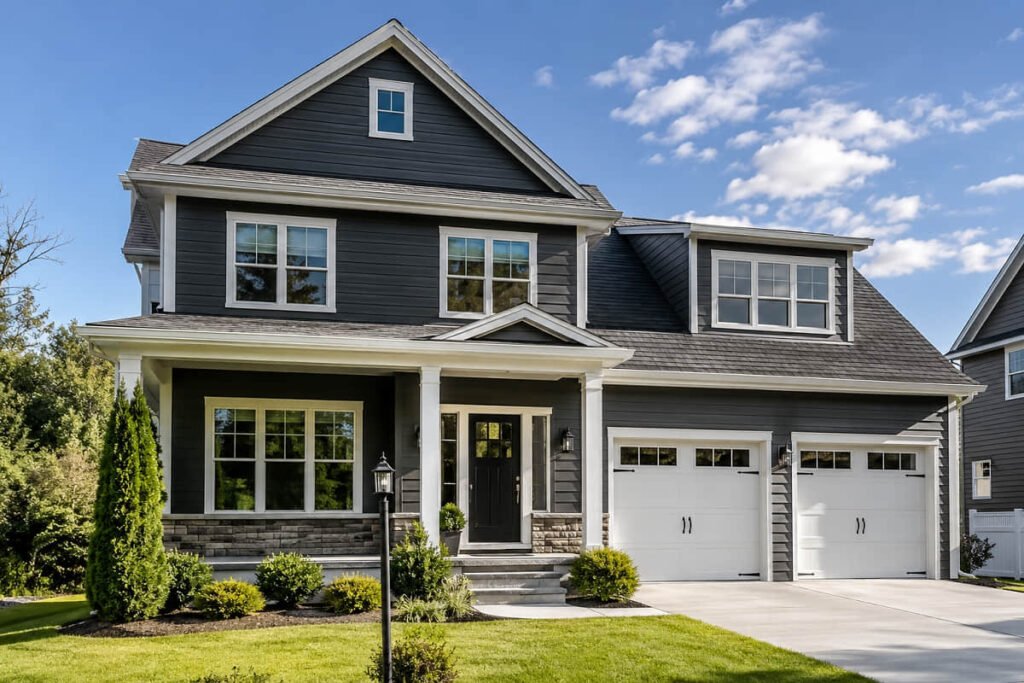
Composite siding — also called composite cladding or composite wall cladding — is a lightweight exterior wall finish system. The standard board is 140 × 12 mm (5.5″ × 0.47″). A male-female interlocking clip system handles the install. No face nailing. No exposed fasteners.
Boards go over steel battens spaced 12″–16″ on center (300–400 mm). A weather-resistive barrier (house wrap) sits behind the battens — required by U.S. building codes for exterior wall assemblies. The batten system creates a natural rain screen gap for drainage and ventilation.
Our siding range shares the same color palette as our decking, so you can match a facade and deck on the same project with no color coordination headaches. That design continuity matters on multi-family and hospitality builds.
Versus fiber cement siding: composite is lighter, needs no silica-dust cutting, and arrives ready to install — no field painting required. Versus engineered wood siding: fully waterproof, no swelling risk if moisture barriers are ever compromised, and no chemical insect treatment needed. Versus traditional wood siding: no annual staining, no rot risk, and consistent visual appeal over decades.
Composite Fencing: Privacy Panels and Screens
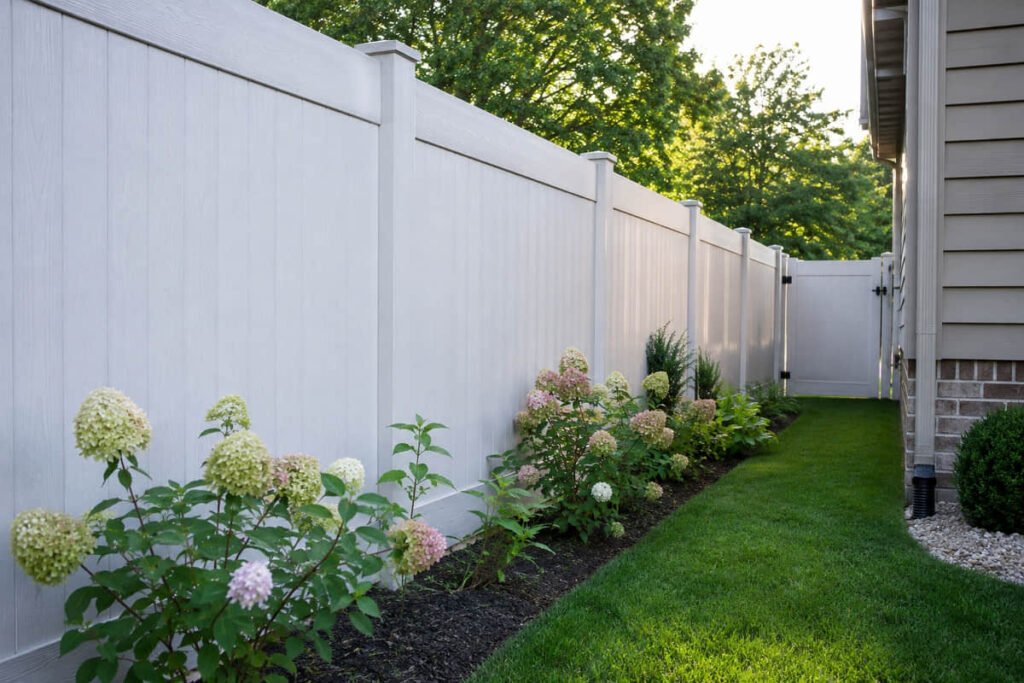
Composite fence boards run from 3.5″ to 8.6″ wide (90–219 mm). That range covers full-privacy panels and semi-open slat designs. Multiple widths give you real design flexibility — you’re not locked into one look.
Install is straightforward: set posts, slot in boards, apply trim. No specialist tools needed. Recommended post spacing is 32″–56″ on center (0.8–1.4 m), with a hard max of 63″ (1.6 m). Closer spacing means greater wind resistance.
In high-wind zones — Florida, the Gulf Coast, the Plains — use 32″–40″ spacing. Contractors we work with in Texas and along the Gulf Coast consistently spec the tighter spacing on any exposed site.
Posts are available in aluminum alloy or WPC. Engineering calculations per ASCE 7 wind load requirements are available for specific project configurations on request.
Why Composite Beats Traditional Wood Outdoors
Here’s where composite building materials prove their value. Against traditional wood — cedar, redwood, pressure-treated pine — composite wins on five fronts:
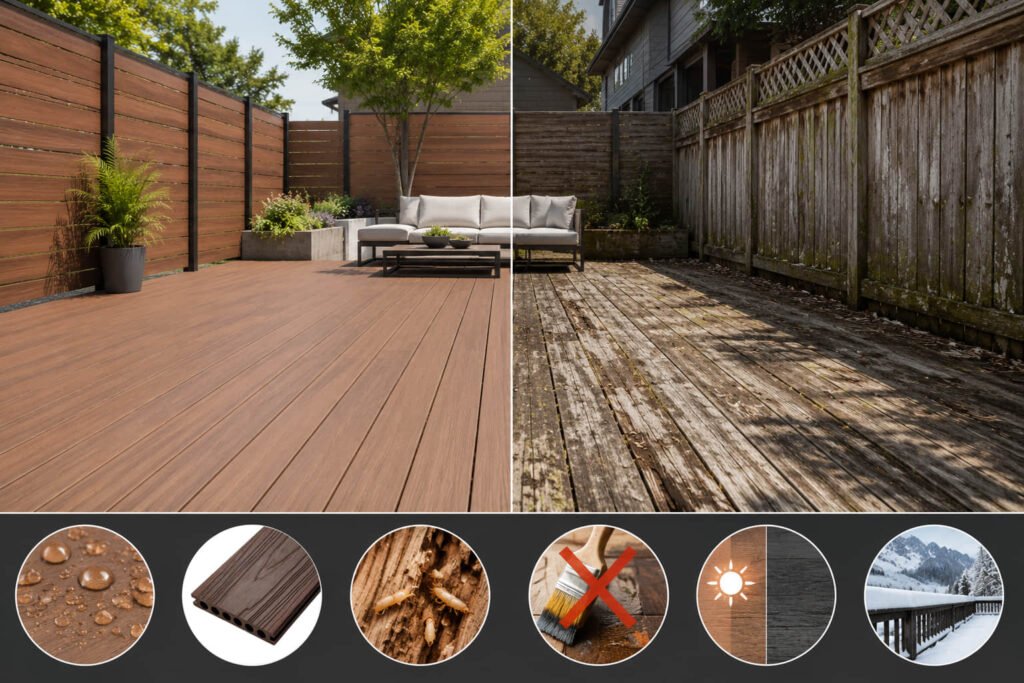
- No rot or warping. Composite boards are waterproof. Water absorption is just 0.2% per ASTM D1037. Natural wood can soak up 20–30% of its weight in moisture over time.
- No insect damage. The polymer cap layer means no exposed wood fiber at the surface. Termites can’t reach the core. No insect infestations, no chemical treatments.
- No regular staining or sealing. Traditional wood siding and decking need recoating every 1–3 years. Composite needs none. That’s a big saving in both upkeep costs and contractor callbacks.
- Stable color in high-UV conditions. After 3,000 hours of QUV accelerated aging per ASTM G154, color shift is ΔE ≤ 4–5. That’s solid color retention for Sun Belt markets. Builders in Florida and along the Gulf tell us consistent color is one of the top reasons clients choose composite over wood siding.
- Reliable slip resistance. R11 rating per DIN 51130 — suitable for wet areas, pool surrounds, and commercial builds where curb appeal and safety both matter.
Composite also handles temperature changes better than wood. Boards expand and contract with the seasons. Proper end-to-end gapping — 5–8 mm (3/16″–5/16″) — keeps that movement manageable. Wood is less predictable — it warps, checks, and splits under repeated freeze-thaw cycles. That’s a structural integrity concern in Northern markets.
One trade-off worth naming: composite runs a higher upfront material cost than pressure-treated pine. The long-term picture is different — no recoating, no rot repairs, no insect treatments over 25–30 years. But the upfront number is real. Factor it into your bids honestly and let clients weigh the lifetime cost themselves.
Composite vs. Wood vs. Fiber Cement: Side by Side
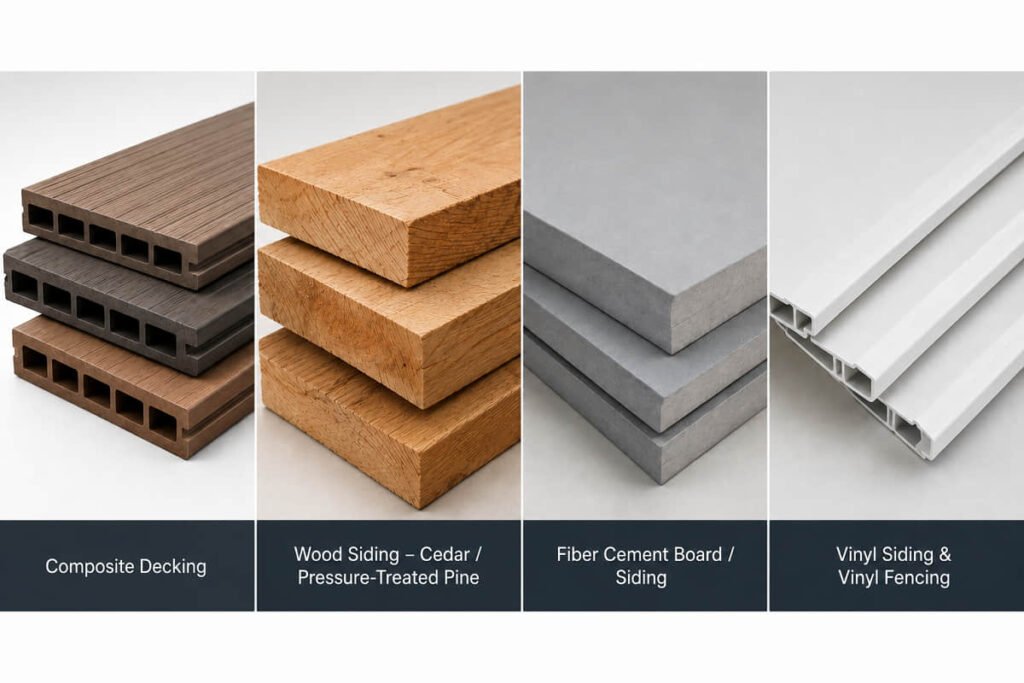
| Feature | Composite WPC | Traditional Wood | Fiber Cement | Vinyl |
|---|---|---|---|---|
| Durability | High — waterproof, rot-proof, insect-proof | Moderate — rots without treatment | High — won’t rot | Moderate — can crack in cold weather |
| Upkeep | Minimal — wash once or twice a year | High — stain or seal every 1–3 years | Moderate — repaint every 5–10 years | Low — occasional wash |
| Install speed | Fast — clip and slot system | Slower — individual nailing and screwing | Slower — heavy boards, specialist cutting | Fast — snap-lock systems |
| Fire rating | ASTM E84 Class C | Varies — typically Class C–D untreated | ASTM E84 Class A | Varies — typically Class A |
| Customization | High — custom color, profile, texture, length | Low — standard lumber sizes | Low — fixed sizes | Low — limited colors |
| Lifespan | 25–30+ years | 10–20 years (with consistent upkeep) | 30+ years | 20–30 years |
| Cost tier | Mid — higher upfront, lower lifetime | Low upfront, high lifetime | Mid-to-high | Low-to-mid |
How Much Upkeep Do Composite Materials Need?
Very little. A simple wash with soap and water once or twice a year is all it takes to keep composite decking, composite wall cladding, and composite fencing clean. No painting. No staining. No sealing. No annual checks for rot or insect damage.
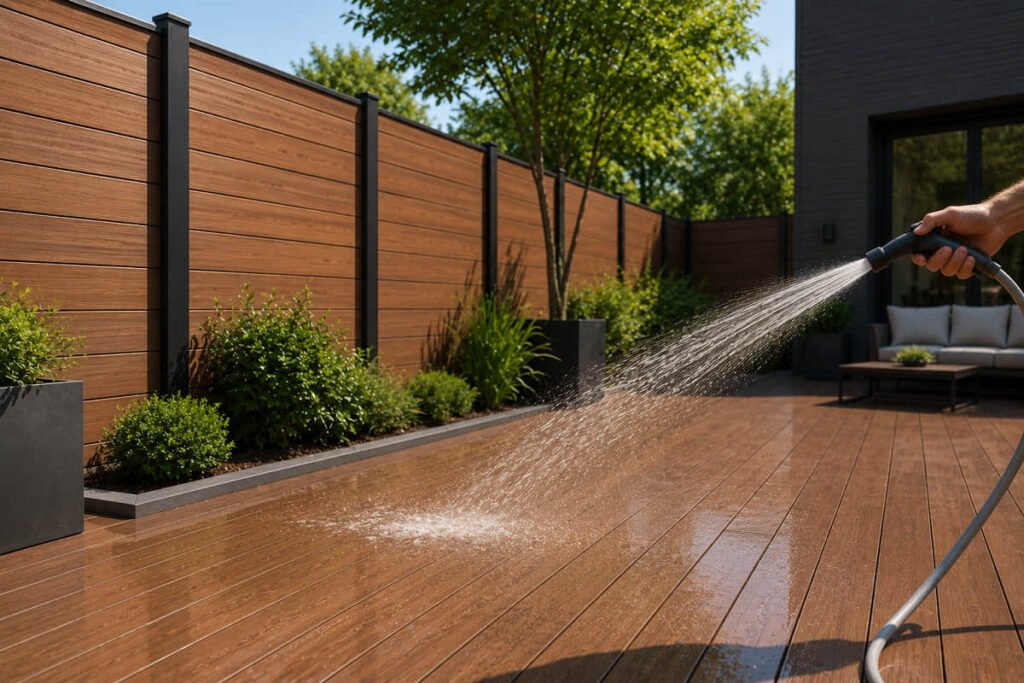
The reason is the co-extrusion cap layer. The 0.8 mm polymer cap fully encloses the wood fiber core on all four sides. Moisture and UV can’t reach the wood inside — so the surface never needs the treatments that keep traditional wood standing.
Cedar and pressure-treated pine work differently. Both need staining or sealing every 1–3 years to stay protected. Skip a cycle and the wood starts soaking up water — which leads to warping, cracking, and eventually rot. That’s a recurring cost and a recurring callback risk. Composite cuts out that whole category of rework.
The minimal maintenance also adds up over a building’s lifetime. Less material used in treatments. Less labor on site. Lower energy use over the building’s life. That’s a real sustainability advantage — one that holds up in whole-life building assessments.
What Does Composite Siding and Decking Cost?
We don’t publish list prices here — every project is different. But here are the three factors that drive your total cost:
- Initial cost of materials — composite runs higher than pressure-treated pine, in the same range as quality cedar or engineered wood siding. That gap narrows when you source factory-direct.
- Installation labor — composite installs faster than wood. Clip systems cut labor time per linear foot. That offsets some of the material premium on larger jobs.
- Lifetime cost of ownership — no recoating, no rot repairs, no insect treatments over 25–30 years. For commercial projects with long hold periods, that’s a smart investment calculation.
We make our products in our own factory in China and ship them straight to U.S. distributors and contractors. This means we cut out the importers and resellers who normally add extra costs along the way. This means distributors pay less — without giving up on material quality.
What to Look For in Composite Building Materials
Use this checklist when evaluating any composite product for specification or distribution. It covers the factors that separate quality composite cladding from cheaper alternatives.
- Cap layer thickness and coverage — 0.8 mm (31.5 mils) minimum. Look for four-sided full encapsulation. Three-sided capping leaves the bottom edge exposed to moisture, which cuts into long-term structural integrity.
- UV stabilizer system — HALS (hindered amine light stabilizers) combined with UV absorbers is the gold standard. UV absorbers alone offer less protection in high-sun markets. Ask for the QUV test results (ASTM G154) and look for ΔE ≤ 5 after 3,000 hours. We’ve seen suppliers skip this documentation on large orders. That’s a red flag — push for the actual test report before you commit.
- Fire rating — verify ASTM E84 Class A, B, or C against your local building code. Class C covers many exterior residential applications. Commercial and multi-family projects often need Class A or B.
- Slip resistance — R11 per DIN 51130 or DCOF ≥ 0.42 per ANSI A326.3 for ADA-sensitive projects. Pool decks, hospitality terraces, and commercial exterior floors need this verified before you spec.
- Recycled content — 60% or above supports LEED project documentation. Ask for the exact ratio. Vague “eco-friendly” claims aren’t enough for formal green building submissions.
- Certifications — CE, ISO, RoHS, and SGS are solid baseline credentials. For California projects, ask about CARB Phase 2 formaldehyde status. For commercial specs, ask whether an ICC-ES evaluation is available or in progress.
A supplier that can back all six points with actual test reports is low risk. One that can’t is high risk on large volume orders — especially for commercial buildings where proper installation and code compliance are audited.
FAQ
Do composite building materials look like real wood?
Modern co-extruded composites use embossed woodgrain textures and deep color tones that closely replicate the look of wood. The surface is consistent — no knots, grain variation, or weathering streaks. That’s an advantage for large commercial facades where uniformity matters, but buyers who want authentic wood character should know the difference before they spec.
Can composite siding be installed over existing exterior walls?
It depends on what’s behind the existing cladding. Composite siding installs over a steel batten subframe — the existing wall needs to be structurally sound, with a weather-resistive barrier in place. In most retrofit jobs, the old cladding comes off first. Have a licensed contractor assess the wall assembly before starting.
What fire rating do composite building materials carry?
LastElegance composite products are tested to ASTM E84 and rated Class C — Flame Spread Index: 85, Smoke Developed Index: 300. Class C suits many exterior applications. Some commercial projects and local building codes require Class A or B — verify your jurisdiction before specifying.
How much recycled content is in composite decking?
LastElegance composite boards contain 60% recycled material — recycled HDPE and recycled wood fiber. The remaining 40% is virgin material, which keeps board quality and color uniform across batches. The 60% ratio can support LEED project documentation where recycled building materials are a credit category.
What warranty covers composite building materials?
LastElegance products carry a 15-year warranty. It applies under normal use and correct installation — not damage from improper install or misuse. Factor that gap into your total cost of ownership evaluation alongside the landed price difference.
Are composite materials right for commercial projects?
Yes — composite decking, siding, and fencing all fit multi-family residential, hospitality, and light commercial builds. For high-traffic commercial decking, solid-profile boards are the right call over hollow ones. For commercial siding where fire or code requirements apply, verify the ASTM E84 class and local jurisdiction rules before you spec. We can provide engineering documentation to support project submissions on request.