

A repaint contract on a commercial facade can run into six figures — every five to seven years. That’s the real cost most facade decisions miss.
Shiplap composite siding skips that cycle. Wash it with soap and water — that’s the maintenance plan. No paint, no caulk, no recoat schedule.
That’s why more architects and developers spec it for hotels, retail, and multi-family builds. This guide covers the specs, how it stacks up against wood, fiber cement, vinyl, and steel, real cost over a 20-year hold, and how it performs in tough climates — including salt air.
What Is Composite Shiplap Siding?
Composite shiplap siding is an exterior wall paneling product built from an HDPE and wood fiber core. Our boards use a 0.8 mm cap layer that wraps all four sides. That cap layer handles UV, moisture, and stains — no field painting needed.
The shiplap profile uses an interlocking joint. Each board overlaps the next. That creates a tight seal and a clean shadow line across exterior walls.
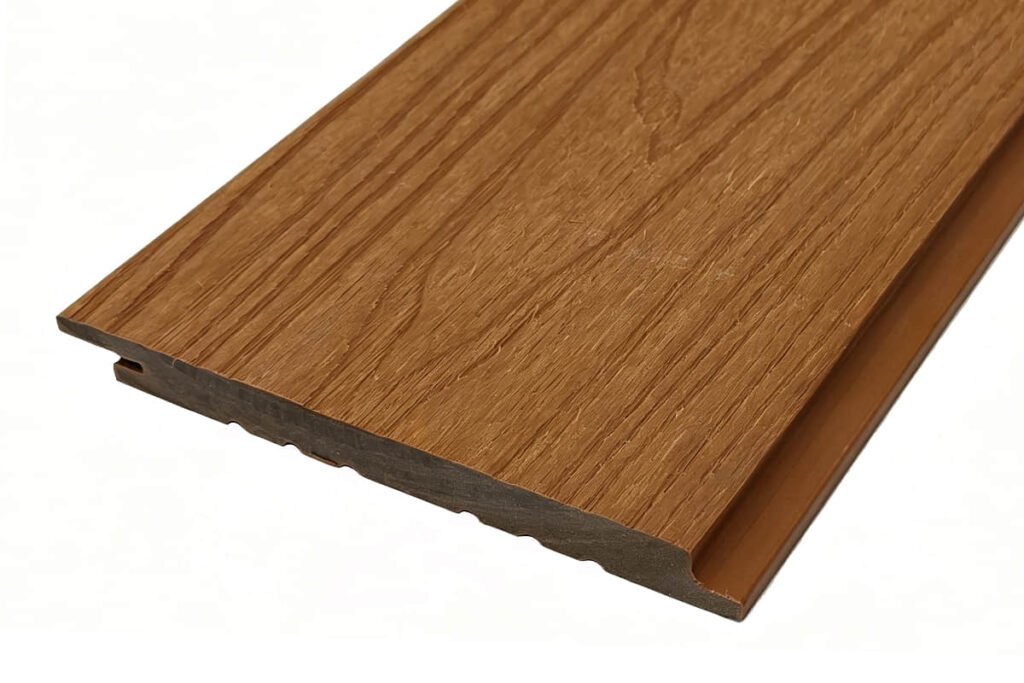
Our standard board size runs 5.5″ × 0.47″ (140 × 12 mm). Custom sizes are available on request.
This isn’t vinyl siding. It isn’t fiber cement, either. The composite core gives it real structural rigidity — something plastic composite alone can’t match.
See full specs → Oakling composite siding product page
Key Benefits for Commercial Buildings
Commercial buyers care about four things: moisture resistance, low maintenance, long lifespan, and curb appeal that holds up over time. Composite shiplap delivers on all four.
- Moisture resistance: Water absorption tests at 0.2%, per ASTM D1037. We’ve seen coastal wood decks swell within a single humid season — composite doesn’t move the same way.
- Slip resistance: Commercial walkways generally need a Dynamic Coefficient of Friction (DCOF) of 0.42 or higher to meet accepted wet-traction standards. Our boards rate R11 per DIN 51130 / AS/NZS 4586 — built for wet and barefoot areas, including pool surrounds and entrance zones.
- Color retention: After 3,000 hours of QUV accelerated aging (ASTM G154), color shift holds at ΔE ≤ 4–5. Our distributors in Texas and Arizona see steady color across sun-facing facades, even after a full summer.
- Fire performance: ASTM E84 groups products into Class A, B, or C by flame spread. Our boards test at FSI 85 / SDI 300 — Class C, which suits many exterior commercial uses. Wildfire zones and other strict fire codes should still get a check from local code officials before you spec any exterior material.
How It Holds Up in Harsh Weather
Three U.S. climate zones stress exterior walls the most: Sun Belt UV, coastal salt air, and northern freeze-thaw cycles. Composite shiplap holds up in all three.
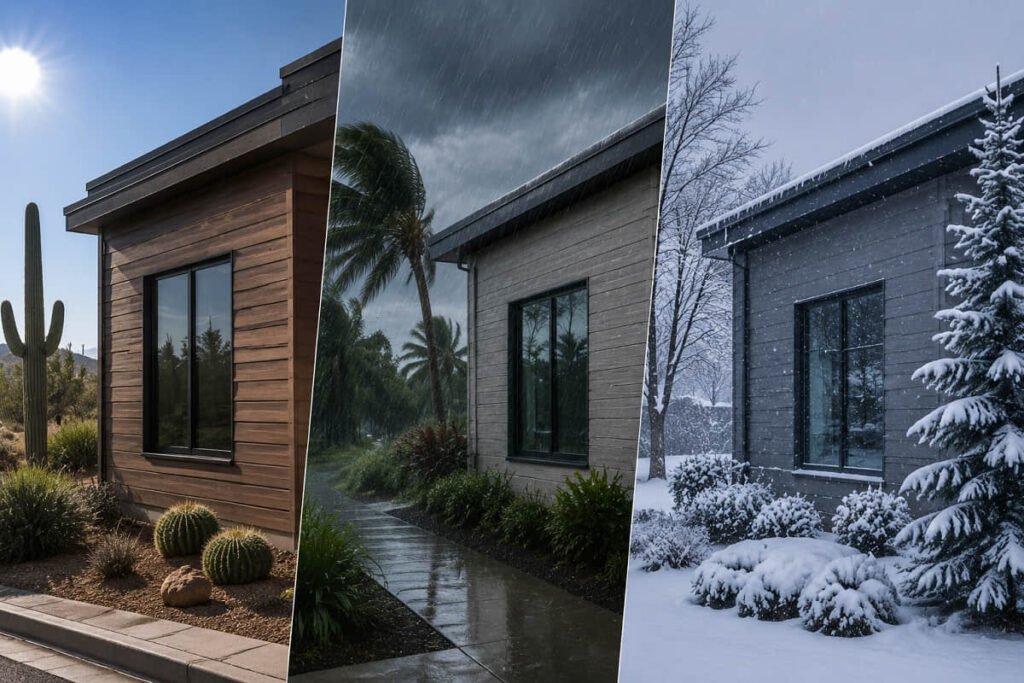
The cap layer uses a HALS plus UV absorber system. It keeps color stable through intense sun. Our distributors in Texas and Arizona see steady results across high-heat installs.
Natural wood absorbs moisture. It warps and rots in coastal conditions. Fiber cement can soak up water once its paint layer fails. Composite avoids both problems. We’ve tested absorption at 0.2%, and it holds steady across all three zones.
In freeze-thaw zones, that low absorption matters even more. Water that can’t get into a board can’t freeze and crack it.
Salt Air and Coastal Hardware Wear
Salt spray doesn’t just fade a facade. It attacks the hardware behind it.
On coastal jobs, the clips and fasteners take the real beating. Standard steel corrodes fast in salt air, and a corroded clip can loosen a whole row of boards over time.
Our hidden clip system uses stainless steel. That’s a direct answer to salt exposure — no rust bleed on light-colored siding, no clip failure a few years in.
The board core itself doesn’t corrode, since it’s plastic and wood fiber, not metal. So on a coastal project, hardware grade matters as much as board grade. Always confirm stainless clips are specified, not just stainless-looking ones.
Maintenance and Warranty
Here’s the upkeep calendar for three common siding materials.
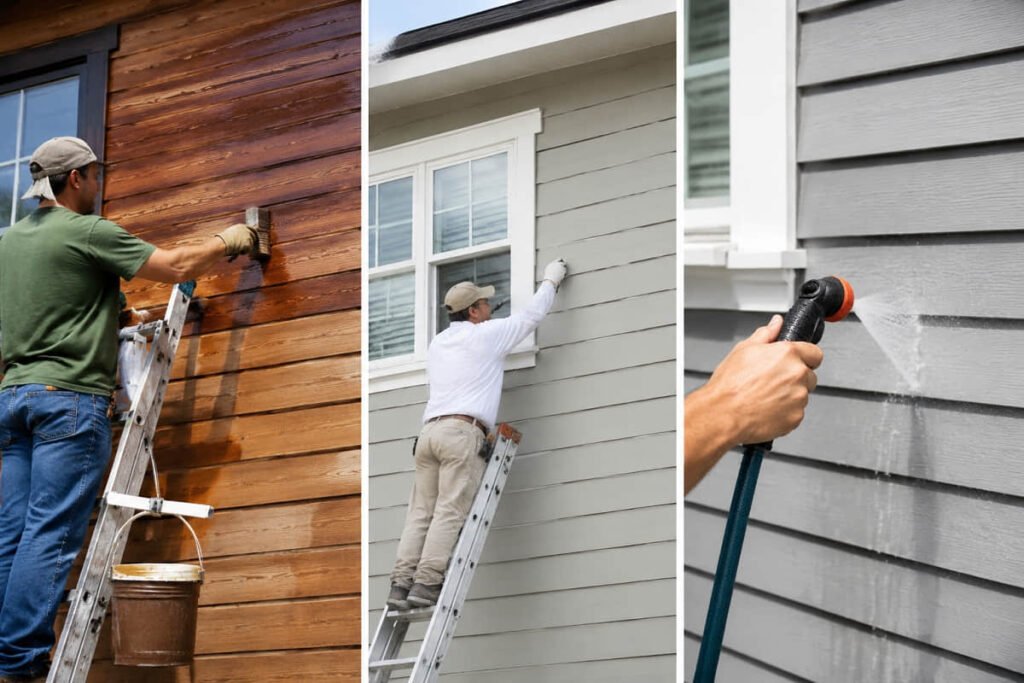
Natural wood: Stain or seal every 12 months. Repaint every 3–5 years. Check for rot and insect damage yearly.
Fiber cement: Paint every 5–7 years. Caulk joints on a schedule. Seal cut edges on-site.
Composite shiplap: Wash with soap and water. That’s the full maintenance requirement.
For building owners and facilities managers, that gap adds up to real savings. No painting contracts. No annual sealing schedule. No rot repairs.
Our 20-year product warranty covers surface cracking, edge warping, structural breakage, and color fade under normal use and proper installation. It’s backed directly by us — no distributor layers, no fine print about who’s responsible for what.
Composite Shiplap Siding vs. Other Siding Materials
Here’s how it stacks up against the materials you’re probably already comparing.
| Material | Upfront Cost | Maintenance Cycle | Lifespan | Installation Method |
|---|---|---|---|---|
| Composite Shiplap Siding | Mid–High | Soap and water only | 25–30+ years | Clip system, no face-nailing |
| Vinyl Siding | Low | Minimal — but fades and turns brittle in cold | 20–30 years | Nail-hem system |
| Fiber Cement | Mid–High | Paint every 5–7 years; caulk joints | 30–50 years | Face-nail; silica dust cutting hazard |
| Steel Siding | High | Repaint or re-coat every 10–15 years | 30–50 years | Panel or board system |
| Timber Wood | Mid | Annual stain/seal; repaint every 3–5 years | 15–30 years (treated) | Individual board nailing |
Fiber cement has a strong lifespan, but it needs paint, caulk, and specialized cutting tools with silica dust precautions. Composite skips all three. That means lower labor costs on large facade jobs, and less work for facilities teams for years after.
Composite also skips the cold-weather brittleness that limits vinyl siding in northern climates. And it holds color better than steel siding in high-UV zones, with no recoat schedule.
Bottom line: if your project timeline runs past 10 years, composite’s low upkeep usually beats its higher sticker price.
What Does Composite Shiplap Siding Cost?
Composite shiplap costs more upfront than vinyl siding, but the day-one price only tells part of the story. Fiber cement needs repainting every 5–7 years. Wood needs staining every year and repainting every 3–5. Composite needs soap and water.
Add up labor, materials, and downtime over a 20-year hold, and the total cost gap closes fast — often in composite’s favor.
Because we manufacture our own boards, we control cost at the source. That control gets passed to trade partners as project pricing, not marked up through multiple distribution layers. We don’t publish list prices, since project size, color, and customization all affect the number.
Lead Times and Ordering
Production and shipping timelines matter for project planning, especially on tight construction schedules.
A standard 20′ container runs about 15 days of production, plus 2 days of packing. Sea freight to the West Coast takes 24–32 days on an express schedule, or 34–42 days standard.
A 40′ container needs about 20 days of production. Packing and freight times match the 20′ container. Actual arrival dates depend on shipping schedules and port clearance.
Standard order minimums start at 100 square meters (roughly 1,076 sq ft) per product line. First-time buyers can ask about smaller trial orders to test the product before committing to a full container.
Energy Performance and Wall Assembly
The install method adds a bonus most specifiers miss: it helps regulate wall temperature.
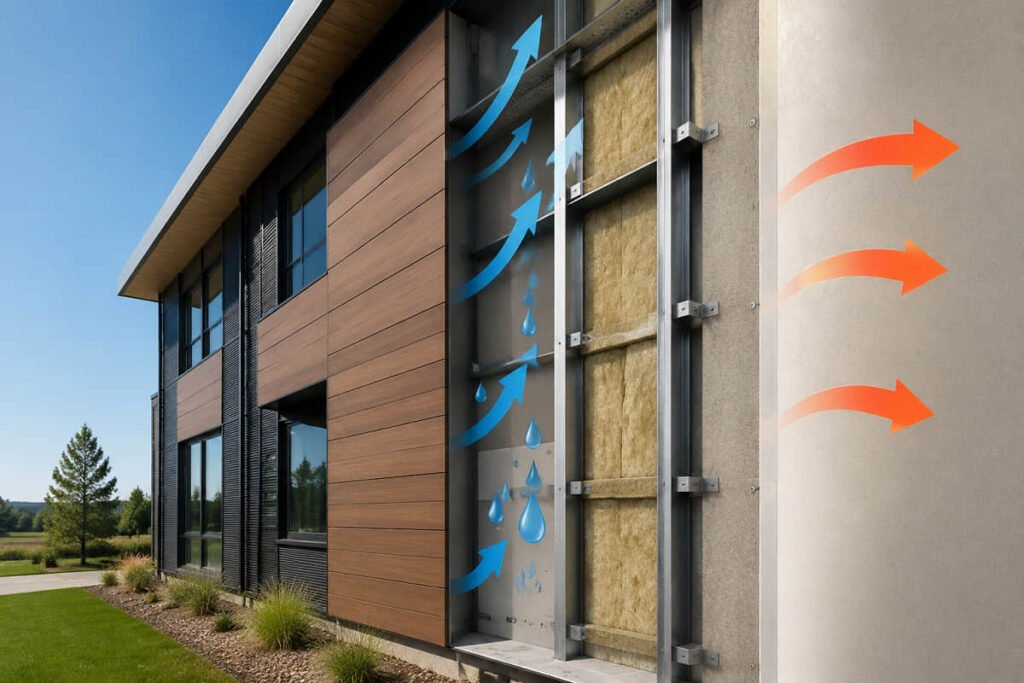
Composite shiplap mounts over steel battens, spaced 12″–16″ on center (300–400 mm). That gap does two jobs. It drains moisture away from the weather-resistive barrier (WRB). And it lets air move behind the boards.
A ventilated wall like this cuts heat transfer. On large, west-facing facades, that means a lighter load on the HVAC system.
This detail matters for projects chasing LEED credits or working toward ASHRAE 90.1 energy targets. Local codes typically require a WRB behind any exterior cladding. The batten system fits a code-compliant wall assembly without adding extra steps.
Which Commercial Buildings Work Best
Composite shiplap siding fits a wide range of commercial building types. Here’s where it earns its keep:
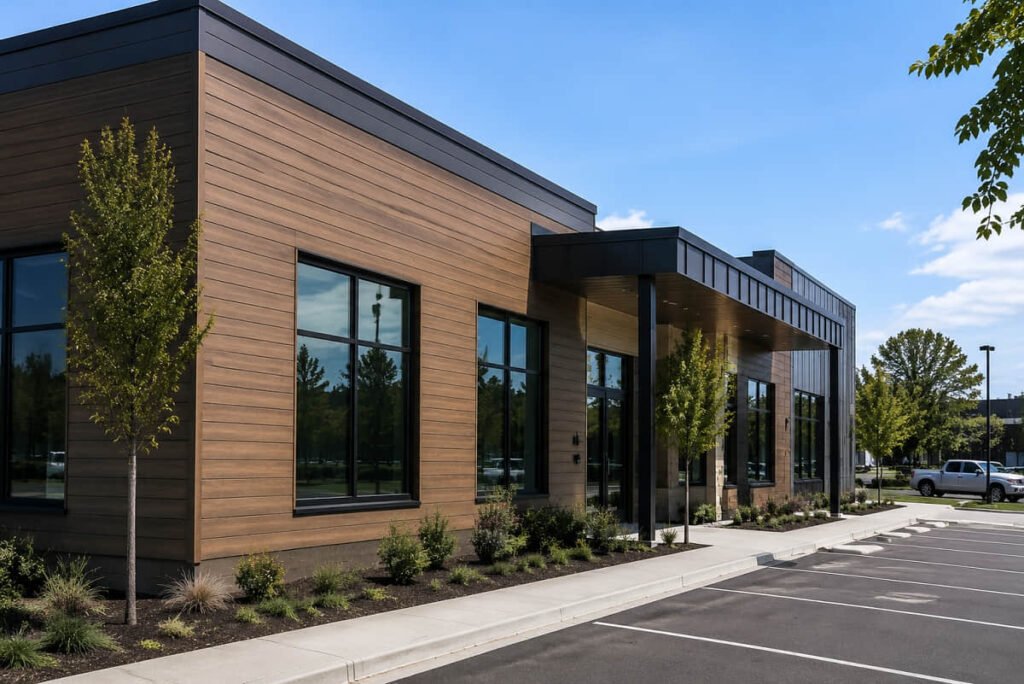
- Multi-family residential developments — Volume pricing and custom colors let developers set a distinct look across buildings. Low maintenance matters when you’re managing dozens of units.
- Hospitality (hotels and resorts) — Big wall surfaces need visual appeal that lasts. No repaint downtime. No exposed fasteners on high-visibility facades.
- Retail stores — Curb appeal drives foot traffic. Composite shiplap gives a modern look with a natural wood feel, without wood’s upkeep.
- Office buildings — Clean lines and a low-maintenance exterior suit property managers who don’t want yearly contractor visits.
- Mixed-use commercial projects — Our siding color palette matches the composite decking range. That gives design continuity across facades, entries, and outdoor areas on the same project.
The male-female clip system leaves no exposed fasteners on the facade. On high-visibility commercial buildings, that finish quality isn’t optional.
Colors and Design Options
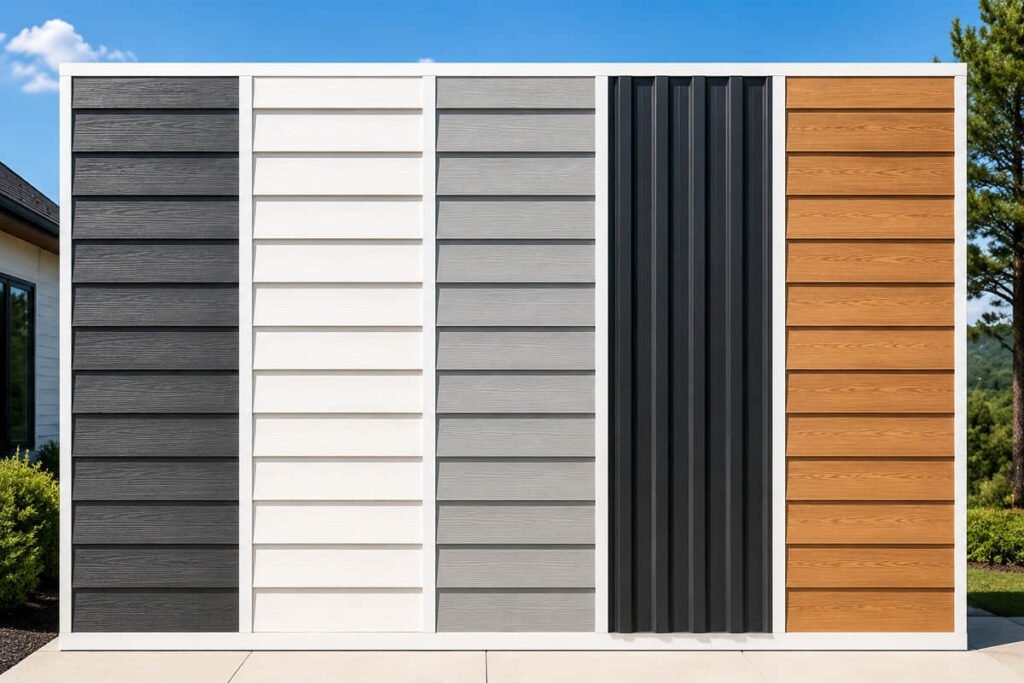
Our composite siding range shares the same color palette and surface textures as our composite decking line. That’s a real design win for projects that want one unified look — matching facade cladding, deck boards, and outdoor wall panels without juggling separate product lines.
Composite shiplap gives you the look and warmth of traditional wood, without the upkeep. The surface texture copies wood grain closely enough to work in both modern and traditional commercial settings.
Standard design options:
- Color families: Warm earth tones for a traditional look, cool grays and charcoals for a modern facade, and deep brown-black shades for high-contrast entries and accent walls.
- Surface textures: Natural wood grain and a smooth, brushed finish.
- Custom colors and textures: Available at volume — no fixed product line limits.
- Board width: Standard 5.5″ (140 mm); custom widths and lengths on request.
For distributors building their own brand, private label options are available. We can arrange custom molds and branded packaging at volume — something most domestic manufacturers don’t offer.
Installing Shiplap Siding on Large Commercial Projects
Composite shiplap uses a clip-based system. No face-nailing. No exposed fasteners on the finished wall. Here’s the sequence for commercial exterior wall paneling:
- Install the WRB (weather-resistive barrier) over the sheathing, per local building code.
- Fix steel battens to the wall at 12″–16″ on center (300–400 mm). These set the ventilation gap and the mounting surface.
- Place clips in the side grooves of the first board row. Secure the clips to the battens.
- Engage each board into the clips below it. The male-female profile locks boards together and sets a consistent gap on its own.
- Add trim pieces — top cap, base trim, corners, and edge trims — to finish the facade.
No specialized cutting tools. No silica dust. That’s a direct labor cost saving compared to fiber cement on large jobs.
Three common mistakes on large facades: skipping the WRB, wrong batten spacing, and no end gap on long board runs. Boards expand and contract with temperature. Follow the gapping spec for your climate. Let boards sit on-site for at least 24 hours before install.
All work should follow local building codes and the IRC/IBC where they apply. Need the full step-by-step walkthrough? See our composite siding installation guide.
Recycled content: Our boards use 60% recycled HDPE and wood fiber, with the remaining 40% virgin material to keep quality and color consistent batch to batch. A facade that lasts decades without repainting or early replacement also uses less material over time than one that needs repeated upkeep — that’s part of the sustainability case too, not just the recycled content number.
FAQ
Does composite shiplap siding need painting or staining?
No. Wash it with soap and water once or twice a year. The cap layer handles UV and moisture, so there’s no paint or stain cycle to schedule.
Can composite shiplap go over existing siding, or does it need bare sheathing?
It needs a proper wall assembly — WRB, steel battens, then boards. In most retrofit jobs, that means removing the old siding down to the sheathing first. Talk to our team about your specific wall condition before you spec the job.
What’s the minimum order for a commercial project?
Standard orders start at 100 square meters (about 1,076 sq ft) per product line. First-time buyers can ask about a smaller trial order to test the product before committing to a full container.
How much does composite shiplap siding weigh, and does that affect the wall structure?
The boards are lightweight compared to fiber cement or steel, since the core blends HDPE with wood fiber rather than dense mineral or metal. Most standard wall assemblies handle the load without extra structural work, but confirm this with your structural engineer on large or unusual facades.
Can a single damaged board be replaced after installation?
Yes. The clip system that holds boards in place also makes them removable, so a crew can swap one board without tearing out the whole wall section. That’s a real advantage over face-nailed systems like fiber cement, where removal often damages neighboring boards.
Is composite shiplap a good fit for coastal or waterfront projects?
Yes, with the right hardware. Water absorption tests at 0.2%, and we use stainless steel clips to stand up to salt air. Confirm stainless hardware is specified on any coastal job — it’s the part that fails first if it’s not.
Is custom color matching available across multiple buildings or project phases?
Yes. Because we manufacture our own boards, we can hold a color match across phased builds or multi-building developments — something distributors sourcing from mixed suppliers often can’t guarantee.
Ready to spec shiplap composite siding for your next commercial building? Contact our sales team for project pricing and a custom sample pack.