

Wood fence callbacks follow a pattern — rot, warping, stain failure. That rework runs 4–6 hours per job, and it comes out of your margin.
Composite fencing cuts that pattern out. But the install process has its own rules — post spacing, acclimation, clip sequencing — and skipping any of them creates problems that show up months later.
This guide covers the full install process, the code requirements your crew needs, and a cost comparison you can use when quoting a job.
What You Need Before You Start
Run through this before the crew shows up. Missing a component on delivery day costs a full day.
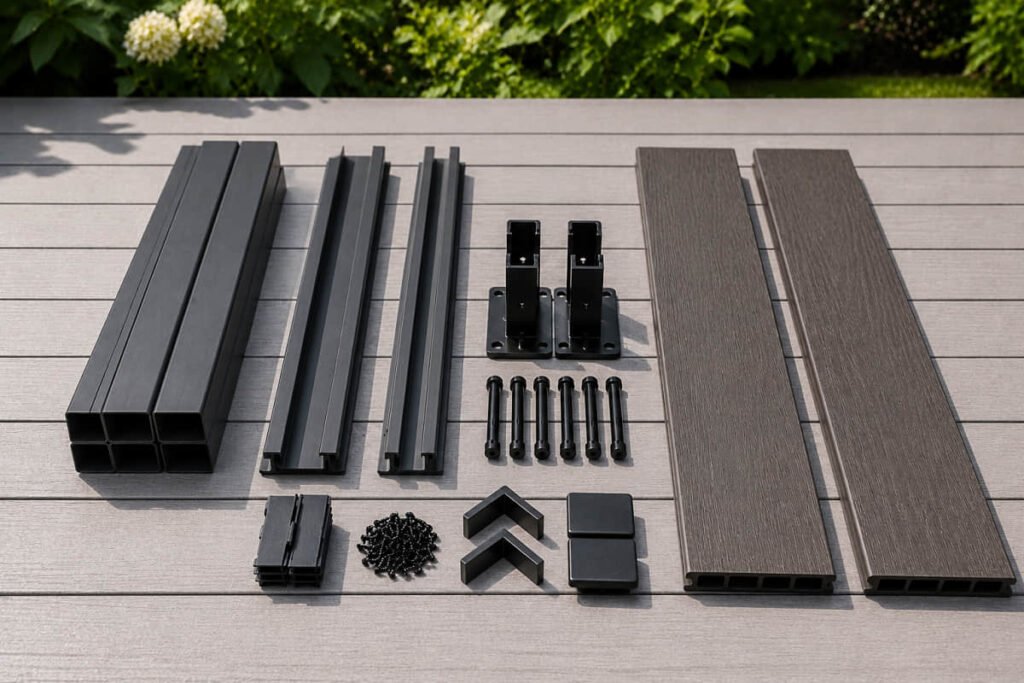
System components — order all of these:
- Composite fence panels
- Aluminium alloy or WPC posts
- Stainless steel clip fasteners
- Top and bottom trim strips
- Post caps and post skirts
- Angle brackets
Privacy fencing and semi-open slat designs use the same components — just different panel profiles. Confirm your layout before ordering.
Tools:
- Post hole digger or power auger
- 48-inch level
- String line and stakes
- Circular saw or miter saw
- Rubber mallet
- Concrete mix
- Measuring tape
Site prep — do this before you dig:
- Call 811. Utility strikes aren’t just a delay — they’re a liability.
- Check local codes and HOA rules before ordering. Height limits and approved materials vary by jurisdiction.
- Let fence panels acclimate. Leave boards at the job site for at least 24 hours so they reach the ambient temperature before install.
How Deep Should Fence Post Holes Be?
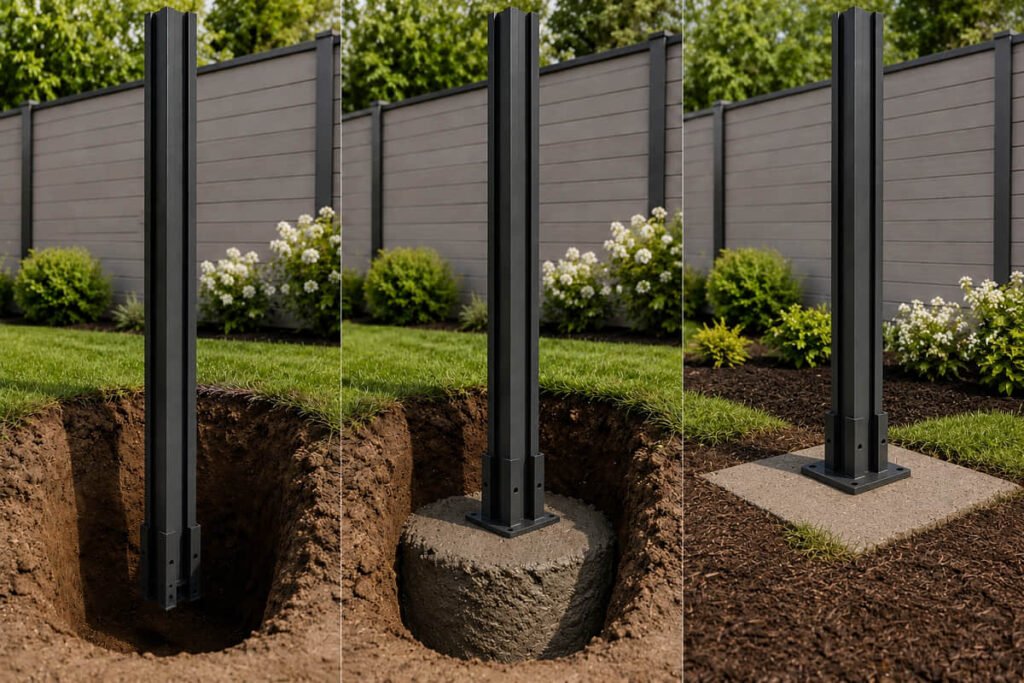
For a standard 6-ft fence, dig post holes 24–30 inches deep — roughly one-third of total post length. In freeze-thaw states like Minnesota, Wisconsin, and across New England, go below the local frost line. Per IRC guidance, post footings in frost-prone regions must reach below the frost depth — check your county’s code for the exact number.
Fill with concrete to within 1 inch of grade. Angle the top so water drains away from the post base. Let concrete cure for 24–48 hours before you load panels. Loading early shifts posts before they’ve set.
How to Install a Composite Fence Step by Step
Three steps. The clip system moves faster than wood — no board-by-board nailing, no measuring gaps between slats.
- Mark the fence line and set posts
- Slot in the fence panels
- Apply trim and post caps
Let boards sit at site temperature for at least 24 hours before you start. Boards installed cold and then exposed to summer heat can expand more than expected, causing fit issues down the run.
Step 1 — Mark the Fence Line and Set Posts
Mark the full fence line with stakes and string. This is your layout — get it right before you dig.
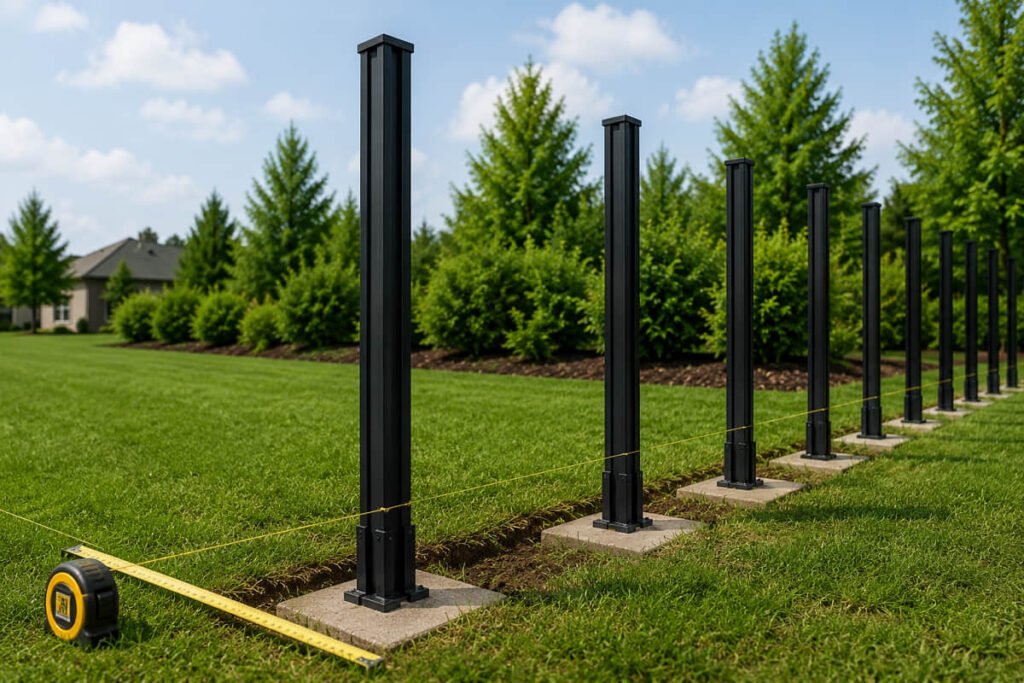
Set posts 32–56 inches on center. Don’t exceed 63 inches. In hurricane zones or high-wind plains states, use 32–40 inches on center — that’s the range required under ASCE 7 wind load guidelines. Aluminium alloy posts are the preferred option for long-term durability in demanding climates.
Dig to depth, check plumb in both directions, pour concrete, and wait. Posts out of plumb throw off every panel in the run. Don’t rush this step.
Step 2 — Slot In the Fence Panels
Work bottom to top. Slide fence boards into the grooves on each post face.
As you go, place stainless steel clip fasteners into the board grooves. The clips lock each slat in place and keep spacing consistent — no measuring between boards, no visible screw heads. Composite fence panels are lighter than wood, so a two-person crew moves quickly through this step.
Check alignment every few boards. On flat terrain, a two-person crew typically covers 50–80 linear feet per day — a useful benchmark for project scheduling and labor quotes. Check alignment every few boards. Catching a drift early is much easier than fixing it at the end of the run.
Step 3 — Apply Trim and Post Caps
Fit top and bottom trim strips to seal the panel edges. Add post caps to protect post tops from water intrusion.
Do a final level check across the full run. You’re done. No painting, staining, or sealing needed. The co-extruded cap layer is factory-applied — UV protection and moisture resistance are built in. That’s a real labor saving over wood, which needs painting or staining after install.
A Few Install Errors Worth Flagging
Three errors come up most often on first-time composite installs.
- Shallow post holes. One-third of post length in the ground, every time. Posts in undersized holes shift in wet soil and freeze-thaw cycles.
- Loading panels before concrete sets. Wait the full 24–48 hours. Loading early moves posts before they’ve cured.
- Wrong post spacing for your wind zone. Don’t exceed 63 inches. In ASCE 7 high-wind zones, stay at 32–40 inches on center.
For a full breakdown of install errors and how to prevent them, see our guide: Common Composite Fence Install Mistakes — and How to Avoid Them.
How Much Does Composite Fence Installation Cost?
Use the table below as a planning guide. Material and labor costs vary by region, profile, and post spacing. Get a project-specific quote before you budget.
| Fencing Type | Material Cost (per lin. ft.) | Labor Cost (per lin. ft.) | Est. 10-Year Upkeep | Estimated Installed Cost | Est. 10-Year Total |
|---|---|---|---|---|---|
| Composite | $20–$45 | $10–$25 | $0–$200 | $30–$70 | $30–$72+ |
| Cedar | $12–$20 | $8–$18 | $500–$1,500 | $20–$38 | $25–$50+ |
| Pressure-treated pine | $8–$15 | $7–$15 | $400–$1,200 | $15–$30 | $20–$42+ |
| Vinyl fencing | $20–$35 | $8–$18 | $0–$150 | $28–$53 | $28–$55+ |
Cost ranges are U.S. market estimates for planning purposes. Contact your supplier for current pricing.
Cedar and pine look cheaper upfront. Add two or three staining cycles and a replacement job over 20 years, and that gap closes fast — or reverses.
Contractors and distributors who source direct from the factory pay less on materials than those buying through domestic retail or wholesale channels. On high-volume projects — multi-family, commercial, or hospitality — that cost gap is worth a direct conversation.
Custom profiles and colors are available for spec projects where standard off-the-shelf options don’t fit. Lead times, volume pricing, and profile options are all project-specific.
Contact Our Sales Team — volume pricing and custom specs available on request.
Composite vs. Wood vs. Vinyl Fencing
| Factor | Composite | Cedar / Pressure-Treated Pine | Vinyl Fencing |
|---|---|---|---|
| Durability | High — rot-proof, termite-resistant | Moderate — needs regular upkeep | Moderate — brittle in sub-zero temps |
| Upkeep | Very low — rinse once a year | High — re-stain every 2–3 years | Low |
| Appearance | Woodgrain texture; consistent over time | Genuine wood look; fades without care | Plastic look; limited texture |
| Installation | Easy — clip system, no face-nailing | Moderate — board by board | Easy–moderate |
| Lifespan | 20–30 years | 15–20 years with upkeep | 15–25 years |
| Warranty | 15 years | None typical | Varies |
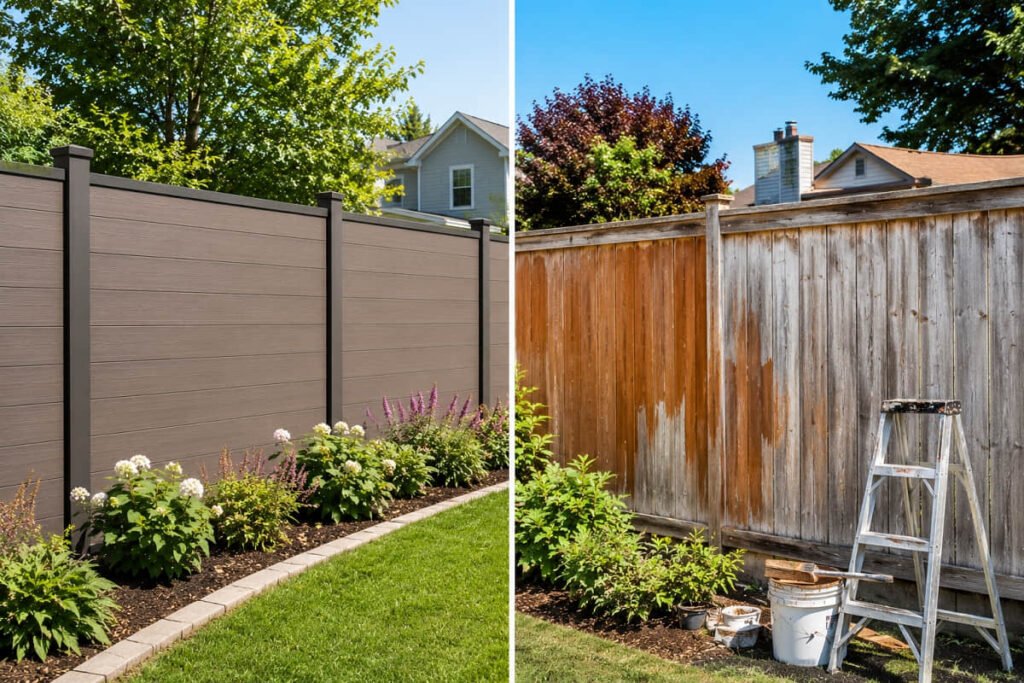
Wood has the lowest upfront cost. That’s real, and worth knowing going in. But composite fence panels don’t rot, warp, or attract termites. There’s no stain schedule, no paint cycle, and no replacement within the first 20 years under normal use.
Vinyl fencing sits in the middle on cost and upkeep. It gets brittle at sub-zero temperatures — a real problem in the Upper Midwest and Northeast. Composite holds up at both extremes: Minnesota winters and Arizona summers.
For commercial properties with long service-life requirements, composite is the stronger long-term call. The durability and longevity make the numbers work over a 15–20 year cycle.
Ready to spec a project? Talk to our sales team about volume pricing, custom profiles, and lead times for your next job.
Frequently Asked Questions
How long does it take to install a composite fence?
A two-person crew can complete 50–80 linear feet per day on flat ground using a clip-based system. Add 24–48 hours for concrete to cure before loading panels. Complex terrain or a high post count will extend the timeline.
Can I install composite fencing on a slope or uneven ground?
Yes. Use a stepped install for sharp grade changes and a raked install for a gradual slope. Post depth may need adjustment on uneven terrain to keep panel height consistent across the run.
What upkeep does composite fencing need after installation?
Very little. Rinse boards with a garden hose once or twice a year. No staining, sealing, or painting needed. If mold appears in a shaded or low-airflow area, a mild soap-and-water scrub clears it.
Do I need HOA approval before installing a composite fence?
In most HOA communities, yes. Check height limits — typically 6 ft rear, 4 ft front — and approved materials before you order. Composite fencing in woodgrain textures often meets the natural-look requirement, but confirm with your HOA board first.
What post spacing is right for composite fence panels?
Set posts 32–56 inches on center. Don’t exceed 63 inches. In hurricane zones and high-wind areas — the Florida Gulf Coast, plains states — use 32–40 inches on center. Check local building codes for wind load specs per ASCE 7.
Ready to spec a project? Talk to our sales team about volume pricing, custom profiles, and lead times for your next job.