

You quoted the job. The client approved it. Now you need boards that won’t come back to bite you.
Slip claims, faded surfaces, fire specs that don’t pass — these are your problems once the deck is down. The right composite product rules them out before you even start.
This guide covers what builders need to know: load ratings, slip resistance, certifications, and which profiles suit which job.
Why Commercial Buyers Choose Composite Over Timber
Timber is still the benchmark most buyers compare against. In commercial settings, though, the numbers shift against it fast.
A hardwood deck may cost less upfront. Over 10 years, you add staining every two to three years, sealing, sanding, and board replacement where insect damage or rot sets in. Those costs stack up. Composite has a higher initial cost — but it needs almost none of that ongoing work.
Here’s a rough comparison for a commercial outdoor space:
| Material | Upfront Cost (per m²) | Annual Upkeep | 10-Year Total (per m²) |
|---|---|---|---|
| Hardwood timber decking | $90–$160 | $20–$40 | $300–$550 |
| Composite decking | $110–$190 | $3–$8 | $150–$260 |
Indicative supply-only figures. Installation costs vary by project and site.
Composite also holds its colour better in strong sunlight. Timber bleaches, cracks, and splinters under the Australian UV index — and each of those is a potential liability call on a commercial site. Composite cuts out that whole category of risk.
For high-volume projects, the long-run case is clear. Less maintenance, fewer replacements, lower total cost.
Is Composite Decking Right for High-Traffic Areas?
Yes — if you’re using a quality capped composite with verified structural specs.
Our boards are rated R11 for slip resistance under AS/NZS 4586. That covers wet surfaces, which matter around restaurants, pools, and public walkways. Flexural strength comes in at 26.2 MPa, tested to EN 15534 — the structural performance you need for daily commercial foot traffic.
The capped co-extrusion structure shields the wood fibre core from moisture and wear. Our cap layer is 0.8 mm thick — thicker than many comparable products. That extra cap material is what gives the board its long-term surface durability under heavy use.
Where Commercial Composite Decking Works Best
Restaurants and Outdoor Dining Areas
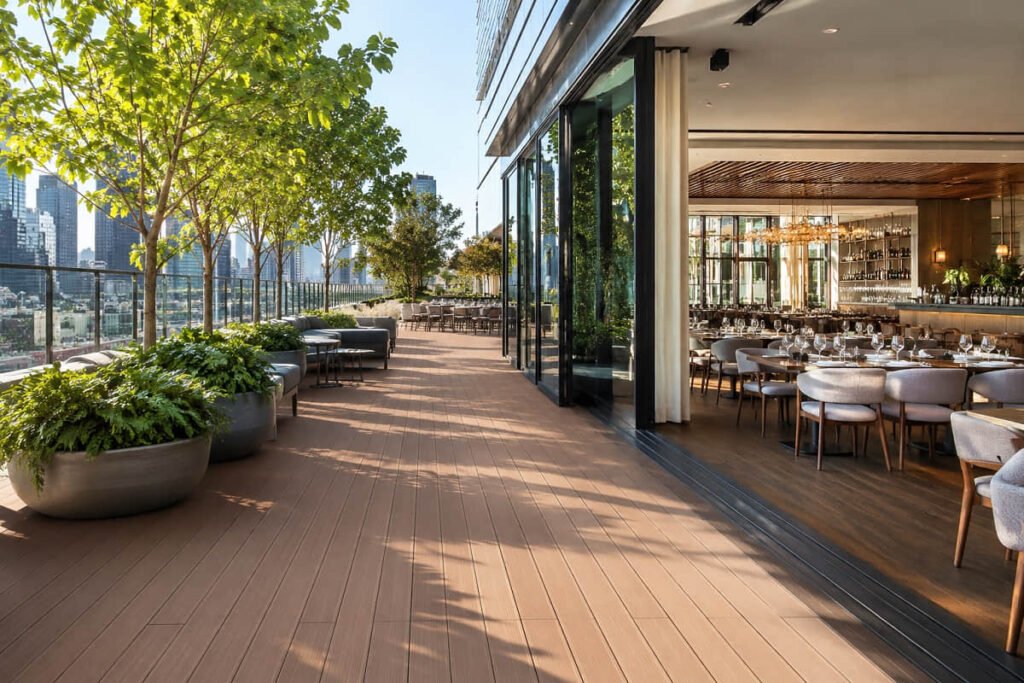
Restaurant decking needs to handle wet spills, constant chair movement, and dropped cutlery — without becoming a slip hazard or looking worn after two seasons.
Composite handles all three. Colour retention is tested to 3,000 hours of QUV weathering, with colour change controlled to ΔE ≤ 4–5. That means the deck looks consistent year after year, even on a north-facing alfresco that gets full summer sun.
For venues in bushfire-prone zones, fire performance is a real compliance question. Our boards are tested to ASTM E84 with a Flame Spread Index of 85 — relevant for BAL-rated sites.
A 200 m² alfresco supply order can go factory-direct, cutting out the importer margin. That’s better per-m² pricing than buying through a domestic reseller.
Request free samples to evaluate colours and surface textures before committing to a full order.
Boardwalks and Public Walkways
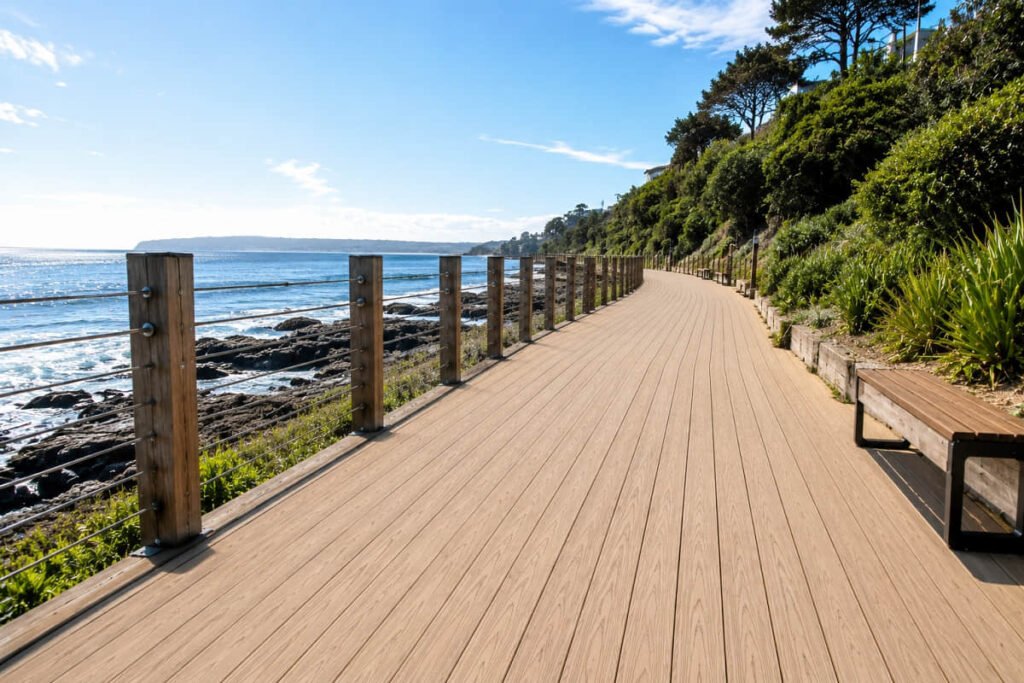
Boardwalks face conditions most commercial decking never sees: salt air, year-round moisture, UV exposure, and constant foot traffic. Timber rots, splinters, and needs regular treatment to stay safe and compliant. That’s not a viable maintenance model for public infrastructure.
Composite holds up far better. Water absorption is just 0.2%, tested to ASTM D1037. In coastal conditions, near-zero absorption is the difference between a 20-year deck and a 10-year replacement cycle.
Our HDPE runs at 0.95 g/cm³ density, with hardwood fibre sourced from Guangxi. For span-sensitive structures where weight matters, hollow profiles with 4–6 mm wall thickness are the right call.
Retail, Hospitality and Entertainment Venues
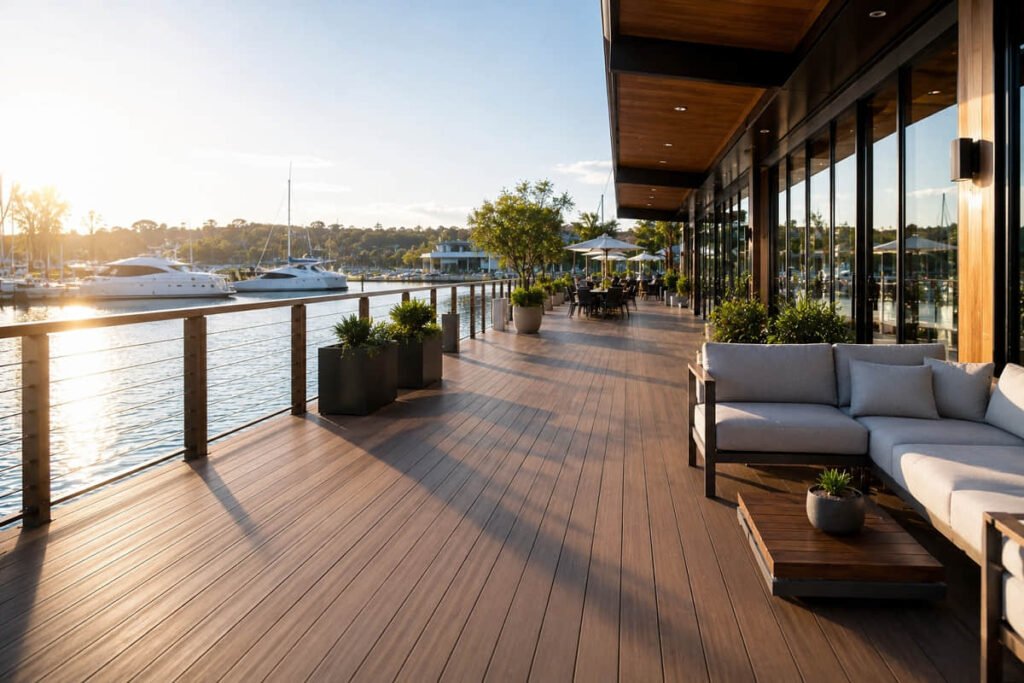
Retail and entertainment venues often have branding needs that go beyond standard board colours. Custom colours, finishes, and layout flexibility matter here. Composite gives you that range.
Lastelegance offers three commercial-grade product lines. For commercial OEM orders, custom lengths, colours, and surface textures are all available.
The hidden fastener system keeps the deck surface clean — no exposed screws, no snag points.
Does Composite Meet Australian Commercial Standards?
This is where procurement managers need specifics — and where many suppliers go quiet.
Here’s what our products are tested and certified against:
- Slip resistance — AS/NZS 4586, R11 rating. Meets commercial requirements for public and food-service areas.
- Fire performance — ASTM E84, Flame Spread Index 85. Relevant for NCC compliance on BAL-rated sites.
- Formaldehyde emissions — EN 717-1: not detected. No indoor air quality concerns for covered commercial spaces.
- Certifications held — CE, ISO, RoHS, SGS.
The NCC sets the performance standards for commercial outdoor surfaces in Australia. Slip resistance and fire performance are the two most common compliance checks for decking. Our products meet both.
For projects in declared bushfire attack zones, confirm the BAL rating requirement for your site with your certifier — then match it to the relevant product spec sheet.
What Does Commercial Composite Decking Cost?
Pricing depends on your profile, volume, and delivery port — so we don’t publish a fixed price list. Factory-direct pricing means the quote reflects production cost, not a reseller’s margin on top of it. That difference shows up clearly in the per-m² figure.
Installation costs vary by site and contractor. Budget roughly $80–$180 per m² for professional fitting, depending on subframe complexity and access.
The initial investment in composite is higher than that in timber. But the gap closes fast once you price in two or three staining cycles, the labour to do them on a commercial site, and any board replacements from rot or insect damage. Most commercial buyers find the composite’s total cost is lower from around year four onward.
Request a quote — we’ll price your project based on volume, profile, and delivery port.
What Upkeep Does Commercial Composite Need?
Not much.
No annual staining. No sealing. No sanding. Composite doesn’t need any of it.
What it needs: a wash down with soap and water, or a low-pressure hose, two to three times a year. For high-traffic areas — restaurant decks and boardwalks — check fastener integrity seasonally and watch for any board movement from thermal expansion.
Our 15-year warranty covers that baseline. Compare it to timber in a commercial setting: staining every two to three years, professional labour to do it safely at height or over water, and the risk of rot where a spot gets missed. The savings compound over the life of the deck.
How to Choose Boards for Your Commercial Project
Board Specs That Matter for Commercial Use
The right board depends on your load needs, span, and site context.
| Product | Dimensions | Weight (kg/lm) | Best For |
|---|---|---|---|
| Renew | 150 × 23 mm | 2.78 | Large-area installs, lighter-weight decking |
| Renew | 140 × 23 mm | 3.09 | Standard commercial decking |
| TimberLuxe | 140 × 23 mm | 4.00 | Premium feel, heavy-traffic zones |
| TimberLuxe | 140 × 20 mm | 3.56 | Mid-weight commercial and hospitality |
| VerdeLife | 139 × 24 mm | 3.09 | Structural depth, boardwalk profiles |
Solid boards handle higher loads. Hollow profiles with 4–6 mm wall thickness suit longer spans where weight is a factor — boardwalks, elevated platforms, and cantilevered structures.
Joist spacing for all profiles: 300–350 mm centre-to-centre. Stainless steel clips are included in the fastener system.
Browse our full product range for complete specs and installation guides.
Can You Customise Boards for a Commercial Project?
Yes — and for large commercial jobs, it’s worth the conversation early in the project.
We can supply custom lengths, custom colours (with sample approval), custom surface textures, and custom packaging for OEM or private-label orders. Custom moulds are available for bespoke profiles. Factor colour sample lead time into your planning schedule before locking in a spec.
For distributors looking to brand under their own label, the OEM/ODM path gives you a product line without a competing SKU from us in your market.
Enquire about custom OEM/ODM options for your commercial or distribution project.
FAQ
What is commercial decking?
Commercial decking is installed in publicly accessible or business-use settings — restaurants, boardwalks, retail precincts, entertainment venues, and public infrastructure. It’s held to higher standards than home decking for slip resistance, load capacity, and fire performance. The NCC sets the baseline requirements for the relevant building class.
How long does commercial composite decking last?
Lastelegance boards carry a 15-year warranty as the baseline. Well-maintained composite in commercial settings typically performs for 20–25 years, depending on UV exposure and foot traffic volume. QUV weathering tests run to 3,000 hours, with colour change ΔE ≤ 4–5 — real evidence of long-term surface stability.
Does composite decking get hot underfoot in summer?
Yes — composite absorbs heat, especially in darker colours under direct sun. The HDPE cap layer helps manage surface temperature compared to uncapped WPC boards. For venues with prolonged sun exposure, lighter colours and shade structures make a practical difference.
Can composite decking be used for a commercial boardwalk?
Yes. Water absorption is just 0.2% (ASTM D1037), which handles coastal salt air and moisture far better than timber. Hollow profiles with 4–6 mm wall thickness suit the span needs of boardwalk structures.
What’s the minimum order for commercial composite decking?
The MOQ is 100 m². Container orders — 20′ or 40′ — offer the best per-unit pricing for large commercial projects. Production lead time is 15–20 days, plus 24–32 days sea freight to Australia.
Does composite decking need council approval for commercial projects?
That depends on the project type, site, and local council rules. Composite decking must meet NCC requirements for the relevant building class. Confirm that your product’s slip resistance (AS/NZS 4586, R11) and fire specs (ASTM E84, FSI 85) match your DA or building permit conditions.