

Salt air eats decking. If you’ve built a coastal project, you’ve seen it — treated pine checking within three years, screws bleeding rust down the fascia. The wrong material near the coast isn’t just a bad look. It’s rework, callbacks, and clients who won’t refer you.
This guide compares four decking materials for coastal use — hardwood, treated pine, composite, and PVC — on salt resistance, UV hold, and real project cost. Every claim is backed by lab data and real project experience. If you’re speccing a coastal deck, this is the detail that matters before you commit.
What Salt Air and UV Do to Decking
Salt air draws moisture out of timber, causing cracks, rot, and surface breakdown. Salt crystals settle in the grain and pull water from the fibres. This leads to “checking” — small cracks that widen over time. UV rays then break down the lignin that holds wood together, greying and weakening the surface. High humidity adds a third layer: boards swell when wet and shrink when dry, warping over repeated cycles. Together, these three forces can halve the life of an unprotected deck.
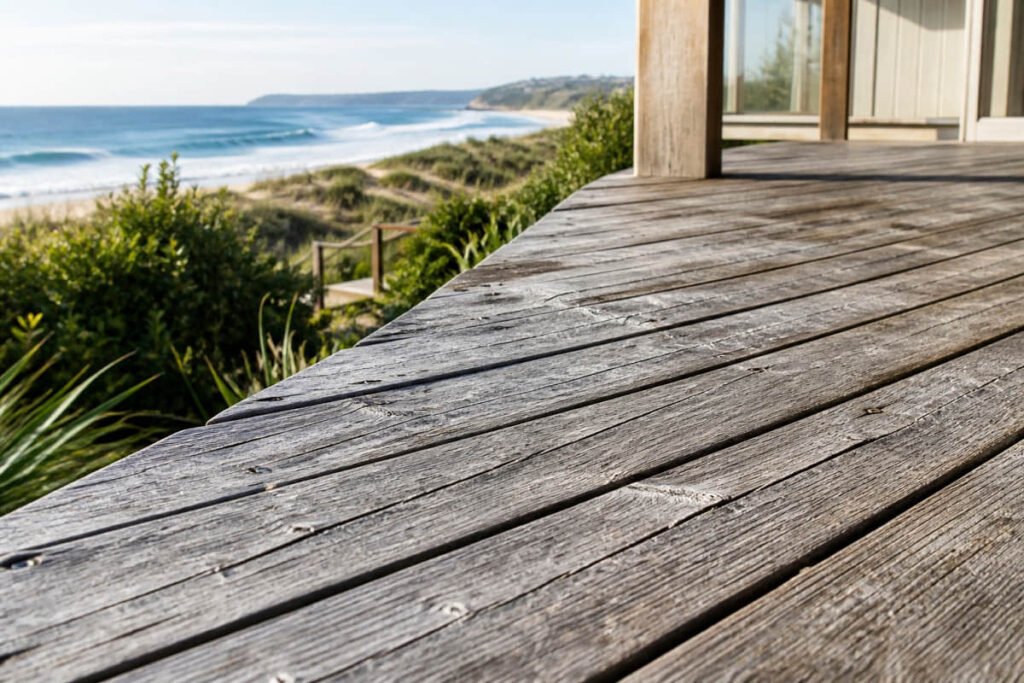
Australian Standards (AS 5604) define coastal salt spray zones as areas within roughly 1 km of a surf coastline. If your project falls in that zone, standard materials face much harsher conditions than inland builds.
Salt also corrodes fixings and speeds up wear on the subframe. UV damage along the Australian coast is among the worst in the world, and humidity stays high year-round in many coastal regions from the Sunshine Coast down to the Great Ocean Road.
Four Decking Materials for the Coast
Not every material fails near the ocean. Some handle salt and UV well. Others need constant care just to survive. Here’s an honest look at the four main options — what works, what doesn’t, and where each one fits.
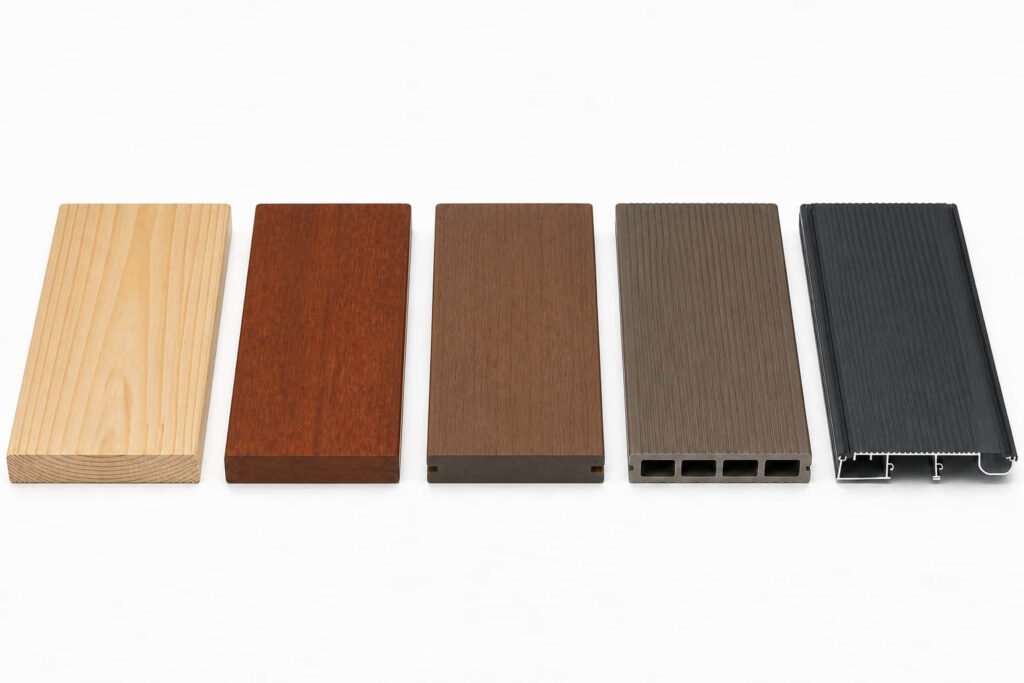
Treated Pine and Hardwood Timber
Treated pine is the cheapest option per square metre. It’s easy to source and simple to work with. But it’s porous. Salt gets into the grain fast and causes checking within a few years on the coast.
Hardwood timber like spotted gum, merbau, and blackbutt is tougher. These species carry a Class 1 rating under AS 5604 for above-ground use, with natural oils that resist moisture better than pine. Merbau can bleed dark tannin stains onto paving if it’s not sealed well — a common call-back issue.
Even the best timber decking needs oiling every 12–18 months near the coast. Salt speeds up greying and surface cracking no matter the species. You’ll also need 316-grade stainless steel fixings — standard galvanised screws will corrode and fail in salt air.
Timber has one clear advantage: you can sand and refinish it. A well-maintained hardwood deck can be brought back to life with sanding and re-oiling. That “restoration factor” matters to some builders and clients. But on the coast, the upkeep cycle is relentless — and that’s a real time and cost factor over the life of the project.
Capped Composite Decking
Composite decking boards blend wood fibre with HDPE plastic. The key feature for coastal use is the cap layer — a full wrap around the board that seals out salt, UV, and moisture.
Not all composite is the same. Uncapped boards leave some sides exposed and can still absorb water. Capped composite is the standard for coastal projects.
Modern capped boards look close to real timber. Grain textures and colour tones have come a long way. These boards cost more upfront than treated pine but far less over time — no oiling, no sanding, no sealing. That’s what makes composite decking a low maintenance option for coastal builds.
The quality of the cap layer matters a lot — its thickness, UV protection, and water resistance vary between brands. We cover the specific test data below.
One honest trade-off: composite boards absorb more heat than timber in direct sun. Dark colours can feel warm underfoot on hot days — a real factor for pool decks and barefoot areas. Lighter colour choices reduce this, and adding a shade structure (pergola, louvred roof) over the main traffic areas makes a big difference. The cap layer surface still stays cooler than uncapped composite, because the sealed finish reflects more heat than raw material.
If you want to see and feel the difference between capped and uncapped composite, request free samples from the range.
PVC Decking
PVC decking is 100% synthetic — no wood fibre at all. It’s fully waterproof and won’t rot, making it very strong against salt. PVC boards typically weigh less than composite, which can simplify handling on elevated coastal builds.
But PVC costs more than composite and gets very hot in direct sun — hotter than both timber and composite in most tests. It also feels less like real timber underfoot. PVC works well for full marine exposure — docks, jetties, and structures that sit over water. For most coastal home decks and commercial projects, capped composite offers a better balance of performance, look, and value.
Aluminium Decking
Aluminium decking is fireproof, rust-proof when powder-coated, and lasts decades. It’s a strong choice for high-traffic commercial spaces, rooftop decks, or coastal areas with extreme fire risk (BAL-40 and above).
The downsides are real. It’s the most expensive option, noisy underfoot, and doesn’t look or feel like timber. It can also be slippery when wet unless a non-slip coating is applied. Most home and mid-range commercial coastal projects don’t need it — but for extreme-exposure sites, it’s worth considering.
Coastal Decking Comparison Table
| Factor | Treated Pine | Hardwood Timber | Capped Composite | PVC | Aluminium |
|---|---|---|---|---|---|
| Salt Resistance | Low | Moderate | High | Very High | Very High |
| UV Colour Hold | Low | Low–Moderate | High | Moderate | High |
| Moisture / Mould | Low | Moderate | High | Very High | Very High |
| Upkeep Level | High | High | Low | Low | Very Low |
| Slip Rating | Varies | Varies | R11 (AS/NZS 4586) | Varies | Varies |
| Heat Underfoot | Low | Low | Moderate | High | Low–Moderate |
| Typical Lifespan | 10–15 years | 20–30 years | 25–30+ years | 25–30+ years | 30+ years |
| Warranty Range | Limited | Limited | 15–30 years | 15–25 years | Varies |
| Eco Credentials | Treated chemicals | FSC-certified options | Recycled HDPE + wood fibre | Synthetic only | Recyclable |
| Standard Board Length | 4.2–5.4 m | 1.8–5.4 m | 2.9–4.9 m (custom available) | 3.6–4.9 m | 4.0–6.0 m |
| Relative Cost (Installed) | Lowest | Mid–High | Mid | High | Highest |
Why Composite Suits Coastal Areas Best
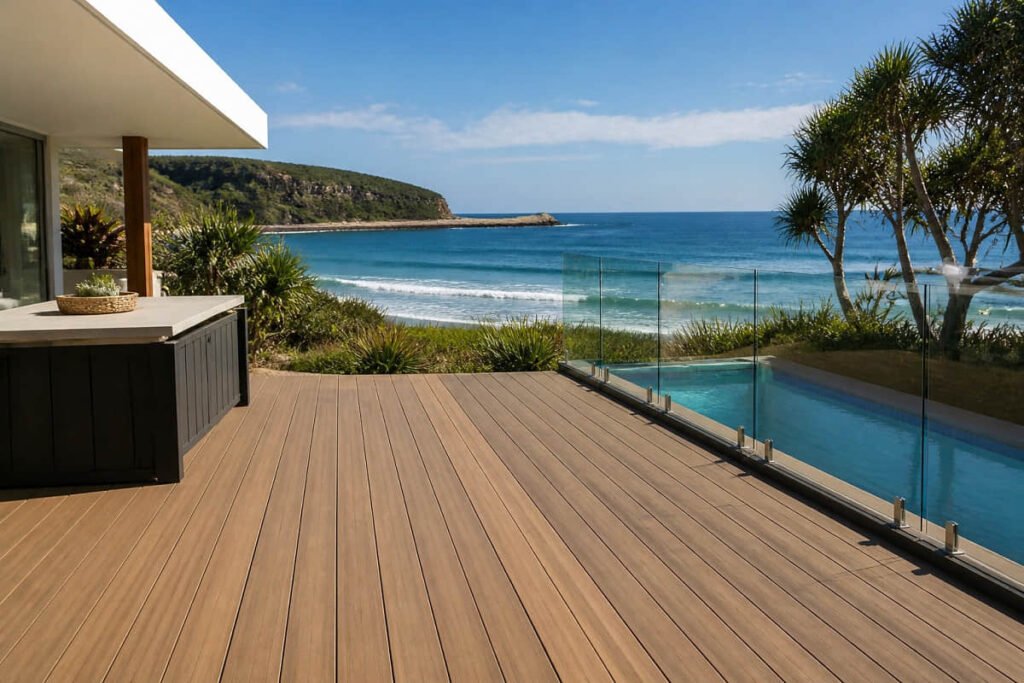
Capped composite handles all three coastal threats — salt, UV, and moisture — with minimal maintenance. That makes it the best fit for most coastal projects in Australia. Here’s what the data shows.
Salt Air and Moisture
The sealed cap layer stops salt from reaching the wood-fibre core. Unlike timber, there’s no open grain for salt crystals to work into.
Our composite boards show just 0.2% water absorption under ASTM D1037 testing. By contrast, treated pine can absorb 15–30% of its weight in water. That gap makes a real difference to long-term durability.
The HDPE in these boards has a density of 0.95 g/cm³, with 60% recycled content. The cap and HDPE also make the boards resistant to termites and mould — insects can’t feed on them, and the sealed surface won’t harbour mildew the way timber grain does in humid coastal zones. Composite won’t swell, warp, or rot in high-humidity conditions.
For projects in a marine environment — within 1 km of the surf — that moisture resistance means fewer callbacks and longer-lasting builds.
UV and Colour Fade
UV exposure breaks down unprotected surfaces fast on the Australian coast. Timber starts greying within months if it’s not oiled. Even with regular oiling, colour hold is limited.
Capped composite tackles this with UV stabilisers built into the cap layer. LastElegance uses a combined system of HALS (Hindered Amine Light Stabilisers) and UV absorbers. After 3,000 hours of QUV accelerated aging, colour shift stays within ΔE ≤ 4–5 — a slight change, barely visible to the eye.
Our 0.8 mm cap thickness is thicker than many comparable products. That extra thickness means a longer barrier life before UV gets through to the core.
Our distributors in Queensland and northern NSW see the same pattern: composite holds its colour where timber fades. We hear the same from trade partners on the Perth coast and along Victoria’s surf belt.
Slip Ratings Near Water
For pool surrounds, beach showers, and any deck near water, slip resistance is a safety need — and often a council requirement.
Capped composite decking is slip-resistant. Our boards are tested to R11 under AS/NZS 4586 — suitable for most home and commercial coastal projects. The anti-slip surface is designed for barefoot traffic in wet areas.
The hidden fastener system adds another safety layer. No raised screw heads means no trip hazards and no spots where water pools on the deck surface.
Bushfire Zones on the Coast
Many Australian coastal areas also fall within bushfire zones — this is common in NSW’s Central and South Coasts, Victoria’s Great Ocean Road, parts of WA, and South Australia’s Adelaide Hills coastline. If your project sits in a designated BAL zone, your decking needs to meet fire safety requirements under the NCC.
Our composite boards have been tested to ASTM E84 with a Flame Spread Index (FSI) of 85 and a Smoke Developed Index (SDI) of 300. These results demonstrate fire performance, but specific BAL compliance depends on the overall build system — boards, subframe, fixings, and the site’s assessed BAL level. For BAL-rated projects, always check with your certifier and refer to AS 3959 for the full system requirements.
If your coastal project has a BAL requirement, get the full fire test report.
Which Series for Coastal Projects?
LastElegance offers three decking series. Each suits a different project type and budget on the coast.
TimberLuxe is the premium pick for frontline coastal projects. It carries a 30-year warranty, the highest board density in the range (4.20 kg/lm), and is available in 140 × 23 mm and 140 × 20 mm profiles. The extra density means better dimensional stability in high-exposure sites.
VerdeLife suits mid-range coastal builds. It comes in a 139 × 24 mm profile with a 20-year warranty and a solid balance of performance and value at 3.1 kg/lm.
Renew is the entry point for coastal projects with tighter budgets — ideal for sites further from the surf zone or lower-exposure areas. Available in 150 × 23 mm and 140 × 23 mm profiles with a 15-year warranty.
All three series share the same cap layer technology, UV stabiliser system, and R11 anti-slip rating. Standard board length is 2.9 m. For projects that need longer spans with fewer joins, custom lengths are available on request.
Timber vs Composite on the Coast
This is the core buying decision on most coastal projects. Both materials have real strengths — the question is which trade-offs matter more for your project.
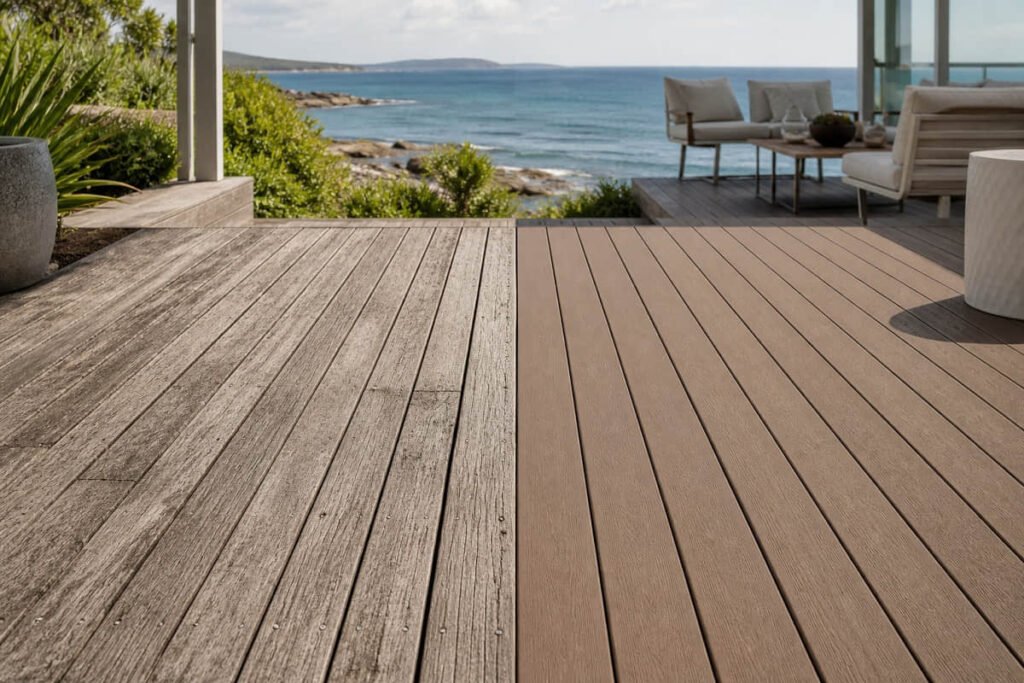
Timber builders argue the “restoration factor” — hardwood can be sanded and refinished. That’s true, and it’s a real advantage. A well-maintained hardwood deck can be brought back to life.
But composite doesn’t need restoration because it doesn’t break down the same way. And for coastal projects where salt and UV are constant, that difference in upkeep adds up fast.
Upkeep Over 10+ Years
Timber decking on the coast needs oiling every 12–18 months. Add sanding every few years for greying and surface cracks. You’ll also need regular washing to clear salt buildup. Over a decade, that’s 10+ rounds of maintenance work — or 10+ call-backs if you’re the builder.
Composite needs a wash now and then — soap and water, or a light pressure clean. No oiling. No sanding. No sealing. For builders doing repeat installs, low-upkeep composite cuts callback risk. Your clients aren’t calling two years later about weathering.
Total Cost Over the Deck’s Life
Timber is cheaper per square metre upfront. Hardwood decking runs roughly $60–$100/m² installed. Quality capped composite sits around $80–$130/m² installed. These are general market ranges.
But add the yearly cost of oil, sealant, and labour for timber care. Over 15–20 years, composite costs less in total. The upfront gap narrows — and then reverses.
For trade buyers ordering in volume, LastElegance’s manufacturer-direct model cuts out the retail markup. As a manufacturer — not a reseller — we control production, quality, and specs in-house. That means capped composite pricing that sits closer to hardwood at the per-square-metre level, with none of the ongoing upkeep costs.
For project-specific pricing on volume orders, request a quote directly from the manufacturer.
Compliance and Certifications for B2B Buyers
When you’re specing composite for a commercial or multi-dwelling coastal project, compliance matters. Here’s what LastElegance products bring to the table.
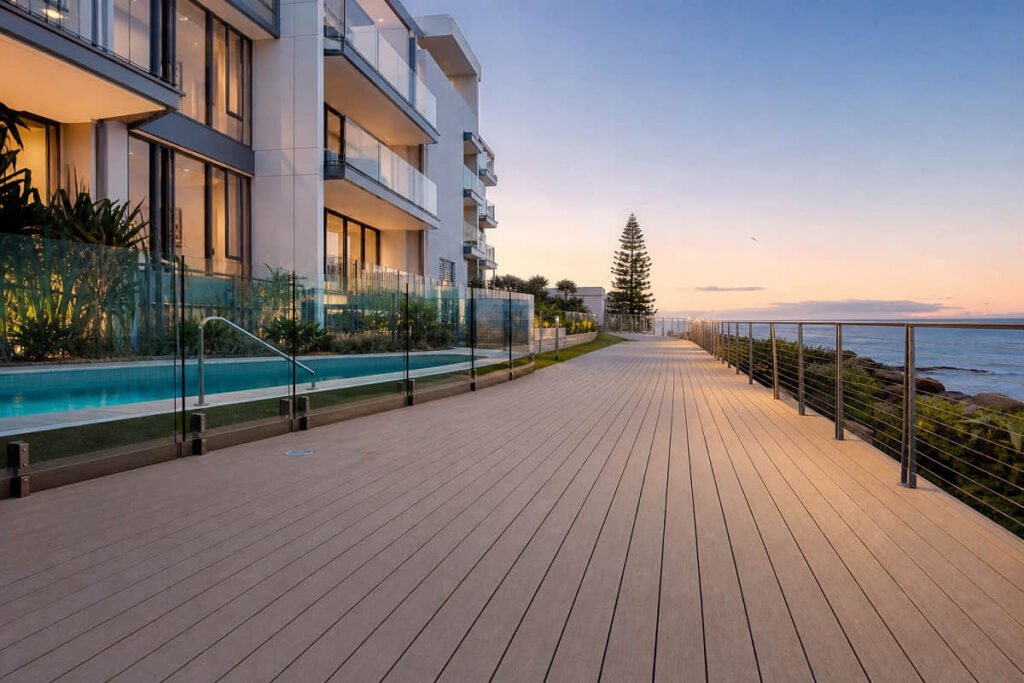
Slip resistance: R11 rated under AS/NZS 4586 (also tested per DIN 51130). Suitable for pool surrounds, public walkways, and commercial deck areas.
Water absorption: 0.2% under ASTM D1037 — well below the threshold for coastal moisture exposure.
Flexural strength: 26.2 MPa, tested to EN 15534. At 300 mm joist spacing, boards stay stable under foot traffic with no bounce.
Fire performance: ASTM E84, FSI 85 / SDI 300.
Emissions: Formaldehyde not detected under EN 717-1. Safe for indoor-outdoor applications.
Environmental certifications: ISO, RoHS, and SGS certified. Boards contain 60% recycled HDPE and hardwood fibre — less waste going to landfill, and a longer service life means less material consumed over the building’s lifetime.
These specs give builders and distributors the data they need for project submissions and council approvals. If you need formal test reports for a specific tender, request formal test reports for your project.
Sustainability on the Coast
Composite decking has a real sustainability story — and it’s not just marketing.
A deck you replace twice uses twice the raw material. One that lasts 25–30 years uses half. Composite lasts longer and needs no chemical treatments over its life. That means less total material over the life of a building.
Our boards contain 60% recycled HDPE blended with hardwood fibre. No preservative chemicals. No annual oiling products going into the ground. At end of life, composite boards can be recycled rather than sent to landfill.
For distributors working with ESG-conscious builders or green-rated developments, this matters. It’s a real advantage over treated pine (which contains chemical preservatives) and over virgin-material alternatives.
How to Buy and Install for the Coast
You’ve picked composite. Now here’s how to get the install right. Proper installation on the coast comes down to your fixings, your subframe, and airflow.
Fixings and Hardware in Salt Zones
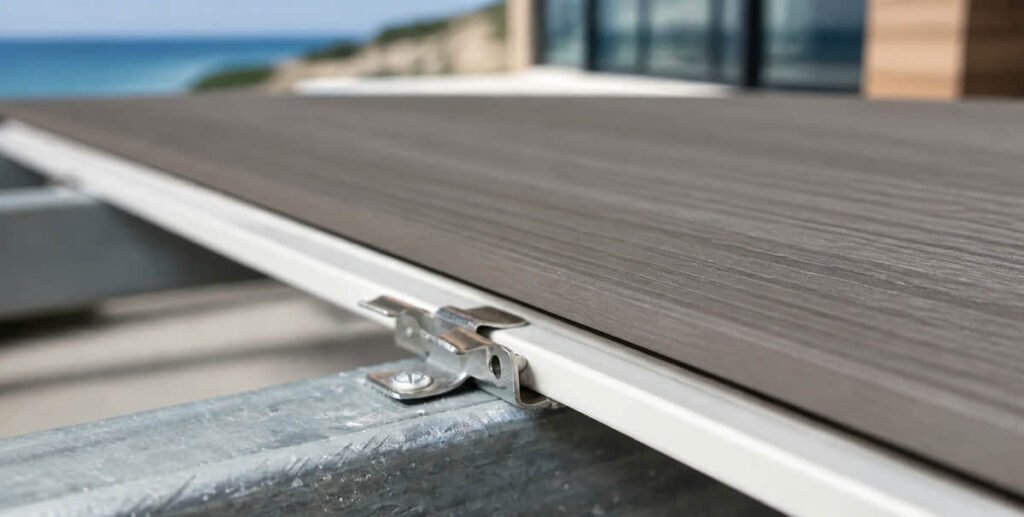
Any deck within 1 km of the coast needs stainless steel fixings — 316-grade, not 304. Standard galvanised screws corrode in salt air and leave rust stains on the boards. The 304-grade stainless is better but still pits in heavy salt zones. Only 316-grade has the molybdenum content to resist chloride corrosion.
We supply stainless steel hidden clips with our decking boards as standard. The clip-in system slots into board grooves and fixes to joists — no exposed screw heads on the deck surface. That means no rust points, a cleaner look, and faster install for trade crews.
We’ve tested this across 200+ colour samples in real coastal conditions. The hidden clip system keeps the surface clean and the boards tight.
Joist Spacing and Airflow
Joist spacing: We recommend 300 mm centres for coastal decks. At that spacing, boards with a flexural strength of 26.2 MPa (tested to EN 15534) stay stable under foot traffic with no bounce.
Airflow: The subframe needs enough ground clearance for air to move underneath. Trapped moisture plus salt causes problems — even for composite. A raised subframe helps drainage after storms and keeps the underside dry.
For high-exposure coastal sites, steel battens or aluminium subframes perform better than timber joists. Timber subframes in salt zones can rot from below while the composite boards on top stay fine. Match the subframe to the conditions.
If you need help specing a coastal install, talk to our team about your coastal spec.
FAQ
Is composite decking a good choice for homes near the ocean?
Yes — capped composite is one of the best options for coastal homes. The sealed cap layer blocks salt air, UV, and moisture from reaching the core. It won’t rot, split, or need oiling, making it a low maintenance choice for salt zones.
What maintenance is required for timber decks in coastal areas?
Timber decks on the coast need oiling every 12–18 months, regular washing to remove salt buildup, and sanding every few years. Hardwood lasts longer than treated pine, but both need steady upkeep to hold up against salt air.
Which decking board colours work best near the coast?
Mid-tone and warm colours work best — sandy browns, natural oak tones, and soft greys. Very dark boards show every grain of sand and absorb more heat. Very light boards show dirt. A mid-range natural timber tone strikes the right balance for look and comfort.
Are there eco-friendly decking options for coastal climates?
Yes. Capped composite uses a mix of recycled HDPE and wood fibre. Our boards contain 60% recycled content and carry ISO, RoHS, and SGS certifications. The boards last decades without chemical treatments or replacement — less waste over the deck’s life.
Does composite decking meet bushfire requirements in coastal zones?
LastElegance boards are tested to ASTM E84 (FSI 85, SDI 300). Full BAL compliance depends on the total build system — boards, subframe, fixings, and the site’s assessed BAL level. For BAL-rated coastal projects, check with your building certifier and refer to AS 3959.
What is the best decking for a saltwater dock?
For a dock over or next to saltwater, PVC decking or marine-grade capped composite are the top picks. PVC is fully synthetic and waterproof. Capped composite handles saltwater contact well too, with water absorption as low as 0.2%. Both outperform timber in constant salt exposure.
Can I get custom board lengths for large coastal decks?
Yes. The standard board length is 2.9 m. For larger coastal projects that need longer spans with fewer joins, custom lengths, colours, and surface textures are available through our manufacturing team.