

A cheap fence quote can turn into lost margin once rework, freight delays, and call-backs start adding up. That risk climbs on coastal blocks, exposed sites, and multi-lot housing builds.
Three materials dominate Australian fencing: Colorbond steel, timber, and composite. This guide compares installed cost, lifespan, maintenance, installation method, and supply timing across all three — written for builders, contractors, distributors, and specifiers who need to back a choice with data.
At a Glance: When to Use Each Material
Colorbond suits projects that need a familiar steel system, broad local stock, and compliance in BAL zones. Timber works where the client insists on natural wood and the budget can carry ongoing maintenance. Composite fits projects that need a timber-like finish, low upkeep, flexible privacy layouts, and boards that won’t rust, rot, or attract termites.
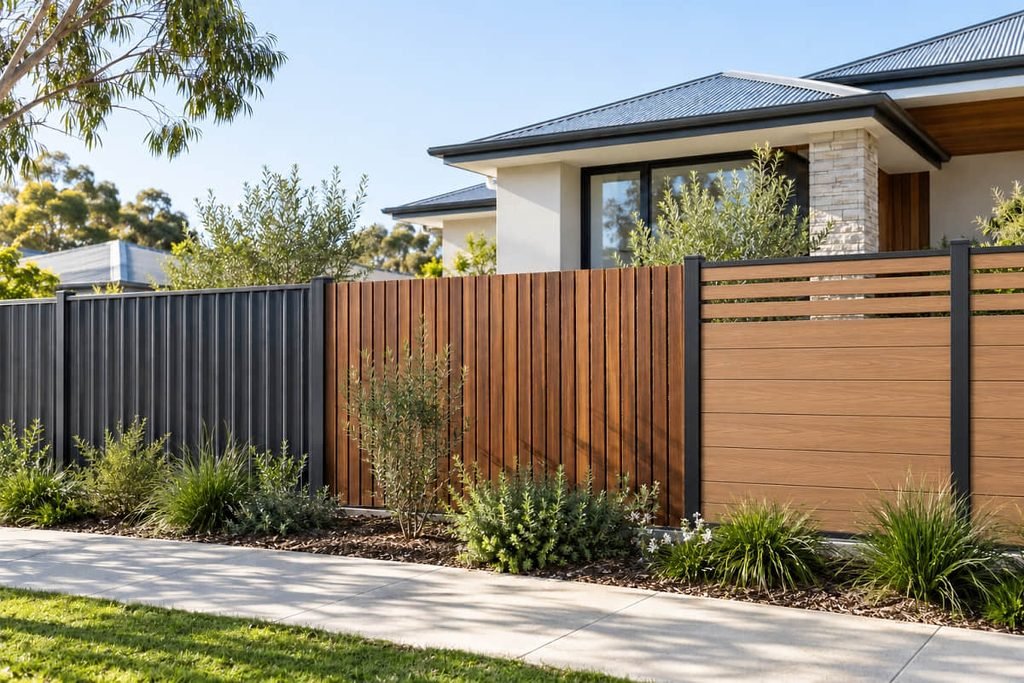
| Factor | Colorbond steel | Timber (hardwood) | Composite (capped) |
|---|---|---|---|
| Best for | Familiar system, local stock, BAL zones | Natural wood look, tight upfront budget | Timber-look finish, low upkeep, coastal sites |
| Upfront cost | Lower | Lowest ($50–$90/lm) | Higher ($90–$150/lm) |
| 10-year total cost | Moderate | Higher ($180–$420/lm with upkeep) | Lower ($90–$165/lm) |
| Lifespan | 25–40+ years | 15–25 years (maintained) | 15–25+ years |
| Maintenance | Low-moderate — rust checks, touch-ups | High — sand, oil, stain, pest treat | Low — occasional cleaning |
| Termite / rot risk | None (check timber framing) | Real — AS 3660 applies | None |
| Coastal performance | Rust risk at coating damage | Poor without constant treatment | No rust; 0.2% water absorption (ASTM D1037) |
| Fire | Non-combustible | Combustible | EN 13501-1: Class B-s1, d0 |
| Privacy options | Full (solid sheet only) | Depends on layout | Full, semi-open, or open from one system |
| Install method | Post concreting, sheet fixing | Cut and fix each board | Clip-in, no welding |
Timber cost estimates are indicative. Actual costs vary by region, species, and project scale.
The water absorption figure matters: 0.2% is well below the 0.5–2% range common across composite products. Lower uptake means less swelling and better long-term board stability in wet conditions.
How Much Does Composite Fencing Cost Per Metre?
Composite fencing costs $90–$150 per linear metre installed — about 15–30% more than Colorbond and roughly double timber’s $50–$90/lm upfront price. But over 10 years, composite’s total cost drops to $90–$165/lm because it needs almost no maintenance. Timber climbs to $180–$420/lm once you add staining, pest treatment, and rot repairs.
Don’t compare panel prices alone. A fair comparison includes posts, rails, fixings, gates, freight, labour, and waste.
Upfront Material + Install
Timber costs least upfront. Colorbond sits in the middle. Composite costs more because of the cap layer, HDPE binding process, and UV stabiliser system. Timber is a raw material with simpler processing. Steel sheet is high-volume local stock.
10-Year Total Cost
The gap narrows once you add ongoing costs.
| Cost factor | Colorbond | Timber | Composite |
|---|---|---|---|
| Staining / painting over 10 years | Touch-up as needed | $80–$130/lm | $0 |
| Pest treatment + rot repairs | N/A | $50–$200/lm | N/A |
| Rust repair / recoating | Varies — coastal sites sooner | N/A | N/A |
| Estimated 10-year total | Moderate (site-dependent) | $180–$420/lm | $90–$165/lm |
For larger orders, buying direct from a manufacturer removes reseller markup — keeping the real cost gap smaller than retail pricing suggests.
Request trade pricing for your project volume.
Fence Lifespan: Colorbond vs Composite vs Timber
Capped composite fencing typically lasts 15–25+ years with minimal upkeep. Colorbond steel lasts 25–40+ years but depends on the coating staying intact — once scratched, rust sets in fast. Timber hardwood lasts 15–25 years only if you maintain a strict staining, oiling, and pest treatment schedule. Skip a year, and you lose years of service.
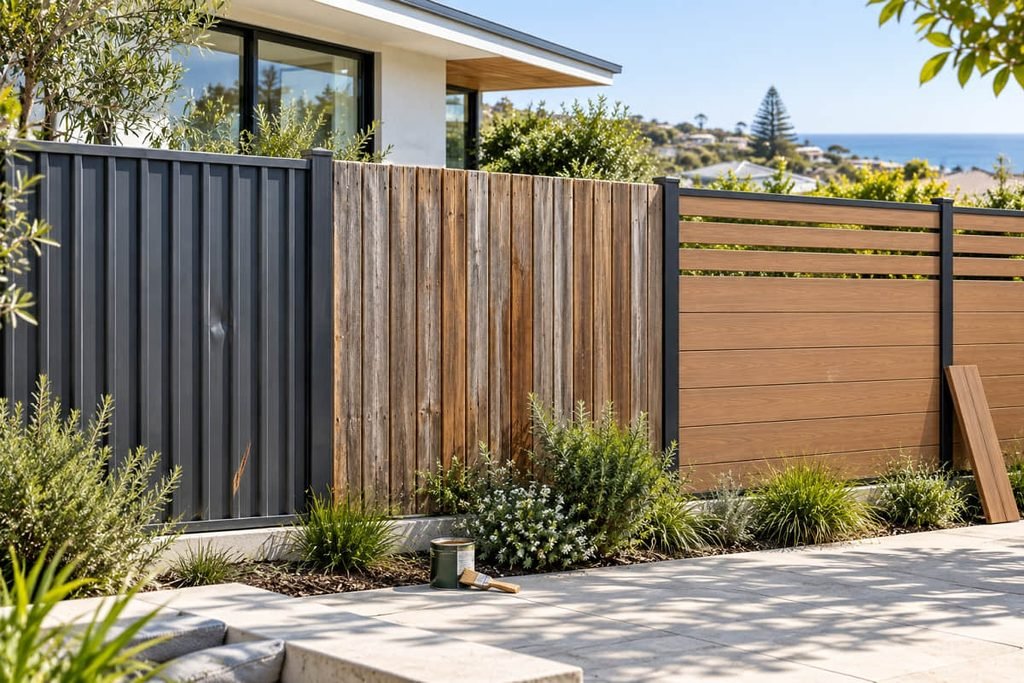
Site exposure and workmanship matter more than any generic lifespan claim. Here’s how each material ages.
| Fence type | Expected lifespan | Main ageing risk |
|---|---|---|
| Colorbond steel | 25–40+ years | Coating damage → rust |
| Aluminium | 25–40+ years | Denting, powder coat wear |
| Standard steel | 15–25 years | Corrosion in coastal zones |
| Timber (hardwood, maintained) | 15–25 years | Rot, termites, UV greying, splitting |
| Composite (capped) | 15–25+ years | Colour fade, thermal movement |
Colour stability: Timber fades and greys fast — even treated hardwoods crack and silver if the oiling schedule slips. Colorbond holds well, but scratches expose bare metal. Lastelegance’s capped composite with a cap layer of 0.8 mm — well above the 0.3–0.5 mm common in the market — delivers better UV performance. After 3,000 hours of QUV accelerated ageing, colour shift stays within ΔE ≤ 4–5 depending on colour. That’s a weathering result, not a “fade-proof” claim.
Termites and rot: Composite gives termites nothing to eat — no food source, no moisture path. Timber carries real risk; AS 3660 exists because insect infestations in timber are common enough to need an industry-wide framework. Metal fences aren’t affected, but timber rails behind Colorbond sheets still need inspection.
Impact and repair:
| Material | Impact risk | Repair method |
|---|---|---|
| Colorbond | Dents from tools, branches, site traffic | Replace dented sheet — may need matching |
| Timber | Rot and termite damage can spread unseen | Swap board, touch up stain |
| Composite | Scratches and scuffs (won’t dent like steel) | Replace single board or trim section |
Tip for composite: order spare boards with your main order. Colour-matching after UV exposure can be tricky.
How Much Maintenance Does Each Fence Material Need?
Yes. Composite fencing needs only a hose-down two to three times a year. Colorbond needs regular scratch checks and recoating every 5–10 years in coastal areas. Timber needs the most work — sanding and oiling every 1–2 years, painting every 3–5 years, plus annual pest and rot checks. Over multiple sites, that difference drives real labour savings.
| Task | Colorbond | Timber | Composite |
|---|---|---|---|
| Sanding / recoating | N/A | Every 1–2 years | Not required |
| Staining / oiling | N/A | Every 1–2 years | Not required |
| Painting / recoating | Touch-up at scratches; full repaint every 5–10 years coastal | Every 3–5 years | Not required |
| Pest treatment | N/A | As needed | Not required |
| Rust / corrosion check | Annually (more often near coast) | N/A | N/A |
| General cleaning | As needed | As needed | 2–3 times/year |
For builders and property managers running multiple sites, the savings compound. One less maintenance task across 10 sites a year adds up fast.
Composite Screening Design Options and Colour Range
Composite screening offers a timber-look finish with custom colours, textures, and flexible layout options — closed, semi-open, or open from a single board system. Colorbond gives a neat, uniform steel finish but limited design variation. Timber wins on first-day appearance with natural warmth, but greys, warps, and cracks within one to two years without regular treatment.
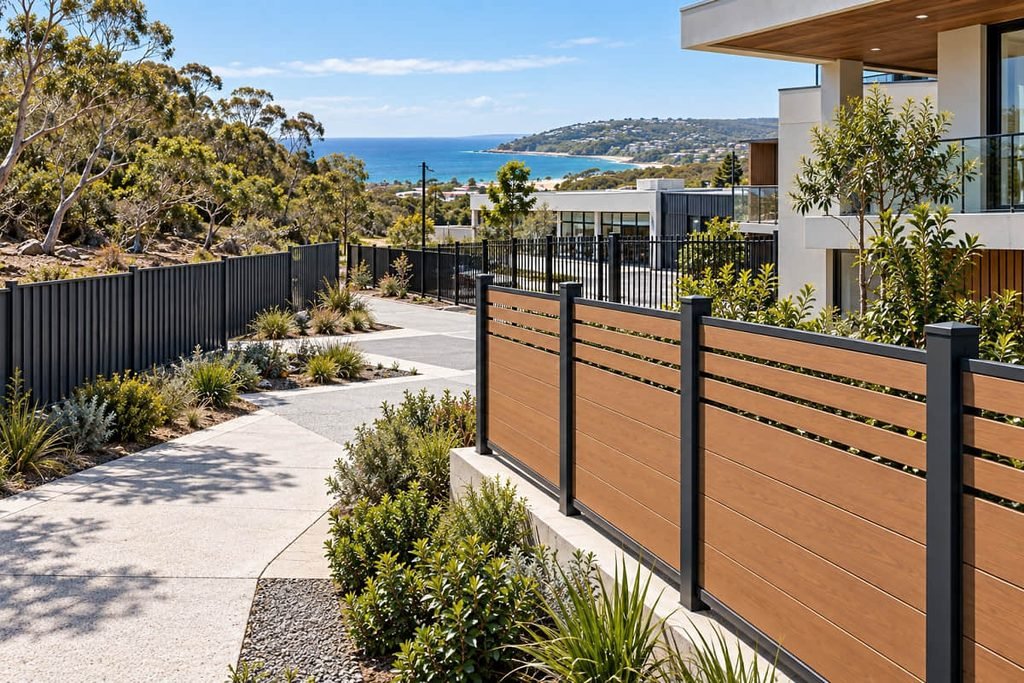
| Option | Colorbond | Timber | Composite screening |
|---|---|---|---|
| Colours | Standard supplier range | Natural tones (fade with age) | Standard and custom colours |
| Surface | Smooth painted steel | Natural grain (weathers) | Timber-look and custom textures |
| Layout | Solid sheet only | Board, picket, or paling | Closed, semi-open, or open |
Composite screening lets you control privacy: install boards tight for full privacy, space them for airflow, or go wide for an open screen. Colorbond is fully private but allows zero airflow. Solid panels in both materials block more street noise than open picket or metal fences, though neither is a rated acoustic barrier.
Batch consistency matters on large projects. On a 20–50 lot development, composite boards from the same production run and mould deliver consistent colour and texture across every lot. Timber varies by log and cut. Colorbond is consistent within a colour run but offers no texture variation.
For the full range of composite screening profiles available in the Australian market — including flat slats, battens, and castellated panels with dimensions and weights across brands — see our composite screening panels guide.
Custom colours, lengths, and textures are available for composite at volume — approve physical samples before specifying.
Request free samples to compare colour and texture before specifying.
Which Fence Is Fastest to Install?
Composite fencing uses a clip-in system that needs no welding and no on-site painting. Two installers can typically run 20–30 linear metres per day. Colorbond goes up faster than timber once posts are set, but posts need concrete footings and sourcing often involves multiple suppliers. Timber is the slowest — each board is cut and fixed individually.
Composite: boards slot into posts with fasteners. A complete kit includes trims, brackets, clips, caps, and edge trims. Post options: aluminium alloy or WPC.
Colorbond: steel posts, rails, sheets, and caps. Posts need concrete footings. Once set, panels go up fairly quickly.
Timber: post-setting, measuring, and cutting each board. Labour per linear metre is higher.
Standard steel/aluminium: may need specialist tools or a welder on site.
Composite post spacing should sit at 0.8–1.4 m, with 1.6 m as the maximum. This is product guidance, not a certified wind rating. Ask your engineer to review exposed sites, taller fences, and non-standard layouts — especially near ridgelines, open land, and the coast.
Which Fence Material Suits Coastal, Bushfire, and Commercial Sites?
No single material wins every site. Colorbond suits inland boundaries and BAL zones. Composite suits coastal projects, multi-lot developments, and sites where maintenance access is limited. Timber suits projects where the client demands natural wood and will commit to the upkeep schedule. Site exposure, wind loads, and fire requirements should drive the final choice — not price alone.
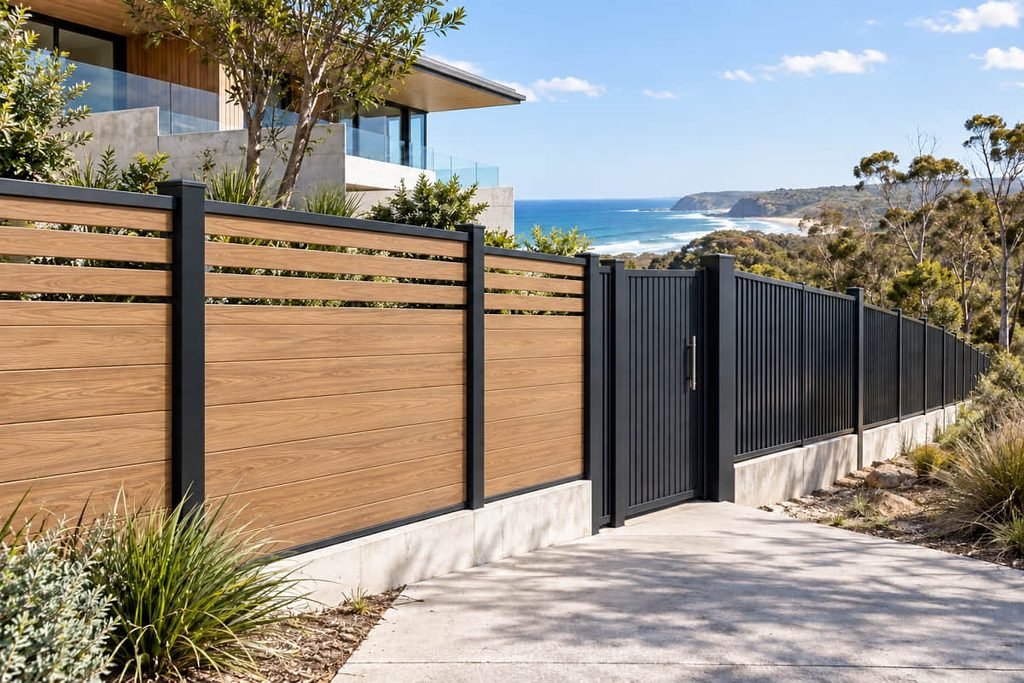
| Site or project need | Better starting point | Why |
|---|---|---|
| Tight budget, quick local access | Colorbond | Familiar system, broad availability |
| Natural timber look (with maintenance budget) | Timber | Genuine wood grain and warmth |
| Timber-like finish, no maintenance | Composite | Textured boards, no staining or painting |
| Coastal area | Composite or aluminium | Composite doesn’t rust; aluminium resists corrosion better than steel |
| High-traffic / industrial boundary | Steel or Colorbond | Handles heavy impacts better |
| Privacy with airflow | Composite | Open and semi-open layouts from one system |
| Bushfire-prone site (BAL-rated) | Metal | Non-combustible — may be mandatory under NCC |
| Multi-lot development, custom spec | Composite | Factory customisation, batch consistency, direct supply |
Coastal and Wet Sites
Composite boards don’t rust — useful near wet areas and the coast. But posts, screws, brackets, and caps still need suitable grades and coatings. Trapped moisture behind Colorbond sheets can cause framing issues over time. Timber near the coast rots faster, and salt air breaks down oil and stain finishes.
Check the supplier’s coastal guidance for the site’s distance from breaking surf.
Bushfire-Prone Sites
Metal is non-combustible — a clear advantage in BAL-rated zones. Metal fencing may be mandatory under NCC.
Our composite screening is tested to EN 13501-1: Class B-s1, d0 — the second-highest euroclass. Most composite products sit in Class C, D, or E. If a project has fire standard requirements beyond this, tell us the requirement, and we’ll scope it with you.
Timber is combustible. Check specific BAL requirements with the project’s fire professional. For NCC guidance, see the Australian Building Codes Board.
Supply Timing: Local Stock vs Factory Production
Colorbond and timber are stocked by local merchants across Australia. Order today, deliver this week — subject to stock and colour availability.
Composite screening is produced to order and shipped from the factory. A full 40′ container involves roughly 20-25 days of production + 24–32 days of sea freight, plus port clearance. A 20′ container is roughly 15-20 days of production.
That lead time is real. But for planned projects — especially multi-lot developments and distribution stocking orders — factory-direct supply also means no reseller margin, custom specs at factory scale, and exact batch consistency across staged construction.
The trade-off is clear: local stock gives speed; factory-direct gives cost control, customisation, and consistency. Plan early and composite’s lead time stops being a constraint.
Sustainability in brief: Timber is renewable, but short replacement cycles cut into that advantage. Metal recycles cleanly. Composite uses 60% recycled content, and formaldehyde emissions test at not detected (EN 717-1) — relevant for projects with air quality or environmental procurement requirements.
Which Fence Should You Choose? Composite, Colorbond, or Timber
Choose Colorbond where a familiar steel system, broad local access, and a uniform finish lead the brief.
Choose timber where the client demands natural wood and the project budget can carry ongoing staining, oiling, and pest treatment.
Choose composite where a timber-like look, lower long-term maintenance, and factory customisation add more value — especially across multi-lot developments where batch consistency and reduced call-backs matter.
Compare written quotes, system drawings, test reports, warranty terms, and site needs before committing.
Talk to our sales team about composite screening for your next project.
FAQs
How Does Composite Fencing Compare on Installed and Lifecycle Cost?
Composite fencing runs $90–$150 per linear metre installed — about 15–30% more than Colorbond upfront. Over 10 years, composite drops to $90–$165/lm because there’s almost no upkeep. Timber climbs to $180–$420/lm once you add staining, pest treatment, and rot repairs. For volume orders, buying direct from the manufacturer cuts out reseller margin and tightens the gap further.
Does Composite Screening Get Hot in Direct Sun?
Dark composite boards absorb more heat on north- and west-facing walls. That matters on handover — surface heat is a common source of client pushback on dark colours. Specify mid-tone or lighter shades on sun-exposed elevations, and test a physical sample on site before locking in colour. One sample check now saves a colour-change dispute later.
Who Carries the Termite Treatment Responsibility on a Composite Fence?
Composite boards contain no organic material termites can break down — the board itself is not at risk. But if the project uses a timber subframe, timber retaining walls, or sits near timber structures, AS 3660.1 termite management requirements still apply to those elements. Specify clearly which parts of the fence system are composite and which remain subject to timber compliance — that line is where liability sits.
Can Composite Fencing Be Used as a Pool Barrier?
Moisture resistance alone does not qualify a fence as a pool barrier. Pool barriers in Australia must comply with AS 1926.1 and the relevant state or territory regulations. Confirm suitability with the project’s building certifier before specifying any material — including composite — for pool barrier use.
What Are the Main Downsides of Composite Fencing?
Composite fencing costs more upfront than timber or Colorbond. Boards can’t be repainted for a colour change on site. Post spacing must stay within 0.8–1.4 m (1.6 m max), which means more posts than some steel systems. And composite screening is produced to order — it’s not local stock, so lead times run 5–8 weeks depending on container size and shipping. None of these rules it out, but they need to be in your programme from day one.
What’s the MOQ and Lead Time for Composite Screening?
LastElegance composite screening has a minimum order of 500 square metres. Production lead time for a full 40′ container is roughly 20-25 days production + 24–32 days sea freight. A 20′ container takes about 15-20 days production. Port clearance adds further time depending on the schedule. For staged developments, place orders early against your construction programme — factory-direct supply gives you cost control and batch consistency, but not next-day delivery.
Can You Colour-Match Composite Screening Across a Staged Development?
Yes. LastElegance composite screening is manufactured from controlled production runs, so boards from the same batch deliver consistent colour and texture. On multi-lot or staged projects, specify the full quantity upfront or lock in the colour and texture profile early — this ensures every stage matches. Custom colours, lengths, and surface textures are available at volume. Request free samples and approve a physical sample before locking the spec across stages.