

Most cladding callbacks aren’t about structural failure. The facade is still standing — it just looks wrong. UV-bleached boards, uneven greying, and a patchy finish three years into a ten-year building warranty. The client notices before you do.
Switching to composite solves the durability side. But one question comes up every time: does it actually read as timber, or does it look like a cheap substitute? The answer depends on the cap layer — its thickness, how the grain is applied, and whether the colour runs through the material or sits on top of it.
If you’re specifying composite cladding for the first time, or comparing suppliers before you stock a new line, this article gives you the specs to ask for and the tests to check. No supplier should ask you to take their word for it.
How Does Composite Get the Timber Grain Right?
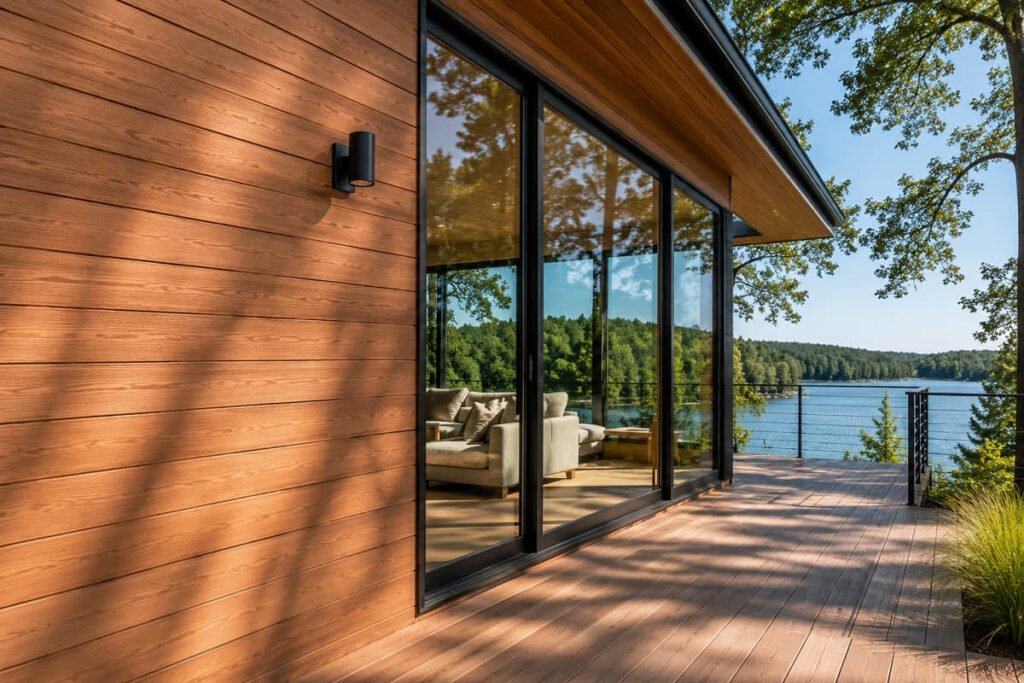
Two things create the timber look: the wood fibre core and the embossed cap layer.
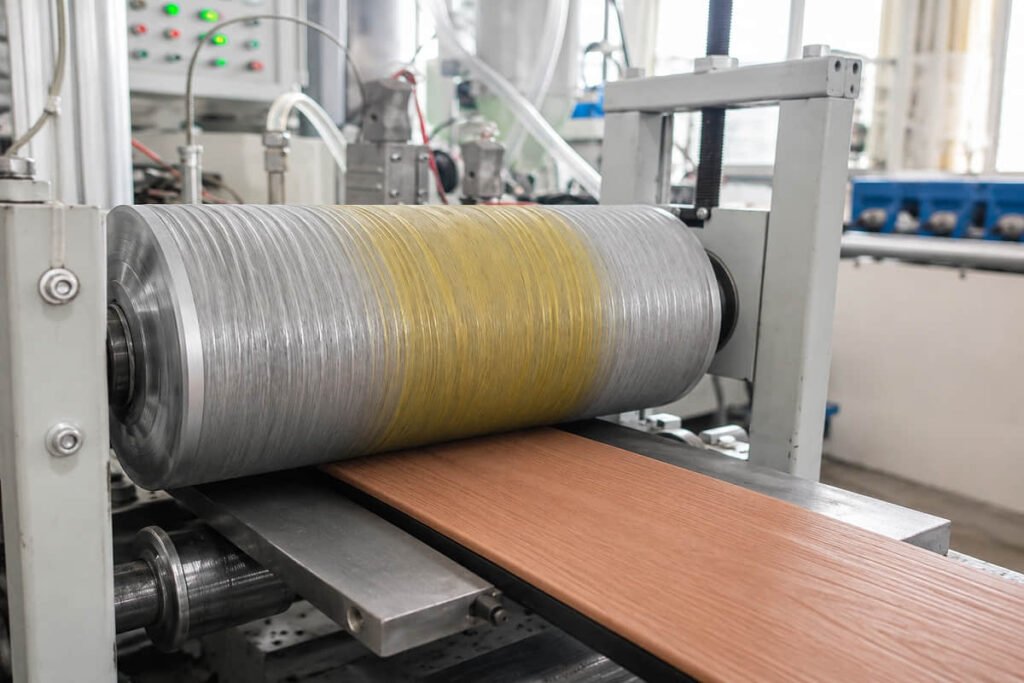
The core blends hardwood fibres — sourced from Guangxi — with HDPE at 0.95 g/cm³. Those fibres give the board its warm base tone and natural character. The cap layer does the surface work. During co-extrusion, the outer cap is pressed with a grain texture that replicates natural timber species. Colour pigment runs through the cap itself — it’s not painted on. That’s why it won’t peel or chip the way a painted finish would.
Co-extrusion means the wood fibre core and the protective cap are made together in one continuous process. The grain and colour are pressed in at the same step — they’re part of the material, not added later. On uncapped boards, the finish sits on the outer surface and can wear away. On capped boards, it’s built into the material.
Cap layer thickness matters. Thinner caps mean less UV and surface protection. Our boards carry a 0.8 mm cap — thicker than many comparable products at a similar price point. When you’re comparing suppliers, this is the first spec to ask for. It’s a quick way to tell quality boards from budget ones.
There’s one honest difference worth knowing. Composite doesn’t give you the board-to-board variation you get with real wood. Every board comes out consistently. On large commercial facades, that consistency is often exactly what’s needed — it makes a finished elevation look clean and intentional. For heritage builds or projects where natural character is part of the brief, real timber still has an edge. Most B2B buyers know which camp their project sits in.
What Timber-Look Finishes Are Available?
Two profiles. One colour system, a clear decision for most projects.
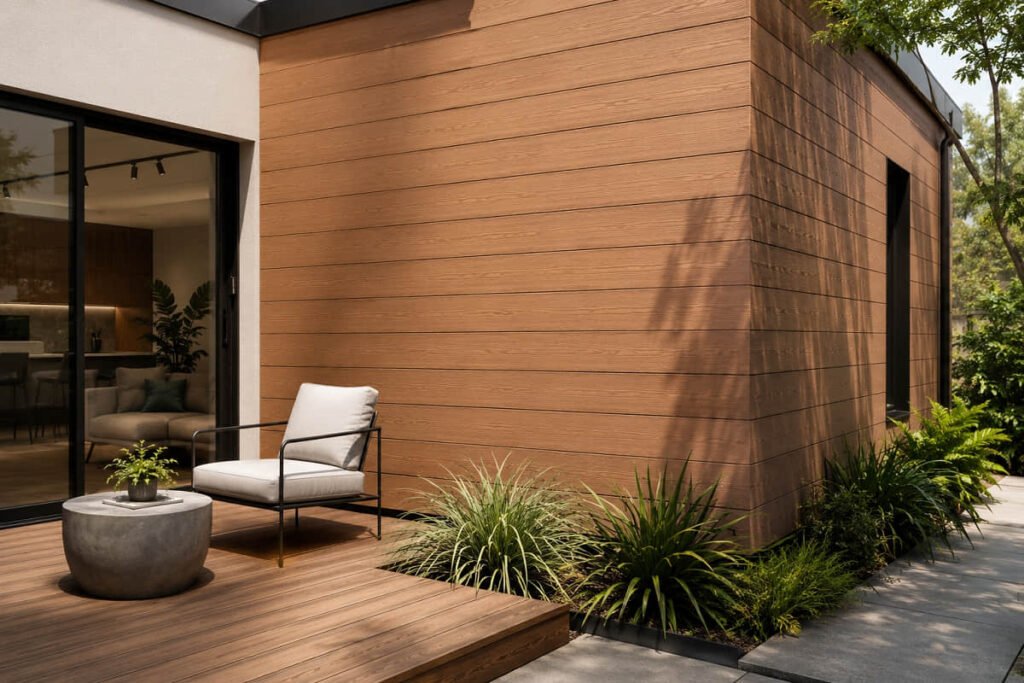
Oakling Cladding — 140 × 12 mm | 1.77 kg/lm
A slim, clean-lined board. It suits contemporary residential facades, feature walls, and projects where a lighter visual weight fits the design. At 1.77 kg per linear metre, it’s easier to handle on multi-storey installs — something your crew will notice on a full day’s work.
DecoGroove Cladding — 219 × 20 mm (2.36 kg/lm) and 219 × 26 mm (2.93 kg/lm)
A wider, more architectural panel. It reads better at scale — on commercial facades, apartment buildings, and larger exterior walls where a bolder horizontal line makes the right statement. The heavier profile suits large, unbroken surfaces.
Both profiles share the same colour palette as the composite decking range. For builders running cladding and decking on the same project, that means consistent colour matching across the facade and deck — no separate matching work needed. The grain texture is embossed during co-extrusion, not printed after. It sits across the full face of the board, including the edges. That matters on shadow-gap or open-joint installs where the board edge is visible.
Want to see how these profiles read at scale? Request free samples — a photo won’t show you how a board looks on a real facade.
Can You Get Custom Colours and Profiles?
Yes. For volume orders and OEM or trade supply arrangements, custom colours, surface textures, and profile dimensions are all available. Custom moulds for surface textures are part of our production capabilities — we are product manufacturers, not a trading operation reselling standard stock.
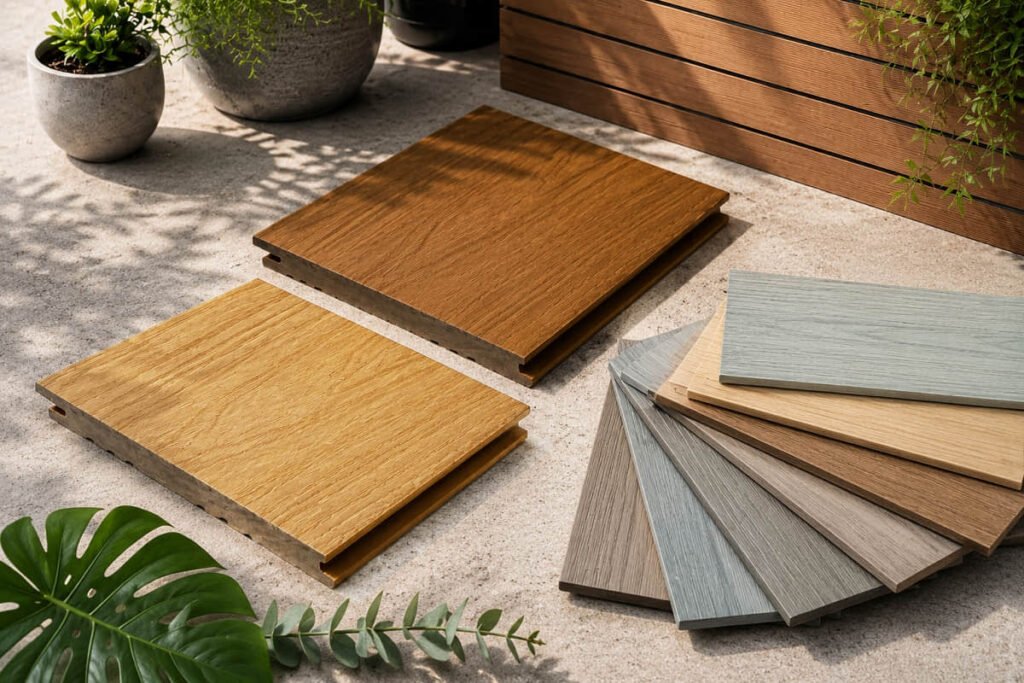
Custom colour development takes time. If a client needs a specific tone to match an existing facade, build the sampling lead time into your project schedule early. Leaving it to the last minute is the most common source of delays on colour-matched jobs.
For distributors and builders running repeat projects, custom colour means a consistent style across multiple builds — without depending on what’s in stock.
Enquire About Custom OEM/ODM — talk to us about volumes and timelines before the project locks in.
Why Composite Holds Its Look Longer Than Real Timber
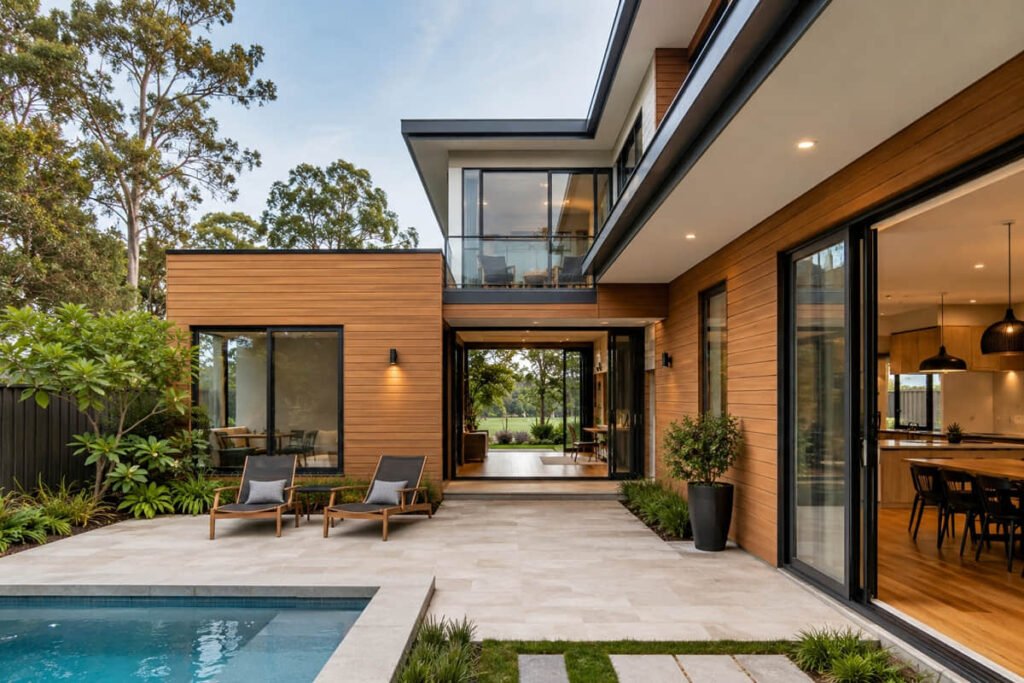
The problem with natural timber cladding isn’t just structural failure. It stops looking good years before it fails.
UV bleaches the surface. Colour shifts unevenly. Boards grey out or develop a patchy finish. Recoating restores it for a season — but the cycle of fade, coat, fade keeps repeating. That’s a real cost, and most builders have seen it firsthand.
Composite holds its colour because the cap layer uses a combined system of HALS (Hindered Amine Light Stabilisers) and UV absorbers. These resist UV breakdown at the surface, where it starts. After 3,000 hours of QUV accelerated aging — equivalent to years of direct Australian sun — colour shift across the range stays at ΔE ≤ 4–5. The boards still look close to how they were installed.
Moisture matters too. Timber absorbs water, which drives the cycle of swelling, shrinking, and surface cracking that breaks down the finish. These boards measure 0.2% water absorption per ASTM D1037. That’s near-negligible. The surface stays stable through wet seasons and coastal conditions — the kind of weather that can visibly age a timber facade in three or four years.
For facades that are public-facing, commercially significant, or central to a building’s design, colour stability isn’t just visual. It’s a maintenance cost and a client expectation.
Want the full durability and cost comparison? See our article on composite cladding vs timber cladding.
How Is Composite Cladding Installed?
The system uses a male-female interlocking clip — fast to install, clean on the face.
Boards lock together edge-to-edge. No exposed fasteners. No surface screws to fill or paint over. The finished wall stays clean without extra finishing work.
The subframe is primarily steel battens. Recommended spacing is 300–400 mm centre-to-centre. For crews who’ve done timber cladding installs, the subframe logic is familiar — the transition is straightforward.
Full system accessories are supplied: top and bottom trim strips, angle brackets, spaced clip fasteners, post caps, post skirts, and post edge trims. You’re not sourcing components from three different suppliers.
An installation video is available on request.
What to Look For in a Quality Composite Board
Five things to check when you’re evaluating composite cladding suppliers.
1. Cap layer thickness
Ask for the exact figure. 0.8 mm is above market standard. Cheaper products often run 0.3–0.5 mm. A thinner cap means less UV and surface protection — the difference tends to show up in year three or four, well after the project is signed off.
2. Grain texture method
Embossed during co-extrusion, or printed after? Embossed texture is integral to the cap and won’t wear away. Printed texture can. Ask the question directly.
3. Test certifications
Ask for: ASTM E84 (fire — FSI 85 / SDI 300), EN 717-1 (formaldehyde — not detected), AS/NZS 4586 (slip resistance — R11), and ASTM D1037 (water absorption — 0.2%). We hold CE, ISO, RoHS, and SGS certification. A supplier who can’t provide test reports on request is a risk for your project and your client.
4. Warranty scope
When comparing suppliers, check what’s excluded and what the remedy process actually looks like — the exclusions matter as much as the headline years.
5. Supply chain
Factory-direct means no importer or reseller margins in the price. It also means direct access to technical data and production records. When building certifiers ask questions — and they do — you need clear answers fast.
Request a Quote or Free Samples — we can turn both around quickly.
MOQ, Lead Times, and Ordering
For trade buyers planning ahead, here’s how our supply works.
Minimum order quantity: 100 m²
| Order type | Production | Packing | Sea freight | Total (approx.) |
|---|---|---|---|---|
| 40′ container | ~20 days | 2 days | 24–32 days | ~46–54 days |
| 20′ container | ~15 days | 2 days | 24–32 days | ~41–49 days |
Actual arrival times vary with shipping schedules and port clearance. For project-critical timelines, contact us early — production can often be scheduled to suit your delivery window.
For first-time trade orders, we recommend starting with a sample request before committing to volume. It’s the fastest way to confirm the colour and profile match your project brief.
Request a Quote — we supply direct to builders, contractors, and building material distributors across Australia.
Frequently Asked Questions
Does composite cladding look the same as real timber up close?
Modern composite boards replicate natural wood grain through embossed texture pressed into the cap layer during co-extrusion. Up close, the grain reads as timber. The honest difference is board-to-board consistency — composite is uniform, while real wood has natural variation. Some buyers prefer the consistency; others want the character of natural timber.
Do different profiles suit different building styles?
Yes. The slim Oakling profile (140 × 12 mm) suits contemporary residential facades and projects where a lighter visual weight fits the design brief. The wider DecoGroove panels (219 × 20 mm or 219 × 26 mm) suit commercial buildings and larger exterior walls where a bolder horizontal line reads better at scale.
Can composite cladding be used indoors?
Yes. Formaldehyde emissions test was not detected under EN 717-1. The boards work well for interior wall cladding, feature walls, and ceiling applications. The lightweight Oakling profile — at 1.77 kg/lm — makes indoor installs easier to handle without specialist equipment.
Can composite cladding be used on curved or angled facades?
Composite boards are rigid — they work on flat, angled, or faceted facades but aren’t suited to tight curves. The male-female clip system handles angular transitions cleanly. Confirm your specific facade geometry with us before specifying.
Does composite cladding come in dark colours? Will they fade?
Yes — charcoal and deep timber tones are available. All colours are UV-stabilised through the cap layer, with colour shift controlled to ΔE ≤ 4–5 after 3,000 hours of QUV testing. Darker colours absorb more heat in direct sun — worth factoring in for north-facing walls.
Does the colour go all the way through the board?
No. The colour and texture sit in the cap layer. If you cut a board on site, the exposed end will show the core material. This is standard for composite products and doesn’t affect performance — but finishing trim at exposed ends is recommended for a clean result.
Can I match cladding and decking colours on one project?
Yes. The composite cladding range shares the same colour palette and surface textures as the composite decking range. For projects running both products, colour matches consistently across the facade and deck — no separate matching work needed.
If you’re specifying composite timber cladding and want to confirm profile options, lead times, or MOQ for your project, contact our sales team. We supply direct to builders, contractors, and building material distributors across Australia.