

The best composite decking in Australia depends on the project. ModWood Flame Shield leads in fire rating (BAL-40). Trex Transcend has the longest warranty (50 years). Ekodeck is the easiest to source through Bunnings. LastElegance TimberLuxe offers the strongest value at volume — a 30-year warranty, full customisation, and manufacturer-direct pricing with no middleman margin.
Seven brands claim to make the best composite decking in Australia. Most comparison pages won’t help you pick — they’re written by one of those brands, with no real data.
We’re LastElegance — a composite manufacturer and one of the seven brands in this table. All data below comes from each brand’s official specs. Where a competitor beats us, we say so.
Short on time? Here’s who leads where:
- Highest BAL rating: ModWood Flame Shield (BAL-40) — the only composite board at that level in Australia
- Australian-made: Everdeck (Tasmania) and ModWood
- Longest warranty: Trex Transcend — 50 years residential
- Easiest to source: Ekodeck — stocked at Bunnings nationally
- Best value at volume: LastElegance TimberLuxe — 30-year warranty, manufacturer-direct, full customisation
How to Compare Composite Decking: 6 Specs That Matter
Not all composite boards are built the same. Before you compare brands, you need a clear framework. Otherwise, you’re comparing brochures, not products.
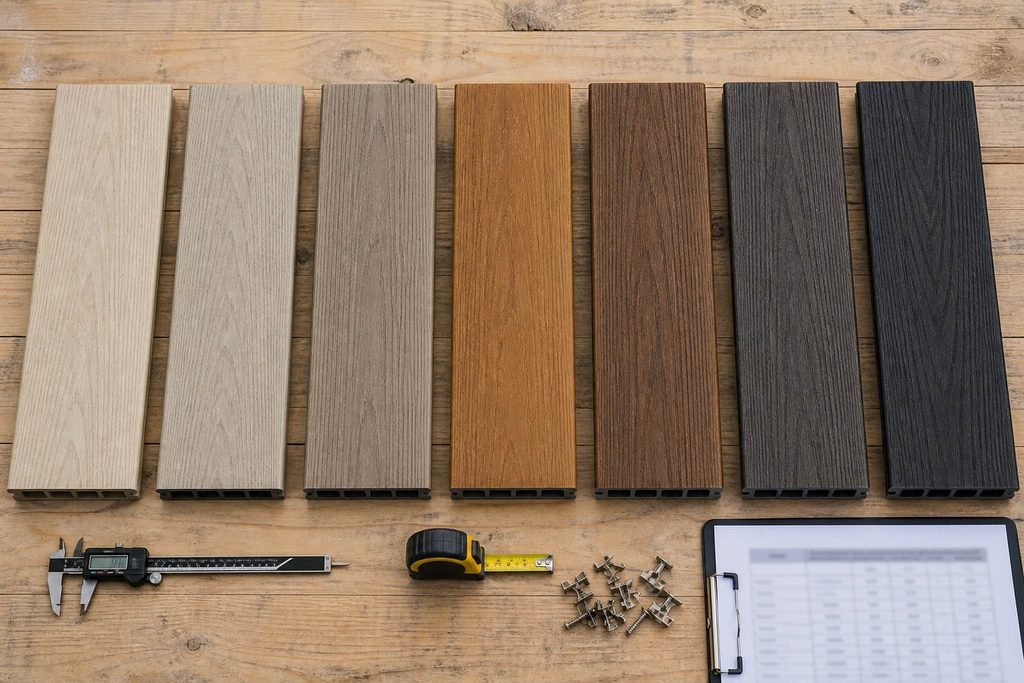
These six specs matter most when specifying composite decking for trade projects.
1. Cap Layer Technology and Thickness
The cap layer is the biggest factor in how long a board holds its colour. Co-extruded (capped) boards wrap the core on all four sides. Surface-coated boards cover fewer faces.
Cap thickness matters too. A thicker cap gives better UV shielding and scratch resistance. Some brands publish this figure. Others don’t. When a brand won’t tell you how thick the cap is, treat that as information.
2. Warranty Terms — Structure vs Appearance
A “25-year warranty” means nothing until you read the fine print. Check whether it covers structure only or includes colour fade. Check whether it applies to both residential and commercial installs. Check what’s excluded.
3. Certifications and Test Standards
For Australian trade buyers, the key certifications are:
- BAL rating (AS 1530.8.1) — required for bushfire-prone zones
- Slip resistance (AS/NZS 4586) — R10 minimum, R11 preferred for pool and commercial areas
- NCC / BCA compliance — non-negotiable for any project needing a building permit
- CodeMark — makes approval with building certifiers simpler
Ask for the test report, not just the claim. There’s a real gap between “fire tested” and “BAL-29 certified to AS 1530.8.1.”
4. Colour Range and Cross-Product Consistency
If your project includes decking, screening, and cladding, check whether the brand shares a colour palette across all three. Colour matching across suppliers is painful and rarely exact. A shared palette from one manufacturer cuts that problem out.
5. Supply Method and Lead Time
Local stock means fast supply — days or weeks. Manufacturer-direct imports mean lower per-m² cost but longer lead times and higher MOQs. Neither is better in every case. It depends on your project timeline and order size.
6. Real Cost per m²
Published retail prices are just a starting point. Trade pricing, volume breaks, and freight all shift the real landed cost. Manufacturer-direct supply removes the importer margin, but it also means planning ahead.
Weight per m² also matters — and most buyers don’t think about it until the first container quote. Heavier boards hit the container weight limit before filling the volume, which drives your landed cost up per square metre. We’ve added a weight row to the table below so you can factor this in.
Composite Decking Comparison: 7 Brands, One Table
This is the core of the article. Every data point comes from the brand’s own website or published product documents. “Not disclosed” means the brand doesn’t make that information public — which is itself worth knowing.
All data sourced from brand websites and official product documents.
| Spec | ModWood | Ekodeck | NewTechWood | Trex | Futurewood | Everdeck | LastElegance |
|---|---|---|---|---|---|---|---|
| Made in | Australia | Not disclosed | Not disclosed | USA | Australia (owned) | Australia (Tasmania) | China |
| Cap type | Capped (Xtreme Guard 360°) | Capped (Durashell™) | Capped (UltraShield® 360°) | Capped (3 sides) | Capped (Xtreme range) | Capped | Co-extruded 360°, 0.8 mm cap |
| Top warranty (residential) | 25 yr (Xtreme Guard) | 30 yr (Summit) | 25 yr | 50 yr (Transcend) | 10 yr | 20 yr | 30 yr (TimberLuxe) |
| Commercial warranty | 7 yr | 10 yr | Not disclosed | Not disclosed | 7 yr | 10 yr | Case by case |
| BAL fire rating | BAL-40 (Flame Shield, AS 3959) | BAL-29 (Flame Fighter, AS 1530.8.1) | BAL-29 | BAL-29 (Transcend, AS 1530.8.1) | BAL-29 (Xtreme) | Not disclosed | EN 13501-1 tested; other standards on request — discuss with our team |
| Slip rating | R11 (AS 4586) | R10 (Summit); varies by range | Not disclosed | Not disclosed | Not disclosed | Not disclosed | R11 (AS/NZS 4586) |
| Board weight (kg/m²) | ~19 | Not disclosed | Not disclosed | Not disclosed | Not disclosed | Not disclosed | 18–30 (Renew hollow 18, VerdeLife 22, TimberLuxe solid 30) |
| Recycled content | Up to 90% | Up to 90% (Classic) | 95% | 95% | Recycled plastic + rice husk | 50%+ timber, recycled plastic | 60% recycled HDPE, 40% virgin |
| Green certification | GreenTag Level C | GreenTag Level C | Not disclosed | Not disclosed | Not disclosed | FSC certified | ISO, RoHS, SGS |
| Flexural strength | Not disclosed | Not disclosed | Not disclosed | Not disclosed | Not disclosed | Not disclosed | 26.2 MPa (EN 15534) |
| Colour fade (ΔE) | Not disclosed | Not disclosed | Not disclosed | Not disclosed | Not disclosed | Not disclosed | ΔE ≤ 4–5 (QUV 3,000 h) |
| Water absorption | Not disclosed | 0% (Summit) | Not disclosed | Not disclosed | Not disclosed | Not disclosed | 0.2% (ASTM D1037) |
| Board profiles | 137 × 23 mm | 137–180 × 23 mm | 138 × 23 mm | Multiple profiles | 138 / 185 × 23 mm | 137 × 23 mm | 138–150 × 20–25 mm (6 profiles) |
| Colour count | 4–5 | 2–6 (varies by range) | 16+ | 20+ | 7 (Xtreme) | 6 (dual-sided) | 6 (shared across decking, screening, cladding) |
| Customisation | Fixed SKUs | Fixed SKUs | Custom colours available | Fixed SKUs | Custom colours and lengths | Fixed SKUs | Full custom: colour, length, texture, profile, mould |
| Supply method | Local stock (retailers) | Bunnings exclusive | Distributor network | Distributor network | Direct + dealers | Dahlsens + select retailers | Manufacturer-direct, MOQ 500 m² |
| Typical lead time | Days–weeks | Days–weeks (Bunnings stock) | Days–weeks | Days–weeks | Days–weeks; custom 9–13 weeks | Days–weeks | 6–9 weeks (production + sea freight) |
Key Differences in This Table
Four rows show the biggest gaps between brands.
Fire rating. The range runs from BAL-40 down to no Australian BAL certification at all. If your project sits in a bushfire zone, this row narrows your shortlist fast. Only boards tested to AS 1530.8.1 carry a genuine BAL rating under the NCC. If your project needs a specific fire standard, talk to our team — we can arrange testing, with costs confirmed upfront.
Published test data. Most brands don’t publish flexural strength, colour fade (ΔE), or water absorption figures. The ones that do make specifying easier — you can back up your product schedule with real numbers rather than catalogue claims.
Board weight. This row matters more than it looks. Composite boards are dense — solid profiles run up to 30 kg/m². In a shipping container, you hit the weight limit long before you fill the volume. That means weight drives your real landed cost per m², not just the unit price. The Decking Calculator shows net board weight alongside your material schedule so you can plan freight properly.
Customisation. Most brands sell fixed SKUs. A few offer custom colours, lengths, or profiles at volume. If your project needs a non-standard spec, check this row before you shortlist.
Best Composite Decking Brands in Australia Reviewed
ModWood — Best for Bushfire Zones
ModWood is Australian-made and has been in the market since the early 2000s. Its key advantage is the Flame Shield range — BAL-40, the highest of any composite board in Australia.
The Natural Grain range carries a 10-year residential warranty with R11 slip resistance on the 137 × 23 mm profile. The Xtreme Guard capped range extends that to 25 years with 360° capping. GreenTag Level C certified. Board weight sits around 19 kg/m².
Strongest point: BAL-40. No other composite board matches this in Australia.
Weakness: The standard Natural Grain range only carries a 10-year warranty — shorter than most capped competitors. Limited profiles and colour options.
Ekodeck — Best Retail Availability
Ekodeck has been sold through Bunnings since 2009, which makes it the easiest composite board to source in small quantities at short notice. Five series cover warranties from 10 to 30 years, including a BAL-29 rated Flame Fighter range. The top-end Summit board is 180 mm wide with a 30-year warranty. GreenTag Level C certified.
Strongest point: Bunnings availability. Walk in, buy, build. No MOQ, no lead time. The Summit series matches the longest warranties on the market.
Weakness: Bunnings-exclusive distribution limits trade pricing flexibility. No custom colour or length options. Board weight not published.
NewTechWood — Strong Global Brand
NewTechWood’s UltraShield technology wraps all four sides in a co-extruded polymer cap. The brand offers a 25-year residential warranty and BAL-29 rated decking. Made from 95% recycled materials with over 16 colour options.
Strongest point: Broad colour range and a well-known global brand backed by established distribution.
Weakness: Cap layer thickness not publicly disclosed. Limited published test data on flexural strength and colour fade. Pricing tends toward the upper end.
Trex — Highest Brand Recognition
Trex is the world’s largest composite decking manufacturer. The Transcend range carries a 50-year residential warranty — the longest on this list. BAL-29 certified (AS 1530.8.1) when installed to the Trex BAL installation guide. Made from 95% recycled materials.
Trex boards are capped on three sides, not four — the bottom face is exposed. That’s fine for most decks but worth noting if underside moisture is a concern.
Strongest point: Global scale, long track record, and the 50-year Transcend warranty. Strong brand recognition for builders presenting to clients.
Weakness: Premium pricing. Installed cost in Sydney runs around $850–$900 per m² (board, subframe, and labour). Made in the USA, so Australian stock depends on distributor inventory.
Futurewood — Australian Owned, Budget-Friendly Entry
Futurewood is Australian owned and supplies the CleverDeck range in three tiers: Eco-Pro, Original, and Xtreme (capped). The Xtreme range is BAL-29 rated and available in 138 mm and 185 mm widths.
Custom colours and lengths are available for larger orders, with a 9–13 week lead time and a minimum order.
Strongest point: Good value entry point. Australian-owned. Custom options on the Xtreme range.
Weakness: 10-year warranty across all ranges — the shortest of the capped boards on this list. Core is rice husk and recycled plastic rather than hardwood fibre and HDPE.
Everdeck (Timberlink) — Made in Australia, FSC Certified
Everdeck boards are made by Timberlink in Bell Bay, Tasmania. That makes it one of only two Australian-made composite boards on this list (alongside ModWood). FSC certified. 20-year residential warranty, 10-year non-residential. Capped surface with an embossed timber-grain finish.
Available through Dahlsens and select independent retailers — not nationally stocked.
Strongest point: Australian-made in Tasmania. FSC certification. Strong sustainability credentials for Green Star projects.
Weakness: Limited distribution. No published BAL rating. Smaller colour range (6 colours) compared to global brands. Board weight not disclosed.
LastElegance — Manufacturer-Direct, Full Customisation
We’re a composite manufacturer, not a reseller. We produce decking, screening, and cladding in-house with a 0.8 mm co-extruded cap layer — thicker than many products on the market. Three decking series: Renew (15 yr), VerdeLife (20 yr), and TimberLuxe (30 yr).
We publish specs most brands don’t: flexural strength (26.2 MPa to EN 15534), colour fade (ΔE ≤ 4–5 after 3,000 h QUV), water absorption (0.2% to ASTM D1037), and formaldehyde (not detected to EN 717-1). Our six board colours are shared across the decking, screening, and cladding ranges — so colour matching across three product lines is built in. Full technical data sheets are available for download.
Board weight ranges from 18 kg/m² (Renew hollow) to 30 kg/m² (TimberLuxe solid). We publish this because it directly affects your container loading and landed cost — see the weight section below.
Full custom manufacturing is available: colours, textures, lengths, profiles, and packaging. We’ve built custom moulds for trade partners running their own brand programmes.
Strongest point: Published test data, full customisation, and manufacturer-direct pricing with no middleman margin. TimberLuxe’s 30-year warranty matches or beats most competitors.
Weakness: No local Australian stock — lead time is 6–9 weeks from order to delivery. MOQ is 500 m².
Which Composite Decking Brand Suits Your Project?
The right composite brand depends on the job, not a ranking. Here are four common trade scenarios and which brands suit each.
Small Residential Project — Tight Timeline
You’re building one deck under 50 m² and need boards on-site this week. Local stock matters more than per-m² cost.
Best fit: Ekodeck (Bunnings, off the shelf), ModWood (stocked by major retailers), or Trex (distributor network).
Single Project Builder — Best Value per m²
You’ve got a 100–200 m² project and want a strong board at a good trade price. You can plan two to three months ahead.
Best fit: Futurewood (good pricing, 10-year warranty), or LastElegance (manufacturer-direct, MOQ 500 m², 15–30-year warranty depending on range).
Build your material schedule in the Decking Calculator, then request trade pricing with your quantities attached.
Contractor on Repeat Supply — Consistency and Margin
You run composite decking across multiple builds per year. You need reliable supply, steady specs, and pricing that protects your margin project after project.
Best fit: LastElegance (manufacturer-direct, custom specs, consistent batch quality) or NewTechWood (established distributor network, wide colour range). If BAL compliance is a regular need, keep ModWood Flame Shield or Ekodeck Flame Fighter in your schedule.
Importer, Distributor, or Private Label
You want to source composite boards at manufacturer pricing for resale under your own brand or through your distribution channel. You need a manufacturing partner, not just a supplier.
Best fit: LastElegance. We offer custom colours, textures, profiles, packaging, and branding. MOQ starts at 500 m². Apply for trade pricing.
Buying Composite Decking at Volume
Below 500 m², you’re buying retail or small-trade. Above that threshold, three things change.
How Trade Pricing Works
Retail pricing includes the importer margin, distributor margin, and retailer margin. At volume, manufacturer-direct supply strips those layers out. The gap between retail and manufacturer pricing on composite decking can be substantial — that’s margin you’re either capturing or giving away.
Because we’re a manufacturer, not a middleman, your price reflects production cost and freight — not three layers of markup. That’s a structural cost advantage, not a discount.
For a landed cost on your volume, apply for trade pricing with your project specs and quantity.
Lead Times and Delivery
Manufacturer-direct orders run on production schedules. A 20-foot container takes about 15 days of production, 2 days of packing, and 24–32 days of sea freight. A 40-foot container is roughly 20 days of production plus the same packing and freight window. Add port clearance and local delivery.
That means you need to order 6–9 weeks ahead of boards hitting site. For builders running a pipeline of projects, this works well — you batch orders and keep stock turning. For a single project with a tight deadline, local stock is the better call.
Board Weight and Freight — Why kg/m² Matters
Most buyers focus on per-m² pricing, but weight often sets the real landed cost on an import order.
Here’s why. A 20-foot container holds roughly 28 cubic metres of volume but maxes out at about 21–22 tonnes gross weight. Solid composite decking at 30 kg/m² fills the weight limit well before it fills the space. Hollow boards at 18 kg/m² let you fit more square metres per container.
Our three ranges span that full range:
- Renew (hollow): ~18 kg/m² — best container yield per shipment
- VerdeLife: ~22 kg/m²
- TimberLuxe (solid): ~30 kg/m² — strongest board, heaviest load
The Decking Calculator returns the net board weight in kilograms alongside your material schedule. Use that figure when you’re comparing quotes — a lower unit price on a heavier board can mean a higher cost per container.
Most competing brands don’t publish kg/m² data, which makes accurate freight planning harder. We include it because it affects your real cost.
Custom Colours, Sizes and Profiles
At manufacturer-direct MOQ, you’re not picking from a fixed catalogue. Custom lengths reduce waste on-site. Custom colours let you match an architect’s spec exactly. Custom textures and profiles give you a product no other builder in your market is offering.
We’ve built custom moulds for trade partners in Queensland running branded composite ranges. That kind of flexibility is only possible when you’re dealing with the manufacturer directly.
Use the Decking Calculator to build your material list. Or go straight to the Trade page if you already know what you need.
FAQ
What is the best composite decking for full sun in Australia?
Look for a co-extruded cap with published QUV test data. Cap thickness and UV stabiliser quality drive fade resistance, not brand name alone. LastElegance publishes ΔE ≤ 4–5 after 3,000 hours of accelerated weathering. Test reports are available on request. Ask any brand you’re considering for the same.
Does composite decking need a BAL rating?
Only if the project is in a bushfire zone under the NCC. The board must be tested to AS 1530.8.1. ModWood Flame Shield (BAL-40), Ekodeck Flame Fighter (BAL-29), and Trex Transcend (BAL-29) all hold Australian BAL certifications. Check with the building certifier before specifying.
How does composite decking compare to timber on cost?
Composite costs more per m² upfront than treated pine. But timber needs oiling every 2–3 years, plus sanding and board replacement over time. Over a 15-year cycle, composite’s total cost of ownership is often lower. For a detailed breakdown, see our guide on composite decking cost.
What is the best composite decking material for pools?
Slip resistance is the key spec. Look for R11 or higher to AS/NZS 4586. ModWood and LastElegance both publish R11 ratings. Use proper drainage gaps between boards and specify stainless steel clips in coastal or pool-adjacent areas.
Is Australian-made composite decking better?
Australian-made boards (ModWood, Everdeck) offer faster delivery and local warranty support. Imported boards from established manufacturers can match or beat specs at a lower per-m² cost. “Better” depends on your priority: speed of supply, or cost and customisation. Both are valid depending on the project.
How long does composite decking last in Australian conditions?
Quality capped composite lasts 15 to 30 years depending on the board, the cap layer, and the install quality. Warranty length is a useful guide but not the full picture. Ask for test data on colour fade, water absorption, and flexural strength — these tell you more about real-world performance than a warranty headline. For more, see composite decking vs timber.
How much does composite decking weigh per square metre?
It varies widely by profile. Hollow boards run 18–20 kg/m². Solid boards can reach 28–30 kg/m². This matters for freight — heavier boards fill a container by weight before they fill it by volume, which pushes up your landed cost per m². The Decking Calculator returns net board weight for each area so you can factor this into your quote.