
Hundreds of WPC decking products move through the Australian market each year. Most of them couldn’t pass a compliance check.
That’s your problem — not just the supplier’s. Under the NCC, everyone in the supply chain carries compliance responsibility: the manufacturer, the distributor, the specifier, and the installing builder. A stop-work order. A forced rebuild at your cost. Insurance that won’t pay out. None of that needs a product failure to trigger. Supplying or installing a product without the right documentation is enough.
This guide covers the standards that apply, the documents to request before you place an order, and the questions to ask any supplier before you commit.
Key Takeaways
- Confirm the compliance pathway for the proposed decking system before ordering, with input from the project engineer and building certifier.
- Request current fire, structural and slip test reports that identify the exact board, formulation and intended application.
- General fire test results do not establish suitability for every bushfire zone; check the site’s BAL requirements separately.
- Keep test reports, engineering assessments and installation instructions together so suppliers, specifiers and installers work from the same evidence.
Why WPC Decking Is a Non-Standard Building Product
The NCC — Australia’s National Construction Code, formerly known as the Building Code of Australia — works through two pathways: Deemed-to-Satisfy provisions and Performance Solutions.
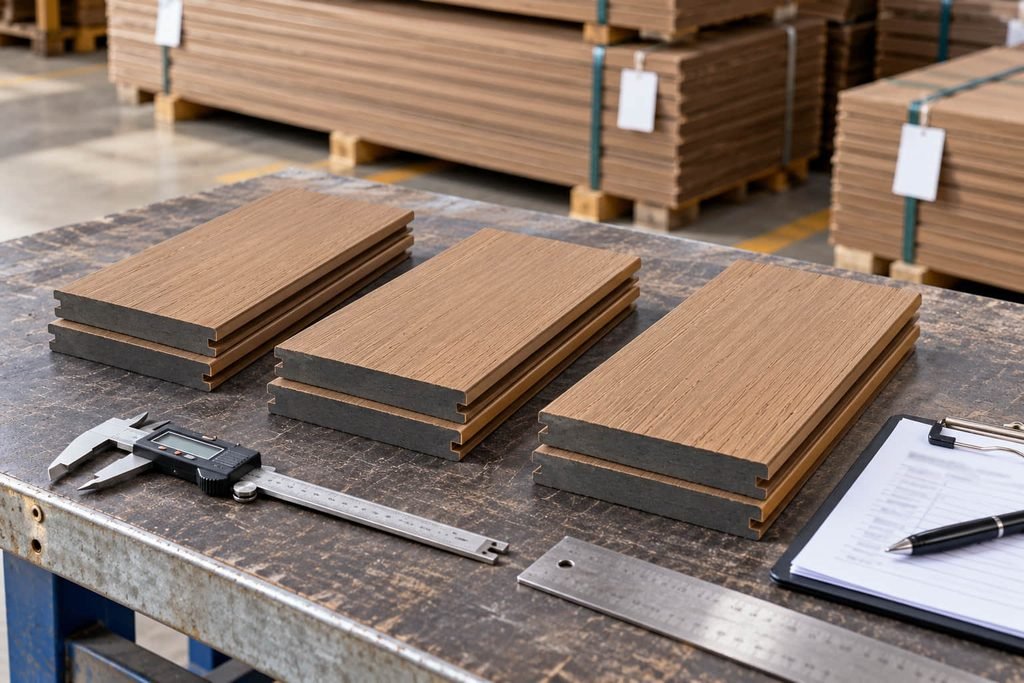
WPC decking doesn’t have a Deemed-to-Satisfy provision. So it follows the Performance Solution pathway under NCC 2022 Part A2G2. A registered engineer assesses the product’s test reports against NCC performance requirements and signs off a Performance Solution report. That goes into the project’s construction documentation.
It’s not a shortcut — but it’s a clear, workable pathway. As long as the supplier can back their product with current, accredited documentation.
The QBCC has published a fact sheet on WPC decking compliance that’s the clearest plain-language summary available. It applies nationally, not just in Queensland.
Which Australian Standards Apply to WPC Decking?
Use this table as a supplier audit checklist. No current test report against an applicable standard? That’s a red flag — before the first order, not after.
| Standard | What It Tests | Industry Benchmark | Why Builders Check It |
|---|---|---|---|
| AS 1530.3 | Early fire hazard — ignitability, spread of flame, heat, smoke | Varies by NCC building class; used in Performance Solution assessments | NCC-referenced fire test; required evidence for building surveyors |
| ASTM E84 | Flame Spread Index (FSI) and Smoke Developed Index (SDI) | Class B: FSI ≤ 75, SDI ≤ 450; Class C: FSI ≤ 200, SDI ≤ 450 | Widely accepted international equivalent used in NCC Performance Solutions |
| AS 3959 | Bushfire attack level (BAL) performance of building elements | BAL rating depends on site’s mapped hazard level — BAL-12.5 through BAL-FZ | Mandatory in designated bushfire-prone zones across all states |
| EN 15534 | Flexural strength and structural performance of WPC boards | Typically 18–20 MPa for standard residential designations; confirm with an engineer for balcony or commercial loads | Confirms load-bearing capacity; required for engineer sign-off on elevated decks and balconies |
| AS/NZS 4586 | Slip resistance — wet and dry pendulum and ramp testing | R10 (standard), R11 (commercial outdoor areas, pool surrounds), R12 (ramps, slopes, heavy wet traffic) | Mandatory for commercial, public and pool-area decks; R11 is the minimum for most trade project categories |
| EN 717-1 | Formaldehyde emission level | E0 ≤ 0.5 mg/L; E1 ≤ 1.5 mg/L (E0 is the benchmark for semi-enclosed and indoor-adjacent applications) | Relevant where boards are used in covered areas, pergolas, or internal wall applications |
Test reports must come from an accredited lab. They’re only valid for the exact formulation tested — if a supplier reformulates without re-testing, previous reports don’t count.
Ask for test reports against each of these standards before placing a volume order. LastElegance makes all reports available to trade partners on request. Download Test Reports
Fire Testing — FSI and SDI
ASTM E84 measures how fast flame spreads across a surface (FSI) and how much smoke the material produces (SDI). Lower is better on both. Class B (FSI ≤ 75, SDI ≤ 450) is the common commercial benchmark — but the required level depends on building class and fire zone, so confirm with your certifier for each project. AS 1530.3 and ASTM E84 aren’t direct equivalents; your Performance Solution engineer will advise which one applies.
Structural Testing — Flexural Strength and Joist Spacing
Flexural strength (EN 15534) tells you how much load a board can handle. Joist spacing must come from the manufacturer for their specific product — 300 mm centre-to-centre is a common starting point, but it varies by board type and load. No EN 15534 report means no engineer sign-off on a balcony or elevated deck. Have that data before you commit.
Slip Resistance — AS/NZS 4586
R11 is the minimum for most commercial outdoor areas, pool surrounds and wet areas across NSW, Queensland, WA and SA. Surveyors want an accredited lab report — not a self-certified claim. If your supplier can’t produce one, flag it early.
BAL Ratings and Bushfire Zones
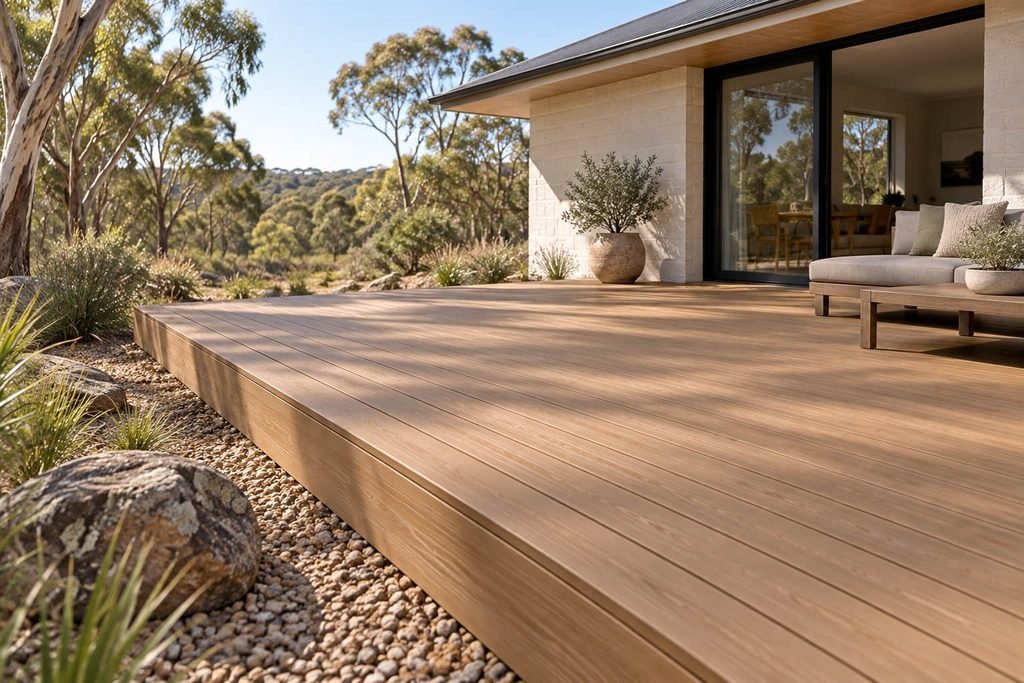
If you work in NSW, Queensland, WA or SA, you’ll hit BAL zones. Specifying a product without checking BAL suitability is a compliance and liability risk.
What BAL ratings apply in Australia?
- BAL-12.5 — low risk; ember attack possible
- BAL-19 — moderate risk; elevated ember attack
- BAL-29 — high risk; burning debris and ember showers
- BAL-40 — very high risk; radiant heat and direct flame likely
- BAL-FZ (Flame Zone) — extreme risk; direct flame contact expected
Site BAL levels are mapped by state fire authorities: NSW Rural Fire Service, QFES in Queensland, DFES in WA, and the SA Country Fire Service. Where a deck falls in a BAL zone, the product must meet the AS 3959 provisions for that level — through a Deemed-to-Satisfy pathway or a Performance Solution backed by fire test evidence.
Not all WPC products have been assessed for BAL zones. BAL-29 is the current ceiling for most tested composite decking in the Australian market. Ask any supplier directly: has this product been assessed for BAL zone use, and is there a signed engineering evaluation certificate to prove it?
Who Is Responsible for WPC Decking Compliance?
Everyone. Manufacturer, distributor, specifying engineer, installing builder — all of you carry NCC compliance responsibility.
The consequences are practical, not just regulatory. A non-compliant product can trigger a stop-work order, force a full deck removal and rebuild, void project insurance, and create direct liability under state building acts. None of that requires an actual failure on site. Using a product without the right documentation is enough.
The QBCC’s WPC decking compliance fact sheet names every party in the chain and sets out what evidence each must hold. It applies across all states.
What Compliance Documents Should You Request?
Seven documents. Request all of them from any WPC decking supplier before you place an order.
- Fire test report (ASTM E84 or AS 1530.3, accredited lab)
- Structural test report (EN 15534 or equivalent)
- Slip resistance report (AS/NZS 4586, R-value confirmed)
- Formaldehyde emission test (EN 717-1 or equivalent)
- Engineering evaluation certificate (signed by registered engineer)
- Installation guide (NCC-referenced joist spacing and subframe)
- Performance Solution report (where one exists for Australian projects)
Get these from the manufacturer directly — not a reseller or agent who may hold outdated versions. The manufacturer ran the tests and controls the formulation. Their documents are the ones that hold up when a certifier asks.
Contact the LastElegance trade team if you need documentation for a spec or tender. All test reports and certificates are available on request. Contact Our Sales Team
How a Performance Solution Works
A Performance Solution is how WPC decking demonstrates NCC compliance without a Deemed-to-Satisfy provision. A registered engineer prepares a performance-based design brief — it sets out what the product must achieve and how test evidence will prove it. The engineer reviews the reports, signs off a Performance Solution report, and that goes into the project’s construction documentation.
This is the supply chain’s job, not the certifier’s. On commercial or multi-residential projects, budget for engineer engagement early. A late compliance assessment costs far more than the boards.
What to Ask Before You Order: A Supplier Checklist
Can you provide current, accredited test reports for fire, structural and slip resistance? Reports must match the exact product you’re ordering — not an older formulation that may have since changed.
Has your product been assessed under a Performance Solution for Australian projects? If yes, ask for the engineering evaluation certificate. If no, ask how they’ll support compliance documentation for your specific project.
Do your engineering evaluation certificates carry a registered engineer’s signature and a current date? No signature means the certificate doesn’t satisfy NCC requirements.
Is your product formulation stable? Ask for written confirmation that any reformulation triggers re-testing. This matters on long-run orders.
What are your lead times, and how do you manage batch consistency on volume orders? Consistent quality across batches matters as much as the first-order documentation.
Buying direct from the manufacturer means compliance documents come from the entity that ran the tests. That’s the shortest path to paperwork that holds up on site.
LastElegance holds ISO manufacturing certification and SGS testing across our composite decking range. Those confirm process rigour — but they don’t replace product-specific test reports against Australian standards. We supply both, on request. Download Product Specs
Frequently Asked Questions
Does WPC decking need council approval in Australia?
It depends on project type, state, and deck height. Most decks above a certain height or area threshold need a building permit — a builder or certifier can confirm what applies. NCC compliance is required regardless of whether a permit is needed.
Is there a difference between compliance for new builds and renovations?
The same NCC performance requirements apply to both. In a renovation, the existing subframe must also be assessed for compatibility with the WPC product. A registered engineer should review the full system, not just the boards.
Can WPC decking be used on a balcony or elevated deck?
Yes — subject to structural assessment. Balcony construction needs a design signed off by a registered professional engineer, and EN 15534 flexural strength data from the manufacturer is required as part of that. Joist spacing must follow the manufacturer’s specification for the specific product.
What does the NCC say about WPC boards used on external walls?
External wall cladding has stricter fire performance requirements than decking — especially for Class 2 buildings and above. WPC boards used as cladding need separate compliance documentation for that application. If you’re specifying the same composite boards for both uses on one project, request a separate compliance pack for each.
Who signs off on the structural performance of WPC decking boards?
A registered professional engineer. They review the structural test reports and sign the engineering evaluation certificate. The manufacturer supplies the data; the engineer assesses it for the specific project conditions. No engineer signature means the certificate doesn’t satisfy NCC Performance Solution requirements.