

The board price is never the whole story.
Labor, subframe, trim, and freight all add up — and they add up fast. Contractors who don’t account for every layer end up squeezing margin on jobs that looked profitable on paper.
This guide breaks down the real cost of composite siding: per square foot, by project size, by material grade, and by region. We’ll compare it against vinyl, fiber cement, and engineered wood — and show you where smarter sourcing makes a real difference on volume orders.
What Does Composite Siding Cost per Sq Ft?
Composite siding materials run $3–$8 per sq ft, depending on board grade, profile, and supplier. Installed cost — materials plus labor — typically falls in the $10–$20 per sq ft range. Board weight affects both shipping cost and labor time on site. A lighter profile like the Oakling Siding (140 × 12 mm, 1.19 lb/ft) handles and installs faster than a heavier board like the DecoGroove (219 × 26 mm, 1.97 lb/ft). That difference flows through to your total project cost.
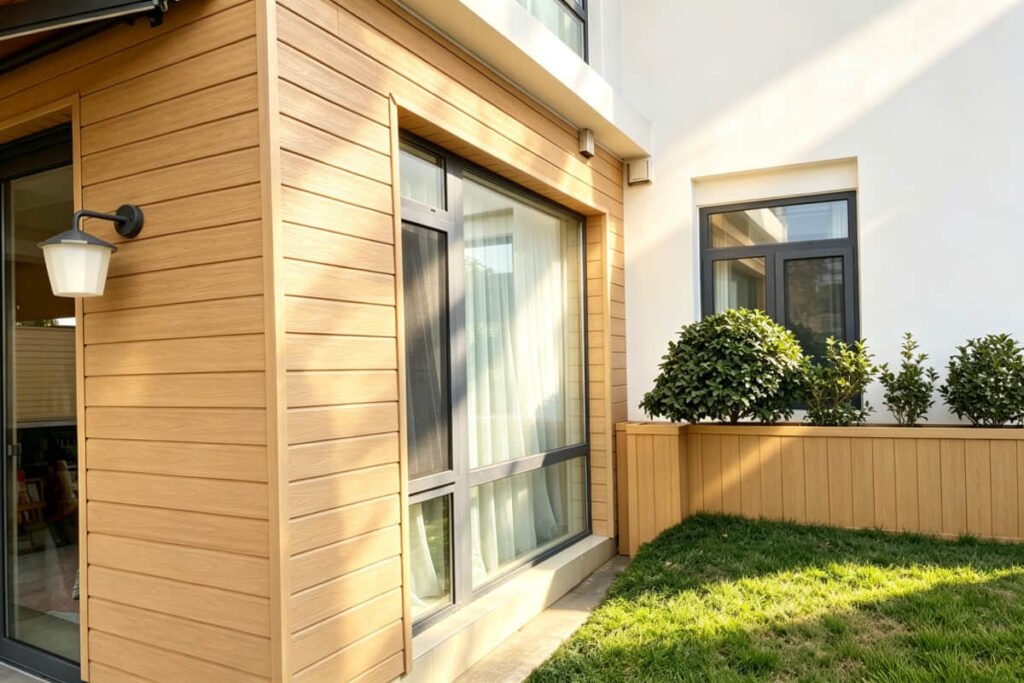
| Cost Type | Price Range (per sq ft) |
|---|---|
| Material only | $3–$8 |
| Installed (materials + labor) | $10–$20 |
Factory-direct sourcing is a real price lever — and most buyers don’t fully account for it. When you buy through a domestic distributor, the material price includes multiple layers of markup. Going directly to the manufacturer removes those layers. On volume orders, the savings per sq ft add up fast.
Composite Siding Cost by House Size
Contractors estimating for clients and project managers building material budgets often need a quick per-job reference. The table below gives you that — based on typical siding coverage for each home size, using the $10–$20 per sq ft installed range.
Wall area and floor area aren’t the same thing. A 2,000 sq ft home doesn’t have 2,000 sq ft of siding to cover. How much wall area you’re working with depends on ceiling height, number of stories, and how much you subtract for windows and doors. As a rough guide, total siding area typically runs 60–80% of floor area — before those deductions.
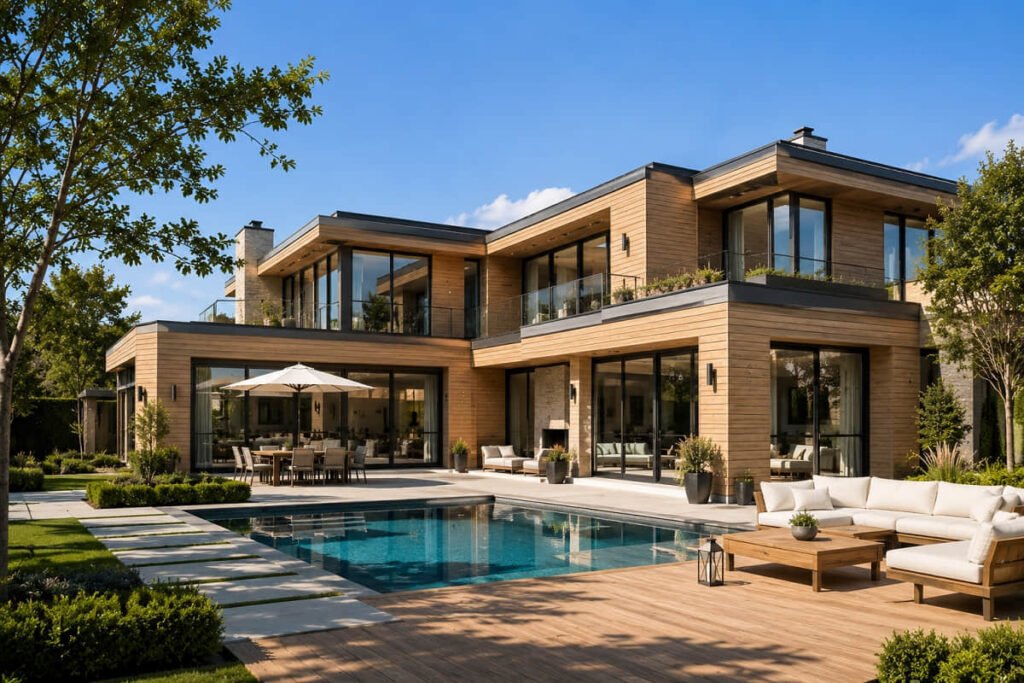
Plan for 10–15% extra material on any job. Cuts, waste, and trim add up, especially on homes with gables, dormers, or multiple window surrounds. First-time project managers and homeowners often underestimate this.
| Home Size (floor area) | Est. Siding Coverage | Low Estimate | Mid Estimate | High Estimate |
|---|---|---|---|---|
| 1,000 sq ft | ~800–1,000 sq ft | $8,000 | $14,000 | $20,000 |
| 1,500 sq ft | ~1,100–1,400 sq ft | $11,000 | $20,000 | $28,000 |
| 2,000 sq ft | ~1,400–1,800 sq ft | $14,000 | $26,000 | $36,000 |
| 2,500 sq ft | ~1,700–2,200 sq ft | $17,000 | $32,000 | $44,000 |
Note: Sales tax, permit fees, and scaffolding are not included in these estimates. Confirm your local siding coverage area before requesting quotes.
What Factors Affect Composite Siding Cost?
Four main factors move the final price:
- Board grade and cap layer quality — the single biggest quality and cost differentiator
- Labor costs and what installers charge — typically $2–$7 per sq ft
- Home complexity and site conditions — corners, gables, and access all add time
- Regional price differences — labor markets vary across the United States
Understanding these helps you evaluate bids and spot gaps in a quote before you sign off.
Board Grade and Cap Layer Quality
Not all composite siding is built the same. The cap layer — the outer shell on a co-extruded board — is the key quality indicator. A thicker cap means better UV resistance and color retention over the board’s life.
Boards without a cap, or with a thin outer shell, cost less upfront. But they fade and wear faster, especially in high-UV climates. That means earlier replacement and higher lifetime cost.
When comparing price per sq ft across suppliers, ask for the cap layer spec and the test data behind it. A co-extruded board with a 0.8 mm cap, a HALS + UV absorber system, and a QUV result of ΔE ≤ 4–5 is a very different product from an uncapped board with no numbers to back it up. Price alone doesn’t tell you which one you’re buying.
Labor Costs and What Installers Charge
Labor typically runs $2–$7 per sq ft for composite siding installation. In high-cost markets — the Northeast and California — labor alone can push the installed cost past $15 per sq ft.
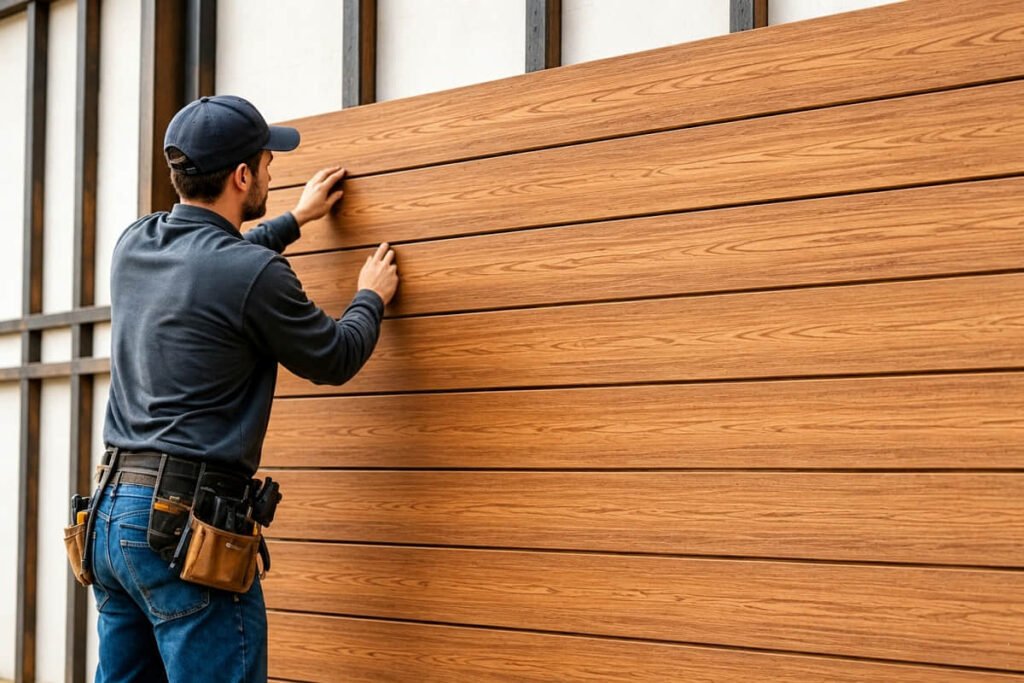
The installation system matters here. A male-female interlocking clip system means no face-nailing and no specialty cutting tools. Crews familiar with clip-based systems install composite siding faster than fiber cement, which requires diamond-blade cutting and field painting after each cut. That speed advantage reduces crew hours on site — and shows up directly in the labor line of your quote.
Home Complexity and Site Conditions
A simple two-story box costs less to side than a home with multiple gables, inset windows, or detailed trim work. Every extra corner, window surround, and roof transition means more cuts, more flashing, and more finishing time.
Multi-story work often requires scaffolding — that’s a cost before a single board goes up.
Wall prep is another line item that gets missed. Removing old siding typically adds $1–$3 per sq ft. A weather-resistive barrier (house wrap) is required by most local building codes before cladding goes on — that’s part of the full wall assembly cost, not an optional extra.
Regional Price Differences Across the U.S.
Labor rates vary across the United States. The Southeast and Midwest tend to have lower installed costs. The Northeast, West Coast, and Pacific Northwest run higher — often $2–$4 per sq ft more on labor alone.
Seasonal timing plays a role too. Spring and early summer are peak seasons for exterior work. Contractor availability tightens, and rates reflect it. Fall and winter can offer better availability in many markets.
Buyers in hurricane-prone zones — the Gulf Coast and Carolinas — should also check local building code requirements before specifying. Wind resistance and moisture barrier specs vary by jurisdiction and can affect both material selection and total cost.
How Composite Siding Compares to Other Materials
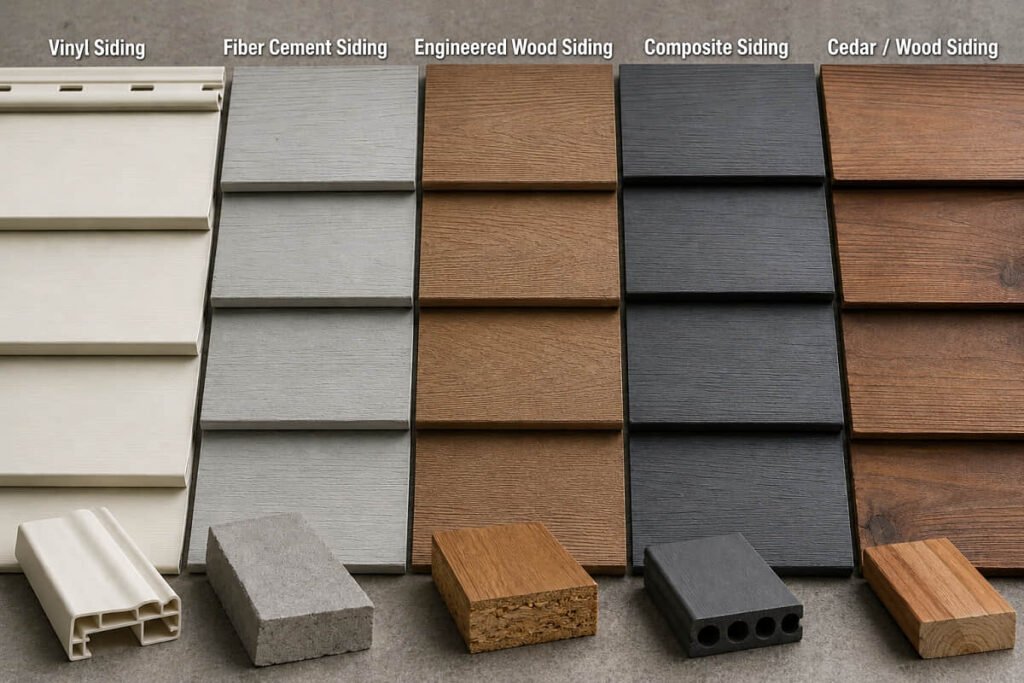
| Siding Type | Installed Cost (per sq ft) | Est. Lifespan | Maintenance | Key Weakness |
|---|---|---|---|---|
| Composite | $10–$25 | 25–50 years | Low — rinse only | Higher upfront cost |
| Vinyl | $4–$12 | 20–30 years | Low | Brittle in cold; less natural look |
| Fiber cement | $6–$15 | 30–50 years | Medium — repainting required | Heavy; specialty tools needed |
| Engineered wood | $7–$12 | 20–30 years | Medium | Can swell if moisture barrier fails |
| Cedar / wood siding | $6–$16 | 20–40 years | High — paint, stain, seal | Rot, insects, ongoing upkeep cost |
Vinyl is the cheapest upfront option. That’s a real advantage, and it’s worth saying plainly. The trade-off is appearance and durability — vinyl can buckle in summer heat, become brittle in cold winters, and won’t hold a premium look over time. For commodity work or tight budgets, it makes sense. For projects where the facade matters, it has a low ceiling.
Fiber cement performs well over time — but the installation process is demanding. Every field cut needs a diamond blade and generates silica dust. After cuts, you’re painting on-site. That adds labor time and cost to every job.
Engineered wood offers a natural look at a lower price point than composite. The risk is moisture. If the barrier behind it is compromised, the boards can swell — and that turns into a mold and rot problem that requires remediation before you can re-side. Contractors we talk to flag this as their most common warranty call-back on engineered wood jobs.
Composite costs more upfront than vinyl or engineered wood. Where it earns that price: no painting, no sealing, no rot, no insect risk. Moisture resistance is built into the material, not dependent on a paint film or a perfect barrier install. That’s the durability argument in plain terms.
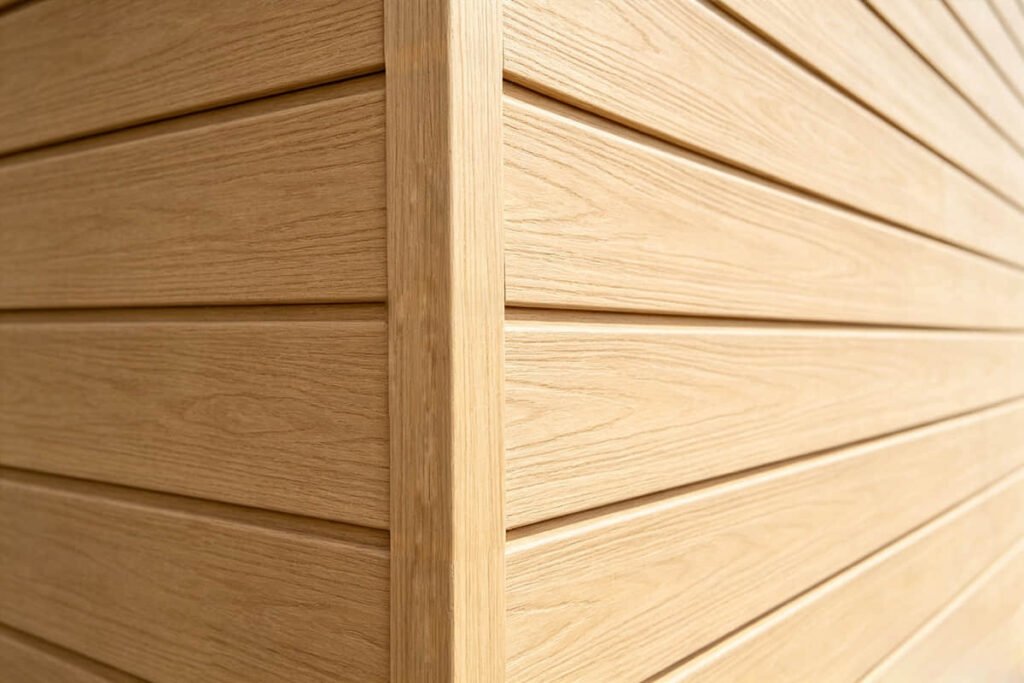
Board profiles and surface textures vary more than a spec sheet suggests. If you’re evaluating composite siding for an upcoming project, physical samples give you a faster read than any table.
Does Composite Siding Hold Up Over Time?
Co-extruded composite siding typically lasts 30–50 years, depending on product grade, climate, and how the wall assembly is built. That lifespan is the core of the cost argument. A $12/sq ft product that lasts 40 years costs less over time than a $6/sq ft product you replace in 20.
Warranty terms are a separate number. Lastelegance provides a 15-year warranty; the product’s actual service life runs well beyond that under normal conditions.
Moisture resistance is baked into the material. Composite boards don’t rot, swell, or soak up water the way wood products do. Water absorption for co-extruded composite runs around 0.2% (ASTM D1037). Wood-based products depend on a paint or sealant layer to keep moisture out. When that layer fails, you get swelling, mold growth, and eventual rot — all of which require remediation before any new material goes on.
Color retention follows the cap layer. After 3,000 hours of QUV accelerated aging, a well-spec’d composite board shows a color shift of ΔE ≤ 4–5 — barely visible in real conditions. The HALS + UV absorber system in the cap drives that result. It’s a test number you can ask any supplier to match.
Cleanup is straightforward. No staining, no sealing. Periodic rinsing keeps the surface clean. Mold doesn’t get a foothold the way it does on wood siding with compromised paint.
What Are the Downsides of Composite Siding?
Composite siding has real trade-offs. Professional buyers should know them before they spec a job.
Higher upfront cost vs. vinyl. Vinyl at $4–$12/sq ft installed is cheaper on day one. That’s a fact. If first cost is the only metric, vinyl wins.
Fire rating limitations. Most composite siding products rate Class C per ASTM E84. Class C is fine for most exterior residential and light-commercial work. But if a project is governed by the IBC and requires Class A or B — schools, hospitals, certain multi-family builds — confirm the local fire rating requirement before you spec composite. Not all products clear that bar, and you need to verify before the job goes to plan review.
Thermal expansion. Composite boards move with temperature changes more than fiber cement or masonry. Proper gapping at board ends is required during installation. Skip it, and you’ll see buckling in high-heat climates. It’s not a dealbreaker — it just needs to be built into the install process from the start.
Weight and handling vs. vinyl. Heavier board profiles add handling time on site. For multi-story work, that labor cost is real, even if it’s smaller than the equivalent fiber cement penalty.
Most exterior residential and light-commercial projects fall well within the scope where composite performs well. The cost-performance ratio still favors it over time. But go in knowing the trade-offs, not discovering them mid-bid.
What to Look For When Buying Composite Siding
Before you lock in a supplier, run through this checklist. These are the spec points that separate a quality composite siding product from one that looks similar on paper but underperforms in the field.
Cap layer thickness. Ask for the spec sheet, not a marketing claim. Look for 0.8 mm or thicker on a co-extruded board. Thinner caps fade faster and wear down sooner — especially in high-UV climates like the Sun Belt.
UV protection system. A HALS + UV absorber combination in the cap layer is the industry benchmark. Ask suppliers what’s in their cap. This is what drives color performance over a 10–20 year horizon.
QUV accelerated aging test results. Ask for the number. Three thousand hours of QUV testing with a color shift of ΔE ≤ 5 is a solid threshold. If a supplier can’t produce test data, treat that as a red flag.
Water absorption. Look for 0.2% or lower per ASTM D1037. The lower the number, the less moisture the board takes on — and the less risk of swelling, mold, and long-term structural issues.
Formaldehyde emissions. If the product will be used in mixed-use buildings or interior applications, ask for EN 717-1 or equivalent test results. “Not detected” is the right answer.
Slip resistance. R11 minimum for any exterior-facing surface. This matters for commercial projects, pool surrounds, and anywhere ADA compliance is on the table.
Warranty terms. Read what’s actually covered — surface cracking, color fade, structural failure — and who backs it. A manufacturer-direct warranty removes the intermediary risk. A distributor’s warranty is only as good as that distributor’s longevity.
Customization and supply flexibility. For distributors building private-label programs or contractors working on spec-driven projects, ask whether the supplier can produce custom lengths, colors, and packaging. Most domestic brands can’t. Factory-direct suppliers often can — and that flexibility is worth building into your sourcing evaluation.
On volume orders, factory-direct buying moves the material cost meaningfully compared to sourcing through a domestic distributor. That’s worth working out before you lock in a supplier relationship.
For distributors evaluating a new composite line, factory-direct sourcing removes the intermediary cost that domestic distribution adds. That margin stays with you.
FAQ
How long does composite siding last?
Co-extruded composite siding typically lasts 30–50 years, depending on product grade, climate, and wall assembly quality. Capped composite boards — with a full polymer shell on all four sides — outperform uncapped boards in UV and moisture resistance, which extends service life in harsh climates.
Is composite siding cheaper than vinyl siding?
Vinyl is cheaper upfront at $4–$12/sq ft installed vs. $10–$20/sq ft for composite. Over 10–15 years, composite’s lower upkeep and longer lifespan close the gap. Factory-direct sourcing also narrows the material cost difference compared to buying composite through a domestic distributor.
Does the price vary by region in the United States?
Yes — labor rates drive most of the regional difference. The Northeast and West Coast typically run $2–$4/sq ft higher on labor than the Southeast and Midwest. Material cost stays fairly consistent across regions, though distance from the port of entry can add a small freight variable.
What is included in a composite siding installation quote?
A full quote should break out material cost (boards, trim, fasteners), labor, weather-resistive barrier (house wrap), old siding removal if applicable, and permit or inspection fees. Always ask for itemized quotes — it’s the only way to compare bids apples to apples. Don’t forget to ask whether sales tax is included.
Does composite siding need to be painted or sealed?
No. Co-extruded composite siding doesn’t need painting, staining, or sealing. Color is factory-applied in the cap layer, and UV stabilizers maintain appearance over time. Routine cleanup is periodic rinsing — no stripping, no recoating.
Can composite siding help with energy efficiency?
Composite siding itself isn’t an insulating material. But when it’s installed over continuous insulation board — rigid foam or mineral wool — with a proper rain screen gap, the full wall assembly can cut thermal transfer. Specify the full wall system for energy performance, not just the cladding.