

Wood fencing is still the most-installed fence type in the U.S. It’s also the one contractors get called back on most — boards rotting, warping, staining that needs to be redone year after year. Composite fencing cuts out that whole cycle.
This guide covers what composite fencing is made of, how it holds up in real U.S. conditions, how it compares to wood and vinyl, and what to check before you source or stock it.
What’s Composite Fencing Made Of?
Composite fencing is built from two core materials: wood fibers and recycled HDPE plastic. The wood fibers give the board its natural look and texture. The plastic binds the fibers together and shields the core from moisture, rot, and insect damage.
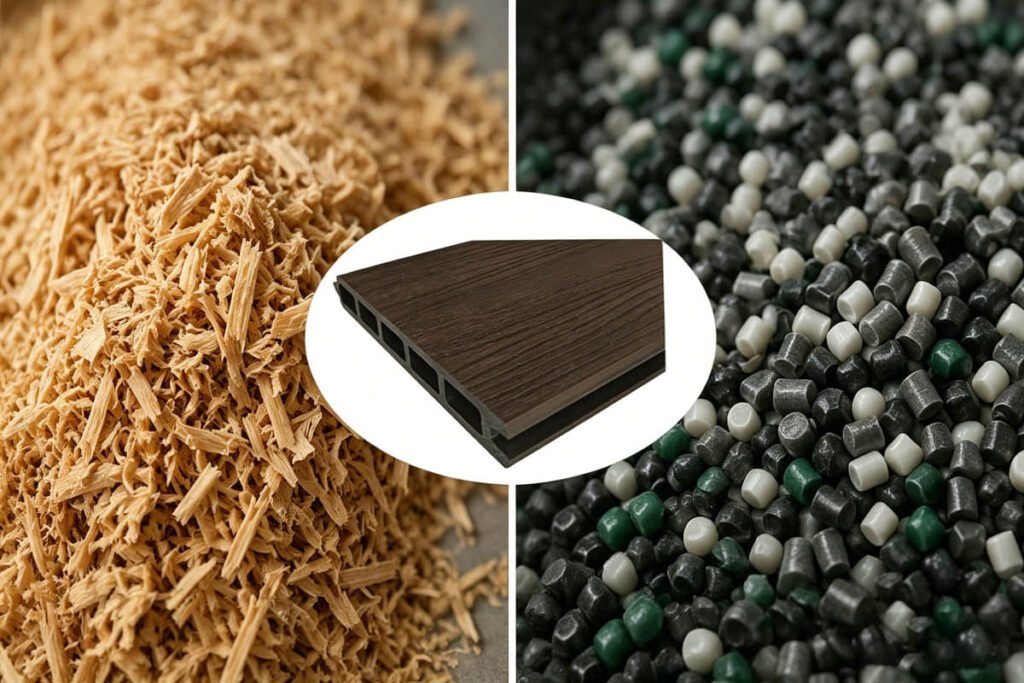
In quality products, recycled content runs around 60%. That’s a mix of reclaimed wood fiber and recycled HDPE, with virgin material making up the balance. The two materials are blended, heated, and extruded into board profiles in a controlled forming process. The result is a composite panel that holds its shape, resists water, and doesn’t need painting or sealing to stay looking good.
Well-made composite fence boards test at no detectable formaldehyde (EN 717-1). Look for products carrying CE, RoHS, ISO, and SGS certification. These confirm the composite materials meet international standards for both safety and performance.
Capped vs. Uncapped Composite — What’s the Difference?
A capped composite fence board has a protective outer shell — called a cap layer — extruded around the core on all four sides. This shell resists UV fade, staining, and moisture far better than the core material on its own. An uncapped board leaves some surfaces exposed and tends to wear faster in harsh weather or high-UV settings.
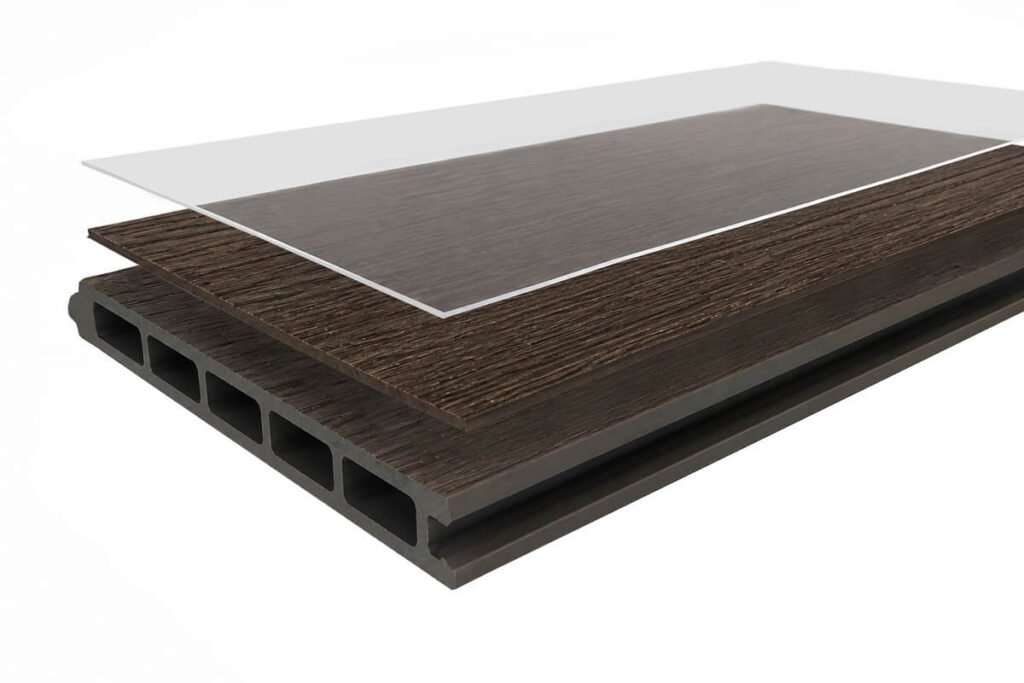
For commercial sites, multi-family developments, or waterfront projects, capped composite fencing is the right spec.
Uncapped boards carry a lower initial price and work fine in sheltered or lower-exposure settings. But for any product line aimed at distributors or commercial buyers, capped is the stronger long-term choice.
How Long Does Composite Fencing Last?
A quality composite fence typically lasts 15–20 years with minimal maintenance — no staining, sealing, or annual retreatment required. By comparison, cedar and pressure-treated pine fences often need major repairs or replacement after 8–15 years, depending on climate and maintenance history.
Vinyl fencing can reach 20+ years, but it gets brittle in cold climates and can crack or discolor over time. Composite handles temperature changes and UV exposure better than vinyl across most U.S. climate zones.
Three things drive composite fence lifespan: cap layer quality, correct post installation, and climate zone. A solid manufacturer warranty — covering surface cracking, edge warping, structural breakage, and color fade — gives buyers real peace of mind. Warranty terms vary, so ask for the coverage details in writing before you commit.
Does It Hold Up in Harsh Weather?
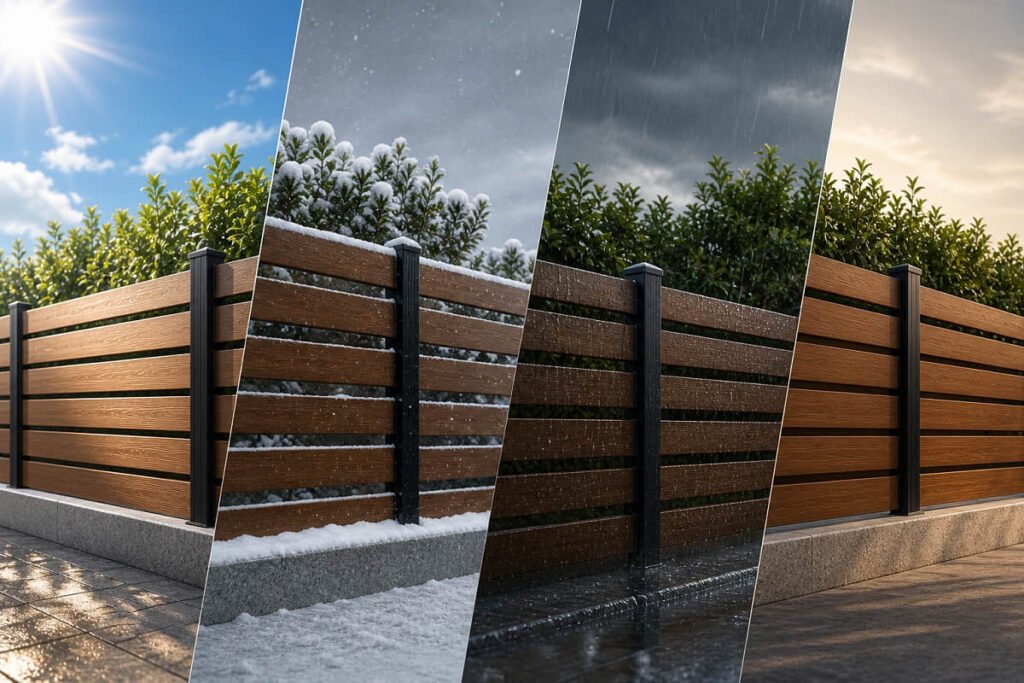
Composite fencing holds up well across the full U.S. climate range — though performance varies by product and supplier. LastElegance composite fencing uses a HALS-based UV stabilizer system to control color fade in high-exposure markets like the Sun Belt. QUV testing at 3,000 hours (ASTM G154) holds a color difference to ΔE ≤ 4–5. Water absorption comes in at 0.2% per ASTM D1037 — meaning boards won’t swell or warp in the humid Southeast.
In the Midwest and Northeast, freeze-thaw cycles are hard on wood. Composite absorbs very little water, so it moves far less with temperature changes.
For high-wind zones — Gulf Coast, hurricane belt, high-plains states — post spacing is the key variable. Use 32″–40″ on center for exposed sites, and verify against local building codes and ASCE 7 wind zone requirements for the project location. Closer post spacing means more structural integrity where wind loads are high.
Will Pests or Rot Damage It?
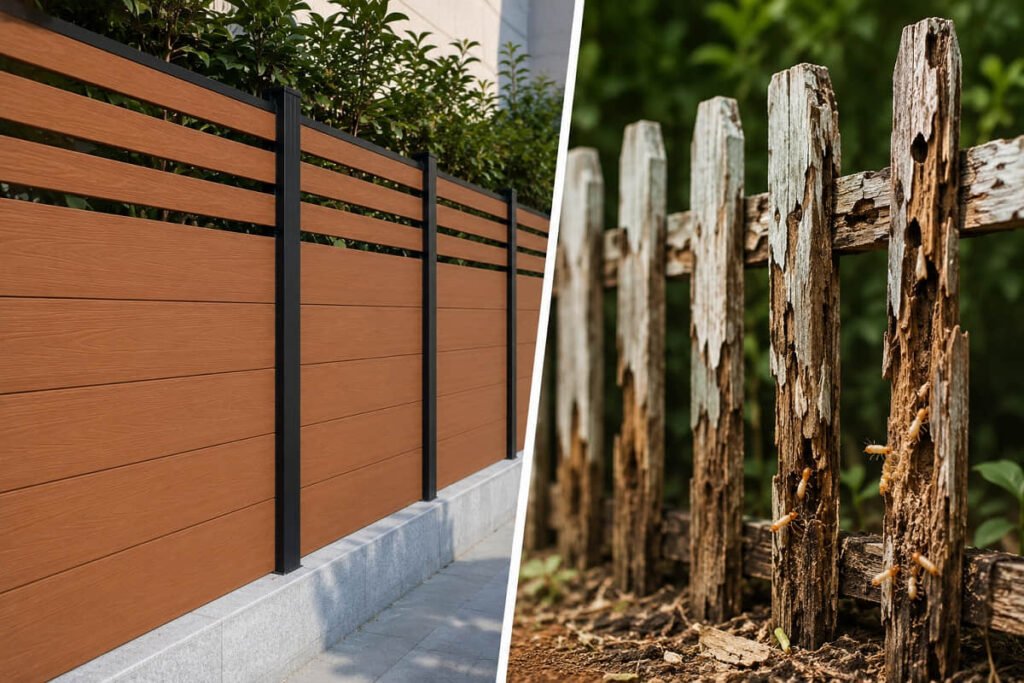
No. Composite fencing doesn’t rot, warp, or attract termites. The HDPE content makes it inhospitable to the moisture and organic matter that insects and mold feed on.
Unlike pressure-treated lumber, composite needs no chemical treatment to stay pest-resistant. That’s a real benefit for fence projects near waterways, coastal soil, or any site where low-chemical specs matter. LastElegance composite fencing carries RoHS compliance, confirming no restricted heavy metals in the product.
Composite Fencing vs. Wood, Vinyl, and Metal
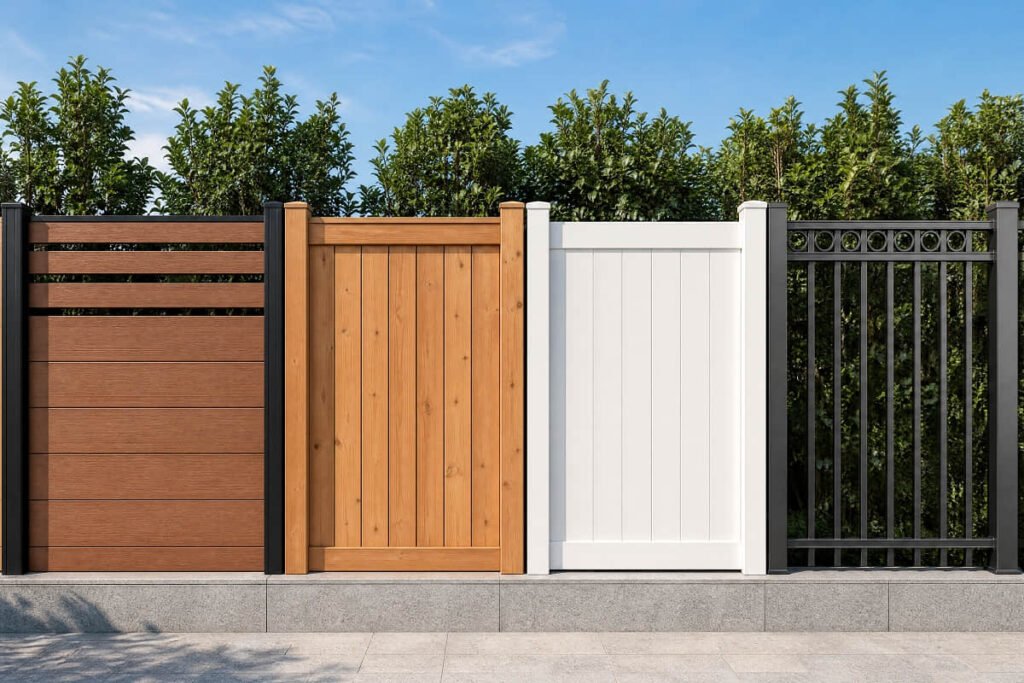
| Criteria | Composite | Wood (Cedar / PT Pine) | Vinyl / PVC | Metal / Aluminum |
|---|---|---|---|---|
| Lifespan | 15–20 years | 8–15 years | 20+ years | 20–30 years |
| Maintenance | Periodic wash only | Annual staining / sealing | Periodic wash | Periodic wash |
| Appearance | Natural wood look | Natural wood look | Smooth / plastic look | Modern / industrial |
| Upfront Cost | Medium–high | Low–medium | Medium | Medium–high |
| Weather Resistance | High | Medium | Medium | High |
| Pest Resistance | High — no treatment needed | Low–medium — treatment required | High | High |
Composite wins on long-run value and low upkeep. Wood fencing costs less upfront — especially pressure-treated pine. But add in annual staining, board swaps, and termite treatment over 15 years, and the cost gap closes fast.
Vinyl is the closest match to composite. It’s low-maintenance and widely stocked, but it doesn’t give you the look of real wood. In cold climates, rigid PVC becomes brittle and can crack on impact. Composite keeps its structural integrity in cold weather — an important point for buyers stocking products for Northern markets.
Traditional wood fencing still dominates by installed volume. It’s familiar, widely available, and cheaper at the point of purchase. But the long-term maintenance burden is real, and that’s where composite earns its premium. Metal fencing — aluminum in particular — is durable and low-maintenance. But it can’t match the natural aesthetic most residential and multi-family projects call for.
Pros and Cons of Composite Fencing
Pros
- Low maintenance — no staining, sealing, or painting after install
- Long lifespan — 15–20 years with minimal upkeep
- Rot and insect resistant — no chemical treatment required
- Design options — wide range of colors, board widths, and textures
- 60% recycled content — supports LEED project eligibility and sustainability reporting
Cons
- Higher initial cost — upfront spend is more than pressure-treated pine
- Surface color is fixed — composite can’t be repainted after install
- ASTM E84 Class C fire rating — suitable for most exterior uses, but check local codes for covered structures and commercial buildings
- Minor batch color variation — slight differences can occur between production runs; for large continuous runs, specify from the same batch
Composite fencing is the right call for projects where long-run value and low upkeep outweigh the higher initial price. That covers most residential developments, multi-family properties, commercial landscaping, and any project where client call-backs for maintenance are a real cost.
Is Composite Fencing Eco-Friendly?
It’s a responsible choice — with honest context. Composite uses reclaimed wood fiber and recycled HDPE that would otherwise go to landfill. A 60% recycled content ratio supports LEED reporting and meets RoHS and CE environmental standards.
No annual staining also means no VOC runoff into soil or groundwater. That’s a genuine benefit for outdoor spaces near parks, waterways, or environmentally sensitive sites. The environmental impact is lower than virgin-material wood fencing. But composite is still a plastic-based product with a real manufacturing footprint — know what your clients need before making broad sustainability claims.
How Much Does Composite Fencing Cost?
Composite fencing typically runs $25–$45 per linear foot installed at U.S. retail pricing. Pressure-treated pine usually comes in at $12–$20 per linear foot installed. Cedar sits in the middle, around $20–$30.
| Fence Type | Installed Cost (per linear foot) | Typical Lifespan |
|---|---|---|
| Composite | $25–$45 | 15–20 years |
| Pressure-Treated Pine | $12–$20 | 8–12 years |
| Cedar | $20–$30 | 10–15 years |
| Vinyl / PVC | $20–$35 | 20+ years |
The initial cost is higher for composite — no question. But over 15 years, wood fencing needs annual staining, periodic board replacement, and retreatment. For a property manager running multiple sites, that labor and material spend adds up fast. Composite cuts out that whole category of recurring cost.
A 15-year manufacturer warranty also reduces cost risk. When you’re sourcing at volume, factor the warranty into your total cost model — not just the per-board price.
For distributors and contractors buying at volume, a factory-direct supply chain changes the math. Cutting out distribution markup can bring composite panel costs down to a point where the total installed cost is far more competitive. Contact our sales team for project-specific or volume pricing.
What to Look For Before You Buy
Five things matter most when you’re evaluating composite fencing as a distributor or contractor.
1. Cap layer quality. Ask whether the product is capped or uncapped, and what the cap thickness is. A 0.8 mm cap on all four sides is a solid benchmark. Request QUV aging test results — a ΔE of 4–5 or better after 3,000 hours (ASTM G154) is what quality products deliver.
2. Certifications. Ask for CE, RoHS, ISO, and SGS test reports. For California or LEED projects, request the EN 717-1 formaldehyde result. These confirm the composite fencing materials meet safety and performance standards — and give you something solid for a spec review.
3. Fire rating. Get the ASTM E84 classification for any product you spec. Composite fencing typically rates Class C — fine for most exterior applications. But check your local building code, especially for covered structures and commercial sites.
4. Product range and customization. Can the supplier color-match to a specific spec? Do they offer multiple board widths and profiles? LastElegance’s Vista Composite Fence Panels and Linea Composite Fence Panels cover full-privacy and open-slat designs across a range of widths — and custom colors, textures, and packaging are available.
5. Supply chain reliability. Know your lead time before you commit. Ask for a clear production and shipping schedule upfront — and confirm the total door-to-door timeline to your destination port. Check the MOQ per product line. Ask whether the supplier can support a stocking program for ongoing volume, not just one-off orders.
Ready to Source Composite Fencing?
Composite fencing holds up across the full U.S. climate range, needs almost no ongoing care, and delivers a wood-like look that stays consistent for 15+ years. For distributors and contractors sourcing at volume, the factory-direct model changes the total cost equation — no middlemen, full customization capability.
Request a quote. Our team can turn around samples and project pricing within days.
FAQ
How are composite fence panels installed?
Composite fencing uses a clip-based or slot-in system — set your posts, slot the fence boards into place, and apply the finishing trim. No specialized tools are needed. A two-person crew can typically match or beat the pace of vinyl fence installation, and well outpace traditional wood frame-and-nail construction.
Can composite fencing be installed on sloped or uneven ground?
Yes, but the method matters. The most common approach on sloped sites is a stepped install — each fence section drops to a fixed height at each post, creating a stair-step profile along the grade. This works well with clip-based composite systems. A racked install, where boards follow the slope continuously, is harder to achieve with panel-style composite fencing — confirm with your supplier whether the board profile and clip system support it. Post depth and footing requirements stay the same regardless of grade. Follow the standard post spacing guidelines (32″–56″ on center) and verify against local code for the site.
What’s the best fence type for high-wind areas?
For hurricane belt, Gulf Coast, and high-plains sites, use composite fence panels with tighter post spacing — 32″–40″ on center rather than the maximum 56″–63″. Aluminum alloy fence posts add more rigidity than WPC posts in exposed locations. Always verify against local building codes and ASCE 7 wind zone requirements for the project.
Is composite fencing better than vinyl?
For most buyers, yes. Composite offers a more natural wood look, stronger structural rigidity, and better cold-weather performance — vinyl can become brittle and crack below -10°F. Vinyl is often cheaper upfront, but composite comes in more colors and textures and holds up better to impact.
How much upkeep does composite fencing need?
Very little. A periodic wash with soap and water keeps most composite fences looking good for years. There’s no staining, sealing, or painting — and none of the annual retreatment that wood fencing needs to stay ahead of rot and insect damage.