

Railings are the first thing clients judge on a finished deck — yet most builders spec them last. That leads to rushed choices, rework, and margin lost on jobs that were otherwise well-run.
This guide breaks down ten composite deck railing ideas matched to Australian conditions, building codes, and real project types. You’ll get material options, code notes, and install details for both home and commercial jobs — so you can spec railings with the same care you give the deck itself.
10 Railing Ideas for Composite Decks
These ten deck railing ideas pair well with composite decking across a range of styles and budgets. Each one suits a different project type, site, and client brief.
1. Glass Panels for Open Views
Glass panel railings step back and let the view take over. They’re the go-to for elevated decks, coastal homes, and pool surrounds where you don’t want anything blocking the sightline.
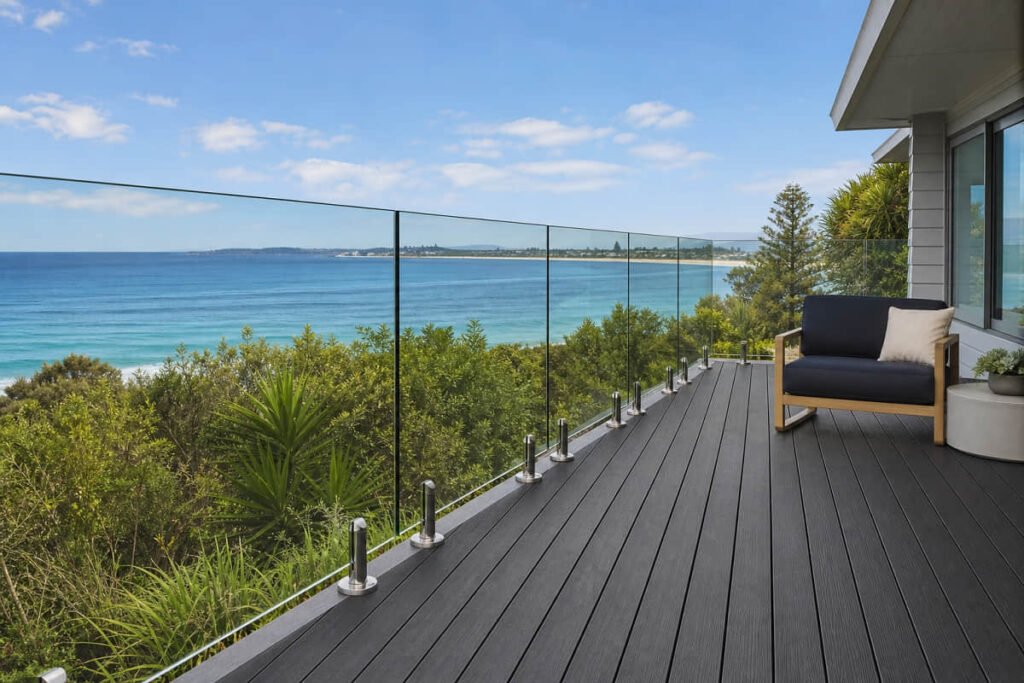
Tempered safety glass is required under AS 1288 — the Australian standard for glass in buildings. Frameless glass suits modern builds and gives the cleanest look. Framed glass works across a wider range of styles and tends to cost less.
Darker composite deck boards create strong contrast against clear glass. If the site has a view worth protecting, glass panels are hard to beat.
2. Aluminium Balusters with a Timber Look
Powder-coated aluminium balusters give you a clean, modern railing system with almost no upkeep. They come in black, white, and bronze tones — all of which pair well with timber-grain composite deck boards.
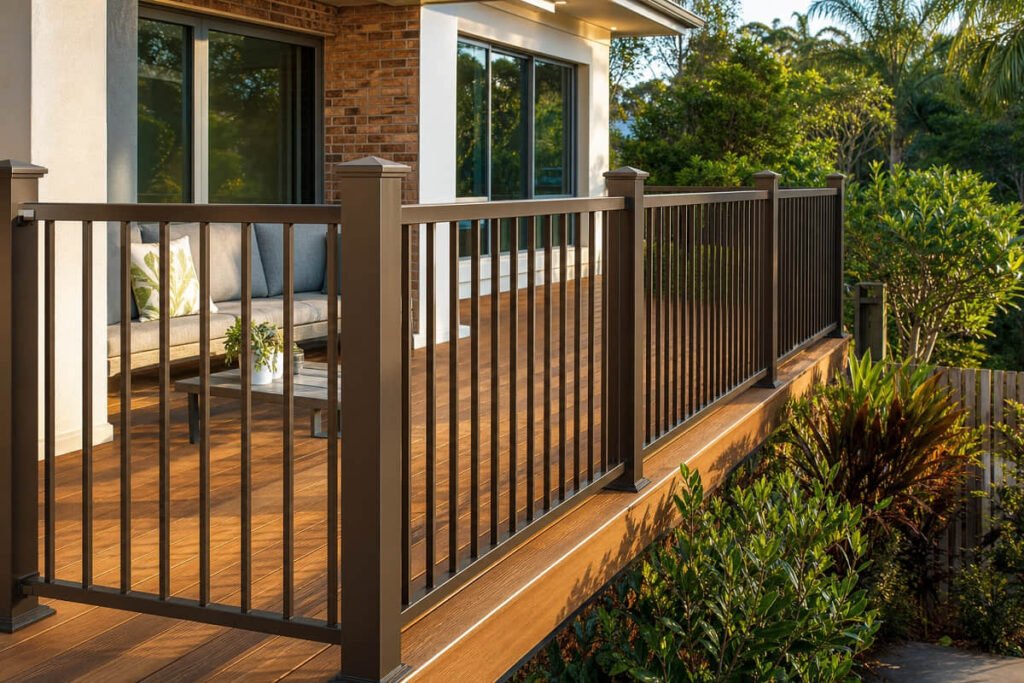
The railing stays sharp and uniform. The decking carries the warmth. It’s a good split.
Aluminium resists corrosion, which makes it a strong choice for coastal and high-humidity areas across Australia. For builders who want low maintenance and minimal maintenance call-backs, this is one of the safest picks. Aluminium balusters also keep working in salt air long after painted timber starts flaking.
3. Cable Railing for a Sleek Finish
Stainless steel cable railing keeps sightlines open. The thin horizontal cables almost vanish against the landscape, making it a popular railing design for modern and coastal builds.
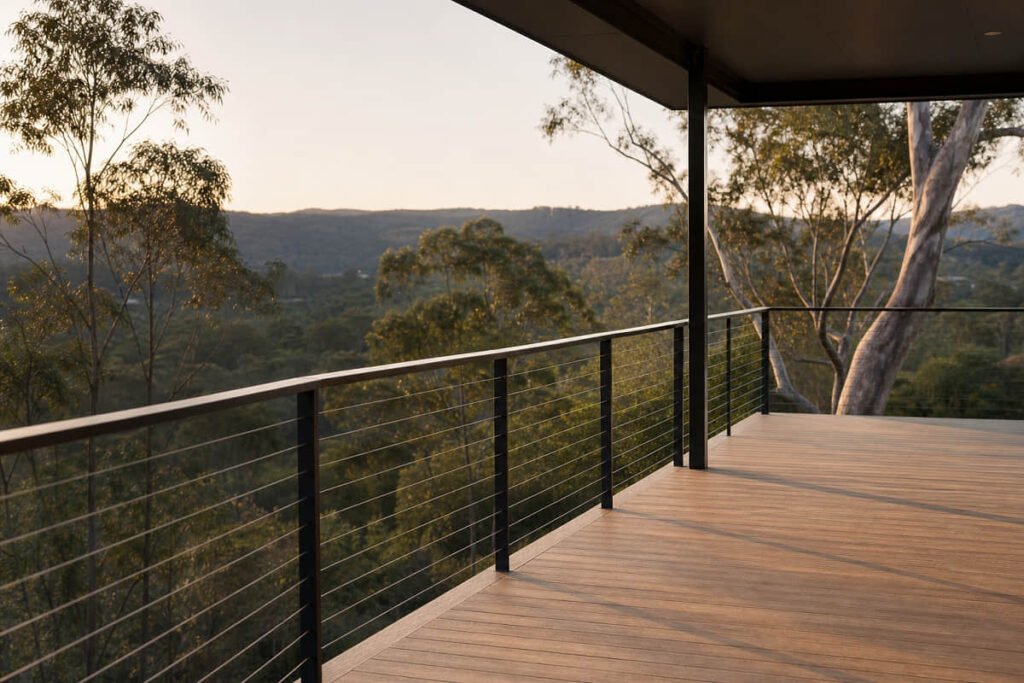
Cable tension and spacing need to meet NCC requirements. Infill gaps can’t exceed 125 mm — that’s the child-safety threshold under Australian building codes. Make sure the stainless steel cable rail grade suits the environment. Marine-grade 316 stainless is the standard for coastal jobs.
Cable railing works with both light and dark composite decking. The cables don’t compete with the deck boards visually — they just frame the space.
4. Bold Black Rails on Light Decking
Nine out of ten mood boards we see from Australian designers right now feature one thing: matte black railing against light grey or sandy composite decking. It’s a high-contrast pairing that gives the deck a sharp, finished feel.
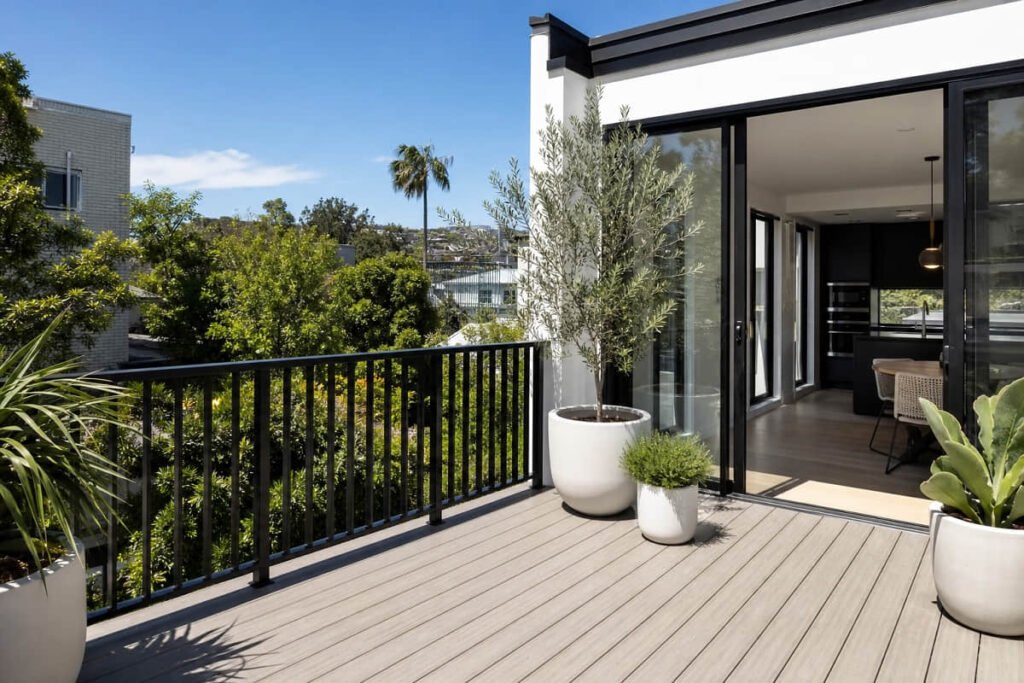
This modern deck railing style works in aluminium, steel, or composite frames. The monochromatic look draws the eye and adds visual interest without extra detail.
From Sydney terraces to Perth poolside decks, this is the pairing clients keep asking for. If the brief says “modern”, this is usually where you start.
5. Composite Railing to Match the Deck
One of the most typical client requests: “Make it all look the same.” Composite railing matched to the composite decking delivers that — a seamless, unified finish with no competing tones or textures.
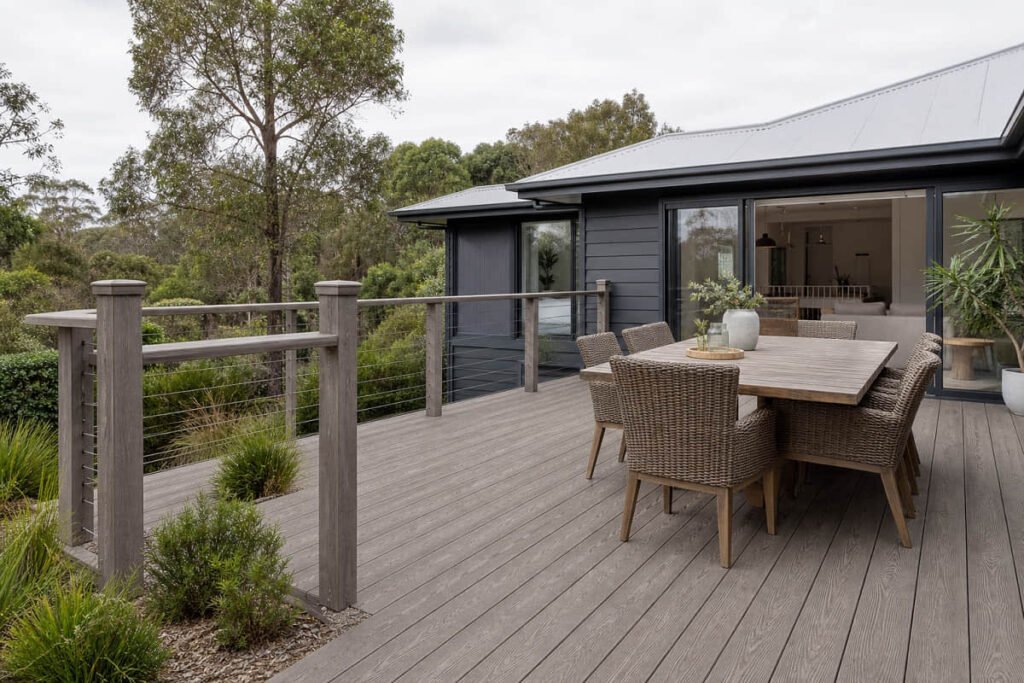
The trick is sourcing deck boards and railing from the same manufacturer or colour system. That’s the easiest way to get a true colour and texture match. A variety of composite profiles are available, so matching doesn’t mean settling. It’s the finishing touch that ties the whole project together.
Request free samples from LastElegance to colour-match your composite deck railing to our decking range.
6. Mixed Materials for Contrast
Mixing materials gives builders more control over the final look. Pair composite posts with aluminium balusters. Or set a timber top rail on a steel frame. Each combo changes the feel.
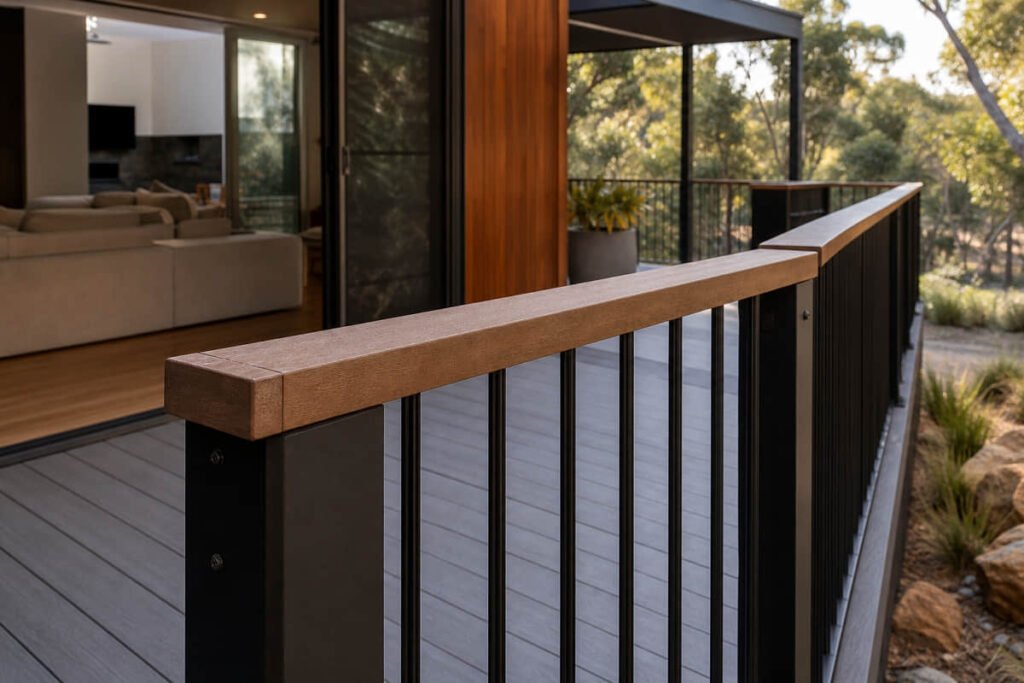
A composite or timber top rail adds warmth — it’s the part people touch, so texture matters. Metal balusters underneath keep the railing design clean and open. Aluminium railings in black or bronze work well here.
This approach lets you tailor the railing to the build rather than picking a single off-the-shelf system. Traditional wood top rails on modern frames are a popular hybrid right now.
7. Coastal-Style White Railings
Many builders assume white railings won’t last near the ocean. That depends on the material, not the colour.
A classic white railing suits coastal homes and Hamptons-style builds. It pairs well with grey or weathered-look composite deck boards and gives the outdoor space a relaxed, finished look.
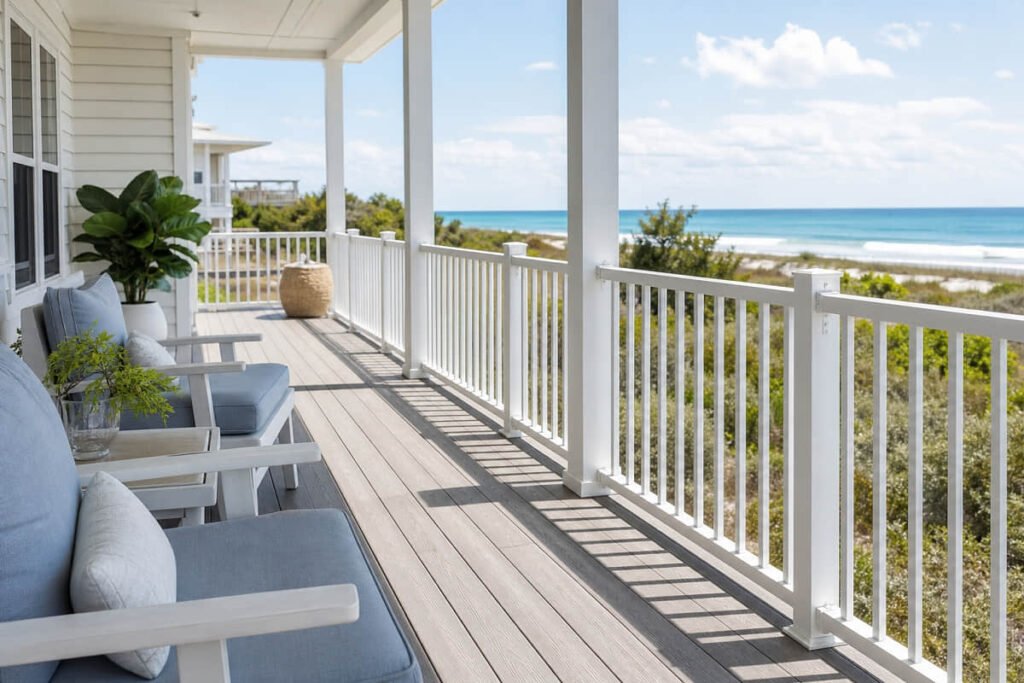
The key is picking the right material for salt air. Powder-coated aluminium or UV-stable composite rails hold up well where painted timber won’t. If the project is within a few kilometres of the coast, low maintenance isn’t a nice-to-have — it’s a must. Composite and aluminium deliver that without the maintenance hassles.
8. Railings with Built-In Lighting
Lighting built into the railing system adds function and atmosphere. It extends the usable hours of a deck — a real selling point for hospitality and commercial builds.
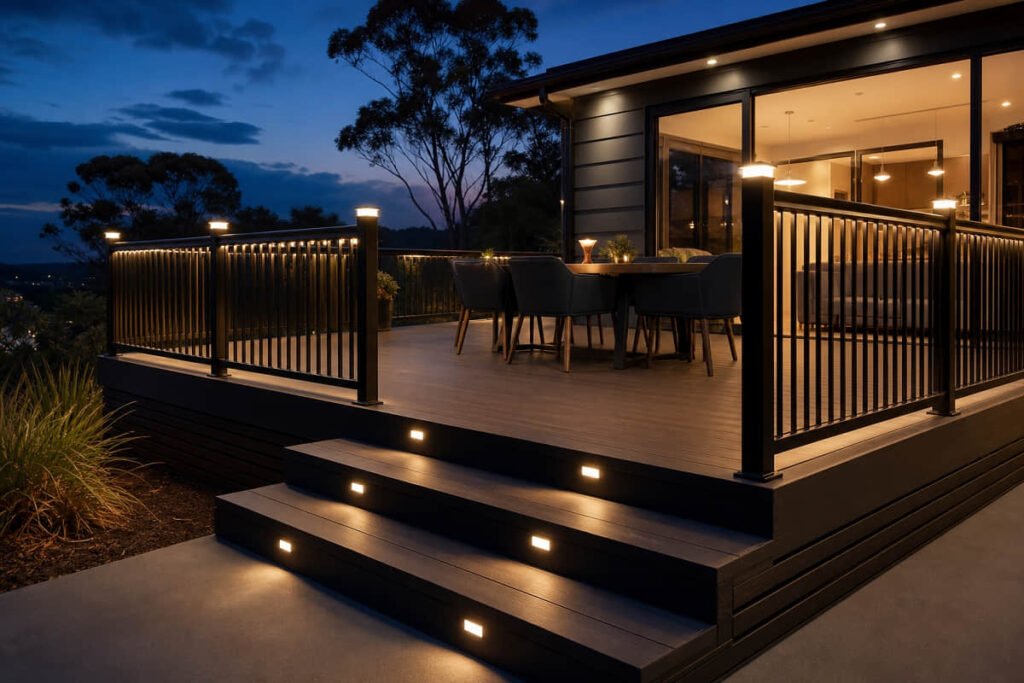
Three common options:
- Post cap lights — sit atop post caps and cast a soft downward glow.
- Riser lights — mount along stair risers for safe step visibility at night.
- Strip lighting under the top rail — a continuous top rail with LED strip underneath lights the deck surface evenly.
Low-voltage LED is standard now and easy for electricians to wire. The cost is small relative to the value it adds to the outdoor space.
9. Horizontal Slat Screening as Railing
Horizontal composite screening panels used as railing infill create a privacy-focused, modern look. This is where screening products — like privacy fence boards — double as balustrade infill between posts.
It suits rooftop decks, multi-level builds, and commercial projects where privacy matters. The horizontal lines add a design element that vertical balusters don’t offer. The structural integrity holds up well when fixed to aluminium or steel posts.
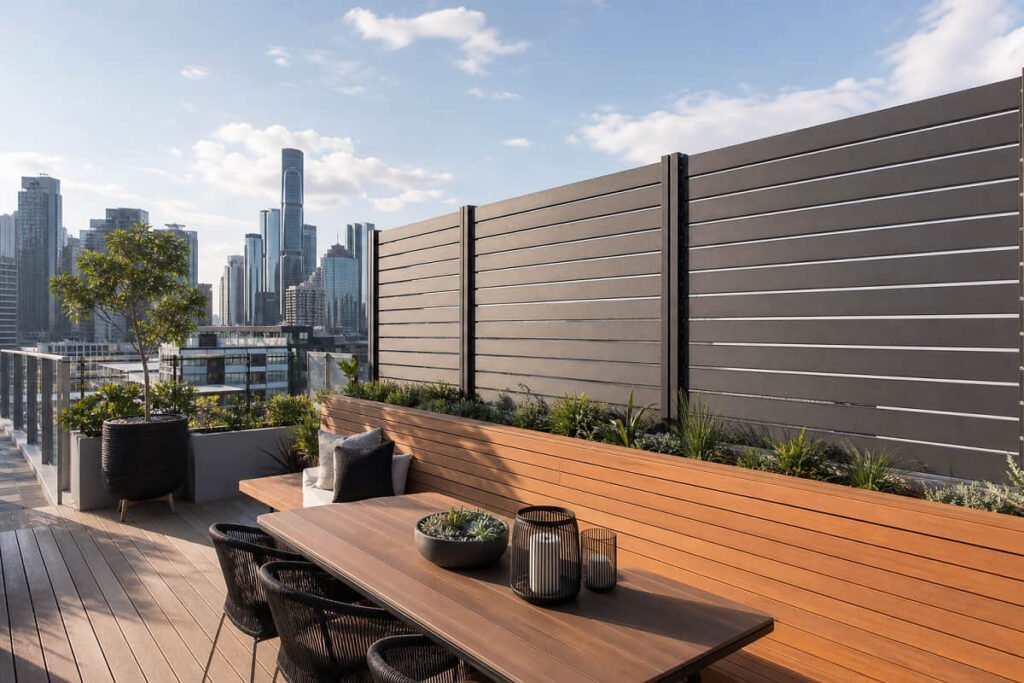
We’ve seen this railing system on elevated decks across multi-residential projects in Melbourne and Brisbane. Profiles like the LastElegance Vista (160 × 20 mm) and TwinLine (158 × 20 mm) screening panels work well as infill — the board widths give clean, even spacing between slats.
View LastElegance’s full product catalogue to see our screening range as a railing infill option.
10. Curved or Custom Railing Profiles
For statement builds, custom-shaped railing follows the curve of a deck or wraps around a fire pit, planter, or feature wall. It’s a premium option, but it makes a strong visual impact on high-end projects.
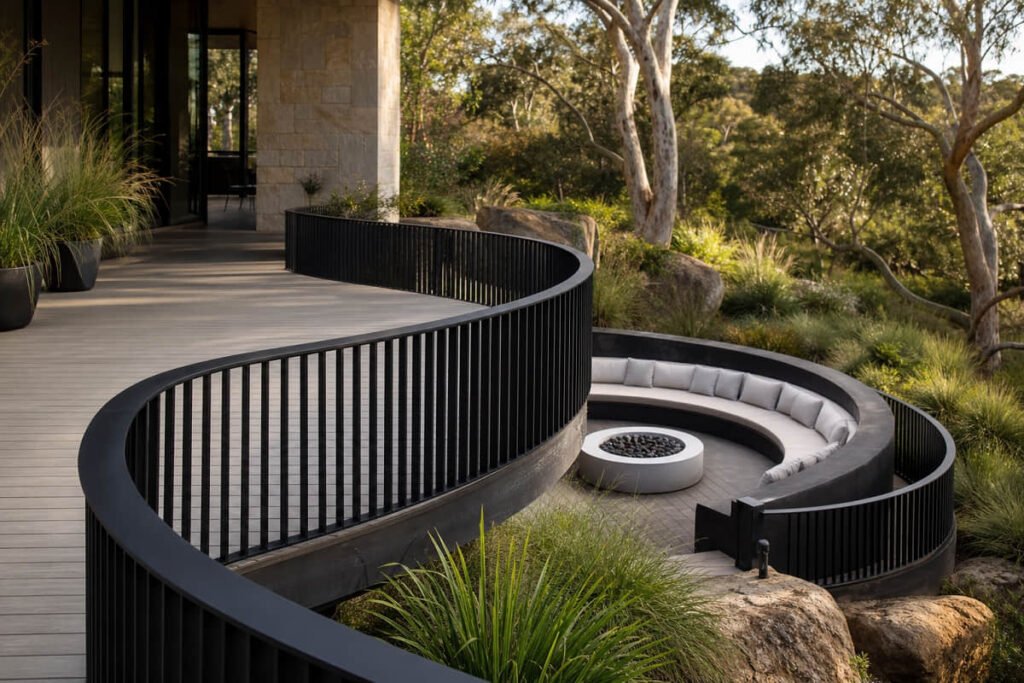
Most curved railing is done in metal — steel or aluminium bent to spec. Curved railing works best with straight-laid composite decking to avoid competing lines. That contrast between curved rail and clean deck boards adds visual interest without clutter.
This is a deck design choice that suits architects and designers working on feature projects where the railing is part of the story.
How to Pick the Right Railing Material
Every railing material has trade-offs. The right one depends on the site, the budget, and how much upkeep the client will accept. Here’s how the main options stack up for Australian conditions.
| Material | Lifespan | Upkeep | Install Speed | Cost (per LM) | Best For |
|---|---|---|---|---|---|
| Composite | 15–25 years | Low — wash once or twice a year | Moderate — clip or screw-fix | $$ | Matching the deck, warm look |
| Aluminium | 25+ years | Minimal — occasional wipe-down | Fast — pre-made panel systems | $$ – $$$ | Coastal, modern, low-care builds |
| Stainless steel | 25+ years | Low — check cable tension yearly | Slow — tensioning takes time | $$$ | Open views, modern design |
| Glass | 20+ years (frame-dependent) | Medium — regular cleaning | Slow — heavy panels, precise fit | $$$$ | Views, pool areas, high-end builds |
| Traditional wood | 10–15 years | High — re-stain every 2–3 years | Moderate — standard carpentry | $ – $$ | Heritage, budget, natural wood look |
Composite railing resists rot, insects, and UV. It won’t splinter and doesn’t need staining. But it can’t span as far as metal, so post spacing is tighter on long runs.
Aluminium railings are the low-maintenance workhorse. They handle salt air, rain, and UV without fading or corroding. The upfront cost is higher than timber, but the lifetime cost is lower.
Glass railings look stunning — but they show every fingerprint, water mark, and salt spot. Budget for regular cleaning, especially near the coast or around pools.
Wood railings have a natural warmth that some clients won’t give up. That’s fair. But timber deck railings in Australian conditions need re-staining every two to three years, plus checks for rot and insect damage. The upkeep is real.
Matching Railing Colour to Your Deck
Colour choice can make or break a railing design. Three approaches work well with composite decking:
Match it. Railing and deck boards in the same colour create a seamless, quiet look. It suits projects where the deck should blend into the house rather than stand out.
Contrast it. Black railing on light decking — or white railing on dark boards — draws the eye and frames the space. This is the most popular approach on new deck builds in Australia right now.
Complement it. Pick a railing colour that sits between the deck and the house exterior — a neutral that ties the two together. Grey railing on warm-toned boards with a light rendered wall, for example.
One rule: never trust a screen for colour matching. Order physical samples and check them under natural light, on site. Screens shift colour based on brightness and angle. Physical samples don’t lie — that’s the finishing touch that separates a good result from a great one.
Get free samples from LastElegance to colour-match your composite deck railing to our decking range.
Railing Heights and Australian Building Codes
Australian building codes set clear rules for deck railings. Getting them wrong means failed inspections and rework — so it pays to know the basics.
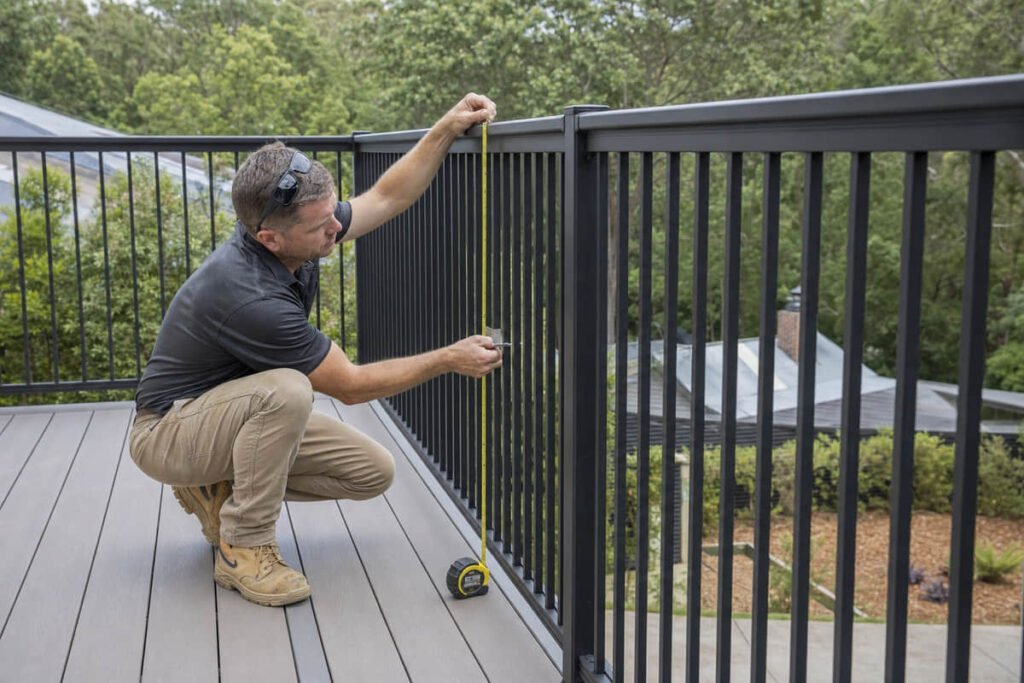
Under the National Construction Code (NCC), any deck 1 metre or more above ground level needs a balustrade. The minimum railing height is 1,000 mm for decks up to 4 metres above ground. That’s the standard residential requirement.
Balustrade gaps — the space between balusters or infill elements — can’t exceed 125 mm. This prevents child entrapment and is a non-negotiable safety requirement under the NCC. Railings must also have no climbable elements (horizontal rails spaced in a way that creates a ladder effect).
Some states and local councils add extra requirements on top of the NCC. Always check with the local building codes authority before locking in a railing design. Load requirements for balustrades fall under AS 1170.1 — your engineer or certifier will confirm the structural integrity specs for the project.
Why Railing Choice Starts with the Deck
Most railing decisions start with the railing itself. But the smarter starting point is the deck underneath.
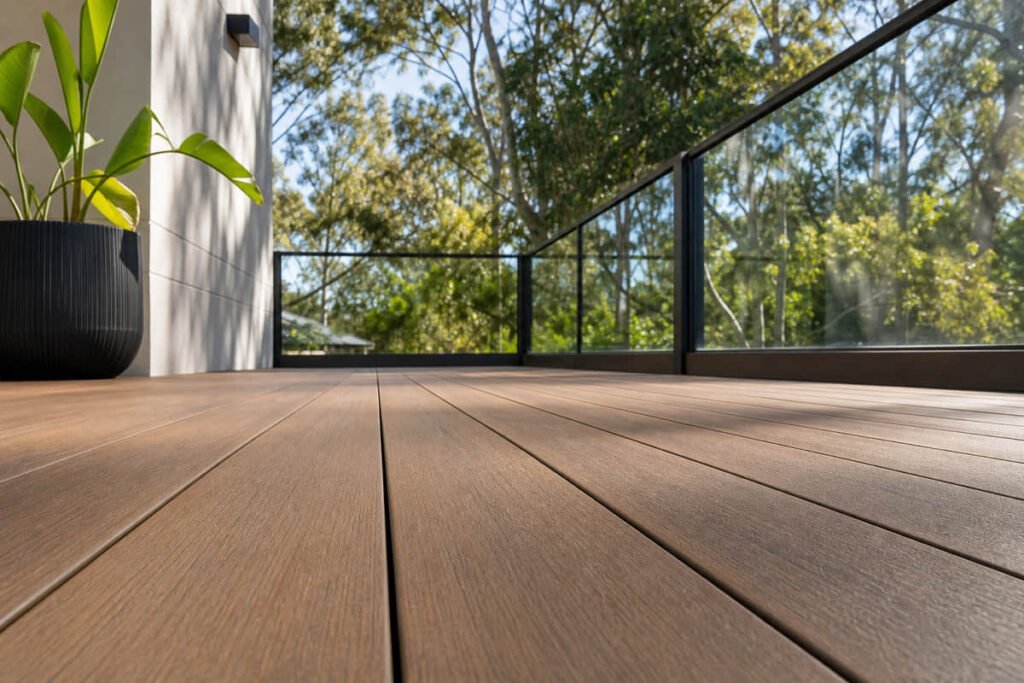
If the composite decking has a realistic timber grain, rich colour, and consistent finish, the railing can be simpler — the deck boards do the visual heavy lifting. Board width, colour, and texture all shape what works above. A wide, dark-toned board with deep grain calls for a clean, minimal railing — glass or slim aluminium. A lighter, narrower board gives you room for a bolder railing design without the deck feeling busy.
Here’s the thing: if your deck boards fade or warp within a year or two, even the best railing will look out of place. The deck colour sets the baseline — and if that baseline shifts, the whole pairing falls apart.
That’s why the decking spec matters as much as the railing choice. LastElegance composite decking uses a co-extruded cap layer at 0.8 mm — thicker than most on the market — for strong UV protection and colour retention. After 3,000 hours of QUV testing, colour stays within ΔE ≤ 4–5. The boards are rated R11 for slip resistance under AS 4586.
As a manufacturer, we control the specs, the colour, and the quality across every order. That consistency matters when you’re matching deck boards to a railing system across a large outdoor space — or across multiple projects.
Request a quote or talk to our trade team about your next composite deck project.
FAQ
Is Composite Deck Railing Worth It?
Yes. Composite railing lasts longer than timber, won’t rot or splinter, and needs far less maintenance. It costs more upfront but saves on upkeep over 15–25 years — most composite railings carry warranties in that range.
What’s the Best Low-Maintenance Deck Railing Option?
Aluminium and composite railings are the two lowest-maintenance choices. Both resist rot, insects, and UV damage. A wash with soapy water once or twice a year is all they need — no staining, no sealing.
What Is the Most Durable Deck Railing Material?
Stainless steel and aluminium last longest in Australian conditions. Composite deck railing is close behind and ages better than traditional wood, especially in high-UV and coastal areas. For cable railing, marine-grade 316 stainless is the benchmark.
What Is the Most Popular Deck Railing?
In Australia, powder-coated aluminium balusters with a composite or timber top rail are the most common choice across residential and commercial builds. Black aluminium balusters are the most popular finish right now.
How Much Does It Cost to Install Deck Railings?
Based on 2025–2026 Australian market rates, deck railing materials run from $120 to $350+ per linear metre. Aluminium and glass railings sit at the higher end; composite and timber at the lower end. Labour adds $50–$100 per linear metre on top. Check local building code requirements, as some council areas need certified installers for balustrades — that can affect the labour rate.
The right railing depends on the project, the site, and the client. There’s no single best answer — but there are plenty of strong composite deck railing ideas to work with. Whatever you spec above the deck, the composite decking underneath sets the standard for the whole outdoor space. Get in touch with LastElegance’s trade team to start your next project.