

Composite cladding in Australia costs $140 to $280 per square metre fully installed in 2026. Materials run $80–$130/m². Labour, steel battens, clips, and trims make up the rest.
That’s the headline number. But we see the same pattern across the cladding projects we supply to builders in every state: the board price looks right, then the final quote lands 20–30% higher. Trims, membranes, and stainless steel fixings get costed separately — or missed altogether. It’s the most common reason quotes come unstuck.
This guide breaks down every line item, from board cost to scaffold and council DA fees, so you can quote accurately and compare suppliers on a true like-for-like basis. We’re a composite manufacturer, so the costs and specs here come from real supply data — not secondhand estimates.
What Does Composite Cladding Cost?
Materials alone typically run $80–$130 per square metre. On top of that, you’ve got subframe, clips, and trims ($20–$40/m²) and labour ($55–$120/m²). Add those up, and you land at $140–$280/m² fully installed.
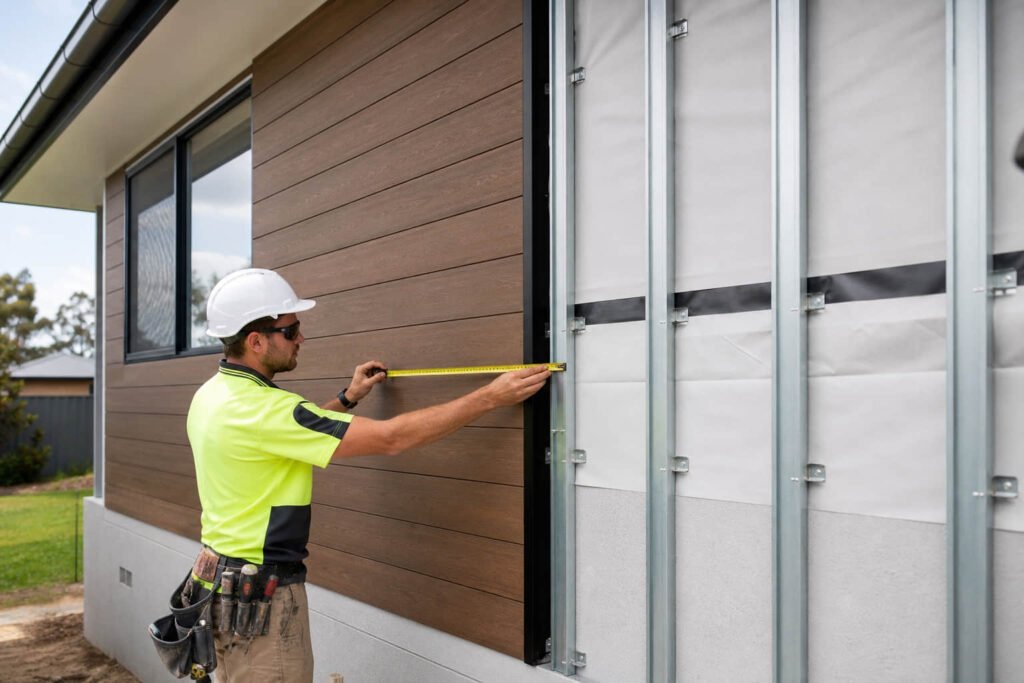
Where you sit in that range depends mostly on the board profile. A wider board like LastElegance’s DecoGroove (219 × 20 mm, 2.41 kg/lm) covers nearly 60% more wall per board than the Oakling (140 × 12 mm, 1.77 kg/lm). That means fewer boards, fewer clips, faster install. For large facades, that adds up fast.
The Oakling suits finer-detail work — feature panels, interior accent walls, tight corners. It takes more boards per square metre, but the narrower profile gives you more design flexibility.
To give you a project-level picture:
| Wall area | Estimated total (installed) |
|---|---|
| 15 m² (feature wall) | $2,100–$4,200 |
| 30 m² (single facade) | $4,200–$8,400 |
| 60 m² (full perimeter) | $8,400–$16,800 |
These figures include boards, battens, stainless steel clips, and standard trims. They don’t include scaffolding, weather membranes, or council DA fees — those are covered in the hidden costs section below.
One thing worth flagging: a 60 m² job costs less per square metre than a 15 m² feature wall. Fixed costs like site prep and mobilisation spread across a bigger area. Most builders know this, but it’s worth spelling out when you’re quoting to a client who’s comparing a feature wall today against a full wrap down the track.
Open a trade account — get a price based on your wall area and preferred profile.
How Does It Compare to Other Materials?
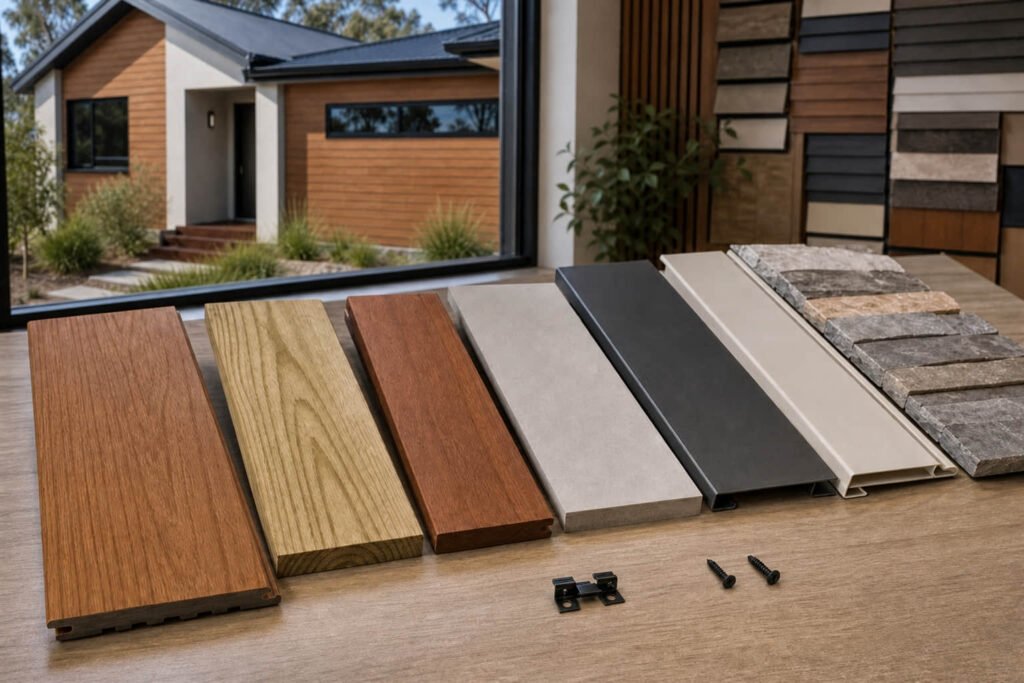
This is the question we hear most from builders deciding what to specify. Here’s how the common cladding options stack up in 2026:
| Cladding material | Material (per m²) | Installed (per m²) | Lifespan | Maintenance |
|---|---|---|---|---|
| Treated pine | $40–$80 | $100–$180 | 15–20 yrs | Sand + repaint every 3–5 yrs |
| Hardwood timber | $100–$250 | $180–$350 | 25–40 yrs | Oil or repaint every 2–5 yrs |
| Fibre cement | $40–$70 | $80–$150 | 30–50 yrs | Repaint every 7–10 yrs |
| Aluminium (standard) | $50–$140 | $120–$280 | 30–50 yrs | Wash only |
| Vinyl / uPVC | $30–$100 | $60–$160 | 15–20 yrs | Wash only |
| Stone veneer | $100–$150 | $230–$310 | 50+ yrs | Periodic resealing |
| Composite | $80–$130 | $140–$280 | 25+ yrs | Wash only |
Premium extruded aluminium systems can run $360–$420/m² or more fully installed. Standard Colorbond and residential panels sit within the range above.
Fibre cement wins on upfront cost — and it’s earned its place as Australia’s most common wall cladding. Strong fire resistance, proven track record, and a price point that’s hard to argue with.
But upfront cost doesn’t tell the whole story. Timber needs repainting every few years. Fibre cement needs it too, just less often. Composite needs none of that — a wash now and then is all it takes. We cover the long-term numbers further down.
Vinyl is the cheapest to buy, but it fades faster under Australian sun and doesn’t last as long. It can work for sheds and garages, but most builders we work with wouldn’t spec it on a house facade.
What Drives the Final Price?
Every cladding project is different. Here’s what moves the needle most.
Wall Area and Access
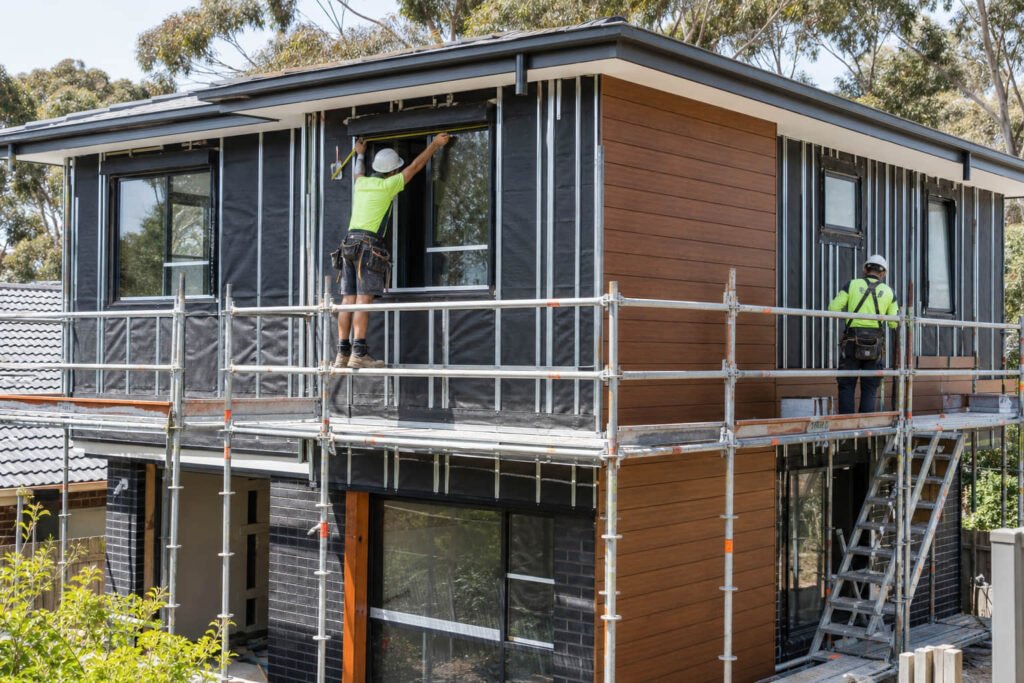
Bigger walls cost more in total but less per square metre — setup and scaffold costs spread further. Upper-storey work needs scaffolding, which adds $15–$40/m² on top.
If you’re testing composite for the first time, a single-storey feature wall is the easiest and cheapest place to start.
Board Profile
Wider boards cost more per lineal metre but cover area faster. That can cut labour time and offset the higher material cost. LastElegance’s DecoGroove at 219 mm wide covers nearly 60% more wall per board than the 140 mm Oakling. On a large facade, that speed difference is real.
One thing to watch when comparing quotes: some suppliers price per lineal metre, others per square metre. A 219 mm board and a 140 mm board at the same per-lineal-metre price are very different per-m² costs. Always convert before you compare.
Subframe and Prep Work
Composite cladding goes onto steel battens at 300 mm centres. That’s standard. What catches people out is the prep behind it.
If the existing wall has loose render, moisture damage, or lumps and bumps, you’ll need to fix that before battens go on. A weather membrane adds about $10–$20/m² — and it’s one of the most common items missing from early estimates.
The good news: composite can go straight over existing brick, render, or old timber. You don’t need to strip the wall — just fix battens to the surface and run a membrane behind the subframe. Unless the wall’s unstable or wet, there’s no demolition.
And if you’re re-cladding, it’s the perfect time to add or upgrade insulation. The wall’s already open. The extra labour cost is minimal, and the energy savings add up over the life of the building.
Location and Timing
Sydney and Melbourne run higher than regional areas — no surprise there. Labour makes up 40–50% of the installed cost, so location hits hard.
Timing matters too. Spring and summer are the busiest months for external trades. March through August is quieter. If the project timeline allows it, scheduling in the off-season can ease both cost and lead time.
Fire Rating and Compliance
Properties in bushfire-prone areas must meet AS 3959. The BAL rating for your site may restrict which cladding systems you can use. The NCC also sets fire spread rules for external walls across all building classes — not just bushfire zones.
LastElegance cladding has been tested to ASTM E84 — Flame Spread Index: 85, Smoke Developed Index: 300. For BAL-rated sites, check your specific requirements with council before locking in any material.
Compliance costs add up beyond the boards themselves. Council DA fees run $200–$1,000+, and you may need extra documentation. For strata-titled buildings, you’ll need body corporate approval before changing exterior finishes — worth checking early so it doesn’t hold up the project.
Hidden Costs to Watch For
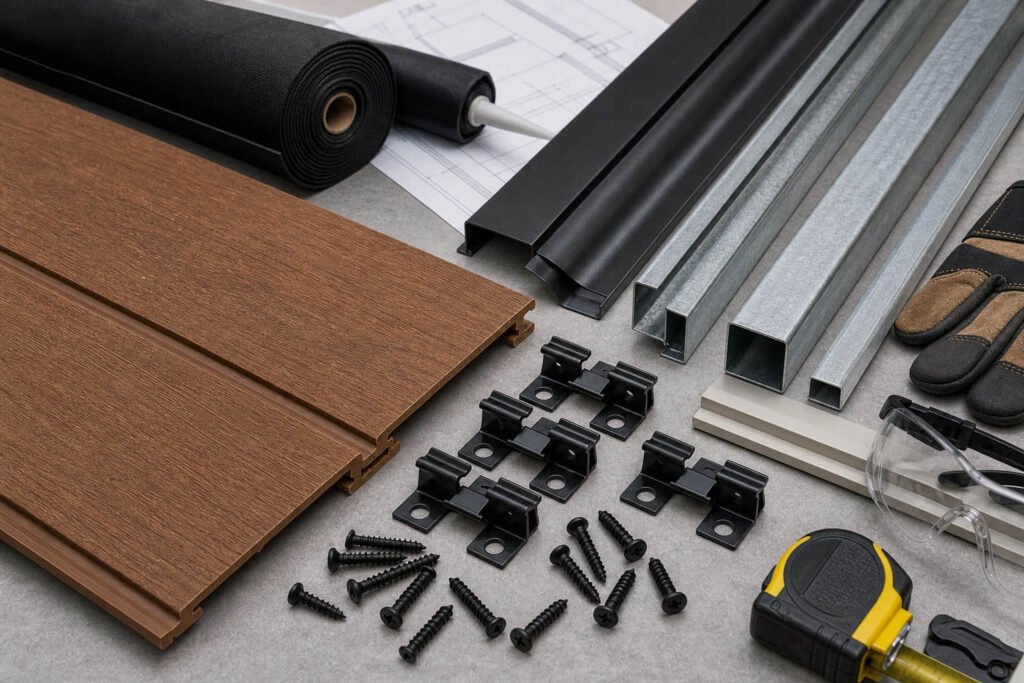
This is where quotes fall apart. A “cheap” per-metre price means nothing if half the accessories are missing from the total.
| Item | Typical range | Why it matters |
|---|---|---|
| Scaffolding | $15–$40/m² | Anything above single storey |
| Weather membrane | $10–$20/m² | Recommended on most external walls |
| Window and door trims | $20–$50 per opening | Often quoted separately |
| Old cladding removal | $20–$50/m² | Depends on what’s coming off |
| Waste removal | $300–$800 per skip | Easy to forget |
| Council DA fees | $200–$1,000+ | Varies by council |
| Strata approval | Varies | Required for units and townhouses |
| Trims, clips, and fixings | 20–30% of board cost | The most common omission |
The last line is the big one. Trims, clips, and membranes can add 20–30% on top of the board cost alone. We’ve seen quotes come in $20–$30/m² apart on boards, then flip completely once accessories are lined up.
Ask for an all-inclusive price. Or at the very least, a line-by-line breakdown. That’s the only way to compare suppliers fairly.
How Much Does Install Cost?
Labour for composite cladding runs $55–$120 per square metre. What makes it different from most other cladding types is the install process.
LastElegance boards use a male-female interlocking clip system. No surface screws. Boards click into place on the battens, and you get a clean face with no visible fixings. Two workers can cover a wall faster than with screw-fixed or nailed systems — and the finish is more consistent.
For builders quoting labour, that speed matters. Less time on site means lower project costs and faster handover.
DIY or Professional?
The clip-in system is simple enough for experienced DIYers on a low, flat, single-storey wall with ground-level access. Cut the boards, fix the battens, clip in, trim out. It’s close to an assembly kit.
For upper storeys, complex window openings, or anything that needs to meet NCC or AS 3959 compliance, professional installation is the way to go. Scaffold, safety regs, and sign-off requirements make it worth having a qualified team on site.
When you’re comparing install quotes, check them against the hidden costs table above. A “$150/m² installed” quote that leaves out scaffold and membrane can end up costing more than a “$200/m² all-in” quote. Always compare like for like.
Long-Term Value: What It Really Costs Over 25 Years
Composite costs more upfront than fibre cement or treated pine. That’s a fact. But builders and designers who’ve been through the cycle a few times know that upfront cost is only part of the picture.
Timber needs sanding and repainting every 3–5 years. On a 30 m² wall, each repaint cycle runs $600–$1,500 — and you’ll do it 5–7 times over 25 years. Fibre cement needs repainting every 7–10 years. Composite needs a wash.
Here’s how that plays out over 25 years on a 30 m² wall:
| Material | Installed cost | 25-year upkeep | Total 25-year cost |
|---|---|---|---|
| Treated pine | $3,000–$5,400 | $4,000–$10,000 | $7,000–$15,400 |
| Fibre cement | $2,400–$4,500 | $2,000–$5,000 | $4,400–$9,500 |
| Composite | $4,200–$8,400 | $200–$500 | $4,400–$8,900 |
Fibre cement still competes at the lower end. It’s cheap, durable, and well-understood. But composite beats timber in every scenario. And at the upper end, composite and fibre cement are close — except composite gives you zero repainting and a wall that holds its colour.
That colour performance comes down to how the board’s made. LastElegance uses co-extrusion with a 0.8 mm cap layer — thicker than many boards on the market. That cap protects against UV, water, and fade. In accelerated weathering tests, colour change stays within ΔE ≤ 4–5 after 3,000 hours of QUV exposure. Our distributors in coastal Queensland see that hold up year after year on real projects.
One honest trade-off: fibre cement has a longer track record in Australia. It’s been on walls here for decades. Composite is newer, but the 25+ year lifespan data is backed by accelerated testing and strong real-world performance in high-UV markets.
Download the technical data sheets — test the board quality before you commit.
How to Get Better Value
You don’t need the cheapest product to get good value. Here’s what we see working well across the projects we supply.
Start with a feature wall. A 15–20 m² wall costs a fraction of a full wrap and lets you test the product on a live project. It’s also an easy way to show clients the finish before committing to a bigger job.
Time it right. March through August is quieter for external trades. Labour rates and lead times both tend to ease.
Stick with standard profiles. Standard widths and colours ship faster and cost less. We offer custom lengths, colours, textures, and even custom moulds — but custom work adds lead time (roughly 20 days production for a 40′ container, plus sea freight). Great for large projects, but overkill for a feature wall.
Add insulation while the wall’s open. If you’re running battens over an existing wall, the access is already there. Adding insulation at this stage costs very little extra in labour and improves thermal performance for the life of the building.
Buy manufacturer-direct. Going through multiple layers of distribution adds markups at each step. As a manufacturer, LastElegance controls production, specs, and quality in-house. That means consistent product and better pricing for trade partners. The minimum order is 100 m², which suits most house cladding projects.
A thicker cap layer and a longer warranty cost more per board. But they pay back through fewer callbacks, less maintenance, and happier clients down the track.
What Cladding Costs at Import Volume
Everything above is an installed retail price for one building. If you are buying to stock, to supply a project, or to fit out multiple units, you are not buying at that number and you should not be planning against it.
At trade volume the price you care about is a landed cost per square metre, and it is built from four things, not one:
- The ex-works or FOB rate for the profile and colour mix you have specified
- Tonnage, because composite cladding fills a shipping container on weight long before it fills the volume — the weight per square metre, not the board price, is usually what decides your cost per square metre on the ground
- Your port and the exchange rate on the day the order is placed
- Production and sea freight, which run 41 to 54 days before anything reaches you
Our minimum is 500 m² in total across composite decking, cladding and screening — any mix of products, any mix of our six standard colours. Below that we are not the right supplier and will tell you so rather than waste your time.
Because the tooling is ours, profiles, textures, colours and private-label packaging are all open to discussion at that volume. Our full range is on the composite cladding page.
Request trade supply pricing — discuss your project specs and get a direct-supply quote.
FAQ
Is composite cladding cheaper than brick?
Upfront, no. Brick veneer and composite land in a similar range once labour is counted, and composite is usually the higher of the two on a straightforward wall. Where composite wins is on light structures and retrofits — it does not need the footing and support that a brick skin does, so on a first-floor addition or over an existing wall it can be the cheaper path even at a higher price per square metre.
Is composite cladding cheaper than timber cladding?
Not on day one — treated pine is $100 to $180 per square metre installed against $140 to $280 for composite. The difference is what happens afterwards. Timber needs oiling or repainting on a cycle of a few years; composite does not. Over 25 years that maintenance is what closes the gap.
How does composite cladding compare to re-rendering?
Rendering costs $30–$50 per square metre on a single-storey house — much cheaper upfront. But render cracks over time and needs patching and repainting. Composite costs more to install but lasts longer with far less upkeep — and gives the wall a completely different look.
Can I pressure-wash composite cladding?
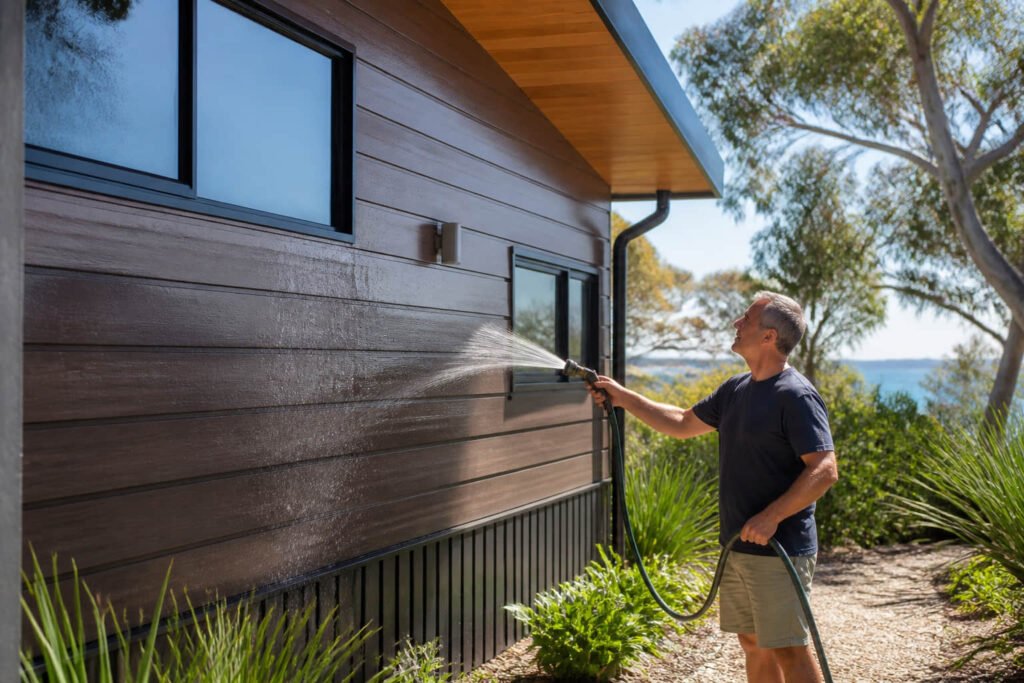
Yes, but keep it under 1,500 PSI. A garden hose with a soft brush handles most jobs. Stay away from harsh chemical cleaners — they can damage the cap layer and may void your warranty.
What voids a composite cladding warranty?
The most common causes are wrong batten spacing, missing expansion gaps, and damage from chemical cleaners or abrasive tools. LastElegance’s 20-year cladding warranty covers cracking, warping, breakage, and colour fade under normal use — but only when it’s installed and maintained per the manufacturer’s guidelines.
Is composite cladding suitable for indoor use?
Yes. The boards produce virtually no formaldehyde emissions, so they’re safe for interior wall cladding and ceilings. Indoor boards are usually thinner and lighter — the Oakling at 12 mm thick works well for interior jobs.
Does composite cladding need council approval?
It depends. Changing an exterior wall finish may need a DA from your local council, especially for front elevations or heritage-listed properties. DA fees start from around $200. Strata-titled buildings also need body corporate approval. Check both before ordering materials.