

Vertical cladding is showing up in more project briefs than it did two years ago. Architects are speccing it across full facades now — not just feature walls — and clients are often asking for it by name.
Timber still gets mentioned. But composite is closing the gap, especially on jobs where low upkeep and long lifespan matter to the end client.
This guide covers what’s driving the shift, how the main materials compare, and what to watch for on installation. If you’re quoting or supplying cladding work right now, it’s worth reading before you spec your next job.
What Is Vertical Cladding?
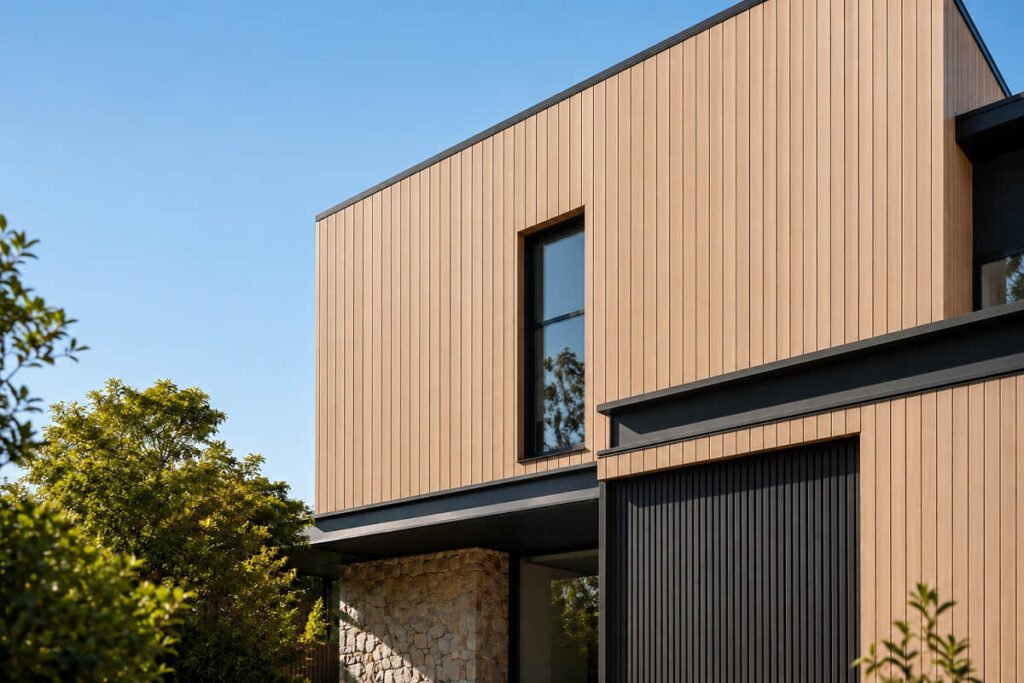
Vertical cladding is boards or panels fixed to exterior walls running top to bottom — up and down, rather than side to side. It protects the building envelope from weather while giving the facade its character.
In Australia, all external cladding must comply with the NCC. Volume One covers Class 2–9 buildings; Volume Two covers Class 1 residential. Material choice, fire performance, and installation method all fall within that framework. Getting the spec right before you order saves real trouble on site.
Why Builders Are Seeing More Vertical Cladding Requests
Architects are drawing vertical lines across more builds right now — contemporary homes, Scandi barn forms, coastal facades, and commercial exteriors. Vertical panels add architectural depth and visual impact that rendered or horizontal surfaces can’t match.
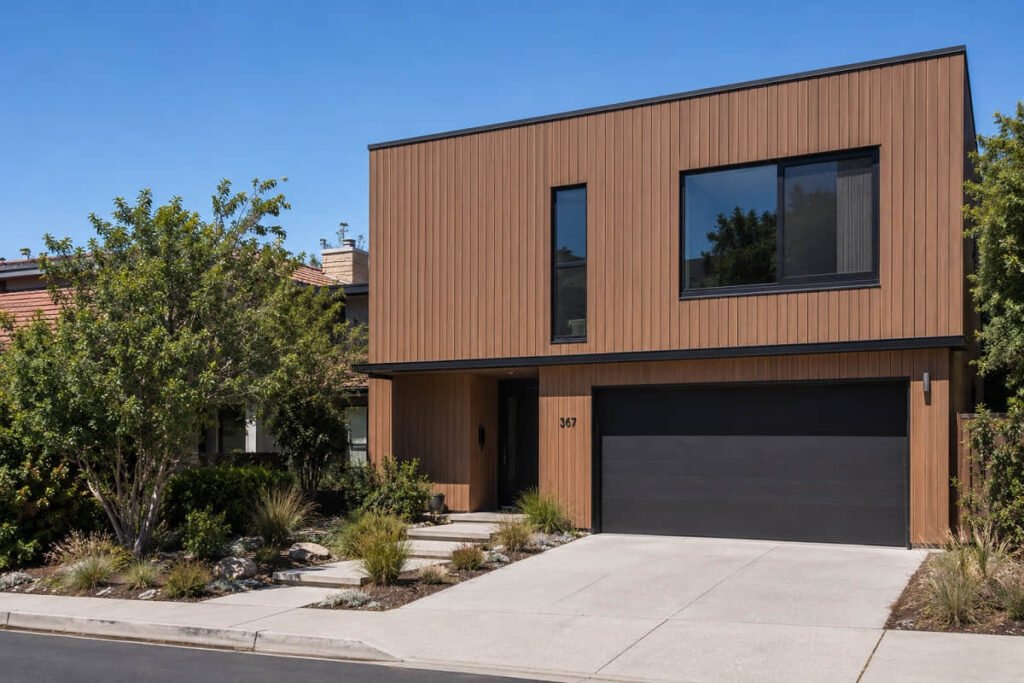
Home renovation projects are a growing part of the mix too. Owners updating older facades want a contemporary look, and vertical cladding delivers it on almost any wall. The design versatility spans residential and commercial buildings equally.
For builders who know the product, that translates to more jobs won. For procurement managers, it means faster stock turns.
Does Vertical Cladding Make a Building Look Taller?
Yes — and the reason is straightforward. Vertical lines carry the eye upward, creating a sense of height that horizontal cladding can’t replicate.
This matters most on narrow sites, single-storey homes with low-pitch rooflines, and infill townhouses where floor-to-ceiling height feels compressed. Strong vertical orientation is one of the most effective ways to add visual height without structural changes.
Which Building Styles Suit Vertical Cladding?
Modern, barn-form, Scandi, and coastal styles all work well. In contemporary architecture, vertical cladding is often a full-facade treatment. On simpler builds, it’s used as a focal point — one feature exterior wall while the rest stays rendered.
Commercial buildings use it widely too. It works on shopfronts, office exteriors, and mixed-use facades as both an architectural element and a practical cladding layer. For procurement managers, that versatility matters: one product type, a wide range of projects.
Vertical vs Horizontal Cladding — Which Should You Specify?
Neither is better across the board. They serve different design goals — and there are practical differences worth knowing before you spec.
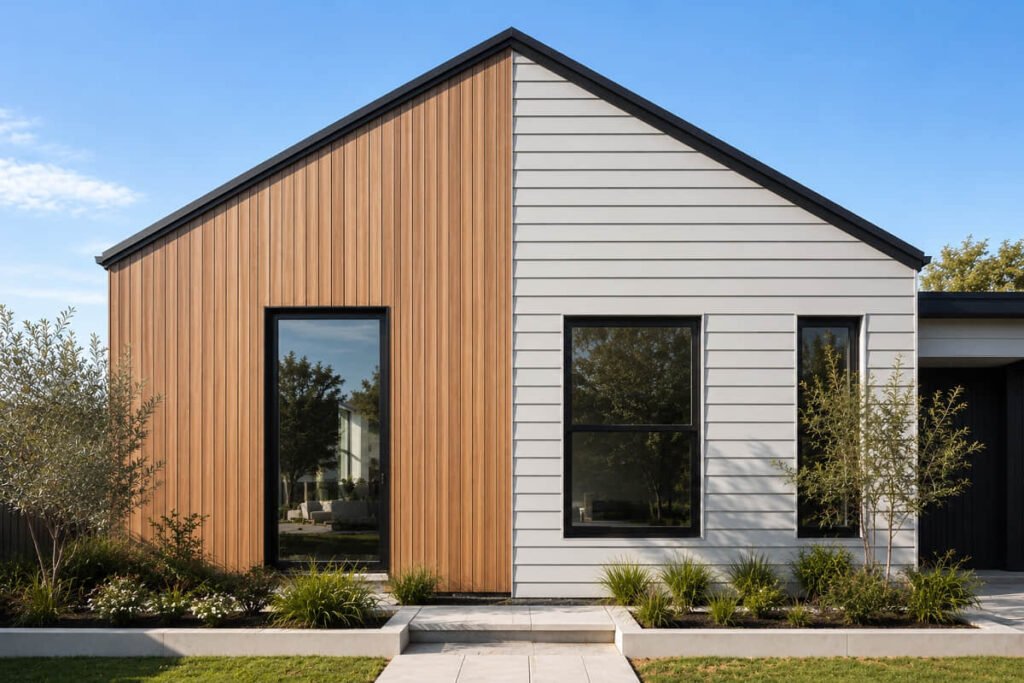
Vertical orientation adds height and drama. Horizontal cladding adds width and suits traditional, farmhouse, and classic coastal styles. Pick based on the project brief.
From a practical standpoint, vertical exterior cladding has a clear drainage advantage. Water tracks down the board face and exits at the base trim. Horizontal cladding relies on correct overlap at every joint. Miss the detail and moisture sits at those joints — especially on the weather side.
Shadow lines are also easier to control on a vertical install. The shadow gap runs top to bottom, so minor spacing gaps are less visible than they’d be running across a wall.
| Vertical Cladding | Horizontal Cladding | |
|---|---|---|
| Visual effect | Adds height, drama, clean lines | Adds width, suits traditional styles |
| Water drainage | Runs off naturally down board face | Relies on overlap detail at joints |
| Maintenance risk | Low with clear drainage cavity | More joint points to inspect |
| Popular styles | Modern, Scandi, barn, coastal contemporary | Farmhouse, classic coastal, traditional |
| Install complexity | Straightforward with clip or slot systems | More joint detailing required |
| Functionality | Strong for residential and commercial use | Better suited to lower-rise residential |
Best Materials for Vertical Exterior Cladding in Australia
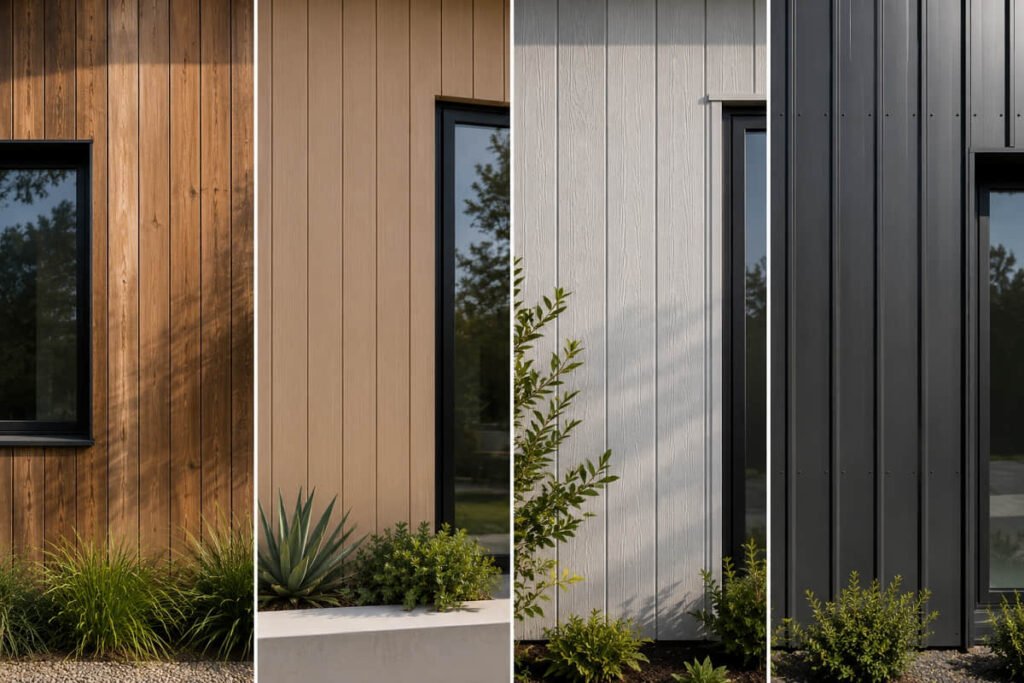
Four material types cover most Australian vertical cladding projects: timber, composite, fibre cement, and steel. Each has a different cost, maintenance profile, and fire performance.
| Material | Supply cost | Durability | Maintenance | BAL suitability | Longevity |
|---|---|---|---|---|---|
| Timber | Mid–High | Moderate | High — recoat every 2–5 yrs | Species-dependent; check spec | 15–25 yrs with care |
| Composite | Mid | High | Minimal — rinse only | ASTM E84 rated; confirm BAL requirement | 25+ yrs |
| Fibre cement | Low–Mid | High | Low — repaint every 8–12 yrs | BAL-40 available | 30+ yrs |
| Steel | Mid–High | High | Very low — inspect edges annually | Generally compliant; check supplier cert | 30+ yrs |
Steel suits commercial buildings and industrial aesthetic homes. It’s tough and needs very little upkeep. The trade-offs: loud in heavy rain, hot in direct sun, and harder in feel than timber or composite. In residential projects, it’s more common as a feature accent than a full-facade treatment. Inspect cut edges during install — that’s where corrosion concentrates, and it’s easy to address early.
Timber — Natural Look, Real Upkeep Costs
External timber cladding has real appeal. Western red cedar and Siberian larch are the most common imported species on Australian projects. Australian hardwoods — blackbutt, spotted gum — are tougher and last longer, but cost more upfront.
The honest trade-off: timber cladding looks great, but it needs regular care. In normal conditions, plan to recoat every 3–5 years. In coastal or high-UV zones, it can drop to every 2 years. Neglect the coating, and you’re looking at UV fade, surface checks, and moisture damage — faster than clients expect.
Some builders now specify charred timber (shou sugi ban) for a bold, lower-maintenance finish. It still needs inspection and sealing over time. Be upfront with clients about the maintenance schedule before the job starts — it prevents callbacks later.
Composite — Minimal Maintenance, Built for Australian Conditions
Composite cladding blends HDPE and wood fibre with a co-extruded cap layer on all four sides. The cap shields the core from UV, moisture, and surface wear. Our cap layer runs 0.8mm thick — thicker than most comparable products — and that’s where the long-term colour retention comes from.
After 3,000 hours of QUV accelerated weathering, colour difference holds to ΔE ≤ 4–5. In practice, that’s a subtle shift — not visible fading. Water absorption is just 0.2% (ASTM D1037), so the boards won’t swell or warp in high-rainfall or coastal zones.
The boards carry virtually no formaldehyde emissions — suitable for both exterior cladding and interior wall applications. On the sustainability side, the boards use 60% recycled HDPE content — useful for projects with environmental specifications.
Our boards test to ASTM E84 — FSI 85, SDI 300. If the site carries a designated BAL rating under the NCC, confirm the requirement against this data before you order. We can provide the full test documentation on request.
Two profiles suit vertical cladding designs:
- Oakling Cladding — 140×12mm, 1.77 kg/LM. A slim profile with clean lines. Well-suited to residential facades, feature walls, and interior wall applications.
- DecoGroove Cladding — 219×26mm (2.93 kg/LM) or 219×20mm (2.36 kg/LM). A wider board with shadow groove detailing — strong shadow lines and visual depth on larger facades or commercial projects.
Both profiles share the same colour palette and surface textures as our decking range. For projects that include both a deck and a facade, one spec keeps the finish consistent across both. Full customisation is available on larger orders — size, colour, texture, and surface finish.
As a direct-from-factory manufacturer, there are no importer markups — competitive pricing goes straight to trade partners. Samples are available on request.
Fibre Cement — Fire-Rated and Reliable
Fibre cement is the go-to for BAL-rated zones. It comes in shiplap and butt-joint profiles and can achieve BAL-40 certification — which covers designated bushfire attack zones across South-East Queensland, regional NSW, Victoria, and WA.
It won’t swell or rot. The trade-offs: it’s heavier than composite, which affects subframe design, and it needs repainting every 8–12 years. For projects where NCC fire compliance drives the spec, it’s a reliable, low-risk choice.
Check the compliance documentation before specifying. Not all fibre cement cladding carries the same BAL rating, and building class affects which NCC sections apply.
How to Install Vertical Cladding
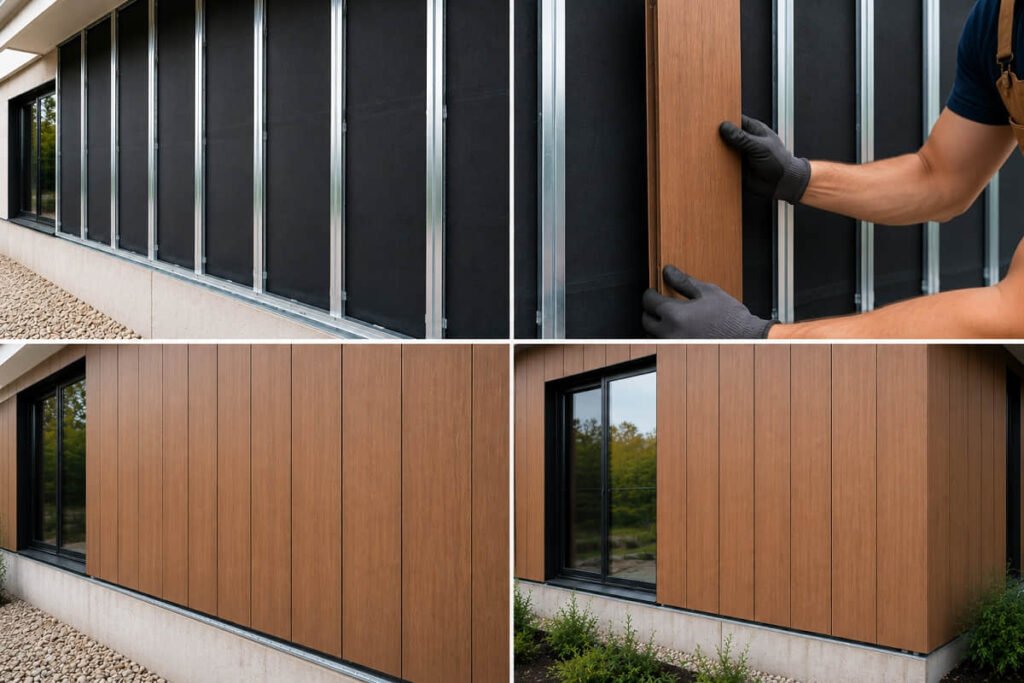
The core process is the same across materials: fix the subframe to the wall, mount the boards, and finish with trim at the base and top. For composite, the male-female interlocking clip system means no exposed fixings on the board face — the surface stays clean.
Start from the bottom and work up. This keeps boards aligned and makes it easy to check the level as you go. Leave a clear drainage gap at the base — sealed bottom trim is one of the most common mistakes on these jobs.
Two people can complete a composite install without specialist tools. The clip-based system cuts install time compared to screw-fixed external timber cladding — especially on larger facades where fixing every board individually adds hours to the job.
Subframe and Batten Spacing
The subframe holds boards away from the wall, creates a drainage cavity, allows airflow, and carries the board load. For composite cladding, use steel battens at 300–400mm centres.
Batten spacing matters more than it looks. Too wide, and thinner profiles deflect — especially the 140×12mm Oakling board. Stick to the recommended spec. The board’s structural performance was tested at that spacing, not beyond it.
For heavier profiles like the 219×26mm DecoGroove at 2.93 kg/LM, make sure the batten layout can carry that load without flex before you start fixing.
Getting the Drainage Gap Right
A drainage gap behind the cladding is not optional — especially in high-rainfall regions. Water gets behind cladding. On vertical profiles, it tracks down the board face and exits at the base. Without a clear exit path, moisture builds up behind the wall and structural damage follows.
Composite has a clear advantage here. At 0.2% water absorption, even if moisture reaches the board, it won’t swell or warp. Timber offers no such protection.
Keep the bottom trim open. That’s the exit point. Seal it and you’re trapping moisture — the leading cause of cladding failures in Australian conditions.
How Much Upkeep Does Vertical Cladding Need?
Here’s a straightforward breakdown by material:
- Timber: Recoat every 2–5 years. Sooner in coastal or high-UV zones. Check for cracks, splits, and coating failure at each service.
- Composite: Rinse occasionally. Inspect fixings and bottom trim once a year. No recoating required.
- Fibre cement: Repaint every 8–12 years. Check for paint adhesion issues at joints.
- Steel: Inspect cut edges and areas of mechanical damage each year. Treat any corrosion risk at exposed edges early.
Composite wins on minimal maintenance — and that’s a real selling point for clients who want a low-maintenance facade. On commercial projects, where labour costs for ongoing care add up fast, it often tips the decision.
5 Common Vertical Cladding Mistakes to Avoid
These errors come up on site more than they should. Each one is avoidable.
- Skipping the drainage cavity. Boards mounted flush to the wall trap moisture. The subframe creates the cavity — don’t cut it to save time on site.
- Using batten spacing that’s too wide. Wider-than-spec spacing causes deflection in thinner composite profiles. Match the spacing to the product’s structural requirements.
- Sealing the bottom trim. This traps water instead of letting it drain. Leave the base trim open.
- Not checking BAL requirements before ordering. In designated bushfire zones, the NCC requires materials that match the site’s BAL rating. Check compliance documentation before you spec — changing materials mid-project costs time and money.
- Mixing profiles from different systems. Fixing methods, colour batches, and shadow gap dimensions vary between product lines. Mixing systems creates visible inconsistencies. Stick to one system per cladding project.
FAQ
Is vertical cladding suitable for all building types?
Yes, for most. Residential and commercial buildings use vertical cladding widely. For bushfire-prone zones, check BAL requirements under the NCC before specifying any material — requirements vary by zone and building class.
What composite cladding profiles are available for vertical applications?
LastElegance offers two profiles: the slim 140×12mm Oakling and the wider 219mm DecoGroove with shadow groove detailing. Both share the same colour palette and surface textures as our decking range, so facade and deck finishes coordinate across the same project.
What is the minimum order quantity for composite cladding?
The MOQ is 100m². For custom colours, lengths, or textures, larger volumes may apply. Contact our team to confirm the right spec and lead time for your cladding project.
How does composite cladding perform in coastal conditions?
Well. The co-extruded cap layer resists UV, salt air, and moisture without recoating. Water absorption sits at just 0.2% (ASTM D1037) — the boards won’t swell or degrade in high-humidity coastal zones. Our distributors across Queensland and northern NSW specify it regularly for this reason.
What is the difference between vertical and horizontal cladding drainage?
Vertical cladding lets water run straight down the board face and exit at the base — proper installation with an open base trim makes water drainage natural and simple. Horizontal cladding relies on correct overlap at every joint, which adds more points where moisture can enter. Vertical orientation is the lower-risk choice in Australian weather conditions.
Vertical cladding projects need the right product from the start — the right profile, the right spec, and a supplier who can deliver to your schedule.
For composite cladding samples, full spec sheets, or a custom quote, get in touch with our team.