

Clients rarely say, “I want Ash Grey with a wood-grain texture.” They say “something natural” or “not too dark.”
Translating that into a colour spec is your call. Get it wrong, and you’re fielding calls about fading, mismatched tones, or a deck that clashes with the cladding — across hundreds of square metres.
This guide walks builders, contractors, and procurement managers through how to choose composite decking colours — and get it right, first time.
What Colour Range Does Composite Decking Come In?
Composite decking colours fall into four main families:
- Earthy browns and warm naturals — honey, amber, and rich timber tones that mimic natural timber like spotted gum, merbau, or blackbutt
- Cool greys — light silver through to mid-grey ash
- Charcoals — deep graphite and near-black shades
- Warm sandstones — lighter naturals that suit coastal and contemporary builds
Colour alone doesn’t tell the full story. Wood grain texture changes how a shade reads once the decking boards are laid. A deep brushed grain in warm brown looks richer than a smooth-finish board in the same tone. Two boards from the same colour family can read very differently on site.
The LastElegance colour palette is shared across all three product lines — decking, cladding, and screening. For mixed-product projects — a composite deck with a matching fence screen and wall cladding — that’s a real procurement advantage. You align the full outdoor space from one factory-direct order, not three separate suppliers.
Matching Composite Decking Colour to Project Type and Client Brief
The working rule: match colour temperature, not exact shade. Warm exteriors suit warm decking tones. Cool exteriors suit cooler ones.
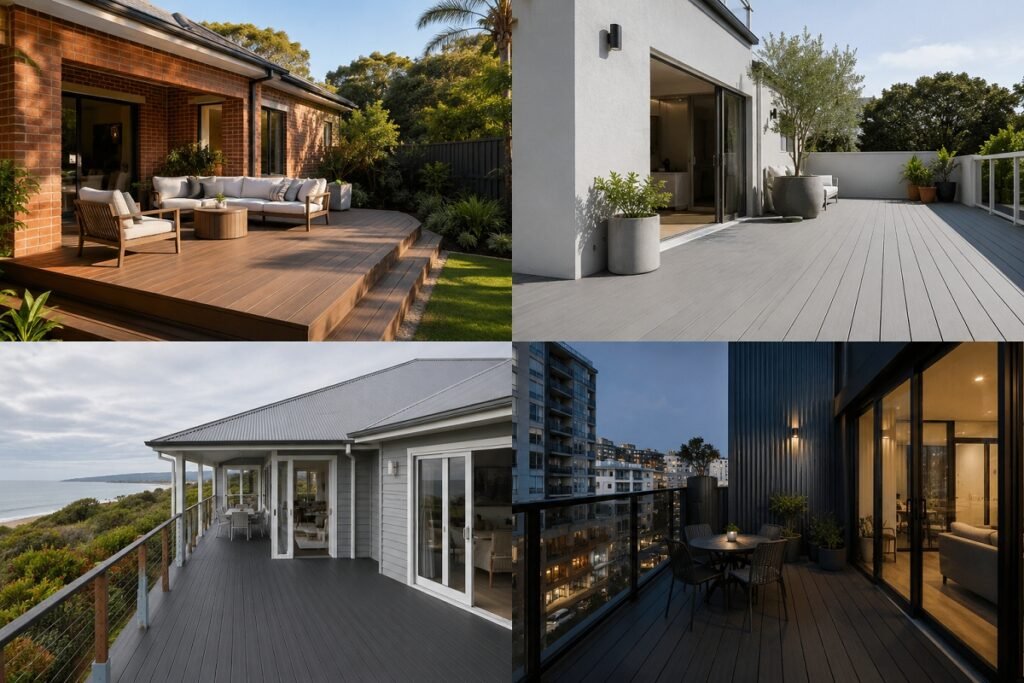
As a contractor or procurement manager, you’re specifying across different project types. The table below maps common exterior types to the right composite decking colour direction — useful for briefing clients or building your own specification templates.
| Project Exterior / Building Type | Recommended Colour Direction |
|---|---|
| Red brick veneer | Earthy browns, warm timber tones |
| White or cream render | Warm naturals or cool grey |
| Grey Colorbond roof | Cool grey, ash, or charcoal |
| Dark Colorbond or Zincalume | Charcoal, deep grey, dark timber tones |
| Dark-stained timber feature wall | Warm brown, natural timber, mid-grey |
| Terracotta or ochre render | Earthy browns, sandstone tones |
| Contemporary apartment / high-density | Cool grey, charcoal, near-black |
| Coastal residential or hospitality | Mid-grey, warm ash, light sandstone |
Red brick veneer is the most specific pairing — earthy brown is the natural complement. A cool grey next to red brick can look cold. White or cream render is the most flexible starting point: it works equally well with warm naturals and cool greys.
For projects that combine composite decking and screening in the same outdoor living space, aligning colours across both products reduces design risk. When the deck and fence screen share the same palette, the whole area reads as one deliberate design — not two separate orders bolted together.
The only reliable way to confirm a colour match is on site, in the project’s actual light. → Request free samples before you commit to volume.
Does Lighting Change How a Colour Looks?
Yes — and first-time buyers on large commercial projects often underestimate this.
A warm brown board in direct sunlight looks richer and deeper. The same board in shade reads cooler and flatter. North-facing decks show colour differently from south-facing ones. Artificial lighting at night shifts things again.
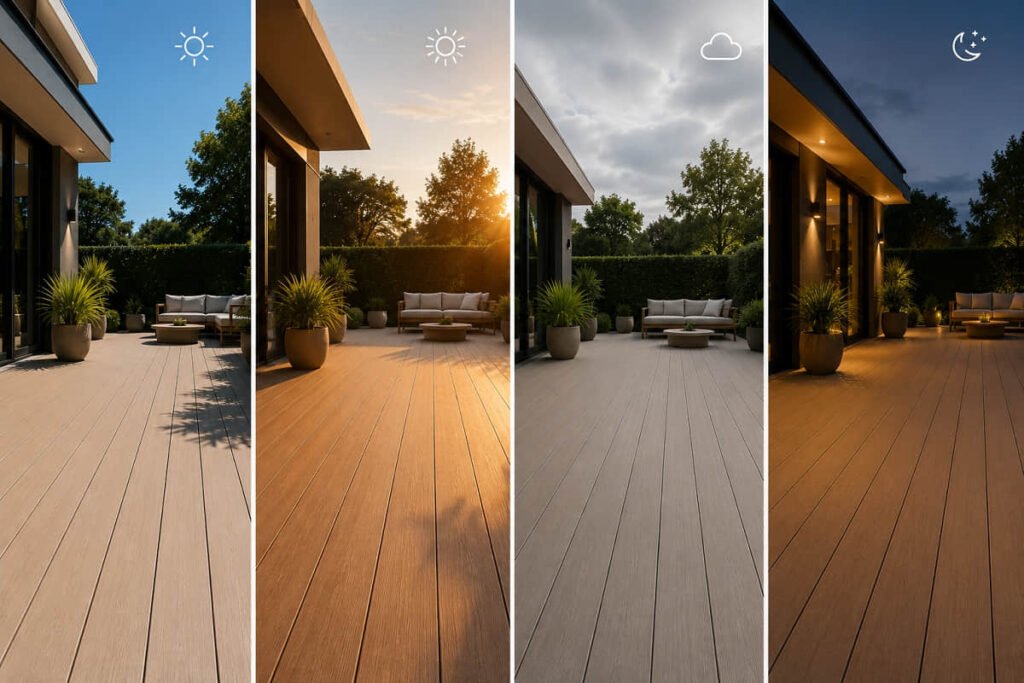
For large projects, view samples at the install location in both morning and afternoon sun before ordering at scale. On commercial fit-outs, build this step into the formal sign-off process. A colour that looks right on screen can surprise you once it’s down.
Light or Dark? Picking Colour for Australia’s Climate
Most colour guides stop at aesthetics. In Australia, the light-versus-dark decision is also a practical one.
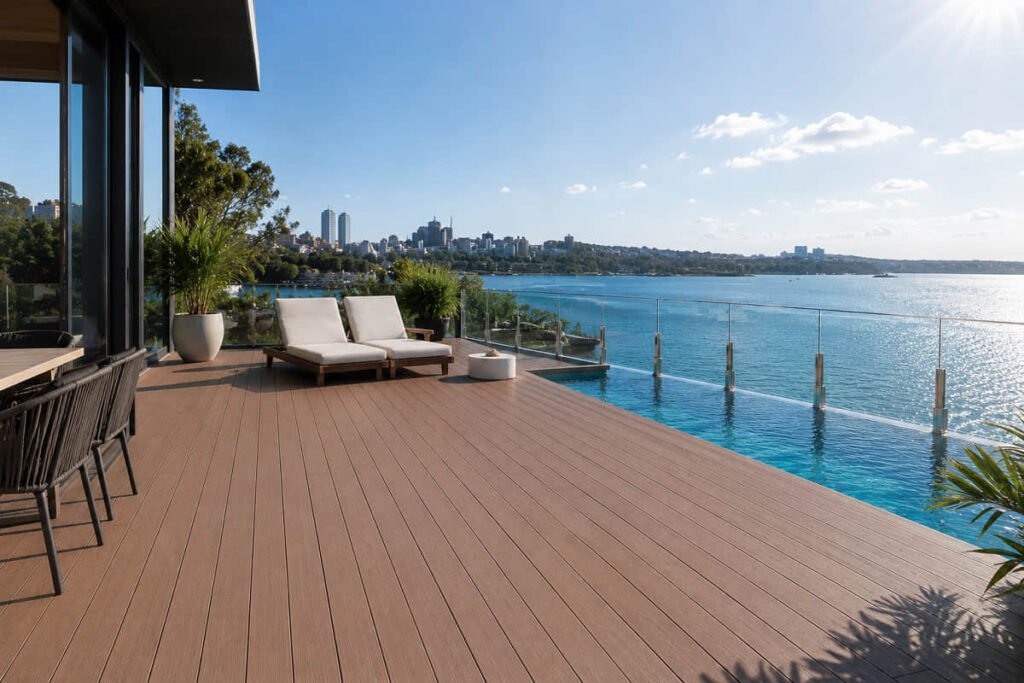
Darker boards absorb more heat underfoot. In Queensland, Western Australia, and the Northern Territory, a charcoal or near-black composite deck in full summer sun can get uncomfortable to walk on barefoot. That matters for pool decks, outdoor dining areas, and any outdoor space with high foot traffic.
Lighter boards absorb less heat. But they show surface deposits — dust, pollen, algae — more clearly. In shaded or damp areas, a lighter board needs more frequent cleaning to stay looking clean.
| Factor | Light Colours | Dark Colours |
|---|---|---|
| Heat underfoot (summer) | Cooler | Hotter |
| Dust and pollen visibility | Higher | Lower |
| Mineral deposits (pool zones) | Lower | Higher |
| Fade performance | Consistent | Consistent |
| Best fit | Pool decks, open sun exposure areas | Shaded zones, commercial fit-outs |
On fade, both light and dark tones hold well across a quality-capped composite range. The LastElegance co-extrusion cap layer is 0.8 mm thick — thicker than most comparable products — with a combined HALS and UV absorber system. After 3,000 hours of QUV accelerated weathering, colour shift is controlled to ΔE ≤ 4–5. That’s a consistent, slight change — not visible fading across a large outdoor living area.
Most Popular Composite Decking Colours in Australia
Trends in Australia are split clearly by project type.
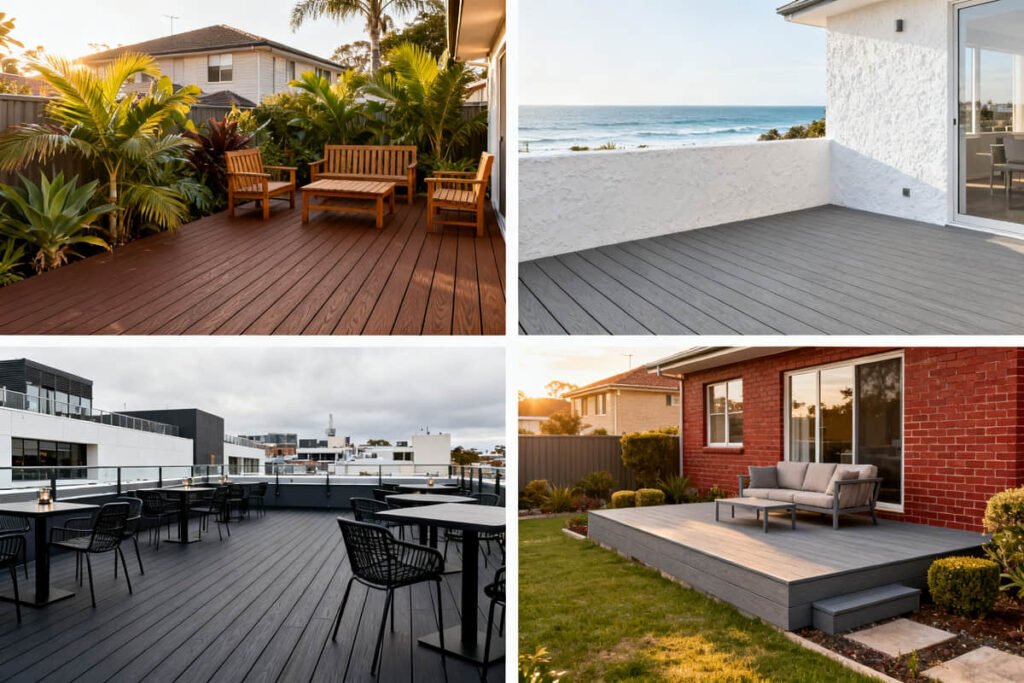
Earthy browns and warm timber tones dominate residential builds in Queensland and New South Wales. The indoor-outdoor lifestyle drives demand for rich tones, earthy tones, and warm naturals that read as a genuine extension of the home. These tones carry a natural beauty that works without looking decorative.
Cool grey and charcoal lead in high-density residential, commercial fit-outs, and coastal builds. Grey suits apartment projects, hospitality spaces, and homes with Colorbond or rendered grey exteriors. It gives a modern appearance that reads as clean and considered rather than cold.
Top composite decking colour choices by project type:
- Residential QLD/NSW: warm browns, earth tones, natural timber tones
- Coastal builds: mid-grey, warm ash, charcoal
- Commercial fit-outs: cool grey, charcoal, near-black
- Mixed residential developments: mid-tone warm grey — the most versatile pick
For procurement managers supplying multiple projects, a mid-tone warm grey is the lowest-risk colour to stock. It suits red brick, rendered white, and Colorbond exteriors — covering most of the Australian housing mix. It’s a contemporary deck look that won’t date within a few years.
How Wood Grain Affects Colour and Look
Surface texture and colour are inseparable on an installed composite deck. A deep brushed wood grain in earthy brown creates shadow and warmth — it reads close to natural wood. A fine-grained board in that same shade looks flatter and more modern.
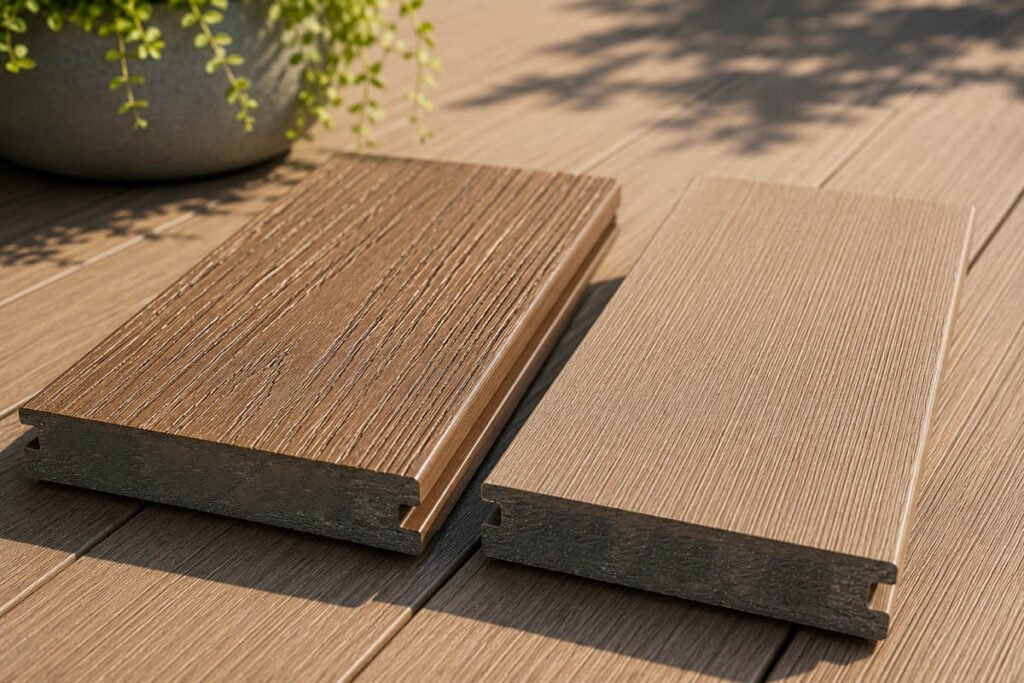
Two boards in the same colour but with different texture profiles will look different once laid. That’s not a defect — it’s a design choice. But surface texture needs to be in the spec from the start, not worked out on delivery day.
The LastElegance co-extrusion process bonds texture directly into the outer cap layer. Wood grain depth and colour are part of the same layer — they can’t delaminate or separate the way applied finishes can. Grain reads consistently across a full project run. That matters when you’re covering hundreds of square metres and the visual interest needs to hold across the whole deck.
For natural beauty and an organic look, specify a deep brushed grain. For a cleaner, modern deck look, a finer surface texture in the same colour family gives you the result without the natural timber feel.
Colour Options Across the LastElegance Decking Range
LastElegance offers three composite decking series. All three share the same core colour palette, so mixed-series specifications are straightforward.
Composite Decking Renew (150×23 mm and 140×23 mm) is the capped composite entry point. It’s available across the full standard colour range — earthy browns, warm naturals, greys, and charcoals.
Composite Decking TimberLuxe (140×23 mm and 140×20 mm) has a deeper wood grain profile. It suits projects where a rich, natural timber look is the priority.
Composite Decking VerdeLife (139×24 mm) is the premium series. It runs on the same colour palette and is available with custom colour and texture options on qualifying orders.
All three series use the same colour system. Procurement managers can specify matching tones across deck boards and screening without risking a colour mismatch. The cladding range — DecoGroove and Oakling — also runs on the same palette.
Colour Choices for Pool Decks and Wet Areas
Every board in the composite decking range carries an R11 anti-slip rating to AS/NZS 4586. Slip safety is consistent regardless of colour choice.
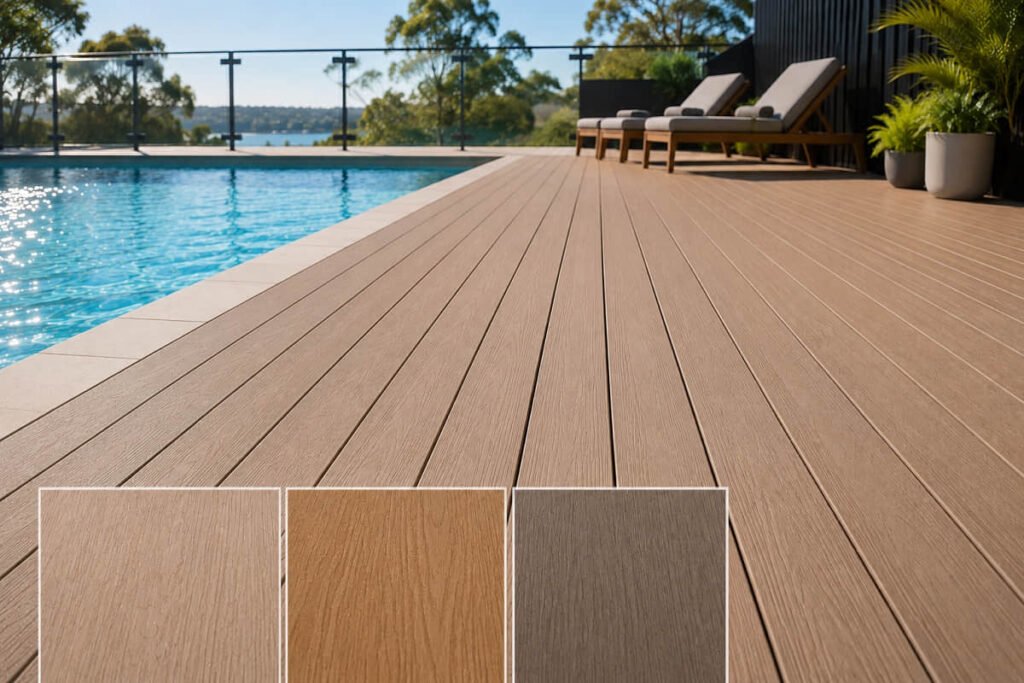
The colour decision around pools comes down to upkeep. Very dark boards show white mineral deposits from pool water — they can look streaky between cleans. Very light boards next to bright pool water can look washed out in direct sunlight.
A warm mid-tone is the practical sweet spot for most Australian pool deck projects. It hides day-to-day surface build-up better than a light board and doesn’t flag mineral deposits like a dark one. It also reads naturally next to most pool surround materials — light concrete, stone, and rendered walls.
For shaded wet areas — under a pergola or in a low-light outdoor living space — go slightly lighter. Shade makes darker boards look heavy and closed-in.
FAQ
Should I choose the same colour decking as my client’s house?
You don’t need to match exactly — you need to complement. Pick from the same colour temperature as the exterior trim or roof: warm exterior, warm decking; cool exterior, cool grey or charcoal. A deliberate contrast can work; an accidental mismatch doesn’t. Build a colour sign-off step into your project handover process.
Can I get composite decking in custom colours?
Yes. Custom colours, lengths, and surface textures are available through factory-direct supply. Custom colour orders need sample approval before production, but working directly with the manufacturer cuts lead time and gives you more flexibility than buying through a distributor.
Do lighter composite decking colours show more dirt?
Light colours show dust and pollen more clearly. Dark colours show mineral deposits and salt residue — especially near pools. Mid-tones are the most forgiving day to day. Regular cleaning with water handles most surface build-up on quality capped composite boards.
What tools can help me see how a colour will look on site?
Physical samples viewed at the install location — in morning and afternoon light, and in shade — are the only reliable method. Online visualisers give a rough idea but aren’t accurate enough for large orders. For commercial projects, build a formal sample sign-off into your project schedule before committing to volume.
Should I follow colour trends or go with a classic?
For pools, decks, and commercial fit-outs, classic naturals and neutral greys hold their appeal much longer than trend-driven picks. Trend colours can date a project within five to seven years. A mid-tone warm grey or natural timber tone is both current and timeless.
How does colour affect how much upkeep a deck needs?
Colour doesn’t change the low-maintenance nature of composite decking — but it does affect how quickly dirt, algae, and stains become visible. Mid-to-light tones in shaded or damp areas may need more frequent cleaning. In full sun with good drainage, any quality capped composite colour is easy to care for.
Can I order multiple colours in one container?
Yes. Mixed-colour orders are possible within one container. Contact our sales team early — per-colour minimums apply, and mixing colours affects production scheduling. Have this conversation before your project timeline is locked.
How do you ensure colour consistency across production batches?
Colour is built into the cap layer during co-extrusion — not applied as a surface finish afterward. That process locks in colour at the point of manufacture. Reorders in the same colour will match your original run, even months apart. For large multi-stage projects, we recommend confirming the colour reference code at your first order.
What’s the lead time difference between standard and custom colours?
Standard colours go straight to production — no extra steps. Custom colours need a sample approval step first. Allow extra time for colour matching and sign-off before the production clock starts. Contact our team early in your project to map out the right timeline for your order.