

Composite decking boards in Australia span a wide range — from basic uncapped product through to premium co-extruded profiles. Buying direct from the manufacturer cuts out the importer and distributor margin, so the same board lands at a lower cost. Your actual price depends on board grade, order volume, customisation and shipping terms.
This guide is about what the board costs you: grade and cap spec, what separates cheap from premium, container economics, and the landed cost items that sit on top of the FOB price. For the full installed project number — subframe, labour rates by city, permits and balustrades — see our deck cost in Australia breakdown.
How Much Does Composite Decking Cost in Australia?
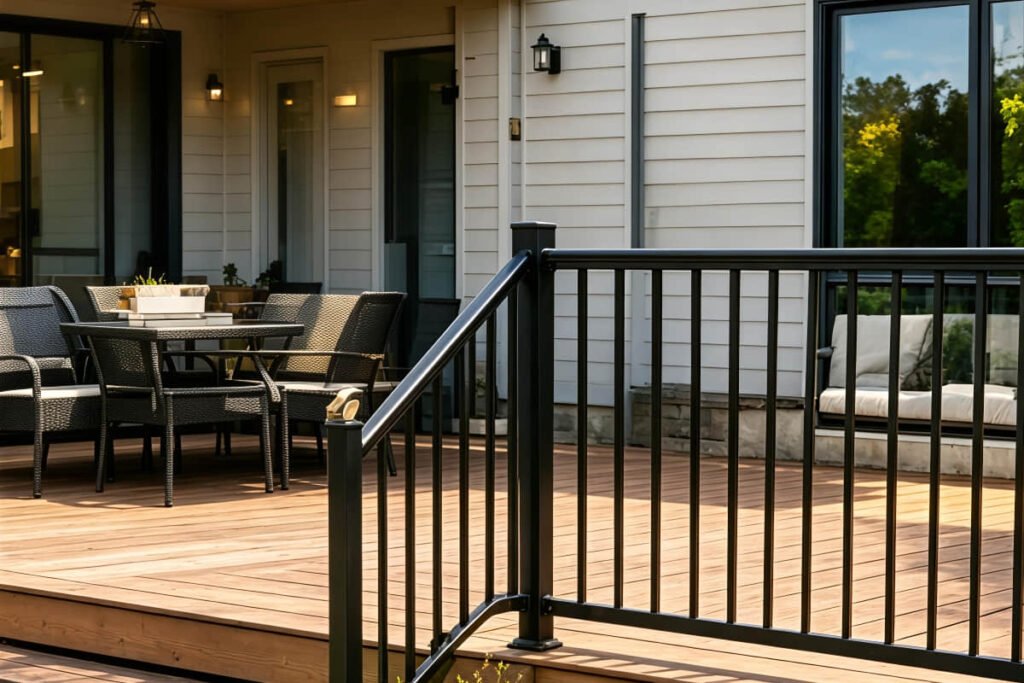
The table below shows how composite decking boards break down by grade. Actual pricing depends on your order volume, specs, customisation needs and shipping terms — so we quote per project rather than publishing a fixed price list.
| Board Grade | What You Get | Key Spec to Check |
|---|---|---|
| Entry-level (uncapped) | No protective outer layer — not recommended for Australian UV | Cap layer: none |
| Mid-range (capped composite) | Protective cap on face and edges — solid performer for most projects | Cap thickness, HDPE density |
| Premium (full co-extruded) | Full cap on all four sides — maximum UV and moisture protection | Cap thickness ≥ 0.5 mm, QUV hours, ΔE result |
These are board-level differences only. Installed cost depends on subframe, site and labour — see the full project cost breakdown.
Buying from a manufacturer rather than through the standard distribution chain removes importer, distributor and retailer margins. The same board, the same cap layer, the same extrusion line — fewer parties taking a cut. Contact us for a quote based on your project specs and volume.
→ Explore our full composite decking range to see board dimensions, weights, and specs across every product series.
What Drives the Board Price?
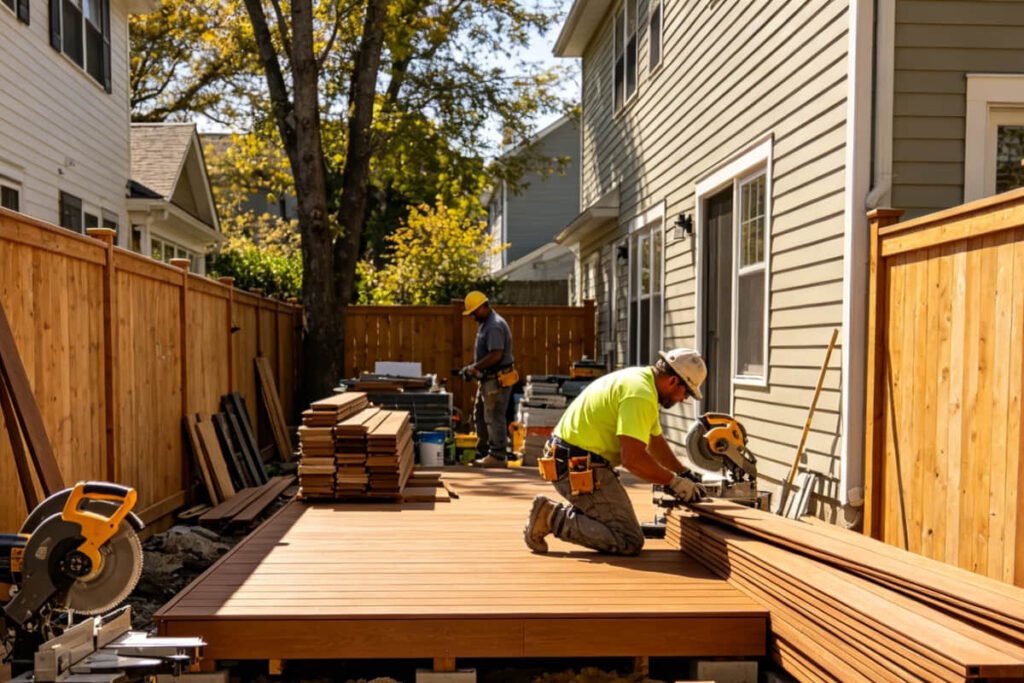
Two boards quoted at the same price per m² can be very different products. These are the four specs that actually move the number.
Board Grade and Cap Layer Quality
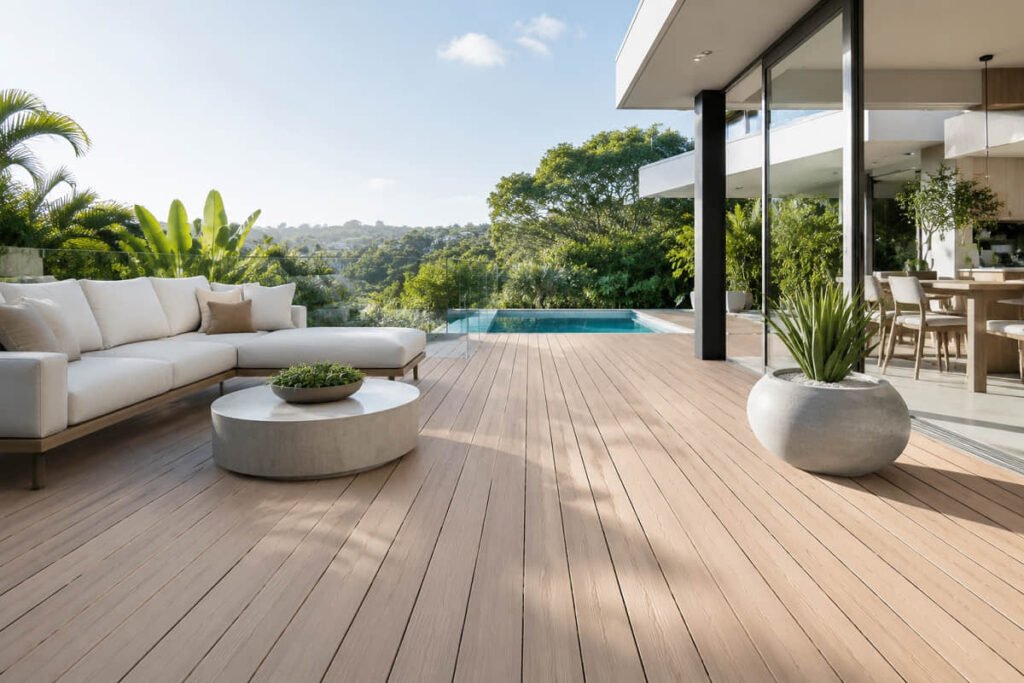
Composite boards fall into three construction types — uncapped, single-cap, and full co-extruded — and each sits at a different price point for a reason.
Uncapped boards have no protective outer layer. They’re cheap upfront, but Australian UV degrades the surface fast — fading, chalking and surface softening within a few summers. They are not a serious option for outdoor use in this market.
Single-cap boards add a protective layer on the face and edges only. The underside and one or both edges remain exposed, which is where moisture ingress and colour drift usually start.
Full co-extruded boards wrap all four sides in a cap layer bonded in the same extrusion pass. That co-extrusion is what gives the cap its adhesion strength — a cap applied as a separate coating step can delaminate; a co-extruded cap cannot, because it is fused to the core while both are still molten.
The cap is the single most important spec when comparing composite decking boards, and it is also the spec suppliers are most likely to leave vague.
LastElegance boards use a 0.8 mm co-extruded cap — thicker than most on the market. The HDPE core runs at 0.95 g/cm³ density, with a 60% recycled / 40% virgin material blend. After 3,000 hours of QUV accelerated weathering, the colour shift is ΔE ≤ 4–5.
That last number is worth understanding. ΔE measures colour difference on a scale where a value under 2 is invisible to most people and a value over 6 is obvious side by side. A board that shifts ΔE 10 over three years is a board your client will call you about. Ask any supplier for their QUV hours and their ΔE result — if they can only offer a phrase like “excellent colour retention,” you have your answer.
Wood fibres in quality composite decking come from hardwood sources, bound with HDPE under heat and pressure. The fibre-to-polymer ratio and the fibre source both affect how the board behaves in heat and how well the cap bonds.
Subframe, labour and site prep sit outside the board price and typically account for 55–65% of the finished deck. We’ve broken those down separately in the deck cost guide, including labour rates by city and NCC subframe requirements.
Solid vs Hollow Boards
Hollow boards are lighter, faster to handle, and cheaper per linear metre. Solid boards cost more but handle heavier loads and feel more solid underfoot.
For standard residential decking — foot traffic, outdoor furniture, typical domestic use — hollow profiles perform well and reduce both material cost and installation time. For commercial projects, high-traffic areas, or decks carrying heavy furniture, planters or equipment, solid boards are worth the premium.
Both profiles are available in the same colour and finish options across the range. The choice affects price and install speed — not the look of the finished deck.
Landed Cost — What Sits on Top of the Board Price
The FOB board price isn’t your landed cost. For trade buyers importing directly, budget for:
- Sea freight and Incoterms — a 40′ container runs approximately 20 days production + 2 days packing + 24–32 days sea freight. A 20′ container runs about 15 days production with the same freight window. Allow 6–8 weeks from order confirmation to site.
- Customs duty and GST — payable on the landed value at clearance.
- Port, cartage and handling — terminal handling charges, quarantine inspection where applicable, and delivery from port to your yard or site.
- Storage and stock holding — container volumes need somewhere to sit between arrival and installation. Factor in the yard space and the working capital.
- Waste allowance — order 10–15% above your measured m², more for angled, curved or multi-level layouts.
Composite vs Timber: The Real 10-Year Cost
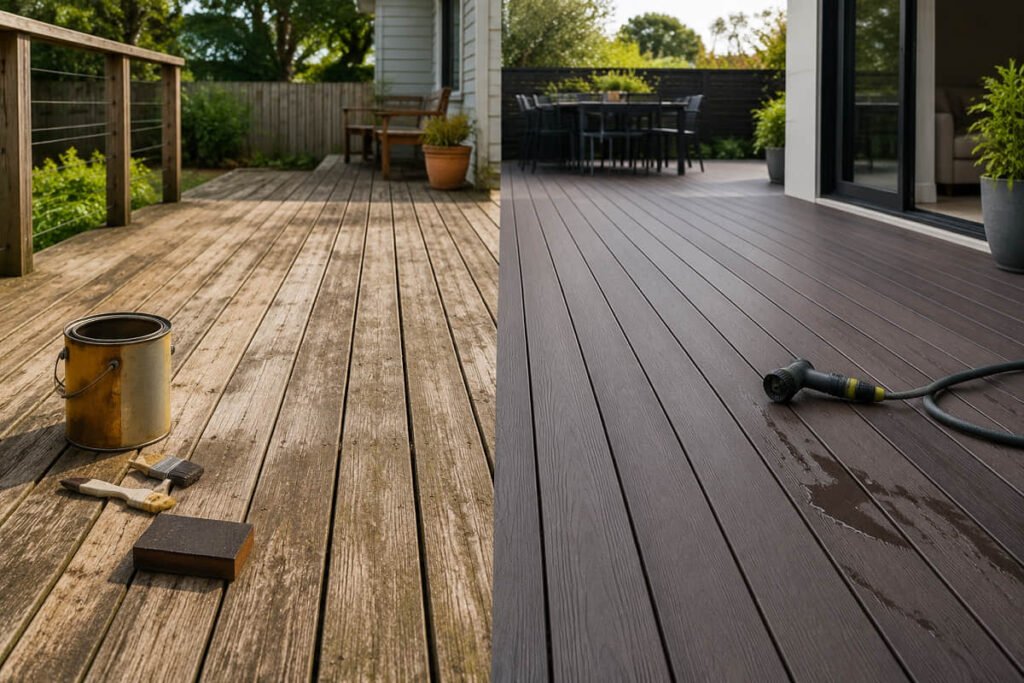
Composite costs more per board than treated pine and sits roughly level with premium hardwood — but it removes the recurring maintenance line entirely. Over ten years, that typically puts composite ahead of both.
Termite resistance matters too. In Queensland, northern NSW and much of WA, timber deck replacement is a live risk that composite simply removes.
→ Request Free Samples — compare decking boards side by side before you spec your next project.
Cheap vs Premium Composite: What’s Different?
Two composite boards can look identical in a supplier photo. They are not the same product.
- Cap layer — present or absent. Uncapped boards have no protective outer layer. They fade and soften under Australian UV. A full co-extruded cap at 0.8 mm gives real protection. Anything thinner is a compromise on longevity.
- HDPE density and blend. Premium composite uses HDPE at 0.95 g/cm³ — a density that holds shape under heat and load. Cheaper boards often use lower-grade polymer, or a high recycled-content blend without the UV stabilisers to back it up.
- Flexural strength. The benchmark is 26.2 MPa per EN 15534. Boards below this deflect more over time, especially at wider joist spacings. That means bounce, creak, and eventually callbacks.
- Slip resistance rating. Premium boards hold R11 per DIN 51130 / AS 4586. That rating is required for pool surrounds and many commercial projects. Cheaper composite may not be tested at all — so nobody knows the real grip rating until someone slips.
How Factory-Direct Pricing Saves Trade Buyers Money
The standard composite decking supply chain in Australia runs: manufacturer → importer → distributor → retailer → buyer. Each step adds margin. By the time the board reaches a builder’s yard, it can carry two or three layers of markup on top of the factory price.
Factory-direct means buying from the manufacturer and shipping straight to your project or warehouse. No importer. No middleman. The same board — same HDPE grade, same 0.8 mm cap, same manufacturing process — lands at a lower composite decking cost because fewer parties have taken a cut.

For a distributor or contractor buying at volume, that difference across a full container is real money.
It also opens up options a retail supply chain can’t offer. Custom board lengths, colours, surface textures, and profiles are available when you’re ordering from the factory. That matters for builders who need to match a specific project spec or give clients something their competitors can’t source off the shelf.
→ Contact Our Sales Team — talk to us about volume pricing and what a factory-direct arrangement looks like for your business.
Mistakes That Push Up Your Decking Costs
These aren’t rookie errors. They’re patterns we see across projects from experienced builders and procurement teams alike.
- Getting only one quote. Without a like-for-like comparison, you can’t tell if the price is fair or if the spec is right. Get at least two quotes — and make sure both are priced on the same board grade and subframe type.
- Choosing boards without checking the cap layer spec. Uncapped composite decking options are cheaper. They’re also wrong for Australian conditions. Always confirm whether a board is co-extruded and what the cap layer thickness is. If the supplier can’t tell you, that’s your answer.
- Underestimating subframe cost. Subframe materials make up 25–40% of the total installed price on most projects. Budgeting only for boards and labour without pricing the subframe leads to gaps and blowouts when the real quote comes in.
- Ordering the wrong quantity. Off-cut waste on most decking projects runs at 10–15% of the total board area. Don’t order to your exact m² figure — especially on irregular shapes. Order 10–15% more and avoid a mid-project materials delay.
- Ignoring delivery lead times. Factory-direct orders need 6–8 weeks from order to delivery in Australia. If you’re working to a build schedule, lock in your order early. A decking delay can hold up the whole project handover.
- Skipping council approval. Decks over 1 m high or attached to the dwelling often need a building permit. Check your state and local council rules before work starts. Permit costs are typically $200–$800. Build without one, and you risk a stop-work order or a problem at resale.
FAQ
What is the cheapest composite decking option?
Entry-level uncapped composite is the cheapest per square metre, but we don’t recommend it for Australian conditions — with no UV-resistant outer layer, it wears down fast in direct sun. The cheapest option worth considering is mid-range capped composite. Contact us for pricing based on your project volume and specs.
What types of composite decking boards are available?
The LastElegance range includes solid and hollow profiles, with widths from 139 mm to 150 mm and lengths up to 2,900 mm. The TimberLuxe and VerdeLife series run at 140 × 23 mm; the Renew series comes in 150 × 23 mm and 140 × 25 mm. All profiles are available with grooved edges for hidden fastener installation. Finishes include wood-grain embossed surfaces across a palette from light naturals to deep charcoals.
What’s the lead time for composite decking orders shipped to Australia?
For a 40-foot container, allow approximately 20 days of production, 2 days of packing, and 24–32 days of sea freight. A 20-foot container runs about 15 days of production with the same freight window. For planning purposes, factor in 6–8 weeks from order confirmation to site delivery. Actual arrival times vary with shipping schedules and port clearance.
When is the best time to place a composite decking order?
Lead times for manufacturer-direct orders don’t change by season, so plan 6–8 weeks from order to delivery regardless of when you buy. What does move is shipping capacity: rates and space tighten around Chinese New Year and in the pre-Christmas peak. If your project lands in Q1, place the order before the shutdown window rather than after it.
