

Your clients don’t call to say the fence looks great. They call when it warps, bleaches, or splinters — and they expect you to fix it.
Timber fencing has been the default for decades. But builders across Australia are switching to composite, and the reason isn’t aesthetics. It’s callbacks. Composite fencing cuts post-install problems that eat into your margins and your reputation.
This guide covers durability, install time, total cost over the life of the project, and what your clients will actually experience five years after handover.
If you’re a builder, developer, or property manager speccing fencing for multiple sites, the numbers look different from a homeowner’s perspective. Here’s the trade-level view.
How Does Each Fence Handle Australian Weather?
Australia is one of the harshest testing grounds for any outdoor material. UV index is among the world’s highest. Termite pressure covers most regions. Coastal salt air, tropical humidity in the north, and temperature swings in the south and inland add to the load.
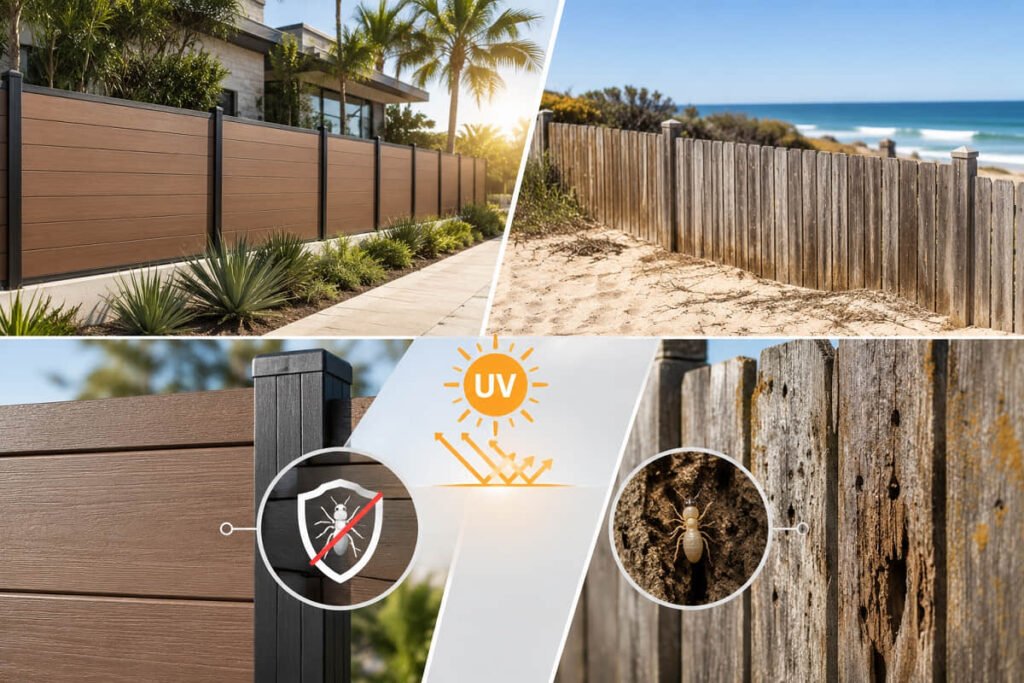
Timber handles these weather conditions with more difficulty each year it ages. Composite holds its form and appearance much more steadily. That gap matters at the spec stage — before the fence goes in, not after.
Do Composite Fences Resist Termites and Rot?
Composite fencing gives termites nothing to eat. The boards contain no organic material insects can break down — no food source, no moisture path, and no rot pathway.
Wood fences — treated pine, merbau, hardwood — carry some risk from insect damage and moisture-driven rot. Australian Standard AS 3660 exists specifically because insect infestations in timber are common enough to need an industry-wide management framework.
Insect damage and rot are two of the biggest drivers of early fence replacement in Australia. Removing both risks matters — especially for property managers or developers who can’t afford unplanned repair calls.
Why composite fencing resists termites:
- No organic food source for insects
- No moisture absorption to enable rot
- No decomposition pathway for insects to exploit
How Does UV Affect Each Fence Over Time?
Untreated timber fades and greys fast under the Australian sun. Even treated hardwoods need regular staining and oiling to hold their colour — and still crack and silver over time if the maintenance schedule slips.
Composite fencing handles UV differently. The cap layer absorbs and deflects UV rather than breaking down under it. Our cap layer is 0.8 mm thick — thicker than many comparable products. That extra thickness is what drives the test results: after 3,000 hours of QUV accelerated aging, our boards show a colour difference of ΔE ≤ 4–5. That’s a controlled, slight shift — not the greying you see with natural wood.
The system behind that result is a combined HALS (Hindered Amine Light Stabiliser) and UV absorber treatment built into the cap layer. In practice, it means the fence colour stays stable for years without regular painting or staining.
Which Fence Needs Less Upkeep?
This is where the real cost difference lives. Wood fencing carries a maintenance schedule. Composite fencing doesn’t — not in any meaningful sense.
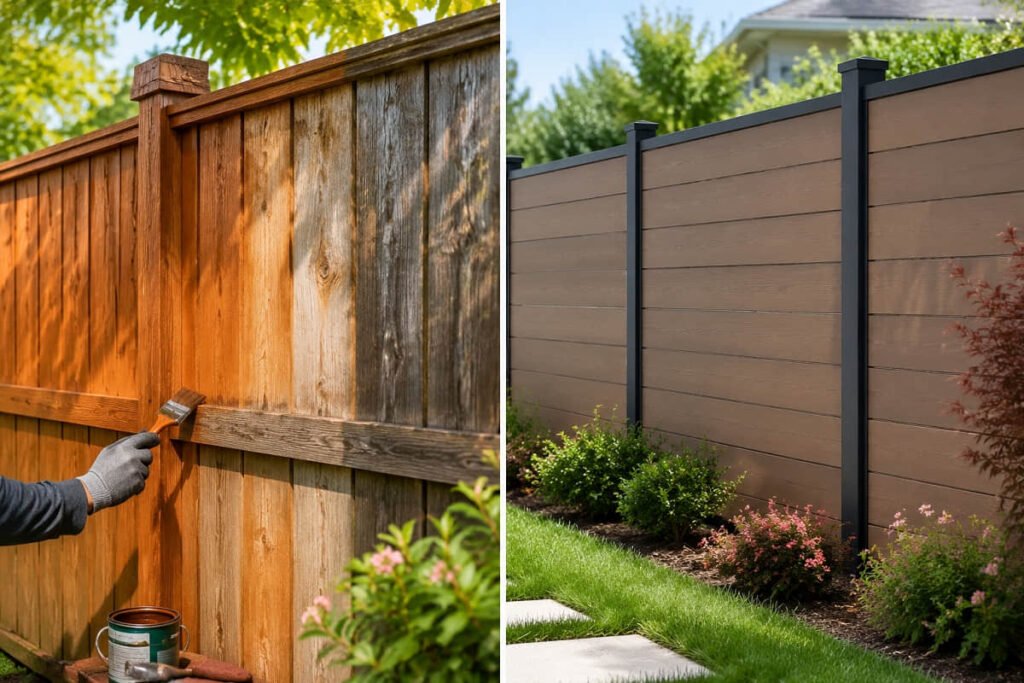
A wood fence needs sanding and oiling every one to two years. It needs staining or painting when the colour fades. It needs pest inspections and sometimes chemical treatment. Over 10 years, that’s a real and recurring cost — in materials, labour, and site visits.
Composite fencing needs a hose-down and mild detergent a few times a year. That’s it.
| Task | Wood Fence | Composite Fence |
|---|---|---|
| Sanding and recoating | Every 1–2 years | Not required |
| Staining / oiling | Every 1–2 years | Not required |
| Painting | Every 3–5 years | Not required |
| Pest treatment | As needed | Not required |
| Rot inspection | Annually | Not required |
| General cleaning | As needed | 2–3 times/year |
For builders and property managers running multiple sites, the savings compound. One less maintenance task across 10 sites a year adds up fast.
Composite vs Wood Fence — What Does It Cost?
Timber costs less upfront. That’s true, and any fair comparison has to say so. But the full cost picture looks different over 10 to 15 years.
| Timber Fence | Composite Fence | |
|---|---|---|
| Material + install (per linear metre) | $50–$90 | $90–$150 |
| Staining / painting over 10 years | $80–$130/lm | $0 |
| Pest treatment + repairs over 10 years | $50–$200/lm | Minimal |
| Estimated 10-year total | $180–$420/lm | $90–$165/lm |
Estimates are indicative. Actual costs vary by region, species, and project scale.
The gap narrows quickly once you account for ongoing timber maintenance. Over a 10-year run, the composite often comes out ahead, not just competitive.
For volume trade buyers, factory-direct supply removes import and reseller margin. Our MOQ starts at 100 m². At that scale, composite panel pricing becomes more competitive than retail supply chains suggest.
Speccing composite fencing for a development? Request free samples before committing to volume. → Request Free Samples
Why Does Composite Cost More Upfront?
The cap layer, HDPE binding process, and UV stabiliser system all add to production cost. Timber is a raw material with simpler processing — that’s why the upfront price is lower.
But the gap shrinks when you buy factory-direct. And it closes fast once you factor in what timber upkeep costs year on year.
How Long Does Each Fence Last?
Composite fencing, when correctly installed, lasts 25 years or more with no meaningful structural breakdown. A well-maintained timber fence can reach 15–25 years — but “well-maintained” does a lot of work in that sentence. Without regular upkeep, that lifespan shrinks.
Our composite screening products carry a 15-year warranty. The warranty applies under normal use and correct installation — the same conditions apply whether the project is residential or commercial.
Composite rarely fails before a timber fence does — and it does so without the maintenance costs timber racks up along the way.
Which Fence Looks Better?
Timber wins on appearance at the start. Fresh hardwood has a warmth that composite closely mimics but can’t fully replicate — that’s honest.
But that comparison only holds for the first year or two. Under sustained sun and weather, untreated timber greys, warps, and cracks. Composite holds its look without any intervention.
For builders speccing across a full development, colour consistency matters as much as initial appearance. Our Screening shares the same colour palette as our composite decking range — fence, deck, and cladding can match across the entire site. Custom colours are available for volume orders.
Is Composite Fencing Better for the Planet?
Neither material is perfect here.
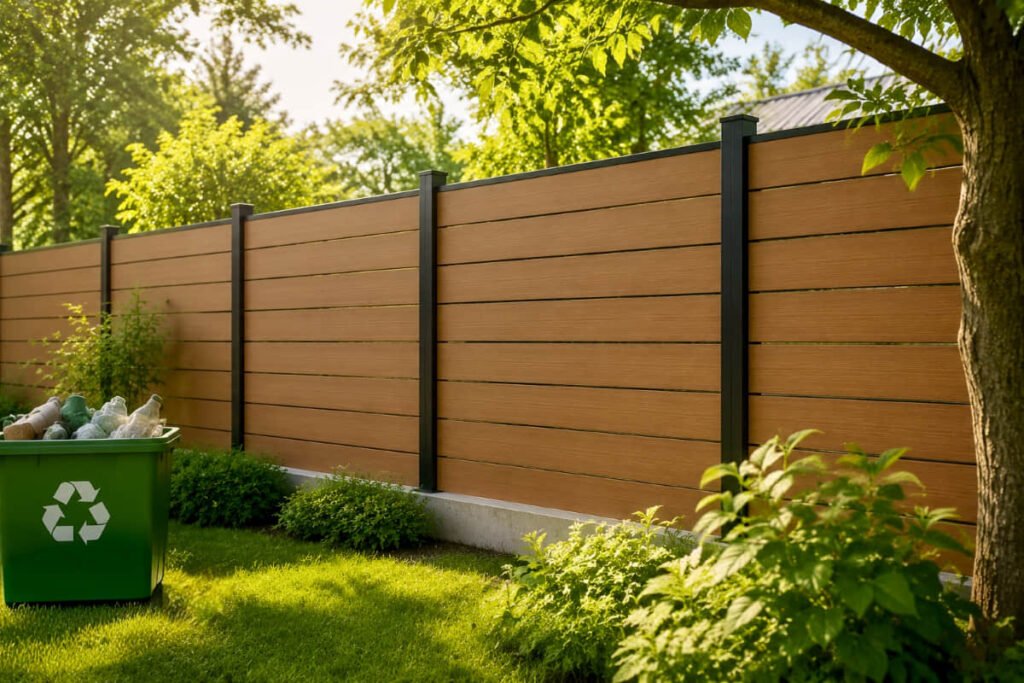
Timber is renewable — but short replacement cycles and treatment chemicals cut into that advantage. A fence replaced twice in 20 years uses twice the raw material of one that goes the distance.
Composite uses recycled plastics — our boards use hardwood fibre sourced from Guangxi and HDPE at a density of 0.95 g/cm³, with 60% recycled content and 40% virgin material. No painting or sealing chemicals are needed during its life. Formaldehyde emissions test at not detected under EN 717-1, which matters for projects with sustainability or air quality requirements.
Our products carry CE, ISO, and RoHS certifications, providing a documented baseline for buyers with environmental procurement requirements.
Which Fence Gives You Better Long-Term Value?
It depends on the project. Here’s a plain framework:
| Project Type | Best Fit | Reason |
|---|---|---|
| Residential homeowner (tight upfront budget) | Timber | Lower initial cost, easy to patch yourself |
| Volume builder / developer | Composite | Lower total cost, less site maintenance, longer life |
| Property manager (multiple sites) | Composite | No recurring paint or pest costs, fewer repair calls |
For a single fence with a tight budget and a hands-on owner, timber still makes sense. That’s a real scenario.
For builders, developers, and property managers running multiple sites or long-term projects, composite wins on total cost, maintenance time saved, and appearance consistency over the life of the fence.
Factory-direct supply is worth factoring in for trade buyers. Our MOQ is 100 m². Custom colours, lengths, and profiles are available for volume orders — useful when you’re specifying across an entire development, not just a single fence run.
Ready to spec composite fencing for your next project? Get a direct factory price for your volume. → Request a Quote
FAQ
What are the disadvantages of composite fencing?
Composite fencing costs more upfront than timber — that’s the main trade-off. It can’t be repainted if you want a colour change later, and it needs proper post spacing (0.8–1.4 m, not exceeding 1.6 m) to perform correctly. None of that is a reason to walk away from composite — but you’re better off knowing before you spec.
Is composite fencing harder to repair than wood?
Timber is easy to patch — swap one board and touch up the stain. Composite is harder to spot-repair because colour-matching a single board after UV exposure is tricky. The fix is simple: order a small number of spare boards when you buy. Composite rarely needs repair when installed correctly, but having spares on hand covers you if it does.
Which fence is better for DIY installation?
Both can be DIY-installed, but the methods differ. Timber means post-setting, measuring, and cutting individual boards. Composite fence panels use a slot-in or clip-fixed system — closer to flat-pack assembly. Two people can run composite fencing efficiently. The most critical step is getting post spacing right: 0.8–1.4 m for composite, never exceeding 1.6 m. Two installers can typically run 20–30 linear metres per day with a composite clip system — faster than cutting and nailing individual timber boards.
Does composite fencing get hot in the Australian sun?
It can absorb more heat than timber, especially in darker colours. That’s worth considering near pool areas where people might lean against it. Choosing lighter to mid-range colours reduces heat absorption. For most fence installs, nobody’s touching the boards — so it’s rarely an issue in practice.
What post options work with composite fencing?
Our composite screening boards work with aluminium alloy posts or WPC posts. A full system is available: top and bottom trim strips, angle brackets, clip fasteners, post caps, post skirts, and post edge trims. Post spacing must sit between 0.8 m and 1.4 m and must not exceed 1.6 m — that’s the most critical factor for panel stability and wind resistance.
Is vinyl fencing a better option than composite?
Vinyl is cheaper and lighter but tends to look more plastic and lacks the wood fibre core that gives composite boards their rigidity and natural appearance. In Australian conditions, sustained UV exposure can also make vinyl brittle over time. For trade projects where both appearance and long-term durability matter, composite fencing is the stronger fence material.
