

Merbau has been the default timber decking choice in Australia for decades — affordable, good-looking when oiled, and widely available. Composite decking is taking ground fast, and when builders run the numbers on long-term upkeep, the reason is clear. This article provides an honest assessment of both decking materials, covering cost, maintenance, lifespan, pool performance, aesthetics, and sustainability. By the end, you’ll have a clear decision framework.
What Are These Two Decking Materials?
Merbau is a tropical hardwood that needs annual oiling to stay in good shape. Composite boards blend wood fibre with recycled plastic — and need very little upkeep.
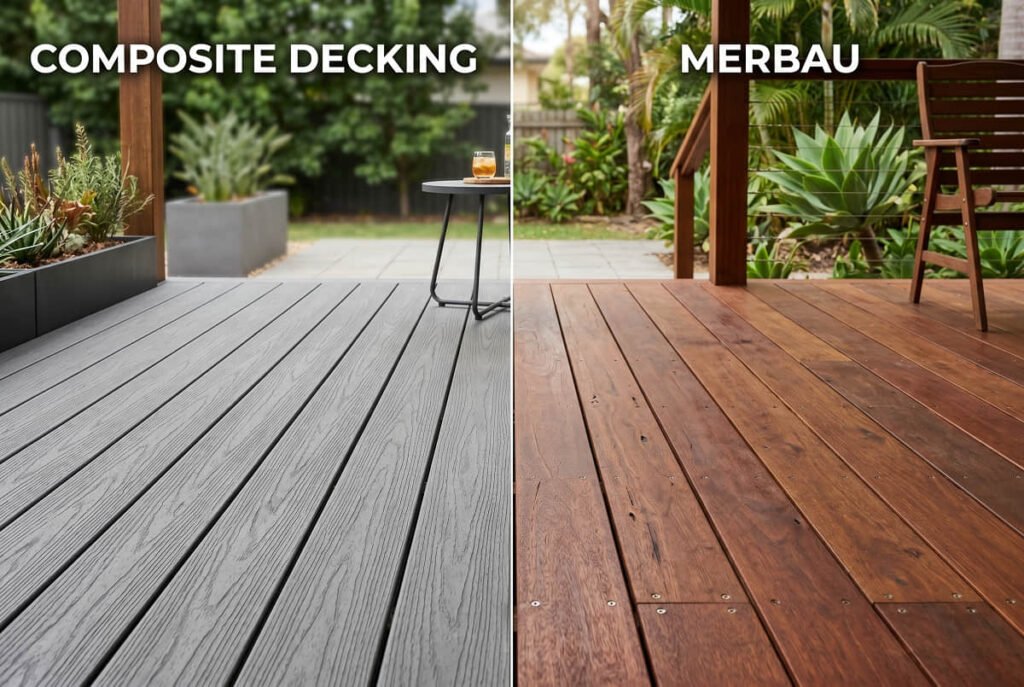
What Is Merbau Decking?
Merbau (Intsia bijuga) is a dense tropical hardwood from Southeast Asia and the Pacific. Builders have favoured it for decades in Australia. The reddish-brown tones, tight grain patterns, and natural termite resistance made it a strong choice for outdoor decks.
Merbau timber is rated Durability Class 1–2 above ground — it holds up well outdoors when maintained. Its natural oils slow moisture absorption. However, those same oils mean the boards require regular oiling to maintain their colour. Without it, merbau fades to silver-grey within a couple of years.
What Is Composite Decking?
Composite boards are made from a blend of wood fibres and recycled HDPE plastic. Quality boards use a co-extrusion process — this bonds a dense cap layer to the wood-plastic core during production. That cap layer is what makes the difference. Premium composite has a cap layer of 0.8 mm or thicker. That spec determines how well the board handles UV and moisture over its full life.
Unlike merbau, composite needs no oiling, staining, or sealing. It comes in many colours, suits custom sizing, and works well across both residential and commercial projects.
Quick Comparison: Composite vs Merbau Decking
| Feature | Composite Decking | Merbau Decking |
| Material cost per m² | $100–$250 | $100–$160 |
| Annual upkeep (30 m²) | ~$50–$100 (wash only) | $300–$800 (oiling + labour) |
| Typical lifespan | 25+ years | 20–25 years (if well maintained) |
| Slip resistance rating | R11 (AS/NZS 4586) | Decreases as oil wears off |
| Tannin bleed risk | None | High — worst in first 2–3 years |
| Termite resistance | Yes (composite material) | Natural oils help — not guaranteed |
| Recycled content | Up to 60% | None |
| Warranty | 15 years | Varies by supplier |
| Splinters over time | No | Yes — especially as boards age |
| Colour stability (QUV) | ΔE ≤ 4–5 at 3,000 hrs | Depends on oiling frequency |
How Do Costs Compare Over Time?
Merbau wins on the entry price for small jobs. Materials typically run $100–$160 per m², which makes the upfront cost lower on a straight comparison.
Mid-range composite boards sit at $100–$250 per m², depending on grade and source. Buy factory-direct at volume, and that range shifts down — the importer and reseller margin is removed. This gives trade buyers a better landed cost than retail pricing suggests.
On installation, both materials are broadly similar. Composite has a small edge on larger jobs — hidden clip systems mean no pre-drilling every board, which saves time.
The real gap appears over time.
15-Year Total Cost: 30 m² Deck
| Cost Item | Composite Decking | Merbau Decking |
| Materials (30 m²) | ~$4,500 | ~$3,900 |
| Annual upkeep × 15 years | ~$1,100 | ~$8,250 |
| Estimated 15-year total | ~$5,600 | ~$12,150 |
Based on $150/m² composite, $130/m² merbau, $75/yr composite wash, $550/yr merbau oiling and labour. Figures are indicative.
That’s a gap of roughly $6,500 on a 30 m² deck — driven almost entirely by maintenance costs. On a larger commercial or strata project, the difference is much bigger. Composite starts to look like the obvious choice once you run those numbers.
How Much Maintenance Does Each Need?
This is where the two materials separate most clearly — and it’s one of the biggest factors for builders who recommend products to their clients.
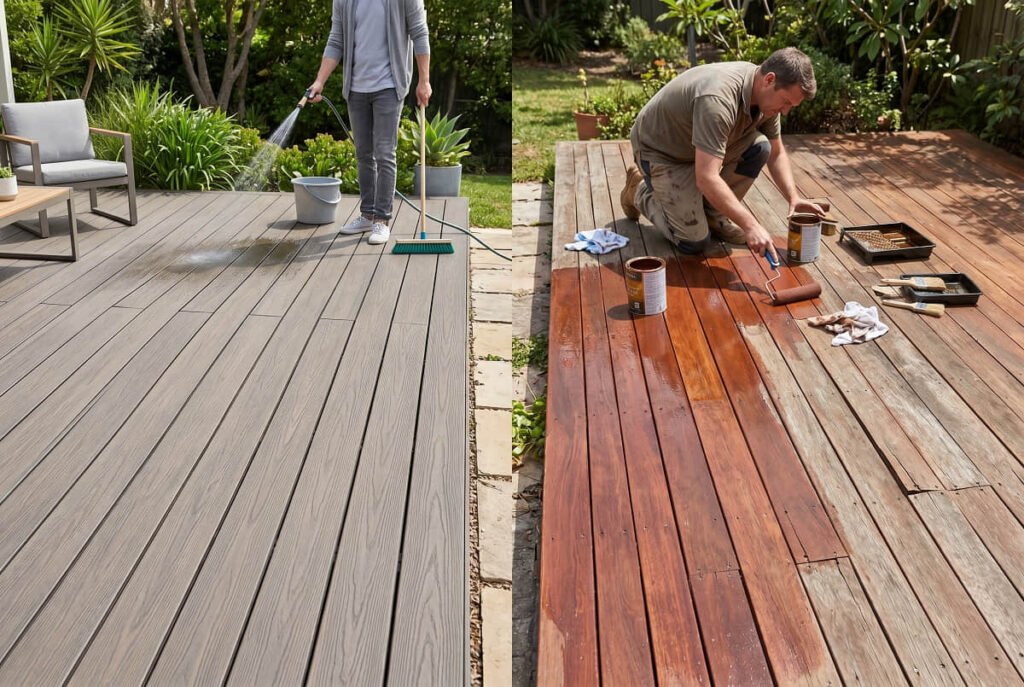
Merbau annual maintenance checklist:
- Sweep the deck and clean with a quality deck wash
- Sand rough or splintered patches
- Apply one to two coats of hardwood oil
- Inspect for splits, raised fixings, and pest activity
That’s a full weekend’s work every year. Materials and labour for a 30 m² deck run $300–$800 each time. Miss a year, and moisture gets into the timber — the wear cycle starts and accelerates quickly.
Composite annual maintenance routine:
- Sweep off debris
- Wash with warm soapy water two to four times a year
No oil, no sealant, no sanding. That’s what minimal maintenance actually looks like.
For strata buildings, commercial projects, or any client who doesn’t want a call about the deck two years in, this difference matters. Composite’s 15-year warranty covers cracking, warping, and colour fade — but it applies under normal use and maintenance conditions. The good news: that routine is a light wash, not an annual trade job.
How Long Does Each Material Last?
Well-maintained merbau lasts around 20–25 years. Quality composite typically runs 25 years or more, with far less upkeep along the way.
In practice, that gap gets bigger in Australian conditions. Coastal salt, strong UV, humidity, and hot summers all wear timber down faster when maintenance slips. And for most clients, maintenance does slip.
Composite holds up better through neglect. It doesn’t rot, split, or fade the same way timber does when it misses a treatment cycle. That’s a real difference in how the product performs across a full project lifespan — not just in ideal conditions.
Performance in Australian Conditions
Coastal areas: Salt exposure breaks down merbau’s oil layer faster than normal. Oiling frequency goes up, or the boards wear faster. Composite resists salt and moisture with no extra care.
High-humidity zones — coastal Queensland and Darwin: Merbau develops mould and mildew between oiling cycles. Composite resists both. Our distributors in Queensland see this pattern consistently across coastal builds.
Hot, dry inland climates: Merbau cracks and cups as moisture levels swing between wet and dry seasons. Composite won’t warp, split, or cup.
Does Merbau Stain Your Pool and Pavers?
This is the issue most buyers don’t hear about until after installation.
Merbau is high in natural tannins. When rain hits the boards, those tannins wash out and stain everything below — pool coping, concrete pavers, rendered walls, outdoor furniture. The stain is reddish-brown and very hard to remove once it sets.
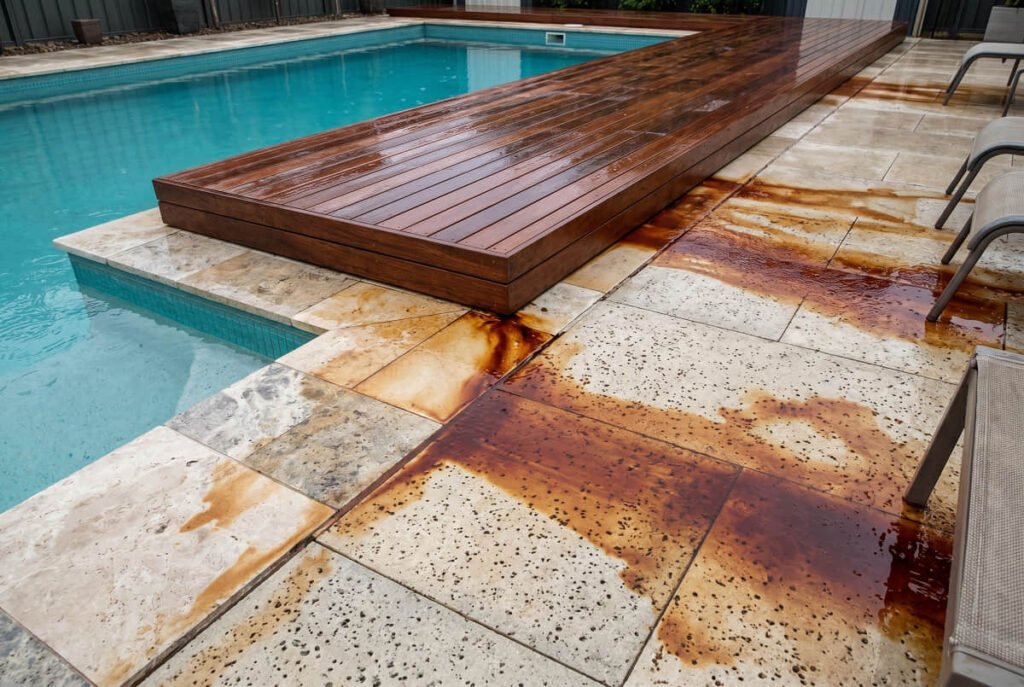
Tannin bleed is worst in the first 6–12 months but can continue for 2–3 years. Commercial tannin removers and oxalic acid cleaners can lift fresh stains. Stains that have sat for months on porous concrete may be permanent.
Composite produces zero tannin bleed. For pool surrounds, light-coloured paving, and any outdoor space where the surrounding surfaces matter to the client, that’s a real advantage — not just a minor point of difference.
Slip Resistance Around Pools
Slip resistance is a safety and compliance issue — not just a comfort preference.
Composite boards with an R11 rating under AS/NZS 4586 meet the requirements for wet areas, including pool surrounds. Merbau can become slippery as surface oil wears off, especially when a biofilm forms in humid conditions.
For commercial pools, public spaces, and any deck used by children, specify the slip rating in writing before the job starts.
Which Looks Better Over Time?
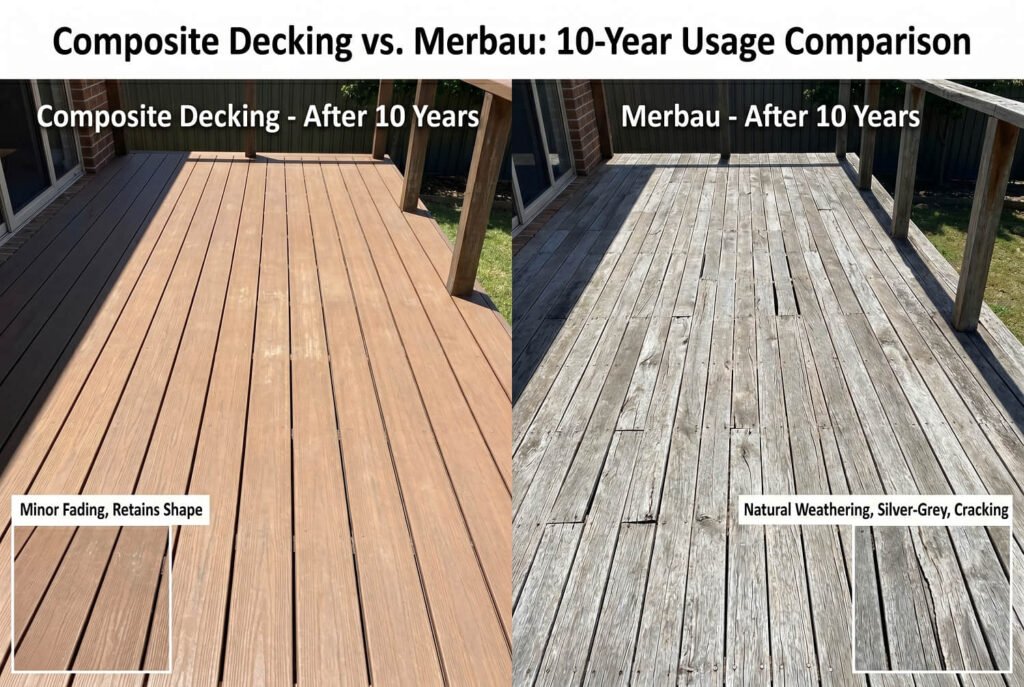
Fresh merbau looks excellent. The reddish-brown tones and natural grain are hard to replicate — that’s a genuine advantage, and some clients will always want real wood for that reason.
But the look depends on consistent upkeep. Skip a year of oiling and the boards start to grey. After two or three years without treatment, an unmaintained merbau deck looks nothing like it did on install day.
That’s also when the callbacks start. Colour fade, surface greying, and tannin staining on pool coping or pavers are among the most common client complaints on merbau builds — and they come back to the installer.
Composite holds its colour without any treatment. No oiling, no recoating, no surprises two years after handover. It also comes in tones merbau can’t offer — greys, charcoals, and custom colours for volume orders.
If the client oils their deck every year, merbau looks great. If they won’t — and most won’t — composite means fewer appearance complaints and fewer calls back to site.
Which Has Less Environmental Impact?
Merbau comes from tropical forests in Southeast Asia. Responsible sourcing is hard to verify — FSC-certified stock makes up a small share of what enters the Australian market.
Composite takes a different path. Quality boards use recycled plastic and reclaimed wood fibre, cutting demand for virgin timber. No chemical treatments over the deck’s life keeps the ongoing footprint low.
It’s worth noting that composite is a plastic-based product — end-of-life disposal is a real trade-off. But over the full life of a deck, the recycled content and chemical-free upkeep give it a better story for most project types.
If a project has green building requirements or sustainability criteria in the tender, composite is the easier material to specify with confidence.
What Trade Buyers Need to Know
The Australian decking market is shifting. Builders and developers are moving away from timber — not because timber stopped working, but because their clients stopped accepting the upkeep.
Strata managers are the clearest signal. A deck that needs annual oiling becomes a body corporate liability. One callback about a slippery surface near a pool is one too many. Composite removes both problems — and that’s driving the specification change at the commercial level.
Residential builders are seeing it too. Clients who built with merbau five years ago are now asking for something with lower maintenance the second time around. The annual oiling conversation has worn thin.
For distributors, the opportunity is straightforward. Composite decking sits at a higher margin than treated pine and competes directly with merbau on installed cost over time. It’s a product that sells itself when buyers run a 15-year cost comparison — and more buyers are running that comparison now.
The brands winning in this space aren’t the ones with the most colours or the thickest catalogue. They’re the ones who can supply consistently, customise for volume projects, and back the product with a real warranty. That’s where the specification decisions get made.
Which Should You Choose?
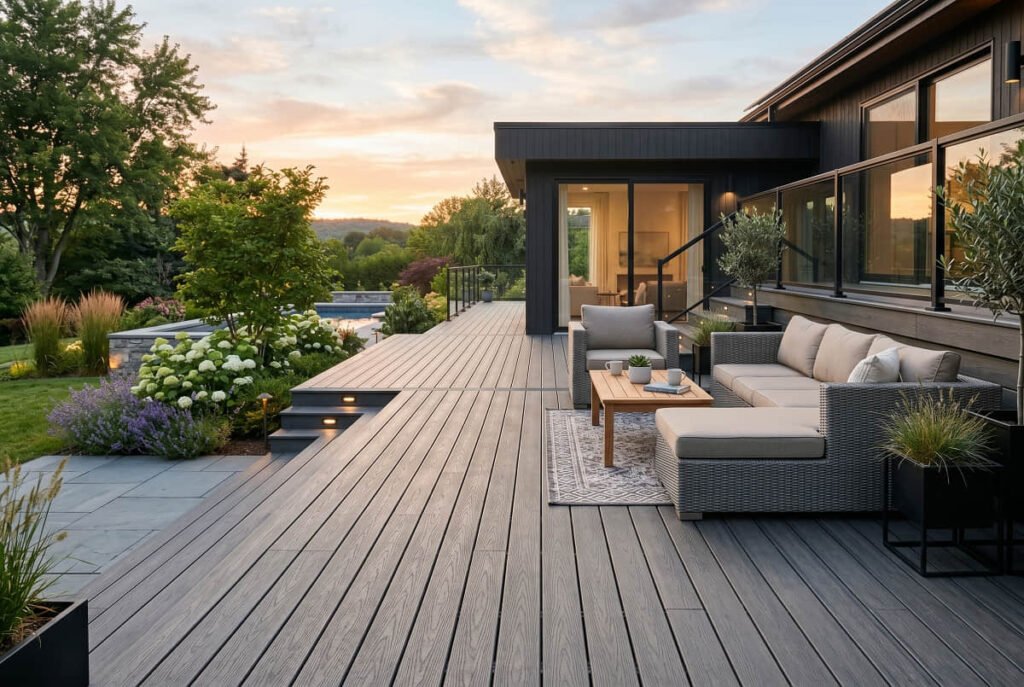
Choose composite decking if:
- The project is a pool surround, coastal build, or humid-climate site
- The client wants low maintenance — no annual oiling
- You’re specifying for a commercial or strata development
- Slip resistance compliance is required (R11 under AS/NZS 4586)
- Sustainability credentials matter to the project or developer
- You’re buying at volume and need a consistent supply across multiple sites
- Custom colours or sizes are needed for a branded development
Choose merbau if:
- The client wants authentic real timber and won’t consider anything else
- The buyer is committed to annual oiling and upkeep
- It’s a small residential job where the entry cost is the deciding factor
- The project is matching or extending an existing merbau structure
Merbau is a strong material in the right hands. If a buyer is disciplined about maintenance and wants a natural timber look, it’s a fair choice. For most commercial projects and low-maintenance builds in Australian conditions, composite decking holds up better over time.
Request free samples to compare look and feel →
FAQ
Can you remove merbau tannin stains from concrete?
Yes, but it takes effort. Commercial tannin removers and oxalic acid-based cleaners can lift fresh stains — the sooner you treat them, the better the result. Stains that have sat for months are much harder to shift, and some discolouration on porous concrete may be permanent.
Does composite decking get hot in the sun?
Like any solid surface in direct sun, composite boards warm up — darker colours absorb more heat than lighter ones. Choosing a light grey or warm brown with a textured surface helps reduce heat underfoot. In shaded or well-ventilated areas, heat build-up is rarely a practical issue.
Can composite boards be installed over an existing timber subframe?
In many cases, yes — but the existing subframe needs checking first. Composite decking requires joist spacing of 300–350 mm centre-to-centre. If the original frame meets that spec and is structurally sound, it can often be reused. Have an installer assess it on-site before committing.
Does composite decking splinter?
No. Composite boards don’t develop splinters over time — the co-extruded cap layer keeps the surface smooth and consistent for the life of the deck. This makes composite the safer choice for bare feet, children, and pets, especially around pool areas.
Can composite decking boards be customised for a project?
Yes — and this is where factory-direct supply makes a real difference. Trade orders can specify custom lengths, colours, surface textures, and board profiles. If a standard size doesn’t suit your project, custom mould tooling is available for unique profiles. Merbau can’t offer that.
The Bottom Line
Merbau timber is a genuine product with a long track record. It earns its place on the right job — a small residential deck, a buyer who loves real timber, a project matching existing boards.
But for most commercial builds, pool surrounds, and coastal projects in Australia, composite decking makes more sense. Lower upkeep, longer lifespan, better slip resistance, and zero tannin bleed. The higher entry price pays back — usually within a few years.
If you’re specifying at volume or looking for a consistent supply partner, the factory-direct model makes composite even more competitive than retail comparisons suggest.
The numbers don’t lie. Run the 15-year cost on your next project and see for yourself.
