

The samples looked good, the price worked, and the sales call went well. Then the container showed up — and the boards didn’t match what you approved.
It happens more than it should. This guide gives procurement managers, distributors, and large contractors a practical framework to vet factory-direct composite decking suppliers before you commit to volume — not after the first bad shipment.
Is Factory-Direct the Right Move for Your Business?
Factory-direct means buying straight from the manufacturer — no importer, no regional distributor, no added markup at each step. For composite decking, that translates to a lower landed cost and a direct line to the people who make the product.
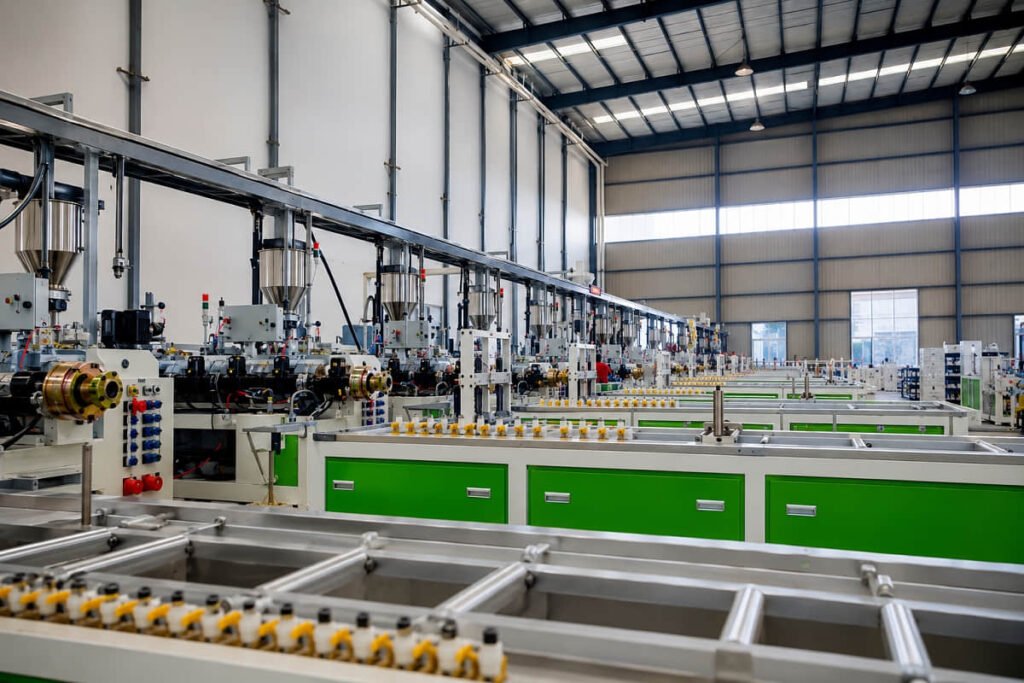
The trade-off is lead time. A full-container order typically takes 45–80 days from order to arrival. That’s roughly 15 days of production, plus 28–35 days of ocean freight to the U.S. West Coast (Los Angeles/Long Beach), or 35–42 days to the East Coast (Savannah/Newark).
Factory-direct works best for distributors building volume replenishment programs and contractors sourcing for large-scale projects. It’s not built for small one-off orders where speed is everything.
The 6-Point Vetting Framework
Here are six things to check before you commit to any composite decking supplier. Run this list on every shortlisted factory — not just the cheapest one.
1. What’s Actually in the Board?
Raw material quality is the foundation. Weak materials lead to boards that fade, warp, or absorb water — and those problems surface after the job is done, not before.
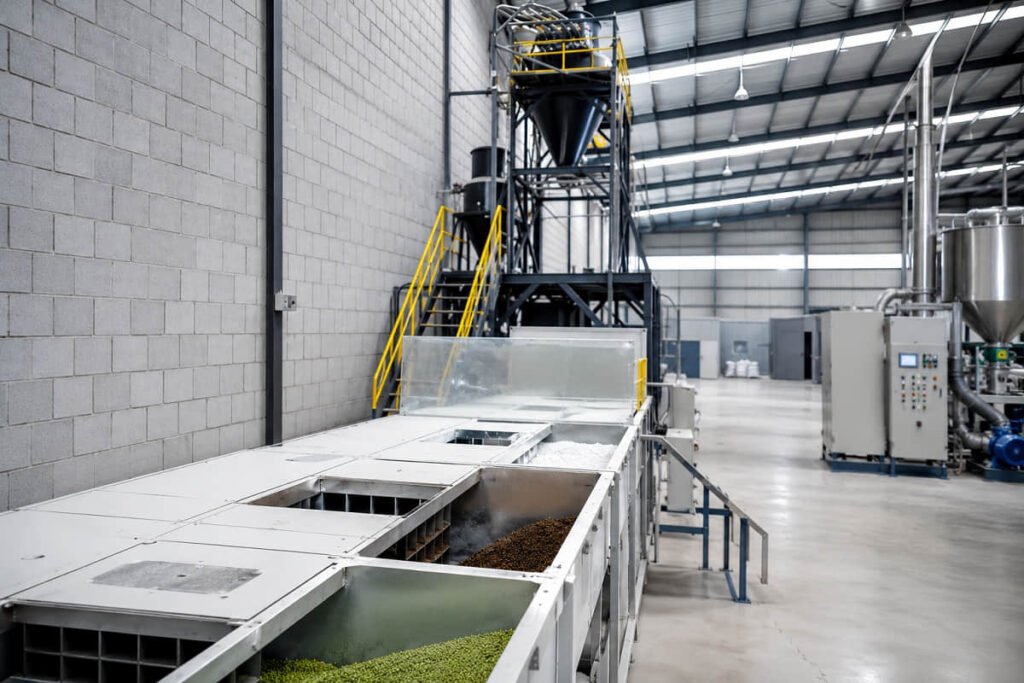
Ask for a material data sheet, not just a product brochure. A credible composite decking manufacturer should confirm all of the following in writing:
- Plastic polymer type — HDPE is the preferred base for outdoor composite decking. PP and PVC composites exist, but HDPE offers better moisture resistance and long-term stability outdoors.
- HDPE density — look for 0.95 g/cm³ or higher.
- Wood fiber content — a 50%–65% wood fiber ratio is standard for quality composite decking boards.
- Recycled content — around 60% is solid. It also matters for LEED project eligibility.
- UV stabilizer system — HALS (Hindered Amine Light Stabilizers) combined with UV absorbers is the benchmark. Vague answers like “UV additives” aren’t enough — ask for the named system.
If a supplier hesitates on any of these, that’s a warning sign. Real manufacturers know their raw materials in detail.
Buyers who’ve switched suppliers mid-program almost always trace the problem back to raw material quality.
2. Is It Capped or Uncapped?
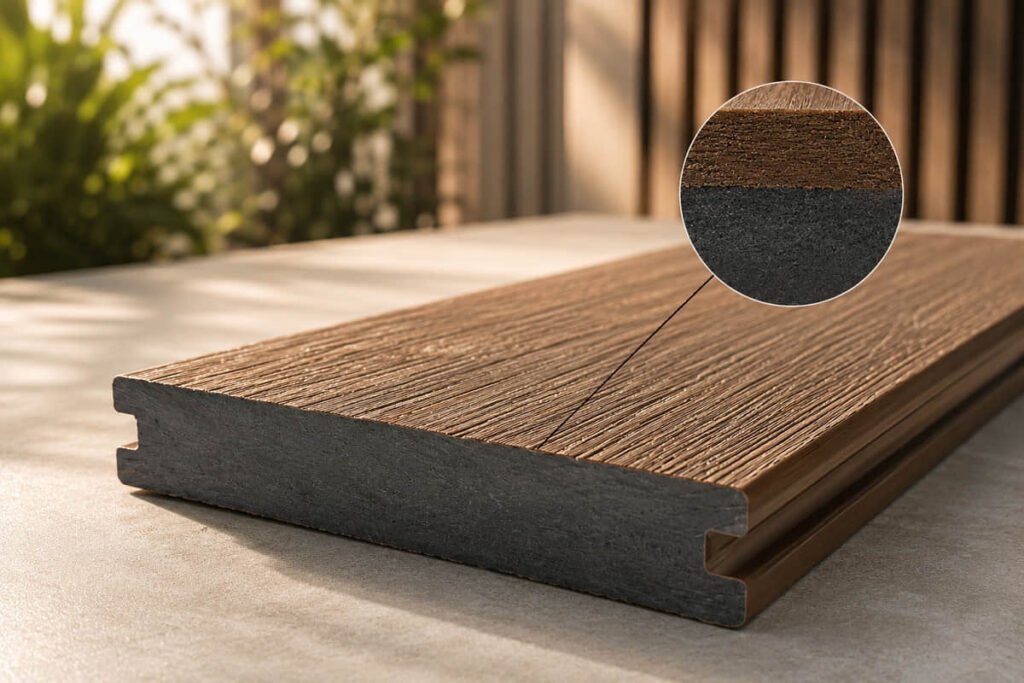
Capped composite decking has a protective outer layer bonded around the core. This cap shields the wood fibers from UV damage, staining, and moisture. Uncapped boards leave the core exposed on some sides — they cost less upfront, but wear faster in harsh weather.
For most U.S. commercial and residential projects, capped (co-extruded) boards are the right call. Ask specifically about cap thickness. A quality cap layer runs about 0.8 mm (31.5 mils). Thinner than that, and UV protection drops off fast.
Also ask for UV aging test data. The standard test is ASTM G154 (QUV accelerated weathering). After 3,000 hours of testing, the color difference — measured as ΔE — should be 5 or less. If a supplier can’t produce this report, you’re trusting their word, not verified data.
This matters in high-UV states: Florida, Texas, Arizona, and California. A composite deck board that looks great in a showroom can fade badly after two Phoenix summers without a proper cap layer.
3. Which Test Reports Should You Request?
Third-party testing is how you verify a supplier’s claims. Don’t accept a self-certified spec sheet — ask for reports from recognized labs: SGS, TÜV, or Bureau Veritas.
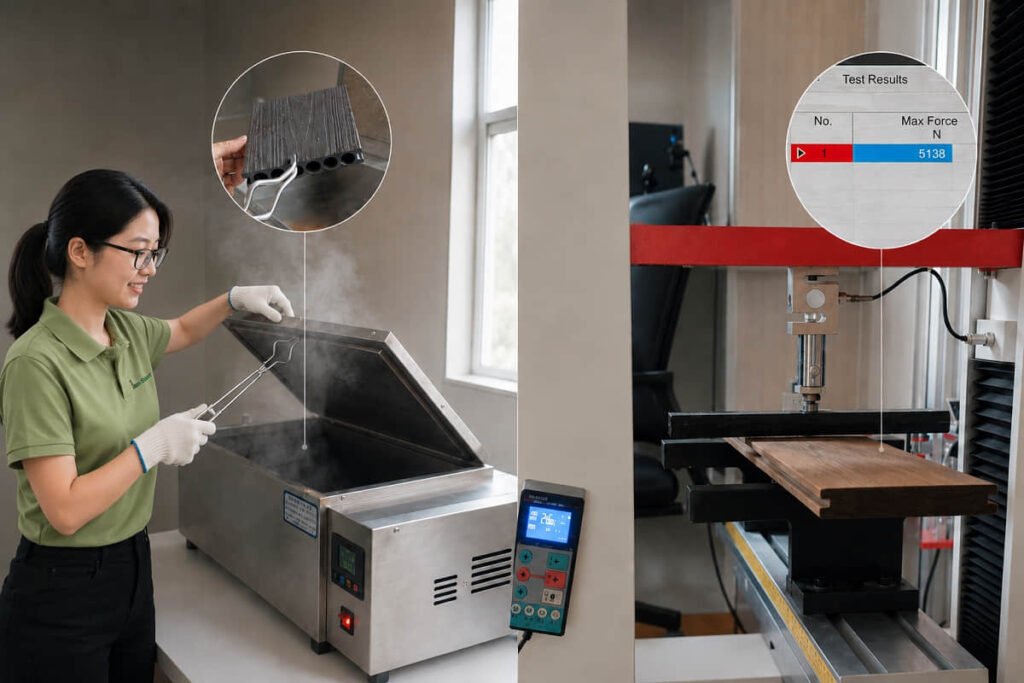
Here’s what to request and what each test tells you:
| Test / Certification | What It Tells You |
|---|---|
| ASTM E84 | Flame Spread Index (FSI) and Smoke Developed Index (SDI). Class A (FSI 0–25) is highest; Class B (FSI 26–75) covers most commercial specs. Class C (FSI 76–200) is acceptable for many exterior applications — verify local code requirements with the AHJ. |
| ASTM D1037 | Water absorption. Look for ≤ 2%. High-quality composite decking boards hit 0.2%. |
| DIN 51130 | Slip resistance. R11 is high — suitable for wet areas, pool surrounds, and ADA-consistent wet surface ratings (DCOF ≥ 0.42). |
| EN 717-1 | Formaldehyde emissions. “Not detected” is what you want. Formal CARB Phase 2 certification is the U.S. standard — ask whether the supplier has it or EN 717-1 data at minimum. |
| CE / ISO / RoHS / SGS | General quality and safety compliance. These don’t replace ASTM-specific tests but confirm the factory operates to international standards. |
| ICC-ES ESR evaluation | The gold standard for U.S. commercial projects. Not all overseas composite decking manufacturers have one, but it strengthens compliance documentation for AHJ approval. |
Some overseas suppliers are still pursuing formal CARB Phase 2 certification. An EN 717-1 “not detected” result is a strong indicator of compliance — but for California commercial projects, verify local requirements with the authority having jurisdiction (AHJ).
4. Can They Handle Your Volume?
Production capacity is a business risk question. A factory with one or two extrusion lines may not hold up when your program scales.
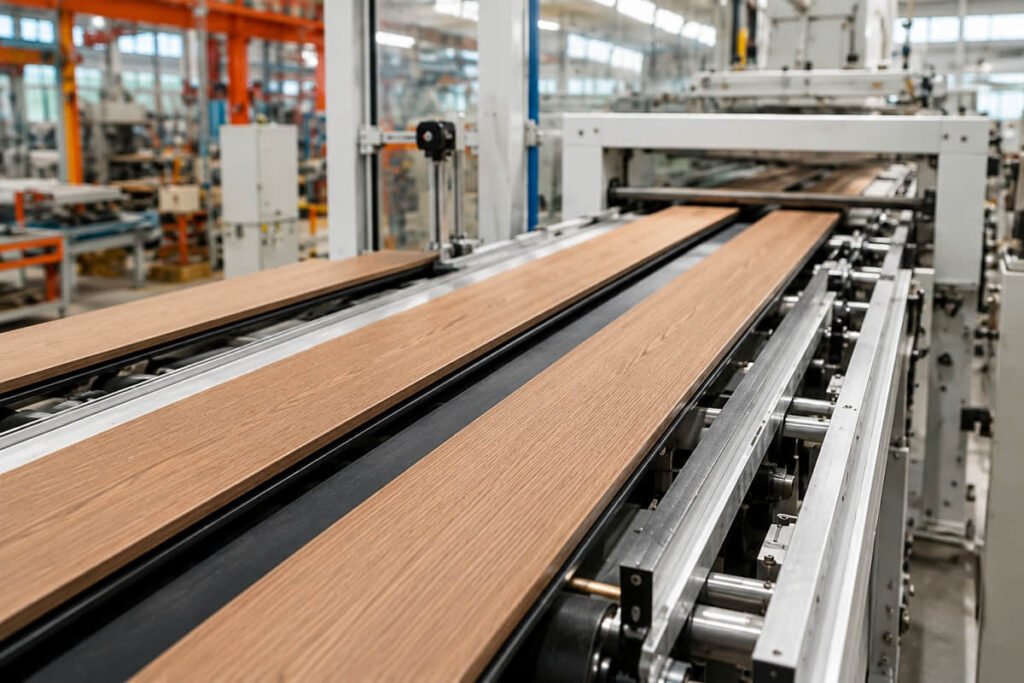
Ask these questions directly:
- How many active production lines do you run?
- What’s the largest single order you’ve fulfilled in the last 12 months?
- What’s your standard lead time per 40′ container?
A well-run factory completes a 40′ container in about 15 days of production. If a supplier quotes three to five days, they’re overstating capacity or clearing slow-moving inventory. Both are problems.
For distributors planning large orders and regular reorders, ask whether the supplier supports a rolling inventory program. That’s how you avoid the feast-or-famine cycle — large orders followed by dry spells while the next container is in transit.
5. Do They Offer Custom Colors and Profiles?
This is one of the strongest reasons to go factory-direct. Most off-the-shelf composite decking lines are fixed — set colors, set profiles, set textures. Every distributor carrying the same brand sells the same board.
A true factory-direct composite decking supplier can offer:
- Custom colors — real color matching with sample lead times of about 5–7 days
- Custom board profiles — modified cross-sections with custom molds
- Custom surface textures — woodgrain, brushed, smooth, or custom-embossed patterns
- Custom lengths — cut to project specs rather than fixed 12 ft or 16 ft runs
Ask any supplier to walk you through a past custom color project: lead time, how samples were approved, and how the production run matched the approved sample. Vague answers here are a red flag.
6. What Does the Warranty Actually Cover?
The headline number isn’t the whole story. Before you use a warranty as a selling point, read what it actually covers.
Many branded warranties look strong on paper — 25, 30, even 50 years on select composite decking products. But most are “limited” warranties — depreciated replacement value, not full board replacement, and claims often flow through a multi-tier distribution chain.
A 15-year factory-direct warranty with a clear claim process and direct manufacturer accountability can be more useful for a B2B buyer than a 25-year limited warranty where remedies shrink over time.
Red Flags to Watch Out For
Run any shortlisted composite decking supplier through this list before you place an order. Two or more flags? Move on.
- Refuses to share third-party test reports — You’re trusting a sales sheet, not verified data.
- Pricing far below every competitor — Low price can mean low-grade raw materials. Ask for a full material breakdown.
- No sample boards available before volume commitment — A real manufacturer can send boards. A trading company often can’t without minimum orders.
- Unrealistically short lead times — A 40′ container quoted at 3–5 days is almost always a red flag.
- Vague answers on raw material sources — “High quality HDPE” isn’t an answer. HDPE density 0.95 g/cm³ is.
- No factory audit option — A confident manufacturer will offer a video walkthrough or in-person visit. A trading company often won’t.
- No written warranty documentation — Verbal warranty promises don’t hold up when you have a real claim.
- Can’t confirm MOQ per color or profile — A manufacturer knows this without asking. A trading company has to “check with the factory.”
That last point is also the easiest way to spot a trading company passing itself off as a manufacturer.
Questions to Ask Before You Order
The six-point framework covers what to look for. These questions focus on what the answers should actually sound like — and flag three areas the framework doesn’t fully cover: shipping terms, warranty claim process, and sampling lead times.
- What are your standard shipping terms — FOB or CIF — and what’s your typical production lead time per 40′ container?
- What does your warranty cover (structural and appearance), and what is the claims process?
- Do you support private-label orders? What is the sampling lead time for a custom color?
- Who will be my dedicated contact for technical issues and after-sales support?
Listen for specifics. If a supplier says “HDPE at 0.95 g/cm³” and “ΔE ≤ 5 after 3,000 QUV hours,” they know their product. If the answer is “our quality is very good,” keep pushing — or move on.
Want to put these questions to our team directly? Talk to our sales team →
How to Compare Pricing Between Suppliers
Price per linear foot is a starting point, not a final answer. Two quotes can look close on paper and land very differently in cost.
FOB vs. CIF: An FOB quote looks cheaper — until you add freight, insurance, and port handling. A CIF quote includes those costs. Compare both on a landed-cost basis, not just the invoice line.
Container size: A 40′ FCL almost always delivers a lower per-unit cost than a 20′. If you’re comparing quotes across container sizes, adjust before you draw conclusions.
Sample evaluation first: Don’t commit to volume on price alone. Request deck boards from any shortlisted supplier and run a side-by-side check — weight, surface texture, edge finish, and flexibility. A board that’s $0.10/linear foot cheaper but fades in two seasons is not a cost saving.
The core price advantage of factory-direct sourcing is the removal of importer and distributor markup. For distributors running regular volume programs, that difference adds up over a full year of orders.
Is It Safe to Order from an Overseas Supplier?
Yes — with the right process in place. Many of the world’s largest building material distributors source directly from Chinese factories. The risk is manageable when you follow a clear process.
Four steps that protect you:
- Verify third-party test reports — Request SGS, TÜV, or Bureau Veritas documentation. Confirm reports are current and cover the specific decking product you’re ordering.
- Start with a trial order — A sample shipment or small container lets you verify quality, lead time, and supplier responsiveness before you scale up.
- Use staged payment terms — A standard structure is 30% deposit on order, 70% before shipment. For larger programs, a letter of credit adds bank-backed security.
- Confirm export documentation capability — Your supplier should handle commercial invoices, packing lists, bills of lading, and certificates of origin without you chasing them down.
Suppliers who offer factory audits — video walkthrough or in-person visit — add another layer of accountability. A factory holding CE, ISO, SGS, and RoHS certifications operates to international standards.
Ready to see the product before you commit? Request free composite decking samples →
FAQ
What is the MOQ for factory-direct composite decking?
Most factory-direct suppliers set a standard MOQ of around 100 sq m (~1,076 sq ft) per product line. Many are open to smaller trial orders for first-time buyers who want to test quality before committing to volume. Sample boards and color swatches are usually available at low or no cost.
How do I know if a composite decking product meets local building codes?
U.S. building codes reference the IRC (International Residential Code) and IBC (International Building Code). Ask your supplier for ASTM E84 fire ratings and any available ICC-ES ESR evaluation reports. For commercial projects, confirm specific requirements with the local authority having jurisdiction (AHJ) before you finalize the spec.
How do I assess a supplier’s after-sales support?
Ask directly: What is the warranty claim process? Who is my dedicated contact for technical issues? A supplier with an assigned account rep and written claim documentation is far more likely to follow through than one that routes you to a generic support inbox.
What’s the difference between a composite decking manufacturer and a trading company?
A manufacturer makes the boards — they can answer technical questions directly, offer factory audit access, and adjust production for custom orders. A trading company resells boards from multiple factories and often can’t verify specs or modify production. The easiest test: ask who makes the tooling for custom profiles. A manufacturer gives you a direct answer. A trading company asks to “check with the factory.”