

Clients ask about composite fencing cost before they ask about anything else. Knowing the numbers — and what drives them — is what separates a confident pitch from a lost sale.
Composite fencing runs $28–$55 per linear foot installed for most residential and light commercial projects. That’s more upfront than pressure-treated wood. But the math changes fast when you factor in zero repainting, no rot repairs, and a product that looks the same in year ten as it did on install day.
This guide breaks down what drives composite fencing pricing, how it compares to wood and vinyl, and what your clients are actually paying for over the life of a fence — not just at the point of sale.
Composite Fencing Cost Per Linear Foot
Material-only composite fencing costs $18–$35 per linear foot, depending on board width, profile type, and supplier. Premium profiles and custom features will run higher than these mid-range figures. Add labor and installation costs and you’re in the $35–$65 range. “Per linear foot” is the standard unit for quoting fencing — it lets contractors and procurement managers price any run length quickly.
Distributors and contractors sourcing factory-direct see a different number on the materials line. There’s no importer margin or reseller markup built in. That difference compounds fast on large orders.
| Fence Style | Material Cost (per linear ft) | Fully Installed (per linear ft) |
|---|---|---|
| Open Slat / Screen | $18–$28 | $35–$50 |
| Semi-Privacy | $22–$32 | $40–$58 |
| Full Privacy | $25–$35 | $45–$65 |
Estimates reflect U.S. national averages for 6-ft fencing. Regional labor markets vary.
Material Cost vs. Fully Installed Price
A composite fence invoice breaks down like this: boards, posts, clips, trim, and labor. Material costs are typically 50–60% of the installed price. Labor covers the rest.
For trade buyers pricing multiple sites, the materials line is the most controllable cost. That’s where factory-direct sourcing has the most impact — no margin stacked on by an importer or domestic reseller.
One thing to factor in: capped composite boards — co-extruded with a protective layer on all four sides — cost more per unit than uncapped profiles. The performance difference is real. Over 30 years, that gap in cap quality changes the whole cost picture.
Cost by Fence Style and Height
Board width drives material cost per linear foot. A narrow open-slat board covers less width per piece than a full-privacy board. You need more pieces to cover the same run — so the material cost goes up.
Fence height adds cost two ways: more boards per panel and heavier posts.
| Style | Typical Board Width | Est. Material Cost / Linear Ft |
|---|---|---|
| Open slat | 3–4 in. (75–100 mm) | $15–$25 |
| Semi-privacy | 6–7 in. (150–175 mm) | $20–$32 |
| Full privacy | 7–9 in. (175–225 mm) | $28–$45 |
Estimates based on U.S. market averages for mid-range capped composite profiles.
Decorative panels add a 10–20% material premium over standard boards. For large runs, sticking with a standard profile cuts both unit cost and lead time.
What Drives the Cost of Composite Fencing?
Several factors move composite fencing costs up or down. Some are controllable. Some aren’t.
Controllable factors:
- Fence style — full privacy fencing costs more than open slat or picket fencing
- Board profile — standard profiles cost less than custom
- Post spacing — closer spacing means more posts per linear foot
- Order volume — larger orders lower the per-unit cost
Factors you can’t control:
- Local labor rates — a big variable in the Northeast, California, and major metros
- Site conditions — slopes and uneven ground push labor costs up
- Delivery — distance from a port or distribution hub adds freight cost
Uneven or rocky ground deserves its own line in the project budget. Most cost guides mention it. Few quantify it. In practice, it can add $5–$15 per linear foot in labor alone — more on hard terrain.
Posts, Gates, and System Accessories
Posts and gates are the most underestimated items in a fencing budget. Plan for them from the start.
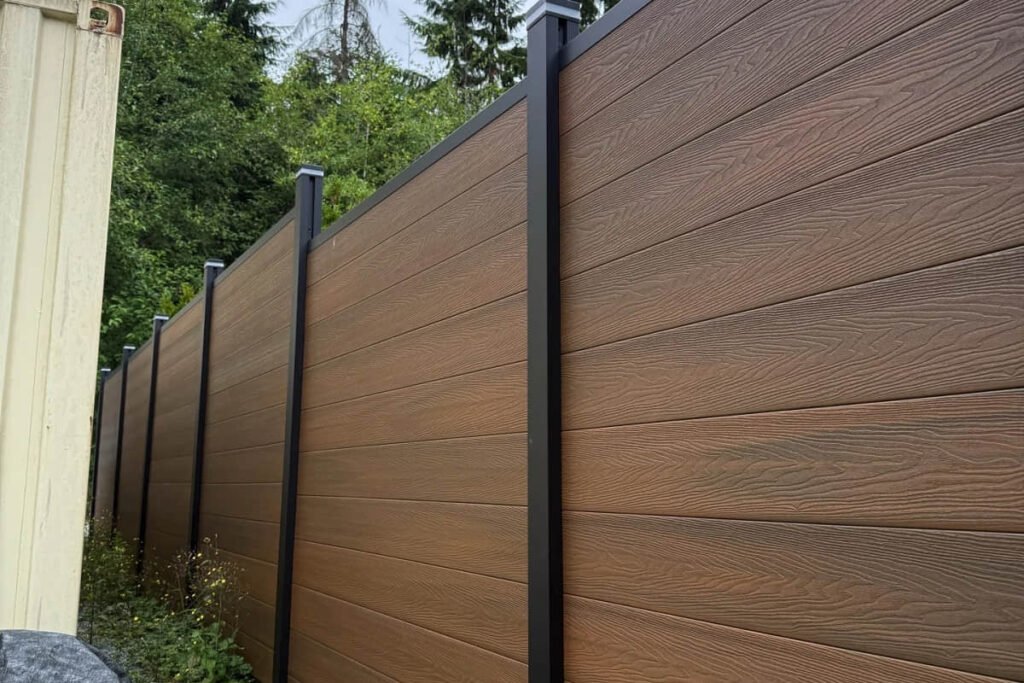
Aluminum alloy posts cost more upfront than WPC posts, but they hold up better in wet climates and coastal zones. A single gate adds $200–$500, depending on width and hardware. On a 150-linear-foot run with two gates, that’s $400–$1,000 before anyone touches a fence board.
Post caps, trim strips, angle brackets, and base skirts are small line items on their own. Together, they add up. A complete system package — boards, posts, clips, caps, and trim in one order — simplifies project costing and avoids mid-project sourcing gaps. LastElegance ships all system components together, so nothing arrives late from a second supplier.
Composite vs. Wood: 30-Year Cost Breakdown
Wood wins upfront. Composite wins every year after around Year 7–10. Here’s what that looks like on a standard 150-linear-foot run of 6-ft privacy fencing.
| Cost Item | Wood (Pressure-Treated) | Composite |
|---|---|---|
| Year 1 Installation | $4,500–$6,750 | $6,000–$8,250 |
| Annual Maintenance (stain/seal) | $300–$700/year | ~$0 |
| Post-Rot Repair (Years 8–12) | $800–$2,000 | Unlikely |
| Full Replacement (Year 15–20) | $5,000–$7,500 | Not needed |
| 30-Year Total (est.) | $19,000–$34,000 | $6,000–$8,250 |
Wood figures based on national averages: installation at $20–$45/linear ft, staining at $300–$700 for 150 linear ft, post-rot repair at $800–$2,000 for 3–5 posts.
Cedar and redwood last longer than pressure-treated pine, so the break-even shifts a bit when comparing against premium wood species. That’s worth saying plainly.
When Does a Composite Fence Pay for Itself?
The break-even point is typically Year 7–10, depending on wood species and local labor rates. After that, savings build with every year of avoided upkeep.
A 150-linear-foot composite fence at $7,000 installed versus wood fencing at $5,500 is a $1,500 gap on the first invoice. Annual wood staining runs $400–$700. By Year 4–5, that cumulative cost closes the gap. Add a wood repair bill at Year 10, and composite is well ahead on total cost.
This is the number to put in front of a client who pushes back on the higher initial investment. The initial cost is higher. The total cost is lower. That’s the case.
Composite also removes the insect damage risk that follows wood fencing — no termite treatment, no annual inspection. What it actually needs for upkeep: a rinse with soapy water once a year, occasional spot cleaning, and a check that post bases drain properly. No staining, no sealing, no painting. For contractors managing multi-unit projects, that means fewer call-backs and a simpler maintenance story to pass to property managers.
Composite Fencing vs. Vinyl, Aluminum, and Chain-Link
vs. Vinyl Fencing
Vinyl fencing typically runs $20–$40 per linear foot installed — slightly less than composite on the first invoice. That’s a real difference. But it comes with trade-offs worth knowing.
Vinyl becomes brittle in sub-zero temperatures. That’s a genuine issue in Minnesota, Wisconsin, and upstate New York. Composite doesn’t carry that risk. Vinyl also has less structural integrity under wind load, and its plastic appearance works against commercial and multi-family specs where aesthetic appeal affects property value.
| Factor | Composite | Vinyl Fencing |
|---|---|---|
| Installed Cost | $25–$55/linear ft | $20–$40/linear ft |
| Cold-Weather Performance | Strong | Risk of brittleness |
| Structural Integrity | Higher | Lower |
| Aesthetic Appeal | Natural wood look | Plastic appearance |
| Long-Term Upkeep | Minimal | Low |
For light residential work on a tight budget, vinyl is a reasonable choice. For commercial and multi-family specs where long-term performance matters, composite is the stronger call.
vs. Aluminum Fencing
Aluminum typically runs $25–$40 per linear foot installed and is common on commercial sites. It’s durable and low-maintenance, but it offers no privacy — most aluminum profiles are open-rail designs. Composite matches aluminum on lifespan, adds full privacy capability, and delivers better aesthetic appeal on projects where curb appeal is part of the spec.
vs. Chain-Link Fencing
Chain-link is the lowest-cost option — often $10–$20 per linear foot installed. It’s functional, but it offers no visual privacy and minimal aesthetic appeal. A composite privacy fence replaces chain-link on any project where appearance or privacy is part of the brief — multi-family developments, commercial yards, and hospitality properties.
How Trade Buyers Can Lower Their Cost Per Linear Foot
Four practical levers.
1. Buy factory-direct. Domestic retail brands carry importer and reseller margin in their pricing. That markup doesn’t improve the product — it just raises the cost. Sourcing direct from a manufacturer like LastElegance removes it. The standard MOQ is 100 sq m (approx. 1,076 sq ft) per product line — workable for a single project run or a small stocking program.
2. Choose standard profiles. Custom profiles cost more and take longer. Standard widths — 90 mm, 160 mm, 180 mm — ship faster and cost less per unit. Unless a project spec calls for custom features, standard is the right call.
3. Minimize offcut waste. Plan board runs against your total linear footage before ordering. Offcuts add material costs without adding output. The 3,000 mm (roughly 9 ft 10 in.) standard board length works well across common fence panel heights with minimal waste.
4. Consolidate orders. A 40-ft container takes about 15 days production plus 28–35 days ocean freight to the U.S. West Coast. Consolidating multiple sites into one container drops per-unit freight cost and simplifies logistics. Build a replenishment cycle and composite fencing installation lead time stops being a pain point.
Contact our sales team to discuss volume pricing and container planning.
FAQ
How do I know if a composite fencing quote is fair?
Compare line by line: board profile, cap layer thickness, post material, and whether accessories are included. A quote that looks cheap per linear foot may be pricing uncapped composite boards or leaving out posts and trim. Ask whether the price covers capped or uncapped composite — and check whether the system accessories are bundled in. That’s how you make an informed decision before committing to a supplier.
What are the downsides of composite fencing?
The two honest trade-offs are higher upfront cost vs. wood fencing and thermal expansion — composite moves with temperature swings, so correct gapping during installation is non-negotiable. LastElegance’s 15-year warranty is shorter than some domestic brands, but it reflects a factory-direct model: comparable product technology at a lower cost, backed by the manufacturer. For most commercial and multi-family projects, neither trade-off outweighs the long-term savings.
Are there big price differences between composite fence brands?
Yes — and the gap is mostly explained by supply chain structure, not material quality. Domestic retail brands carry importer and reseller margin. Factory-direct suppliers offer the same co-extruded composite technology at a lower landed cost. When comparing brands, check cap layer thickness, UV inhibitor type, and warranty terms — not just the per-linear-foot sticker price.
How does composite fencing hold up in extreme weather?
It handles both heat and cold well. In high-UV climates — Texas, Arizona, Florida — the co-extruded cap layer and HALS UV stabilizer lock in color, tested to 3,000 hours of QUV aging with minimal color shift. In cold climates, composite doesn’t become brittle the way vinyl fencing does. For high-wind zones, use tighter post spacing: 32″–40″ on center.
What are the lead times for a container order to the U.S.?
A 40-ft container runs about 15 days production plus ocean freight — roughly 45–55 days total to the West Coast, longer to the East Coast. The most reliable way to avoid project delays is to build a replenishment cycle with your supplier rather than ordering run-to-run. Contact our team to map out a stocking program.
Ready to price a project or set up a supply program? Contact our sales team — we’ll work through specs and lead times with you.