

Labor is one of the biggest line items on any cladding job. For contractor teams managing tight budgets, a system that cuts install time — without cutting corners on quality — changes what’s possible on a project.
Composite siding does that. The clip-based interlocking system most co-extruded boards use means no face nailing, no specialty blades, and no field painting. A two-person crew familiar with the system can move fast on a standard wall.
This guide is written for contractors and building teams handling their own installs. It covers wall prep, clip installation, cutting around openings, and the mistakes that cost the most time on site. Follow the steps in order, and you’ll get a clean, lasting result.
Tools and Safety Gear You’ll Need
Have everything on site before the first panel goes up. Running back for gear mid-install kills your schedule.
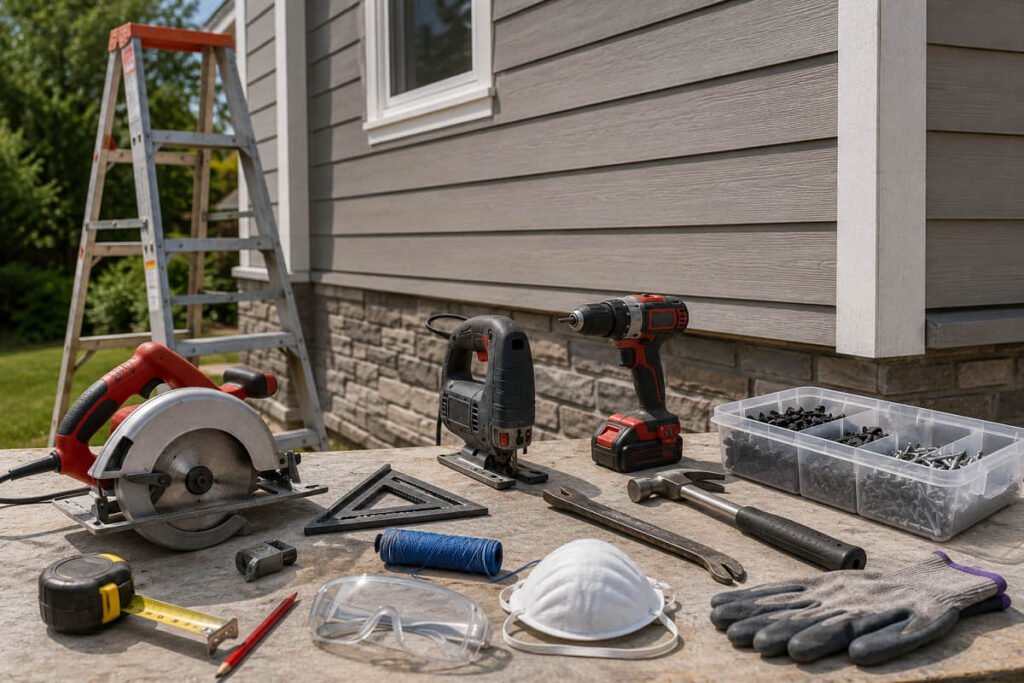
Cutting and measuring:
- Circular saw with a fine-tooth blade (60–80 teeth) — no specialty blades needed, unlike fiber cement
- Tape measure, pencil, and speed square
- Chalk line for snapping level baselines
- Jigsaw for curved cuts around vents and electrical outlets
Fastening:
- Drill/driver
- Hammer for the starter strip and corner posts
- Clip fasteners (typically provided with the boards)
- Corrosion-resistant screws
Safety gear:
- Safety glasses — always, no exceptions
- Dust mask — composite generates fine dust when cut, though far less than fiber cement (no silica, no wet cutting required)
- Work gloves
- Ladder rated for your working height — follow standard ladder safety protocols and stay clear of overhead power lines
- Pry bar if you’re removing old siding first
Composite doesn’t need a respirator or a wet-cut setup. Most cuts can be made on sawhorses at ground level. On a tighter job, that alone saves real hours.
How to Prep Your Walls
Wall prep is the step crews rush — and the one that causes most long-term problems. A bad substrate leads to buckled panels and moisture getting in behind the cladding. Take the time here.
Remove Old Siding
Start at one end of the wall and work across in order. Use a pry bar to pull panels free and remove fasteners as you go. Clear debris before moving to the next section.
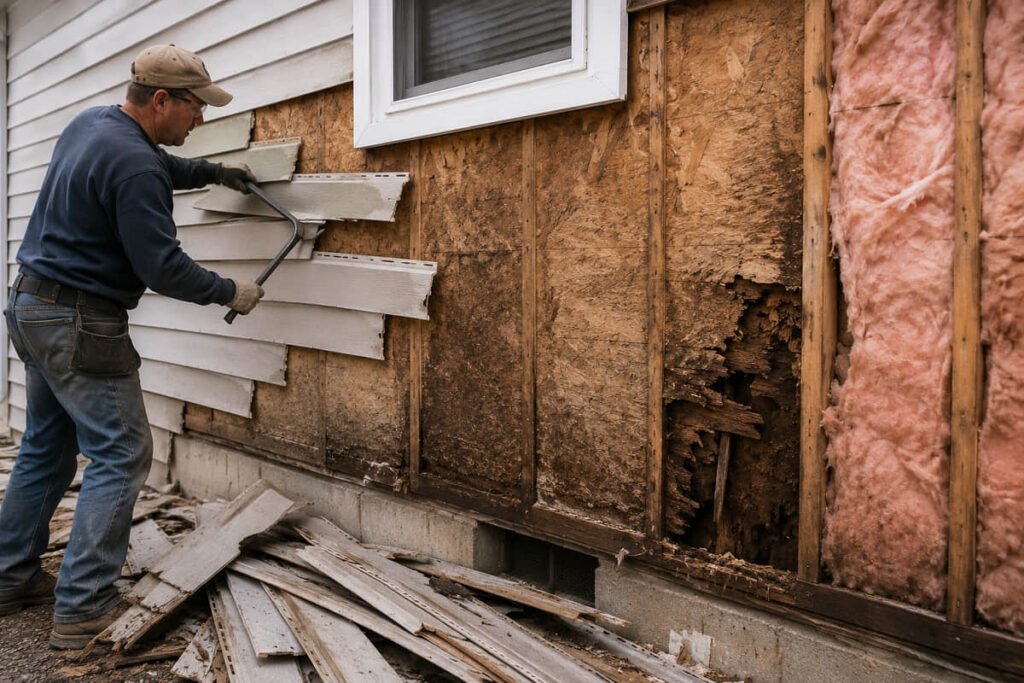
For stubborn sections — older wood boards nailed tight or panels that have shifted — a reciprocating saw cuts through nailing flanges cleanly. Don’t force the pry bar on a section that won’t move. You’ll damage the sheathing behind it.
Once the old siding is off, inspect the wall closely. Press on the sheathing to check for soft spots. Look for signs of moisture damage, rot, or pest activity. The IRC requires the substrate to be flat, nailable, and structurally sound before new exterior cladding goes up. Replace any damaged sections now — not after the new siding is on.
Fix Sheathing and Add a Moisture Barrier
Replace damaged sheathing with OSB (strand board) or plywood. Fasten it into the wall studs — not just the existing framing — so it won’t shift. Get the surface flat before you move on.
Then install a weather-resistive barrier (house wrap). Overlap seams by at least 6 inches and tape them with seam tape. Seal around every window, door, and wall penetration. This is a building codes requirement in most U.S. jurisdictions — and it’s what stands between your sheathing and long-term water penetration.
For a clip-based composite siding system installed over steel battens, the batten layer creates a natural rain screen gap between the WRB and the cladding. That gap lets the wall breathe and drain. It’s why this system handles moisture better than direct-to-substrate installs.
Step-by-Step Composite Siding Installation
Fastening specs and gap tolerances vary by brand — always check the manufacturer’s installation instructions for the specific product you’re using. The steps below reflect a clip/interlocking system installed over a steel batten subframe.
Mark Your Level Line and Install the Starter Strip
This is the most critical accuracy step in the whole job. Snap a chalk line level baseline around the full perimeter of the wall. If this line is off, every course above it is off. There’s no fixing it mid-job without pulling panels back down.
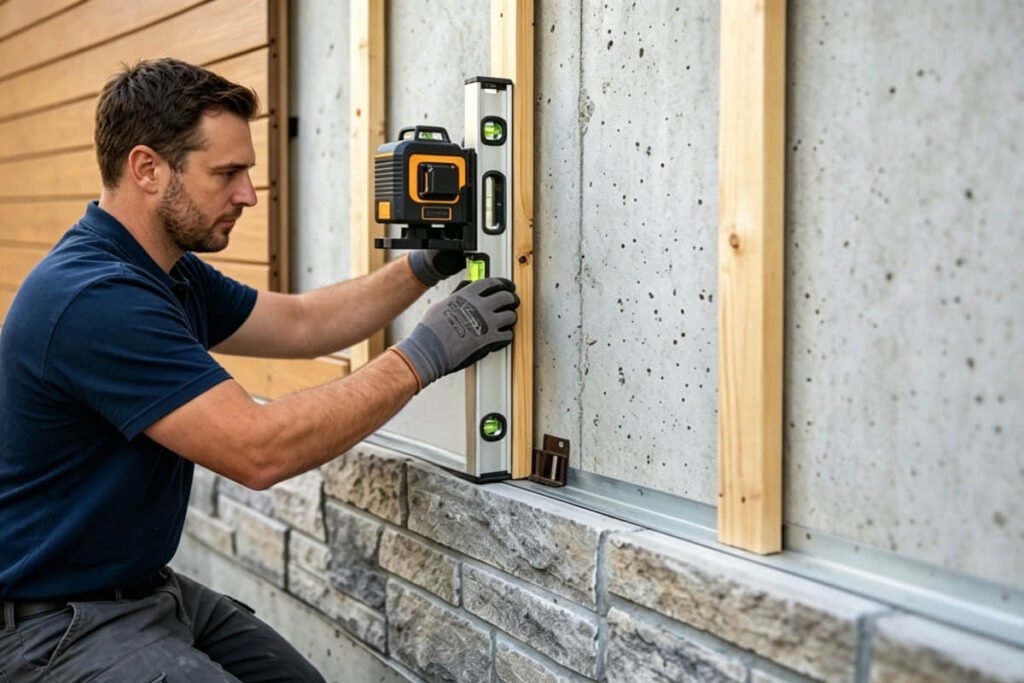
Nail the starter strip along the line every 8–16 inches, hitting solid backing on every fastener. For a subframe system, match your batten spacing — battens at 12″–16″ on center. Leave a small gap between the nail head and the strip so it can expand in heat. Don’t drive nails home tight against the strip face.
Check alignment with a level at multiple points before you move on. This step takes ten minutes. Skipping it costs hours.
Set Corner Posts and J-Channel
Place corner posts at every inside and outside wall corner. Use a level or plumb bob and fasten them into the framing studs — not just the sheathing. Fastening to sheathing only is a wind resistance problem, especially in hurricane-prone or high-wind states.
Install J-channel around all window and door openings. Leave at least a ¼-inch gap inside each channel for the panel to expand and contract. This is one of the most skipped details in composite siding installation — and leaving it out causes buckling in hot climates.
Get all corner posts and trim pieces fully set and plumb before any panels go up.
Hang the Siding Panels
Start at the bottom of the wall. Lock the first panel into the starter strip, then secure it through the clip system. The clip slides into the board’s side groove and fastens to the batten or stud behind it. No face nailing. No exposed fasteners.
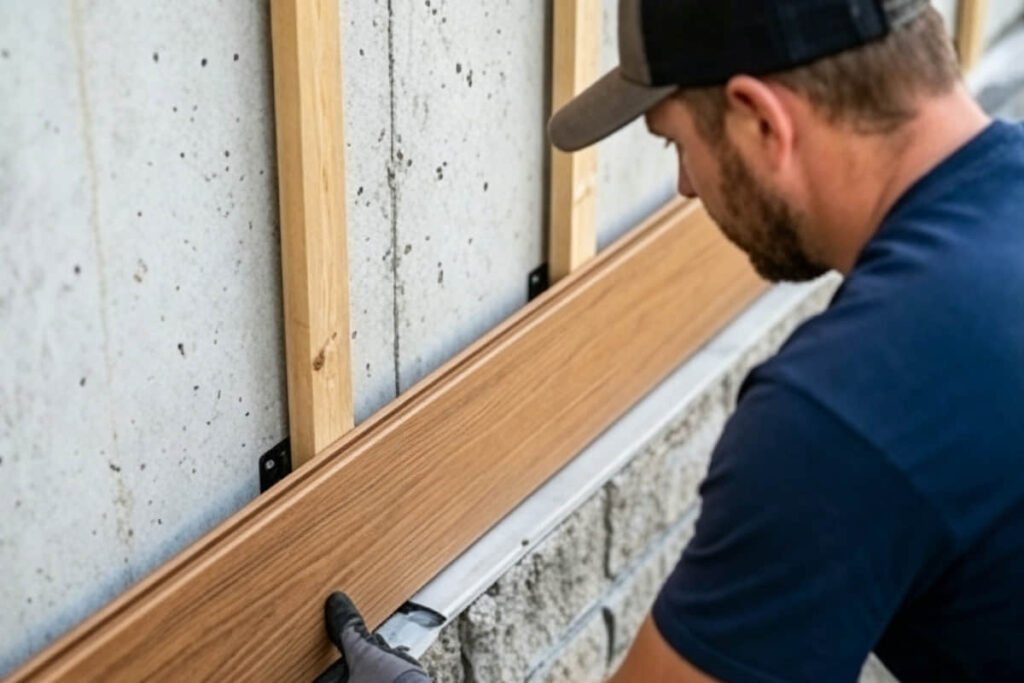
The next panel’s bottom edge locks into the top of the previous one. That male-female interlocking profile creates a seamless course and keeps all fasteners hidden from view. Check levelness every 3–4 courses — don’t wait until you’re ten courses up to find a drift.
Stagger new siding panels seams by at least two stud bays — 32 inches minimum on 16-inch on-center framing. Vertically aligned seams create a weak point in the wall and look wrong on a finished job.
The clip system handles thermal contraction and expansion without extra steps. Boards move slightly within the clips, so you don’t need to gap each panel side to side manually.
Want to see the system before placing an order? Request free composite siding samples and we’ll get them out to you.
Cut Around Windows and Doors
Measure each opening before you cut. Use your fine-tooth circular saw — composite cuts cleanly with a sharp blade. Make precise cuts: a clean edge at a window opening defines the finished look more than almost anything else on the wall.
Leave a ¼-inch expansion gap inside the J-channel on all four sides of every opening. That small gap handles thermal contraction across seasons. Don’t caulk it tight.
Around electrical outlets, dryer vents, light fixtures, and hose bibs, use J-blocks or custom-cut trim pieces in the matching board color. Order these with your boards if you can — matching color locally is harder than it sounds.
Horizontal vs. Vertical: Which Should You Use?
Horizontal installation is the standard for lap siding. It suits most styles and is what most crews know well.
Vertical board and batten is gaining fast in both residential and commercial builds. It works well as a decorative accent on feature walls too. For a vertical layout, calculate the total wall width and divide by the panel reveal width. Split any remainder evenly across the first and last panel — this centers the layout so both ends look proportionate. It’s a pro detail that clients notice when it’s done wrong.
Both orientations use the same batten spacing and clip-fastening method. No change to the subframe setup.
Apply Final Trim and Seal the Gaps
Install utility trim under the eaves and at all wall terminations. Then go around the full perimeter with exterior caulk — everywhere new siding meets another material (window casing, door trim, fascia). These transitions are where water gets in when crews rush.
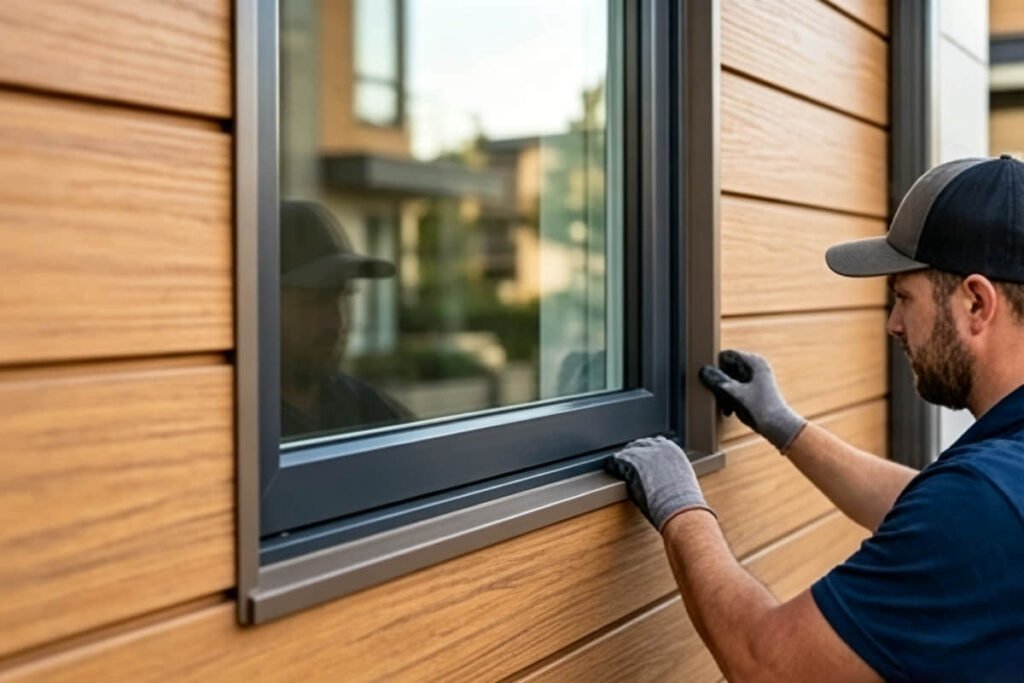
Do a full walk-around before calling it done. Check panel alignment. Look for unseated clips. Confirm all trim pieces are tight. A magnet sweep for dropped fasteners is a small step that earns points on the final walkthrough. For a full breakdown of the install mistakes that cause the most callbacks — and how to fix them — see our guide: common composite siding installation mistakes and how to avoid them
When to Handle Installation In-House
For smaller contractor teams, bringing installation in-house makes sense on the right job. Composite siding with a clip-based system is one of the more accessible cladding systems available — no silica dust, no specialty cutting tools, no field painting, and lighter boards than fiber cement.
Our distributors in coastal and Sun Belt states consistently tell us the same thing: their crews get up to speed on the clip system fast, and the absence of face nailing alone cuts install time on a standard wall.
A two-person crew can handle a straightforward single-story job well. The main skill requirements are accurate leveling, correct expansion gapping, and a basic read of local building codes. For experienced crews, those aren’t a high bar.
Some projects are better left to specialists. Multi-story buildings, complex wall geometry — dormers, angles, multiple material transitions — and commercial jobs with formal code sign-off all reward experience. For commercial projects, check IBC requirements alongside the IRC. LastElegance composite siding carries an ASTM E84 Class C fire rating (Flame Spread Index: 85, Smoke Developed Index: 300). That’s suitable for most exterior applications — but always verify with your local Authority Having Jurisdiction (AHJ) for the specific project type.
Safety glasses and a dust mask apply to every crew on every job, regardless of scale.
Composite Siding vs. Vinyl and Fiber Cement
For contractors evaluating a switch, install experience matters as much as the material.
| Composite | Vinyl | Fiber Cement | |
|---|---|---|---|
| Install method | Clip/interlocking, no face nailing | Nail-flange, face nailing | Nail-flange, face nailing |
| Tools required | Fine-tooth circular saw | Standard saw | Diamond-blade saw, specialty equipment |
| Field painting needed | No | No | Yes (most brands) |
| Weight per linear ft | ~1.2–2.0 lb/ft | Light | Heavy (~2.5–3.5+ lb/ft) |
| Expansion handling | Built into clip system | Manual gapping required | Manual gapping required |
| Moisture resistance | Excellent (cap layer + WRB) | Good | Good when paint is intact |
| Cold-weather performance | Strong | Can become brittle | Strong |
| UV / color stability | Strong — ΔE ≤ 4–5 after 3,000 hrs QUV | Moderate | Depends on paint |
Composite wins on install speed vs. fiber cement — no silica precautions, no wet cutting, no respirators, no field painting. It stays rigid in cold weather where vinyl siding can become brittle and crack during cuts. The clip system removes face nailing entirely, which cuts install time and removes a point where water can enter.
These are category-level comparisons. Specific products vary — always verify specs for the product you’re evaluating.
What Does Composite Siding Installation Cost?
Labor for composite siding installation typically runs $6–$13 per sq ft in the U.S., depending on wall complexity, region, and crew rates. Total installed cost — labor plus materials — generally lands between $10–$25 per sq ft.
Material cost varies a lot by brand and sourcing. Factory-direct supply cuts out the distribution markup built into domestic-brand pricing. On large-volume projects, that difference adds up fast.
The cost view that matters most for project planning isn’t purchase price vs. vinyl. It’s the 10–15 year picture. Composite siding needs no painting, no staining, and no rot repairs. In wet climates or along the coast, where exterior wood demands constant care, that changes the math on a job’s total cost — and on how often your clients call you back with problems.
For LastElegance composite siding pricing, contact our sales team directly. Volume, custom specs, and project scope all shape the final number.
FAQ
What are the disadvantages of composite siding?
Composite costs more upfront than vinyl, and installation requires more care than a basic nail-flange vinyl system. The ASTM E84 fire rating is Class C — suitable for most exterior residential and commercial applications, but confirm your local AHJ’s requirements for the specific project type before specifying.
How does composite siding handle thermal contraction and expansion?
The clip system manages side-to-side movement automatically. For end-to-end expansion, leave a ¼-inch gap at all J-channel penetrations and never caulk panel ends tight. In high-heat climates, let boards acclimate on site for 24 hours before you start.
Is composite siding cheaper than vinyl siding?
Composite costs more per sq ft at purchase. Factor in 10–15 years with no painting, no rot repairs, and no replacement, and the gap narrows fast. For buyers sourcing direct from the manufacturer rather than through domestic brand distribution, material cost can come in well below the typical retail composite price.
Does composite siding require any special maintenance after installation?
No. Periodic cleaning with soap and water is all it needs to stay looking good. No painting, staining, or sealing required — and it won’t rot, warp, or attract termites.
What commercial building code requirements apply to composite siding?
The IRC covers residential projects; the IBC applies to commercial work. An ASTM E84 Class C rating is acceptable for most exterior applications, but some occupancy types or jurisdictions require Class A or B. Always confirm with your local AHJ before specifying for a commercial project.
What fasteners should I use for composite siding installation?
For a clip-based system, use the corrosion-resistant clips provided with the boards — no face nails needed. For nail-flange systems, use hot-dipped galvanized or stainless steel nails that reach at least ¾ inch into wall studs. Always follow the manufacturer’s installation instructions for the specific product.