

Repainting a weatherboard facade every 7–10 years sounds manageable on a single house. On a medium-density project or a commercial build, that maintenance cycle becomes a real cost — and often a client complaint.
Composite cladding removes that cycle. No painting, no sealing, no rot checks. This guide breaks down where composite wins, where weatherboard still makes sense, and how the two compare on cost, durability, and fire compliance.
What Is Weatherboard Cladding?
Weatherboard cladding is a system of boards fixed horizontally to a building’s exterior. Each board overlaps the one below, directing rainwater away from the wall structure. In Australia, it’s one of the most common external cladding systems on homes.
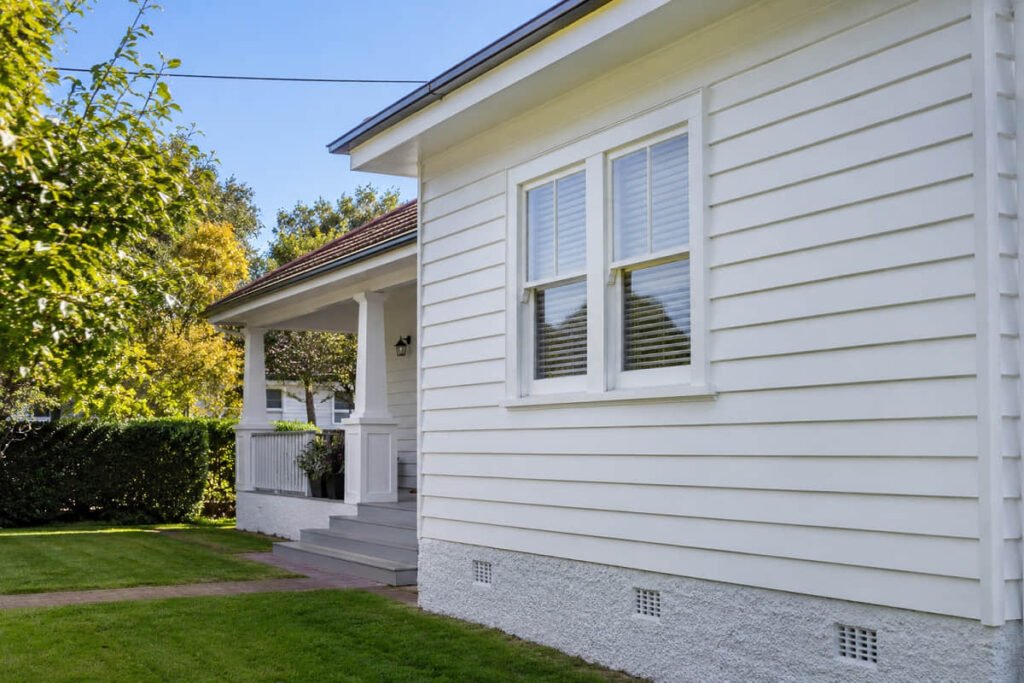
The category covers three main material types. Natural timber — hardwood species like spotted gum, blackbutt, or merbau — is the original and still widely used. Fibre cement boards use a cement matrix reinforced with cellulose fibres. And composite weatherboard profiles use wood fibres bound in HDPE — a newer option that fits the same horizontal-board format. In Australia, “weatherboard” historically meant timber weatherboards. Today it’s a broader category.
Composite Cladding vs Weatherboard: The Key Differences
The comparison isn’t always composite versus timber. Composite cladding can be installed in a weatherboard profile — horizontal boards, with the same look on the facade. The real question is how composite boards stack up against traditional timber or fibre cement on performance and cost over a building’s life.
Here’s how they differ across the five things trade buyers care about most.
How Each Material Is Made
Timber weatherboards are milled from hardwood or softwood logs. Performance depends on species, drying method, and treatment. Fibre cement boards blend Portland cement with cellulose fibres — dense, non-combustible, and heavy.
Composite cladding takes a different approach. Wood fibres sourced from hardwood are blended with HDPE at a density of 0.95 g/cm³, then co-extruded with a 0.8mm cap layer for UV and moisture protection. Our boards contain 60% recycled content, with the remaining 40% virgin material for structural consistency.
That cap layer is what separates a quality composite board from a cheaper one. At 0.8mm, it’s thicker than many comparable products — and it’s what holds colour and protects the wood fibre core from water and UV over the long term.
Profiles, Colours, and Design Options
Colour and surface finish work differently across these three materials:
- Natural timber: Real grain, real warmth. Requires paint or stain from the start — repaintable to any colour, but needs ongoing upkeep.
- Fibre cement: Paintable surface — flexible on colour, no integral finish. Repainting is ongoing.
- Composite cladding: Colour runs through the board and the cap layer — no paint needed. Available in multiple textured finishes, shared across our decking and cladding range for a cohesive exterior design.
Composite boards are available in horizontal closed-board profiles that read visually like traditional shiplap weatherboard. For most new builds and commercial facades, the result is close enough — without the paint cycle.
One note for heritage work: if a project sits in a heritage overlay zone, check with the local council before specifying composite. Some councils require authentic materials on period facades. Confirm it early — it’s easy to miss in the brief.
Durability in Harsh Australian Conditions
Australia has one of the world’s highest UV indexes. That’s hard on any cladding material — but it hits timber the hardest.
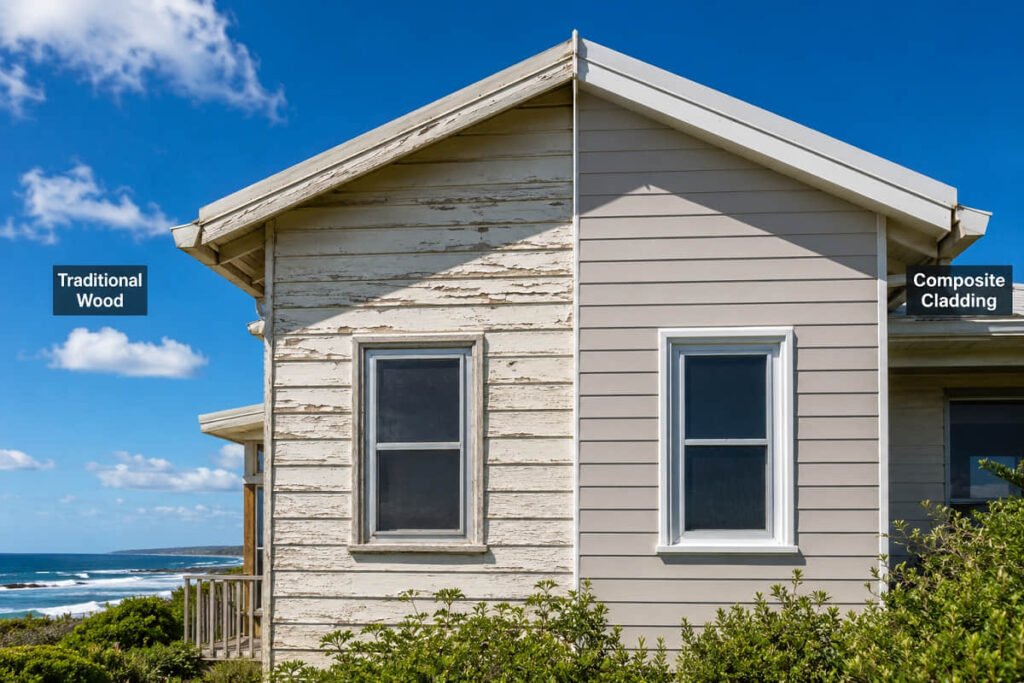
Untreated timber greys and cracks without regular protective coatings. In coastal Queensland or the NT, you can see visible surface wear within two or three seasons without maintenance. Fibre cement holds up better, but still needs regular painting to prevent moisture ingress at cut edges.
Composite cladding is built for high-exposure conditions. Our boards are tested under QUV accelerated weathering — after 3,000 hours, colour change is held to ΔE ≤ 4–5. That’s a slight shift at most, measured under conditions far more intense than normal sun exposure.
The HALS + UV absorber system in the cap layer does this work. HALS (Hindered Amine Light Stabilisers) interrupt UV damage at the molecular level. Combined with UV absorbers in the cap, it outperforms surface coatings applied to timber.
For thermal movement: composite boards expand and contract with temperature, but at a controlled rate. Our male-female interlocking clip system accounts for this — boards aren’t rigidly fixed, so thermal movement doesn’t cause buckling or joint failure over time.
Termites, Moisture, and Coastal Conditions
Termites are a real risk for timber cladding across Queensland, NT, WA, and coastal NSW. Composite cladding contains no organic material termites can consume. There’s nothing to eat — the risk doesn’t apply.
Water absorption tells a similar story. Our composite boards record 0.2% water absorption under ASTM D1037 testing. That’s near zero. Natural timber absorbs and releases moisture constantly with humidity changes — this is what drives swelling, cracking, and rot in poorly maintained boards.
Composite cladding resists:
- Termites and insect damage
- Moisture and rot
- UV degradation
- Salt air (no metal components in the board itself)
For coastal builds, that last point matters. Salt air speeds up corrosion in metal weatherboard systems. Composite boards don’t corrode — they hold their structural integrity across coastal conditions without extra treatment or sealing.
Composite Cladding vs Weatherboard: What Maintenance Does Each Material Need?
Over a 15–25 year period, the maintenance gap is significant. Here’s how it looks in practice:
| Task | Timber Weatherboard | Fibre Cement | Composite Cladding |
|---|---|---|---|
| Repainting | Every 5–10 years | Every 10–15 years | Not required |
| Sealing | Every 3–5 years | Not required | Not required |
| Termite inspection | Annual | Not required | Not required |
| Rot / crack check | Annual | Occasional | Occasional |
| Wash-down | As needed | As needed | As needed |
Timber weatherboard needs the most attention. A repaint every 5–10 years sounds manageable on a single house — but on a commercial building or a volume residential project, it adds up fast in labour and materials.
Composite boards need an occasional wash-down with water. That’s it under normal conditions.
One honest point: not all composite boards are equal. Cap layer quality varies between suppliers. A thin or poorly bonded cap will fade faster. Check QUV test data before you specify — ask for ΔE results at 3,000 hours. If a supplier can’t provide them, that’s a flag.
Cost Per m² — Upfront Price and Long-Term Value
Composite cladding costs more upfront than timber weatherboard. That’s the honest starting point. But over a 10–20 year building lifecycle, the picture shifts.
| Material | Upfront cost (per m²) | Repaint cycle cost (per m²) | 10-year total (est.) |
|---|---|---|---|
| Timber weatherboard | $80–$120 | $25–$45 per cycle | $130–$210+ |
| Fibre cement | $90–$140 | $20–$35 per cycle | $130–$195+ |
| Composite cladding | $120–$180 | $0 | $120–$180 |
These figures are indicative ranges based on publicly available Australian building materials pricing and contractor rate data. Your actual costs will vary by project scale, region, and contractor rates. But the pattern holds: once you factor in one or two repaint cycles, composite often lands at or below the 10-year total for timber.
Factory-direct supply removes importer and reseller margins. That’s how we keep composite cladding competitive at the trade level — not by cutting product quality. The price gap builders expect is often smaller than the actual quote.
Ready to see real numbers for your project? Request a Quote, and we’ll work through the figures with you.
Fire Safety and NCC Compliance
For any project in a BAL-rated zone or on an NCC-compliant commercial building, fire performance needs to be verified before you specify.
Is composite cladding fire resistant? Our composite cladding is tested under ASTM E84, recording a Flame Spread Index (FSI) of 85 and a Smoke Developed Index (SDI) of 300. These results give a baseline fire performance reference for the product.
For any project, check two things:
- The site’s specific Bushfire Attack Level (BAL) under the National Construction Code
- Whether the product’s fire test results meet the requirements for that BAL level and building class
Timber weatherboard fire performance in BAL zones depends on species, treatment, and profile. Fibre cement is non-combustible and well-suited to higher BAL zones. Composite cladding sits between the two. Verify against NCC requirements for your specific site and building class — don’t rely on a supplier’s general statement.
Get the test report, check it against the NCC, and confirm with your certifier. That’s the right process for any cladding material.
Where Can You Use Composite Cladding?
Composite cladding works across more uses than most buyers expect.
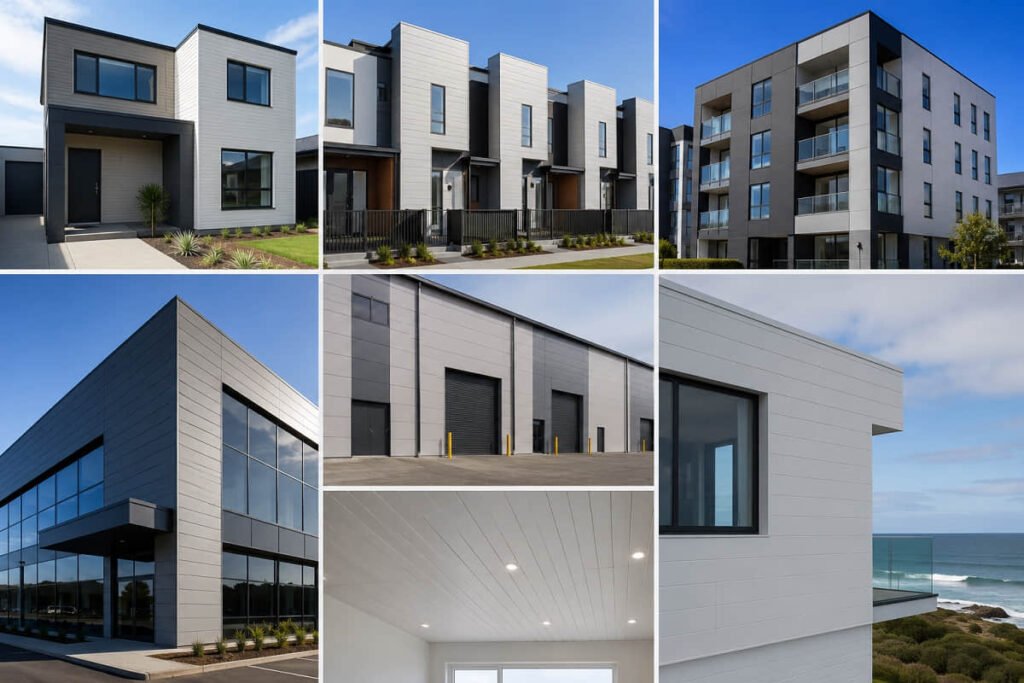
Where composite cladding can be used:
- External walls on new residential builds — houses, townhouses, medium-density projects
- Commercial building facades — offices, retail, industrial, hospitality
- Cladding over existing substrates — steel batten subframe at 300–400mm spacing fixed over existing walls
- Ceiling applications — lightweight boards suit interior ceiling cladding
- Coastal and high-UV sites — UV-stabilised cap layer handles exposed exterior conditions
Natural timber and fibre cement are mainly external materials. Composite’s near-zero formaldehyde result opens the door for interior applications — feature walls, ceiling cladding, hospitality interiors — where timber or fibre cement wouldn’t normally be specified.
Installation uses steel battens at 300–400mm spacing. The male-female interlocking clip system means no surface screws — the facade stays clean, and the fixing is concealed.
Which Should You Choose for Your Project?
Each material has a home. Here’s where each one makes sense.
Choose natural timber weatherboard if:
- Authentic natural material is a design or heritage requirement
- The project is in a heritage overlay zone that requires real timber
- Upfront cost is the main driver and the client accepts the maintenance cycle
Choose fibre cement weatherboard if:
- The project is in a bushfire-prone zone with a BAL rating that requires non-combustible cladding
- A paintable surface with flexible colour is the priority
- Budget sits between timber and composite
Choose composite cladding if:
- Long-term maintenance cost matters — residential or commercial
- The project is in a coastal or high-UV area
- Consistent colour retention is part of the specification
- The project includes interior feature walls or ceiling applications
- You want a 15-year product warranty, backed by factory-direct supply
For builders and distributors sourcing at volume, factory-direct composite supply means you’re not paying for multiple layers of margin. That makes composite a real option for developers who build at scale and care about lifecycle costs.
Want to see the product before you commit? Request Free Samples — we’ll get them out so you can assess colour, texture, and finish in your conditions.
Frequently Asked Questions
Does composite cladding need painting?
No. Composite cladding has integral colour throughout the board, and a co-extruded UV-resistant cap layer — no painting or sealing is required. A periodic wash-down with water is all the care it needs under normal conditions.
How long does composite cladding last?
A quality composite cladding board carries a 15-year warranty. In practice, well-maintained composite cladding in Australian conditions can perform well beyond this — cap layer quality and UV stabiliser grade are the key factors.
Is composite cladding better than fibre cement weatherboard?
They serve different needs. Fibre cement is heavier, paintable, and well-suited to bushfire-prone zones with specific BAL requirements. Composite cladding is lighter, needs no painting, and resists termites and moisture better — making it lower maintenance over the building’s life.
What are the environmental benefits of composite cladding?
Composite cladding contains 60% recycled material — recycled HDPE and wood fibre — reducing demand for virgin timber. Its long service life also means less replacement and less material waste compared to timber weatherboard over a building’s lifetime.
Can composite cladding be installed over existing weatherboards?
In most cases, yes. Composite cladding fixes to a steel batten subframe at 300–400mm spacing, which can be attached over existing walls. A builder should assess the substrate condition and check that the added wall thickness meets NCC requirements for the project.
Does composite cladding improve a building’s thermal performance?
Composite cladding itself doesn’t function as insulation — but it creates an external protective layer that works alongside wall insulation to support thermal performance. For projects where energy efficiency is a key NCC requirement (Section J), discuss subframe and insulation configuration with your builder or certifier.