

Every fence callback eats your margin — rust at the joins, faded boards, warped panels. Composite fencing costs more upfront than metal. But over 20 years on an Australian project, the total cost often flips. Here’s how both materials compare for builders: lifespan, upkeep, true cost, and install speed.
What Is a Composite Fence?
Composite fencing blends wood fibres with HDPE plastic to form tough, weather-ready fence panels. The best composite products add a co-extruded cap layer — a UV-stable shell bonded to all sides of the board. That cap is the key. It locks out moisture and slows colour fade, even under harsh Australian sun.
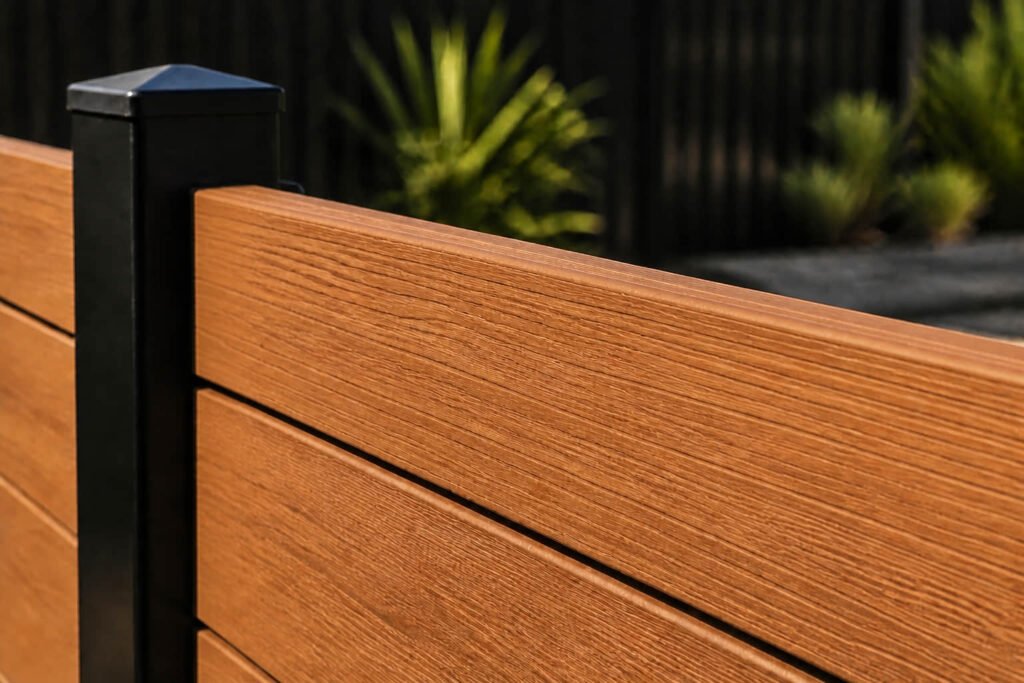
A few numbers show why composite materials hold up. LastElegance composite boards score just 0.2% water absorption (ASTM D1037) and an R11 anti-slip rating (AS/NZS 4586). UV inhibitors built into the cap layer keep colour stable for years, not months.
Composite fence panels come in closed, semi-open, and open profiles — so one board system can deliver full privacy or a light, airy screen. For a deeper look at specs, materials, and board profiles, see the full composite screening panels guide →
Metal Fences in Australia
Not all metal fencing is the same. Most Australian buyers have already ruled out wood fences — too much upkeep. The question now is which non-timber option fits best. In Australia, three types of metal fence dominate.
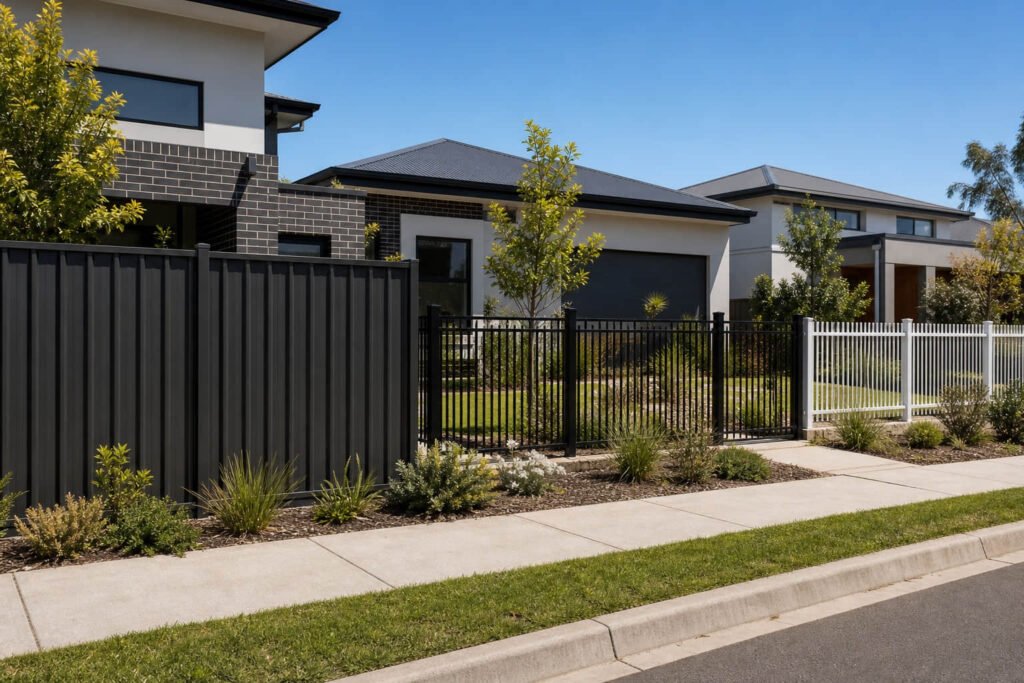
Colorbond steel is the most common metal fence in Australian suburbs. It’s pre-coated steel sheet fixed to steel posts — solid, private, and relatively low cost. Colours are set by the manufacturer’s range, and the finish relies on an intact paint layer to resist rust.
Standard steel fencing covers tubular steel, pool fencing, and welded panel systems. It’s strong and suits high-traffic or security sites. But bare or powder-coated steel needs regular upkeep, especially near the coast. Scratches expose raw metal, and salt air speeds up corrosion fast.
Aluminium fencing resists rust better than steel because aluminium doesn’t corrode the same way. Aluminium fences are lighter, easier to handle, and often used for pool surrounds and front boundaries. The trade-off: aluminium posts and rails dent more easily, and the look stays distinctly metallic.
For most Australian projects, the real comparison is composite vs Colorbond. That’s where the differences matter most.
Which Fence Lasts Longer?
Both materials last — but how they age is different.
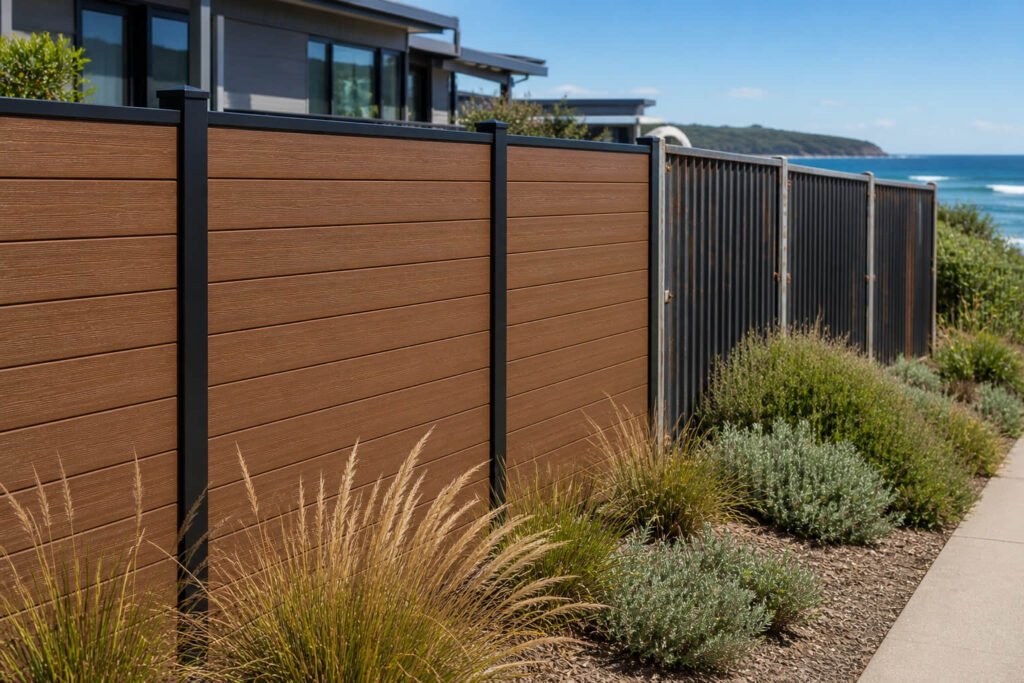
Metal fences, when well maintained, can last 20–40+ years. Colorbond and aluminium sit at the top of that range. Standard steel is shorter-lived unless you stay on top of repainting. The main risk is corrosion: once the coating breaks down, rust sets in quickly.
Composite fences typically last 15–25+ years, depending on the product grade. There’s no rust, no rot, and no termite damage — the structural integrity of the board doesn’t depend on a surface coating staying perfect.
The honest picture? Well-maintained aluminium can outlast budget composite. But a good capped composite board will outlast standard steel in coastal or humid conditions, with far less effort.
| Fence Type | Expected Lifespan | Main Ageing Risk |
|---|---|---|
| Composite (capped) | 15–25+ years | Colour fade, thermal movement |
| Colorbond steel | 25–40+ years | Coating damage → rust |
| Aluminium | 25–40+ years | Denting, powder coat wear |
| Standard steel | 15–25 years | Rust, corrosion in coastal zones |
How Each Fence Handles Weather
Australia’s harsh weather conditions test every fence material differently. Here’s what to expect.
UV and heat. Composite boards with a proper cap layer resist UV fade well. Our products are tested to 3,000 hours of QUV accelerated ageing, with colour shift held to ΔE ≤ 4–5. Metal handles heat without warping, but dark Colorbond panels get hot to the touch in summer — a factor near pools and play areas.
Coastal salt air. This is where composite wins clearly. Composite materials don’t corrode. Steel fences, even powder-coated ones, can rust through at scratches and joins in salty air. Aluminium holds up better on the coast, but still needs the coating checked.
Moisture and insects. Composite is rot-proof and termite-proof. That 0.2% water absorption means the board barely soaks up water at all. Metal doesn’t rot, but trapped moisture behind Colorbond sheets can cause framing issues over time.
Thermal expansion. Composite boards do expand and contract with temperature changes. Budget uncapped boards can bow or warp over time — that’s where most complaints come from. Capped composite with a full co-extruded shell is far more stable, because the cap layer controls moisture uptake and reduces uneven swelling. Correct post spacing (0.8 m–1.4 m, never more than 1.6 m) lets boards move without stress.
Fire. Metal is non-combustible — a clear advantage in BAL-rated bushfire zones. Our composite boards are tested to ASTM E84 (Flame Spread Index: 85, Smoke Developed Index: 300). For projects inside designated BAL zones, check your NCC requirements — metal may be mandatory.
Upkeep: Composite vs Metal
This is one of the biggest real-world differences between the two.
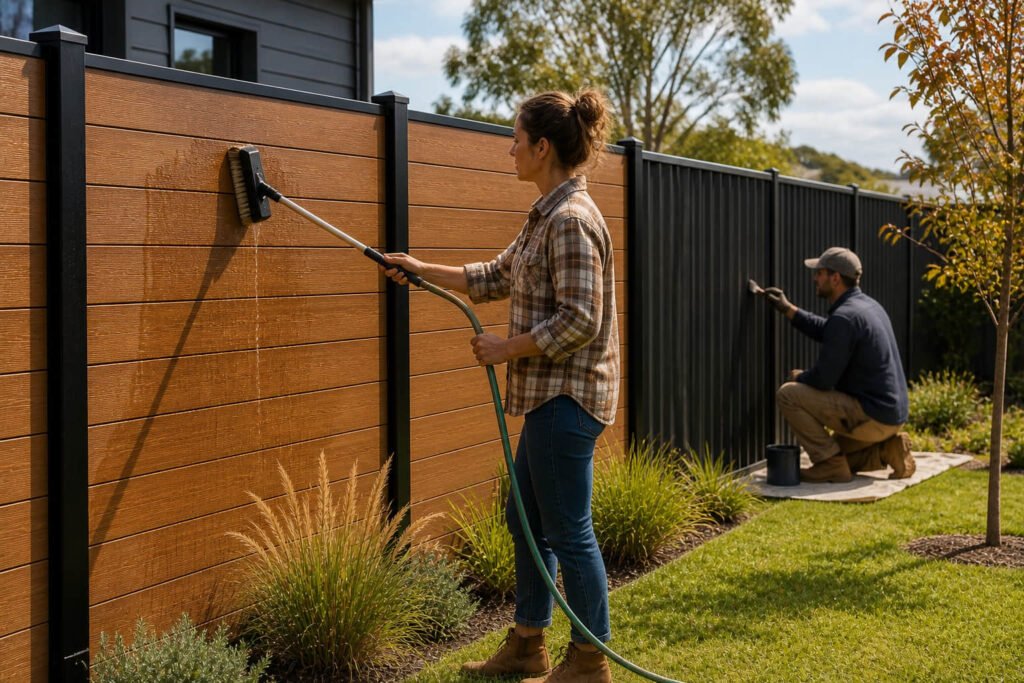
Composite fencing is low maintenance — not zero maintenance. Here’s what care looks like in practice:
- Clean once or twice a year — a garden hose and soapy water is enough. A soft brush handles stubborn marks.
- Check clips and fixings — a quick visual check after winter or heavy storms. Tighten anything loose.
- Look for mould in shaded spots — composite can grow surface mould in damp, shaded areas. A mould wash sorts it out. It doesn’t damage the board.
That’s it. No painting. No staining. No sealing. No sanding.
Metal fences need more. Colorbond holds up well for years. But once the coating chips or a screw rusts, you need to sand back and repaint — or the damage spreads. Steel fences near the coast need regular rust checks. Aluminium is the lowest-maintenance metal option, though the powder coating still wears down over time.
Five years in, a composite fence still looks close to day one. A steel fence in a coastal area? It’ll likely show rust at fixings and edges unless you’ve kept up with touch-ups. Our distributors along the Queensland coast report the same pattern across projects.
Cost: Upfront and Long-Term
Let’s talk money — because the upfront price doesn’t tell the full story.
Composite fencing has a higher upfront cost than standard Colorbond or basic steel. Depending on the project, expect composite to run roughly 15–30% more per linear metre in materials alone. That initial cost is real, and it’s the first thing most buyers notice.
But the long-term picture shifts. Metal fences carry ongoing costs: repainting every 5–10 years, rust repair, and — for steel — earlier replacement in tough conditions. Composite has almost no ongoing cost beyond occasional cleaning. Over a 20-year window, the total cost often evens out or tips in composite’s favour.
| Cost Factor | Composite | Metal (Colorbond / Steel) |
|---|---|---|
| Upfront material cost | Higher | Lower |
| Ongoing maintenance | Minimal (cleaning only) | Moderate (paint, rust repair) |
| Replacement cycle | 15–25+ years | 15–40 years (varies by type) |
| 20-year total cost | Lower to comparable | Comparable to higher |
| Labour costs (install) | Lower (clip system, no welding) | Moderate (post concreting, cutting) |
One more factor matters: buying from a manufacturer cuts out reseller markups. That keeps the price gap smaller than you’d expect. LastElegance manufactures in-house, so trade partners get factory-direct pricing without extra markups layered on.
For project-specific pricing on composite screening, request a quote direct from our team →
Style, Design and Curb Appeal
Metal fences do the job. Composite fences do the job and look good doing it.
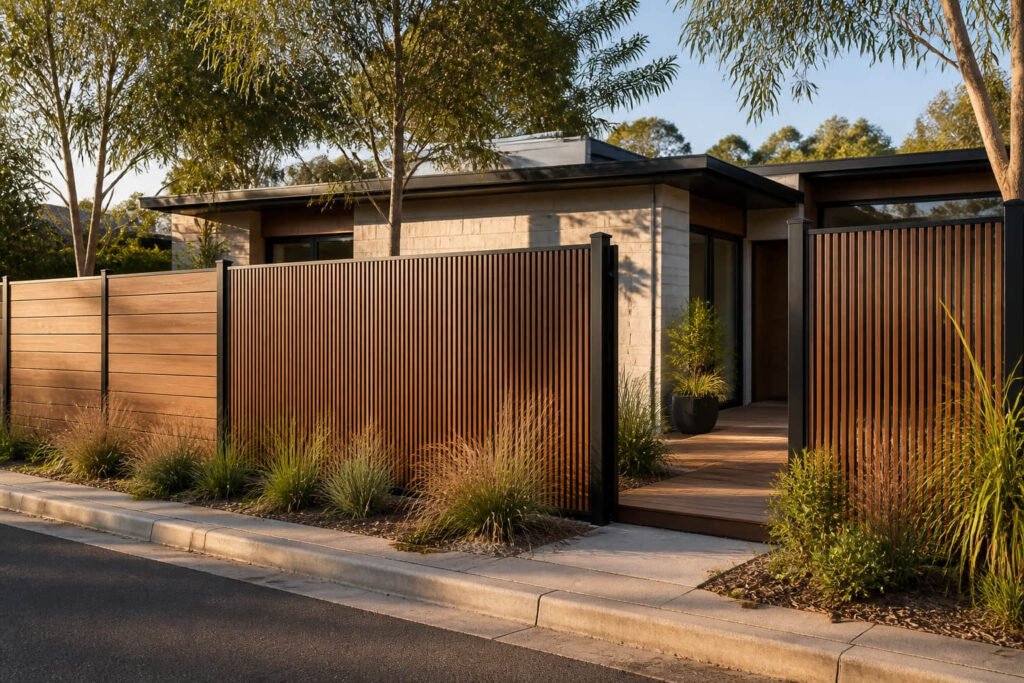
Colorbond comes in a fixed colour range — mostly neutral tones. The panels are flat, uniform, and functional. They suit suburban boundaries and backyards, but they don’t offer much for designers.
Aluminium fencing gives you more colour options through powder coating, but it still looks like metal. The aesthetic appeal is clean and modern, but it’s limited to rails and pickets — no warm, textured finishes.
Composite screening opens up a different range of styles. The boards have a natural wood grain texture that gives the look of wood without the upkeep of traditional wood fencing. You can install them in closed, semi-open, or open layouts — all from the same system. That flexibility matters on projects where the fence is a design feature, not just a boundary.
Our screening range shares the same colour palette and surface textures as our decking products. That means you can match your fence to your deck across a project — a detail that designers and architects notice. The range includes various styles and colours suited to both classic and modern looks.
One more factor: solid composite panels reduce street noise better than open picket or tubular metal fences. For boundary fences near roads, that extra sound dampening can lift both comfort and property value — a real selling point for residential projects.
[INSERT: Photo showing composite screening in a residential landscape design, ideally colour-matched with composite decking]
Want to see the colours and textures in person? Request free samples →
For the full product range and board profiles, visit the composite screening collection →
Which Fence Gives More Privacy?
Composite wins here — and it’s not close.
Standard metal fences (aluminium picket, tubular steel) give you almost no privacy. They’re open by design. Colorbond is the exception — it’s fully private — but you get zero airflow and no design variation.
Composite fence panels let you control the gap. Install boards tight for full privacy. Space them for a semi-open look with airflow. Or go wide for a decorative open screen. One board system, three levels of privacy.
Our Vista panels come in 90 mm and 160 mm widths, so you can fine-tune the balance between privacy and light. See the full Vista range for width options →
How Installation Differs
For builders, install method affects labour costs, timelines, and callbacks. Here’s how the two compare.
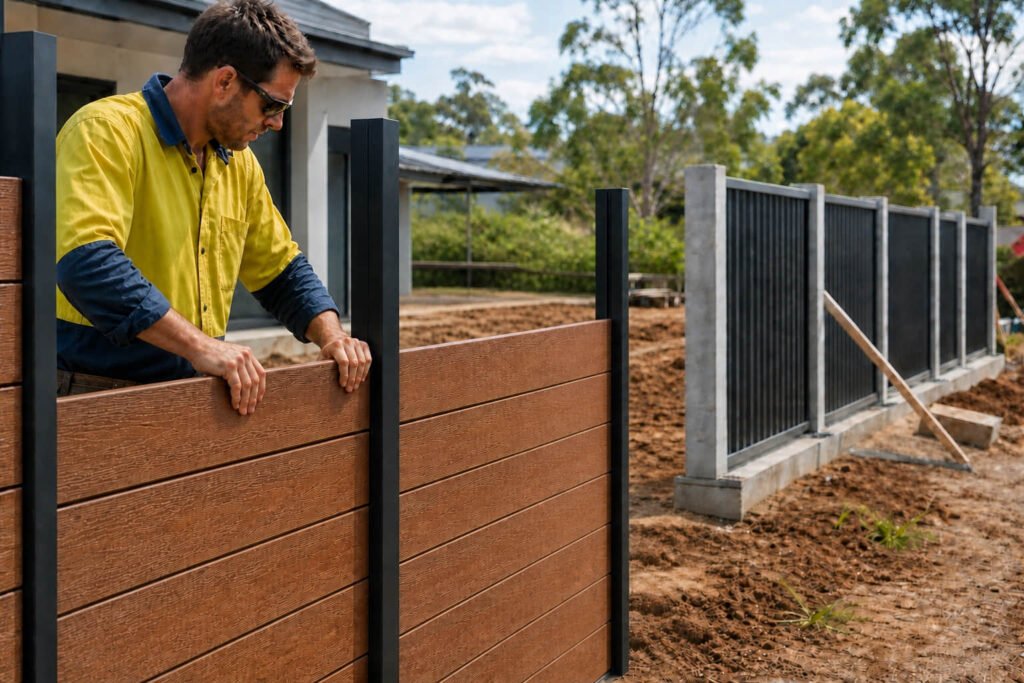
Composite fencing uses a clip-in system. Boards slot into posts with fasteners — no welding, no painting on site. We supply a complete kit: top and bottom trims, angle brackets, clip fasteners, post caps, and edge trims. Two people can handle it with standard tools. Post spacing sits at 0.8 m–1.4 m, which also drives wind resistance.
Metal fencing needs post holes, concrete footings, and often on-site cutting or welding. Colorbond panels are fairly quick to install if posts are already set, but the posts themselves take longer. Steel and aluminium fences may need specialist tools or a welder on site. Sourcing rails, panels, and posts often means dealing with multiple suppliers.
The practical result: composite installs faster, with fewer trades and fewer trips. That means lower labour costs per linear metre and less room for error. For projects where speed and simplicity matter, composite has a clear edge.
Composite vs Metal at a Glance
Here’s the full comparison in one table.
| Factor | Composite Fence | Metal Fence |
|---|---|---|
| Lifespan | 15–25+ years | 20–40+ years (type dependent) |
| Maintenance | Low — occasional cleaning | Moderate — repaint, rust repair |
| Upfront cost | Higher | Lower |
| Long-term cost | Lower (minimal upkeep) | Higher (ongoing maintenance) |
| Style options | Wide — wood grain, colours, textures | Limited — flat panel or picket |
| Privacy control | Full, semi-open, or open | Full (Colorbond) or none (picket) |
| Weather resistance | Excellent — no rust, rot, or insects | Good — but coatings degrade |
| Fire rating | ASTM E84: FSI 85, SDI 300 | Non-combustible |
| Install method | Clip-in system, no welding | Post concreting, cutting, welding |
| Warranty (LastElegance) | 15-year screening warranty | Varies by brand |
| Slip rating | R11 (AS/NZS 4586) | N/A |
Which Fence Suits Your Project?
Neither material is the right choice for every job. The best fence material depends on the site, the design brief, and the client’s priorities. Here’s a quick guide to help you decide.
When Composite Is the Right Pick
Choose composite fencing when the project calls for:
- A natural-wood look without the upkeep. Composite gives you the warmth and texture of real wood — but none of the staining, sealing, or rot risk that comes with wooden fences. It’s a popular choice for streetscapes and front boundaries.
- Flexible privacy. Closed, semi-open, or open — same board, same system. No other fence material gives you that range from one product.
- Termite and rot resistance. In areas prone to insect damage, composite removes the risk entirely. No chemical treatment needed.
- Colour matching with decking. Our screening and decking share the same palette — useful when the fence and deck need to work as one design.
- Custom specs. We offer custom lengths, colours, textures, and surface profiles — manufactured to order, not pulled from a fixed catalogue. That’s peace of mind for projects with tight design briefs.
Composite fences suit residential builds, commercial fit-outs, hospitality projects, and anywhere low maintenance and design flexibility are priorities.
Ready to explore composite for your next project? Talk to our sales team →
When Metal Is the Better Fit
Be honest: metal wins in some cases.
- Bushfire zones. In BAL-rated areas, metal fencing may be required under NCC rules. Metal is non-combustible — a factor no composite product can match.
- Tight budget. If upfront cost is the hard constraint and long-term savings aren’t in the picture, Colorbond is usually the cheapest option per linear metre.
- Impact resistance. Industrial yards, public spaces, and high-traffic areas — steel fences handle heavy impacts better than composite.
- Full recyclability. Metal fences are single-material systems that recycle cleanly. If the project has strict environmental impact targets, steel or aluminium may align better.
If any of these factors drive your decision, metal is the right call. No shame in that — the goal is the right fence for the job, not the most expensive one.
FAQ
Are composite fences or metal fences better for commercial properties?
It depends on the project type. Composite fences suit retail, hospitality, and residential developments where appearance, privacy, and low maintenance matter most. Metal fences — especially steel or aluminium — are better for high-security, industrial, or bushfire-zone projects where fire resistance and impact strength come first.
What factors should I consider when choosing between composite and metal fencing?
Weigh five things: budget (upfront vs long-term), site conditions (salt air, BAL rating, UV), privacy needs, design style, and how much upkeep you’ll accept. If you’re already using composite decking, colour matching with composite screening is a bonus worth factoring in.
