

A bad quote doesn’t just lose the job. It damages the client relationship.
Most deck projects in Australia land between $200–$550 per m² installed, depending on the material. Composite typically sits at $250–$450/m² on a standard site. But that range hides a lot — and the gaps are where margins get eaten.
This guide breaks down the whole project: materials, subframe, labour by city, permits, and the extras clients never expect. If you’re pricing the boards themselves as a trade purchase, see our composite decking cost and factory-direct pricing guide.
What Does a Deck Cost per Square Metre?
Materials and labour are separate costs, but most quotes bundle them. Here’s how they break down across the three main decking materials.
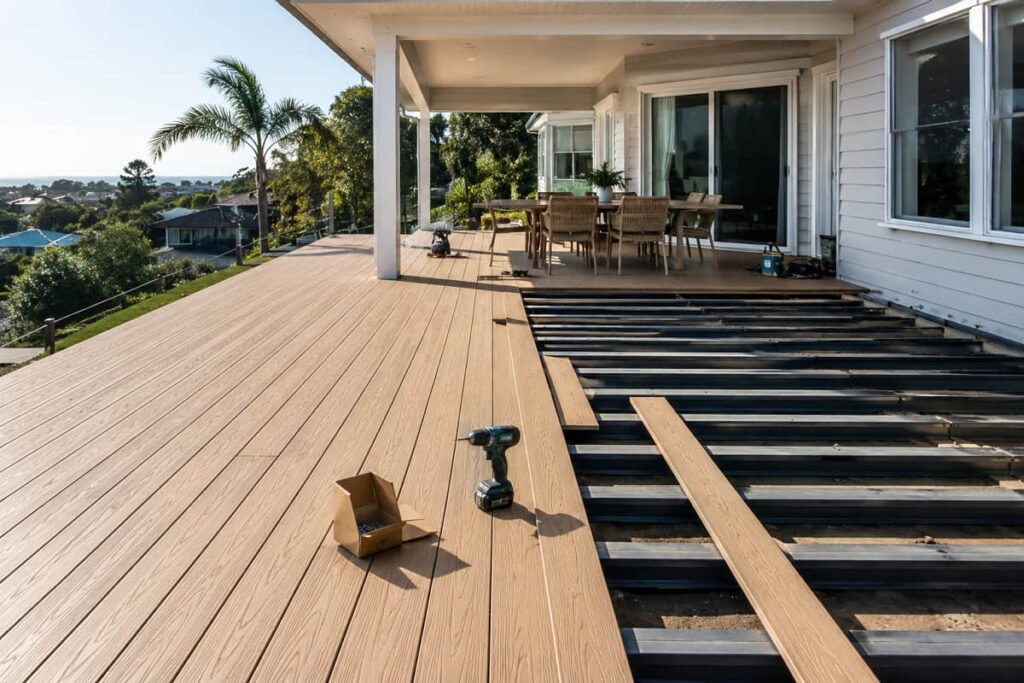
Supply-only cost (boards and fixings, no labour):
| Material | Supply cost per m² |
|---|---|
| Treated pine decking | $40–$90/m² |
| Hardwood timber decking (merbau, spotted gum) | $90–$200/m² |
| Composite decking boards | $100–$230/m² |
Total installed cost (supply + subframe + labour):
| Material | Total installed cost per m² |
|---|---|
| Treated pine decking | $200–$350/m² |
| Hardwood timber decking | $320–$550/m² |
| Composite decking | $250–$450/m² typical $450–$600+/m² complex |
A rough cost breakdown for a typical composite deck: 35–45% boards and fixings, 30–45% labour, 15–25% subframe and footings, 5–10% other. On a sloping or elevated site, the subframe share rises — often to 35% or more, and it comes straight out of the margin you assumed on a flat-site rate.
Full project cost by deck size (composite, fully installed):
| Deck size | Estimated total cost |
|---|---|
| Small (10–20 m²) | $3,500–$9,000 |
| Medium (30–40 m²) | $9,000–$18,000 |
| Large (50 m²+) | $17,500–$35,000+ |
Cost per m² drops as deck size increases. Labour setup costs spread across more square metres — improving efficiency on bigger jobs.
What Drives the Cost of Your Deck?
Two quotes for the same deck can differ by thousands. Here’s what moves the number.
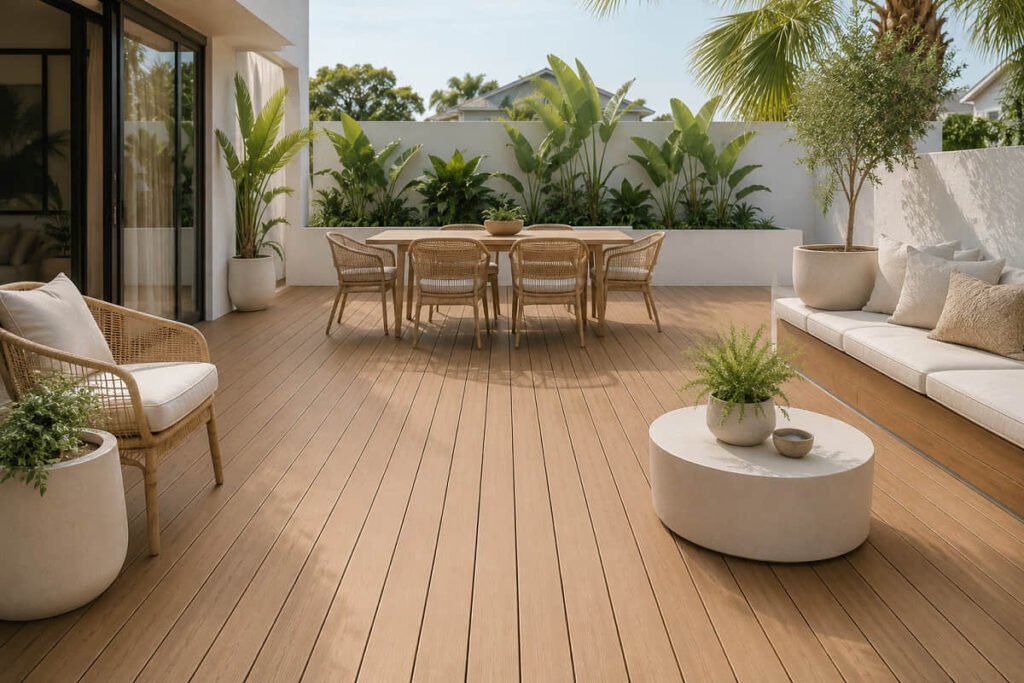
- Deck size: Bigger decks cost more overall, but the cost per square metre tends to fall as the size increases.
- Material choice: This is the biggest single cost driver. Treated pine decking is the cheapest upfront. Composite decking and hardwood timber sit higher at the board level.
- Design complexity: Straight boards on a flat site are the fastest to build. Curves, angled layouts, and multiple levels take more cutting and fixing time — each adds to labour costs.
- Site conditions: Sloping ground, difficult access, and height above ground push up the subframe and footing cost. On a steep site, the subframe can be the single largest line item.
- Subframe material: Steel subframes cost more upfront than timber but last longer — especially in termite-prone or high-moisture areas.
Labour Costs — What Builders Charge in 2026
Labour accounts for 30–45% of the total cost of a deck project and typically runs $80–$230/m² across Australia. The bottom of that range is simple ground-level work in regional areas; the top is complex or elevated builds in Sydney and Perth.
That rate covers layout, fixing, cutting and board installation. It does not include subframe construction, excavation, permit applications or balustrades — price those separately, or you’ll absorb them.
Composite decking has a real edge on labour time. The hidden fastener clip system is faster than face-screwed timber: boards slot into clips fixed to the joists, with no surface screws, no pre-drilling and no splitting risk. On volume projects, that installation speed cuts your labour cost per m² directly — which is where a lot of the composite price premium quietly pays for itself.
Subframe and Joist Spacing
The subframe is the structural base your boards sit on. It’s not optional, and it’s the line most often under-costed at quote stage.
| Subframe type | Cost per m² | Best suited to |
|---|---|---|
| Treated pine | $30–$45/m² | Standard ground-level residential |
| Composite battens | $40–$60/m² | Decks over concrete or existing slabs |
| Steel framing | $60–$90/m² | Elevated decks, termite zones, commercial |
Joist spacing matters. For composite boards, the recommended spacing is 300–350 mm centre to centre. Go wider, and you risk board deflection — and in most cases you’ll void the warranty. Hidden fastener clips also need a solid joist to grip, so spacing errors show up as movement underfoot within the first season.
The NCC (National Construction Code) sets structural requirements for deck subframes. Any quote that doesn’t specify subframe material and spacing isn’t a complete quote.
Hidden Costs That Catch Buyers Off Guard
These are the costs that don’t always make it into the first quote:
- Council permits and approvals: Approval requirements vary between states and local councils. Costs commonly range from $500–$2,500+ depending on location and approval pathway.
- Balustrades: Under the NCC, a compliant balustrade is required where there’s a fall of 1 metre or more. Budget $200–$500 per lineal metre depending on material and design.
- Subframe and footings: Often the biggest surprise — especially on sloping or elevated sites.
- Stairs: Each flight adds $800–$2,000+, depending on height and material.
- Waste and cut allowance: Add 10–15% for a standard layout. More for complex cuts or irregular shapes.
- Delivery and freight: Relevant for regional or remote sites.
- Site preparation: Clearing, levelling, or removing an existing structure all add to the final price.
Approval requirements and costs vary between states, territories, and local councils. Always confirm with your local council or building certifier before you start.
Composite vs Timber Decking: Price Comparison
The upfront price tells only part of the story. The total cost over 10 years is where timber decking and composite decking diverge most.
Treated pine requires oiling or staining every 1–2 years. Hardwood timber decking (merbau, spotted gum) generally needs oiling every 2–3 years. Composite decking needs only occasional cleaning with water — no oiling, sanding, staining, or recoating.
10-year total cost of ownership per m² (based on 30 m² deck):
| Treated Pine | Hardwood (Merbau/Spotted Gum) | Capped Composite | |
|---|---|---|---|
| Materials (supply only) | $60–$90/m² | $120–$200/m² | $100–$190/m² |
| Labour + subframe | $120–$180/m² | $150–$220/m² | $150–$260/m² |
| Upfront total | $180–$270/m² | $270–$420/m² | $250–$450/m² |
| Annual maintenance (DIY) | $15–$25/m² | $10–$20/m² | ~$0–$2/m² |
| 10-year maintenance total | $150–$250/m² | $100–$200/m² | ~$0–$20/m² |
| 10-year TCO | $330–$520/m² | $370–$620/m² | $250–$470/m² |
On a 30 m² deck, the maintenance savings from composite runs roughly $4,500–$7,500 over ten years. That gap is real whether the maintenance is DIY or contracted out — and it’s the number to put in front of a client who’s balking at the upfront difference.
Termite exposure adds a second argument. In Queensland, northern NSW and much of WA, a timber deck carries a replacement risk that composite removes outright.
The material line in this table assumes distribution-chain pricing. Trade buyers sourcing at volume see a different number.
Request a Trade Quote — get pricing, lead times and custom specs for your next composite deck project.
Deck Cost by Size: Small, Medium, and Large
Here’s a worked example for each size band using composite decking, fully installed in 2026. These figures assume a flat or near-level site with standard access.
| Deck size | Total cost range | Worked example (composite) |
|---|---|---|
| Small (10–20 m²) | $4,000–$9,000 | 15 m²: ~$6,750 (boards $2,250 + subframe $1,500 + labour $2,400 + fixings $600) |
| Medium (30–40 m²) | $9,000–$16,000 | 35 m²: ~$14,000 (boards $5,250 + subframe $3,000 + labour $5,000 + fixings $750) |
| Large (50 m²+) | $16,000–$30,000+ | 60 m²: ~$21,600 (boards $8,400 + subframe $4,800 + labour $7,800 + fixings $600) |
Cost per m² falls as deck size increases. Smaller projects absorb a larger share of fixed setup costs; larger projects benefit from labour efficiency and bulk material pricing.
Typical installed rates by size:
- Small decks: ~$400–$550/m²
- Medium decks: ~$350–$450/m²
- Large decks: ~$300–$400/m²
Sloping sites, stairs, and balustrades aren’t included. Add these to your budget early — they’re common on larger jobs, and each adds a real amount.
Do Deck Prices Vary by City?
Yes, and the gap is real. Decking material costs run roughly the same across Australia. Labour rates are where city-to-city differences show up.
These are indicative installation labour rates per m² for 2026. Local quotes will vary by contractor, access, and timing — treat these as benchmarks, not fixed prices.
| City | Labour cost per m² (indicative, 2026) |
|---|---|
| Sydney | $170–230 |
| Melbourne | $150–220 |
| Perth | $150–220 |
| Brisbane | $140–200 |
| Adelaide | $130–190 |
| Hobart | $130–190 |
Perth’s construction market has run hot in recent years. High demand pushed trade rates up, and they remain elevated into 2026. Sydney runs similarly.
Brisbane and Melbourne generally sit lower, but access, design complexity and contractor availability all shift the final price. Regional rates typically fall below every figure in this table — sometimes to $80–$120/m² for straightforward ground-level work — though delivery costs partly offset the savings.
The best approach for a client comparing prices: two to three itemised quotes from local builders, with materials, subframe and labour as separate line items.
Is Composite Decking Worth the Higher Upfront Cost?
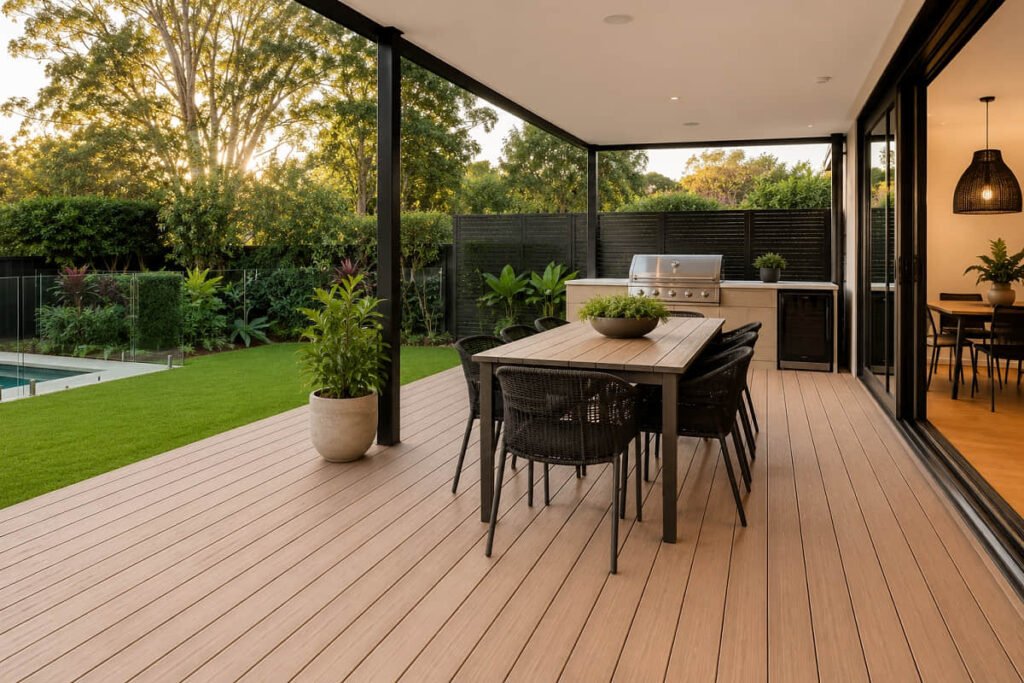
In most cases, yes — especially for commercial projects, high-traffic outdoor spaces, pool decks, and any site with termite risk or high moisture exposure.
The commercial argument is simple: composite removes the recurring maintenance line from your client’s 10-year budget and the callback risk from yours. Over a 10-year window, composite’s lower maintenance and avoided replacement costs typically close the price gap against hardwood. Against treated pine, composite often wins outright on total cost.
There’s also a quoting advantage worth naming: a composite deck lets you present a fixed ten-year number. A timber deck can’t be quoted that way honestly, because the maintenance cost is a variable you don’t control.
Not all composite is equal, though. Cap thickness, HDPE density and slip rating are what separate a 25-year board from a 7-year one. We’ve set out the specs to check, and what each grade costs, in the composite decking cost guide.
Request a Quote — talk to our team about pricing, lead times and custom specs for your next composite deck project.
Council Approval: When Do You Need It?
Permit requirements vary by state, territory and local council. Common triggers include deck height above ground, boundary setbacks, attachment to the dwelling, and total floor area.
In many jurisdictions, low-level decks under roughly 600 mm above ground may be exempt. Raised or attached decks often require building approval. Permit fees commonly range from $500 to $2,500+, and approval timeframes can add weeks to a programme.
Flag permit requirements during quoting, not after. An approval discovered mid-build is a stop-work risk and a variation conversation nobody enjoys. Always confirm with the local council or a building certifier before work starts.
Bushfire-prone areas add a BAL (Bushfire Attack Level) requirement — confirm the site’s BAL classification and check that the chosen decking boards are rated accordingly.
FAQ
How should I structure a deck quote for a client?
List materials, subframe and footings, labour, and extras (stairs, balustrades, permits, waste removal) as separate line items. Bundled quotes are where variations turn into arguments. Itemised quotes also make it obvious why your price differs from a cheaper competitor’s — usually because theirs has left the subframe or the fascia out.
How much should I allow for waste and offcuts?
Allow 10–15% on a standard rectangular layout, and more on angled, curved or multi-level designs. Ordering to the exact m² figure is the most common cause of a mid-build materials delay, and a second delivery costs far more than the extra boards.
How long does composite decking last?
A quality capped composite deck typically lasts 25 years or more with minimal upkeep — well beyond treated pine (10–15 years) and broadly on par with premium hardwood. The cap layer is the key: a thicker cap resists UV fading, surface moisture and wear far better than thin alternatives. The structural warranty length is the clearest signal of how confident a supplier is in their product’s lifespan.
Does composite decking get hot in the sun?
Yes — all dark hard surfaces absorb heat, and composite is no exception. In direct summer sun, surface temperatures rise on darker colours. Lighter colours absorb less heat. Quality HDPE composite with UV stabilisers manages heat retention better than cheaper boards, which is worth factoring in on pool decks and north-facing outdoor spaces.
What is a realistic budget for a 20 m² composite deck?
A new 20 m² composite deck typically costs $6,000–$13,000 installed. That includes decking boards, subframe, labour and basic site preparation, but excludes stairs, balustrades and permit fees.
See Our Full Composite Decking Range — Dimensions, colour options, technical specs, and custom order enquiries for trade buyers and distributors.
