

Most composite decking call-backs come down to two things: wrong joist spacing and skipped expansion gaps. Both are easy to avoid — and this guide shows you exactly how.
It covers the full install process: subframe, fasteners, expansion gaps, and edge finishing. Written for builders and contractors who want a clean job, fewer call-backs, and installs that hold up under Australian conditions.
What to Sort Out Before You Start
Before a single board goes down, you need three things clear: the deck’s purpose, its compliance requirements, and your layout plan.
Skipping this step is the most common reason installs go wrong. Get it right here, and the rest runs smoothly.
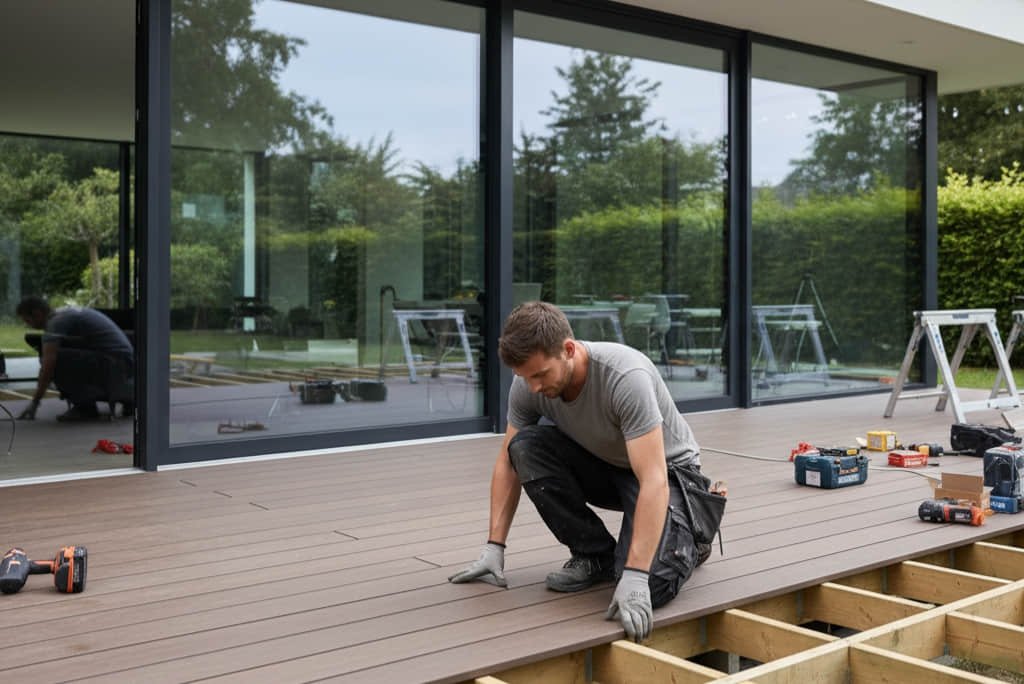
Purpose and load. A commercial deck carries heavier foot traffic than a home deck. That means tighter joist spacing and higher load requirements. Nail down the end use before you spec the subframe.
BAL rating. If the site falls within a bushfire-prone zone, the NCC requires your outdoor structure — including the deck — to meet the site’s Bushfire Attack Level (BAL) rating. Not all composite boards carry a BAL rating, so check before you specify to confirm compliance for your site.
Building permits. Many councils require a building permit for decks above a certain size or height. Check with your local council before starting. A missed permit can mean a costly rebuild.
Layout plan. Map out your board direction and mark where breaker boards will sit. On longer runs, breaker boards manage seams and give the deck visual structure. Finalise colours early — custom orders need lead time built into your project schedule.
Tools and Materials You’ll Need
Have these on site before you start.
Tools:
- Mitre saw — use an 80-tooth blade. Composite is denser than timber, and a finer tooth cuts cleaner without tearing the cap layer. Standard blades dull faster on composite — start with a fresh one.
- Circular saw (for ripping boards to width)
- Chalk line — keeps joists aligned across the frame. Use it early and often.
- Spirit level — for checking frame levelness before the boards go down
- Drill/driver
Materials:
- Composite deck boards
- Subframe joists — treated pine or steel (see next section)
- Hidden fastener clips (stainless steel)
- Composite-rated decking screws for starter and final boards
- Joist hangers and framing connectors
- Ledger board fixings (for house-attached decks)
- Weed control fabric (ground-level builds)
- Fascia boards in your matching deck colour
Composite boards run about three times the density of timber. Standard saw blades will dull faster — plan for a blade change on larger decking projects.
What Goes Under Composite Decking?
Composite boards must be fixed to a structural subframe — not laid directly on concrete, soil, or compacted gravel. The subframe carries the load and keeps the deck flat over its full lifespan. Get this part right, and the boards will perform as designed.
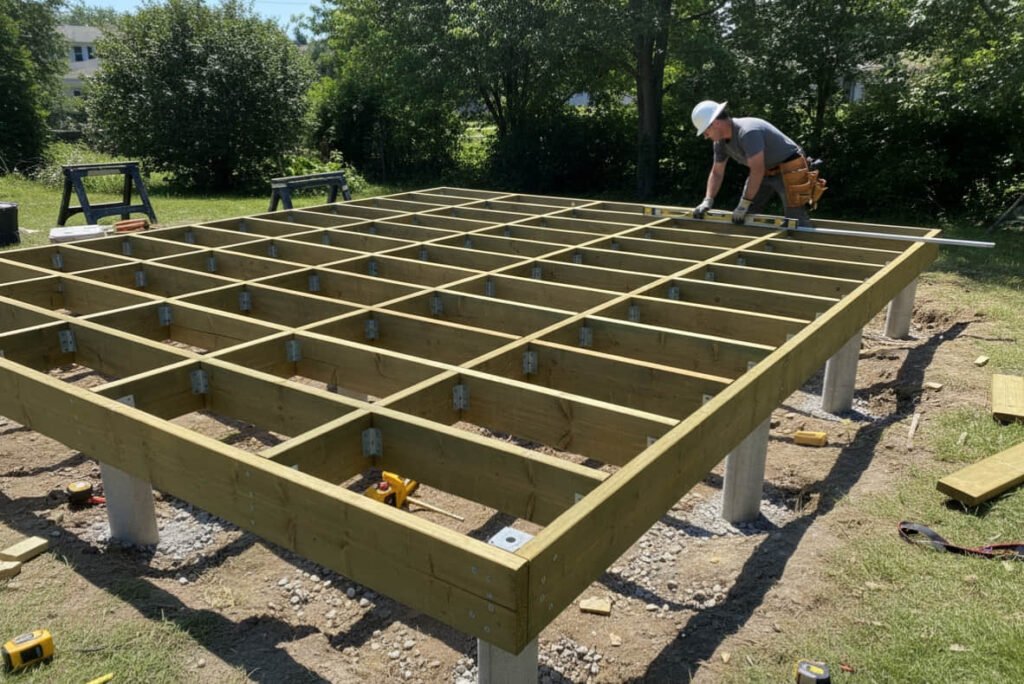
Treated pine vs steel. Treated pine is cheaper and easier to work with on residential projects. Steel is more stable in wet or coastal conditions — it won’t twist, shrink, or absorb moisture the way timber can. For commercial builds or exposed coastal sites, steel is worth the extra cost.
Ground-level decks. Lay weed control fabric before the frame goes in. Vegetation growing under the deck traps moisture and causes problems over time.
Elevated decks. NCC structural requirements apply once a deck sits above ground level. For any deck over 800 mm above ground, consult a licensed builder or structural engineer before you start framing.
One thing we see often on replacement decks: the old frame gets reused without checking levelness. Uneven joists are the biggest cause of poor board installation. Check every joist before boarding.
How Far Apart Should Joists Be for Composite Decking?
Joist spacing for composite decking is tighter than for timber. LastElegance boards are tested to a flexural strength of 26.2 MPa per EN 15534, which supports the following spacing recommendations:
| Application | Recommended Joist Spacing |
|---|---|
| Residential (standard load) | 350 mm centres |
| Residential (pool surrounds, elevated) | 300 mm centres |
| Commercial (high foot traffic) | 300 mm centres |
Each board must span at least three joists. Never run boards with only two bearing points — the board won’t perform as designed, and you’ll see deflection under load.
How to Build the Deck Frame
- Mark out post positions. Use a chalk line to set out the grid. Check for a square using the 3-4-5 method before any posts go in.
- Fix the ledger board. For decks attached to the house, the ledger board goes in first. It must be level and fixed into structural framing — not just the cladding or render.
- Set posts and bearers. Posts go into your structural plan. Bearers sit across the posts and carry the joist load.
- Fit the joists. Use joist hangers where joists meet the ledger board. Space joists to your project spec (see table above). Run a chalk line across the tops to confirm alignment.
- Level the frame. Check the full frame with a spirit level before a board goes down. Fix any low joists with packing or trimming. This step saves hours later — an uneven frame shows through the boards.
- Confirm NCC compliance. Elevated decks need footings and connections that meet BCA structural requirements. For any deck over 800 mm above ground, a licensed builder or certifier should sign off on the frame before boarding starts.
How to Lay Your Deck Boards
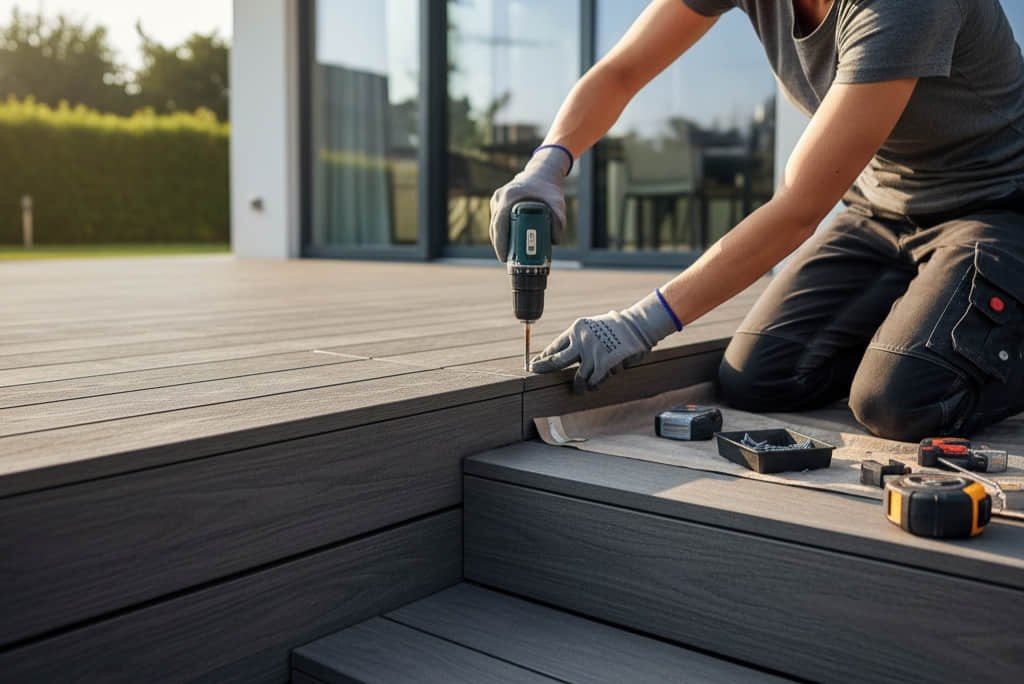
- Set the first board. This is the most important step. The first board sets alignment for every board that follows. Check it’s square to the frame — measure at both ends and confirm it’s parallel to the house or feature edge. If it’s even slightly off, the error compounds across the whole deck.
- Install the starter clips. Fix starter clips to the joist face at the starting edge. These hold the first board in place and set the gap for the first run.
- Work board by board across the frame. Fit hidden fastener clips into the groove of the board just laid. The clip locks onto the joist top. Slide the next board’s groove over the clip and press it into place. No screw heads on the deck surface.
- Handle butt joints correctly. Where boards meet end-to-end, both ends must bear on a joist. Never leave an end joint mid-span. Stagger butt joints across adjacent rows — aligned joints weaken the deck’s look and its structure.
- Place breaker boards. On long runs, a breaker board every 3–5 metres keeps the deck balanced and manages the seam lines. Plan their position before you start laying — don’t try to insert them mid-install.
- Face-fix the final board. Where clip access isn’t possible on the last board, use composite-rated decking screws. Pre-drill to avoid cracking and countersink flush with the board surface.
LastElegance boards carry an R11 slip resistance rating under AS/NZS 4586. Install with the grooved face up — that’s the rated anti-slip surface.
Ready to check colour and texture before ordering? Request Free Samples
Fasteners — Hidden Clips or Face Screws?
Yes, you can screw down composite decking. But hidden fasteners give a cleaner finish and are the preferred method for capped composite boards.
Here’s how the clip system works: the clip slots into the board groove and locks over the top of the joist. The next board slides into the clip, locking both boards into place. No screw heads visible on the deck surface. LastElegance offers stainless steel clasps — this matters in coastal conditions where standard zinc corrodes fast and leaves staining behind.
Face screws are the right call for the starter board, the final board, and any repair situation where clip access isn’t possible.
| Feature | Hidden Clips | Face Screws |
|---|---|---|
| Deck surface look | Clean — no visible fixings | Screw heads visible |
| Install speed | Fast once you find the rhythm | Slightly quicker per board |
| Best use | Field boards, capped composite | Starter/final boards, repairs |
| Coastal suitability | Stainless steel clips — yes | Composite-rated screws only |
Use composite-rated screws wherever you face-fix. Standard zinc screws corrode into the boards and leave stains that won’t come out.
LastElegance boards are fully capped on all four sides. That keeps heat and moisture out better than uncapped boards. The clip system stays locked the way it should.
How to Set Expansion Gaps
Composite boards expand and contract more than timber. In Australian conditions — where inland and coastal sites regularly hit 40°C+ in summer — getting the gaps right is one of the most important parts of a composite deck installation.
Wrong gaps cause two problems: boards laid too close to the pool water between them, and eventually buckle. Boards laid with no end room, lift and warp in summer heat.
You need two types of gaps:
- Side gaps (between boards running parallel): 5–8 mm
- End gaps (at board ends, wall ends, and butt joints): 8–10 mm
The right size depends on the temperature at install. On a hot day, the boards are already expanded — use a smaller gap. On a cold day, they haven’t expanded yet — use a larger one.
| Install Temperature | Side Gap | End Gap |
|---|---|---|
| Under 15°C | 8 mm | 10 mm |
| 15°C – 25°C | 6 mm | 8 mm |
| Over 25°C | 5 mm | 6–7 mm |
WPC (wood-plastic composite) boards behave differently from solid timber because the wood fibre and plastic expand at different rates. Set your gaps before the first board goes in — you can’t adjust them mid-install.
How to Finish the Edges
Fascia boards are the most overlooked step in a composite deck install. Most competitor guides skip this section entirely — but it’s what separates a professional-grade finish from one that looks half-done.
Fascia boards cover the exposed frame ends and cut board ends at the deck perimeter. They hide the subframe, protect it from moisture, and give the deck a clean edge profile from every angle.
How to fix fascia boards: Cut to length with clean mitre joins at corners. Fix to the face of the outer joist using composite-rated screws, pre-drilled. Heads should sit flush — don’t let them stand proud of the surface.
At corners and direction changes, cut a 45° mitre for a clean joint. Measure and mark carefully — these are the boards people see up close.
Exposed board ends are a primary moisture entry point. Finishing them properly with fascia boards and end-cap trim is required for long-term board performance and warranty compliance. The fascia range shares the same colour palette as the deck boards, so colour-matching is straightforward.
Installation mistakes are one of the most common causes of call-backs and warranty issues. See our full guide to avoiding composite decking installation mistakes.
Ready to spec your next project? Talk to the LastElegance sales team about product specs, custom lengths and colours, and volume pricing. We ship factory-direct — no middlemen, no inflated lead times. Get in Touch
FAQ
Is composite decking easy to install?
Yes — generally easier than timber once the frame is built. Boards don’t splinter, cut cleanly with a mitre saw, and the hidden clip system speeds up laying. The subframe still needs to be right, and that’s where most first-timers run into difficulty.
Can I install composite decking myself?
A capable DIYer can handle board installation. The subframe is where building code requirements apply — elevated decks over 800 mm above ground typically need a licensed builder or certifier. LastElegance provides an installation video, and our sales team can walk trade buyers through product specifications.
What is the best time of year to install composite decking in Australia?
Spring (September–November) and autumn (March–May) are ideal. Mild temperatures mean the boards are near their mid-range size, making expansion gap sizing more predictable. Avoid installing on days over 35°C or under 10°C where possible.
How long does it take to install composite decking?
For a two-person crew, a standard 30 m² frame takes one to two days. Board installation on a prepared frame runs at around 8–12 m² per person per hour using a hidden clip system.
How is installing composite different from timber decking?
Three key differences: composite boards expand more with heat, so expansion gaps matter more. Composite can’t be nailed — use clips or composite-rated screws. And composite boards must never sit in direct ground contact without a proper subframe. Frame building, joist alignment, and chalk line layout are the same as for timber decking.
Do I need a building permit for a composite deck?
Permit needs vary by state, council, and deck height. In most Australian states, decks over 800 mm above ground need building approval. Check with your local council before starting — a quick call now avoids a costly problem later.
Can I get free samples before ordering?
Yes. Free samples let contractors and procurement managers check colour, texture, and surface finish before committing to volume.