

Bad composite decking doesn’t announce itself on day one. It shows up at year two or three — faded boards, a warranty dispute, and a client who remembers who specified the product.
For builders, distributors, and procurement managers buying at volume, the supplier you choose is the risk you carry. This guide is for trade buyers making that call — not homeowners picking a colour.
What Should You Look for in a Supplier?
A good composite decking supplier can provide documented test results, clear warranty terms, honest lead times, and real customisation capability — before you sign anything. For B2B buyers, six criteria separate a reliable long-term partner from one who looks fine until something breaks. The sections below cover each one.
How Do You Judge Product Quality?
Don’t take a supplier’s word on quality. Ask for the data.
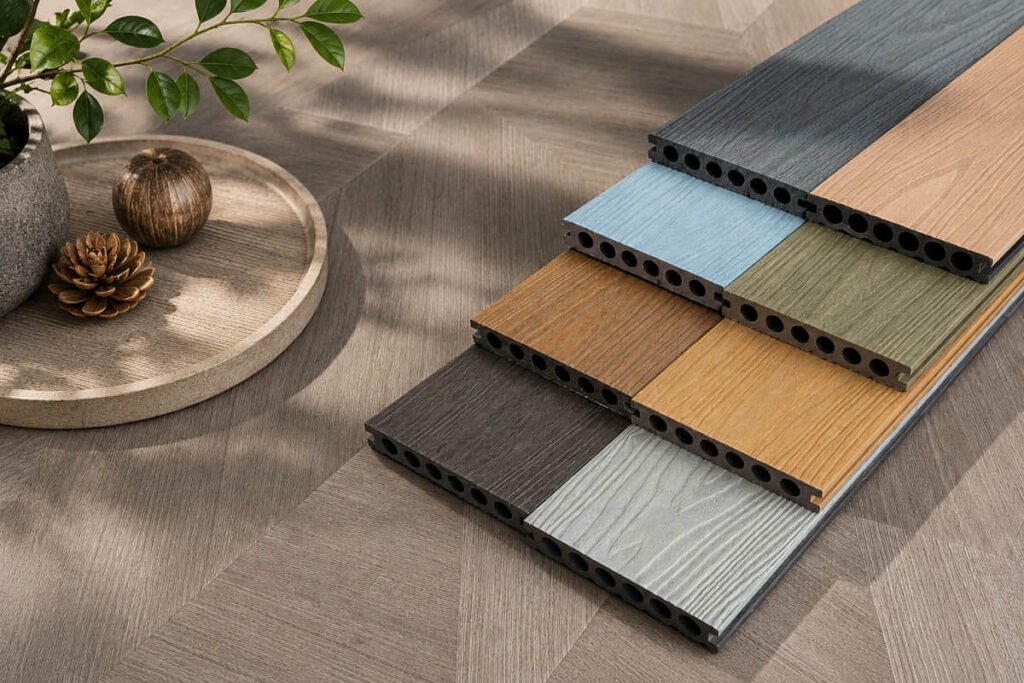
Composite decking materials vary more than most buyers expect. The gap between a quality board and a cheap one isn’t always obvious from a sample — it shows up three years into a project. Here are five questions to ask before you place a volume order.
1. What is the cap layer thickness? The cap layer is the polymer shell over the wood fibre core. Thicker is better. A 0.8 mm cap layer is a solid benchmark — many cheaper alternatives are thinner and offer less UV and moisture protection.
2. What is the HDPE density? HDPE at 0.95 g/cm³ is a quality marker worth checking. Lower density means a softer, less stable board.
3. What is the recycled content ratio? Quality composite boards typically blend 60% recycled content with 40% virgin material. Ask for the split — it matters for performance and any sustainability claims you pass on to clients.
4. Has the board passed QUV accelerated ageing testing? This test simulates UV exposure over time. A colour difference of ΔE ≤ 4–5 after 3,000 hours is a strong result. In Australia’s UV index, this is not a nice-to-have.
5. What is the flexural strength? For composite deck boards spanning joists, 26 MPa or above per EN 15534 is a useful benchmark. Ask for the test report.
A supplier who can’t answer these questions in writing is a risk — especially for pool areas, coastal projects, or any commercial outdoor space.
Which Specs Should You Request in Writing?
Capped composite boards have a protective outer layer bonded to all four sides. Uncapped boards leave some surfaces exposed. In Australian conditions — strong UV, coastal salt air, and wet-dry cycles — capped boards resist moisture, staining, and UV wear far better. Aim for a cap layer of 0.8 mm or above. That’s the thickness that makes a real difference in performance over five years.
Before placing a volume order, ask for documented results on each of these:
| Spec | What to Ask For |
|---|---|
| Cap layer thickness | 0.8 mm or above |
| HDPE density | 0.95 g/cm³ |
| Recycled content ratio | % recycled vs virgin material |
| Flexural strength | 26 MPa or above (EN 15534) |
| Slip resistance | AS/NZS 4586: R11 or better |
| UV ageing test | ΔE ≤ 5 after 3,000 hours QUV |
| Formaldehyde emissions | EN 717-1: not detected |
A supplier who can’t fill out this table — before you commit — is not one you can rely on for commercial or volume residential projects.
What Certifications and Compliance Matter in Australia?
Many imported composite decking products arrive in Australia without proper compliance documentation. That creates liability for whoever specifies them.
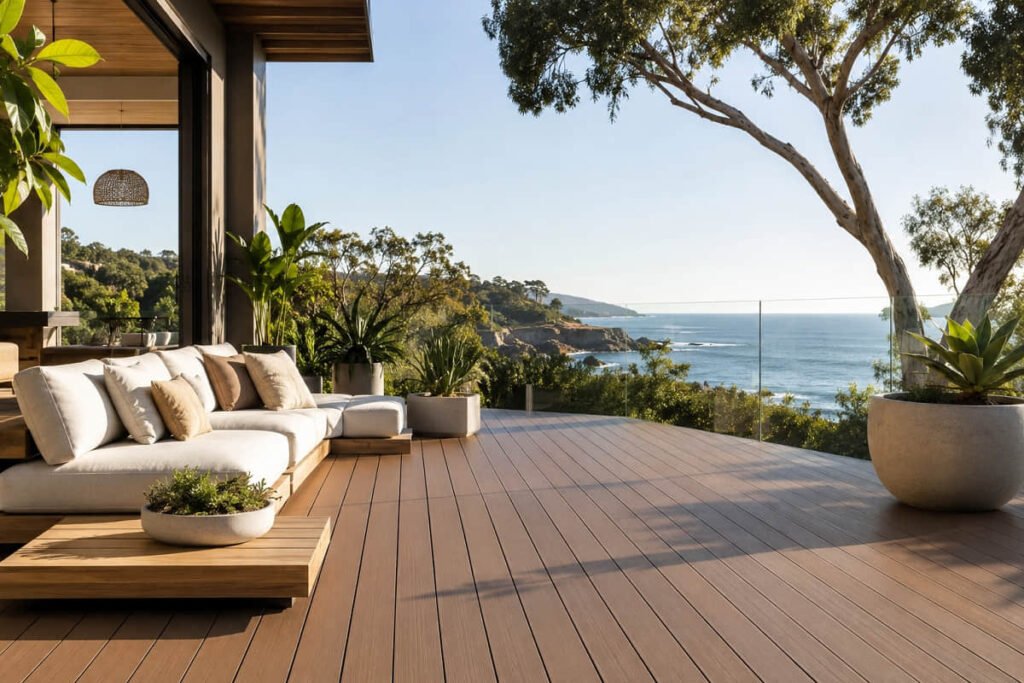
Here are the key checks for the Australian market:
- Fire safety — ASTM E84 is the standard to ask for. A Flame Spread Index (FSI) of 85 or below, and a Smoke Developed Index (SDI) of 300 or below, are the benchmarks. For projects in bushfire-prone zones, confirm the applicable BAL rating before specifying any product. The NCC sets the compliance framework here.
- Slip resistance — AS/NZS 4586 applies to any deck used around pools, in public areas, or in commercial spaces. R11 is the minimum for most outdoor applications.
- Formaldehyde emissions — EN 717-1 is the test to ask for. “Not detected” is the result you want.
- Environmental certifications — CE, ISO, RoHS, and SGS documentation are baseline quality signals worth confirming.
Not every supplier can produce documentation for every standard. If they’re slow to provide test reports, assume the product hasn’t been tested — or hasn’t passed. That’s not a bureaucratic concern. It’s a liability one.
How Does the Supply Chain Affect Your Business?
Most buying guides skip this section. It’s where B2B buyers lose the most money.
There are three main supply chain models for composite decking in Australia. Each affects price, lead time, and risk in a different way.
| Supply Chain Model | Typical Lead Time to Australia | Price Impact | Risk Level |
|---|---|---|---|
| Factory-direct (manufacturer) | 26–46 days (production + freight) | Lowest — no importer margin | Longer freight lead times |
| Importer / agent | 14–30 days (from local or regional stock) | Medium — importer margin added | Moderate |
| Local distributor | 1–7 days (from local stock) | Highest — multiple margin layers | Lowest for urgent orders |
Factory-direct removes the importer margin. For high-volume, repeat buyers, that saving compounds fast. The trade-off is freight lead time.
→ Need a lead time estimate for your next project? Contact Our Sales Team.
What Does the Warranty Actually Cover?
A composite decking warranty typically covers surface cracking, edge warping, breakage, and colour fade beyond an agreed threshold — under normal use and maintenance conditions.
Read the fine print. Three things catch buyers out.
Structural vs appearance warranty — they’re not the same. Structural coverage applies to cracking, breakage, and warping. Appearance coverage applies to colour fade. Some warranties split these into separate terms with different durations.
Colour fade clauses — appearance warranties only trigger when fading exceeds the agreed range, usually expressed as a ΔE value. Normal weathering within that range isn’t covered. Ask your supplier to define the threshold upfront and put it in writing.
Installation exclusions — most warranties are void if the boards were incorrectly installed. This is standard across the industry. Document your install process and follow the supplier’s spec sheets. Don’t assume the warranty will hold if you skipped a step.
For commercial projects, check whether warranty terms differ from residential coverage. Some suppliers offer separate commercial terms or limit them.
How Should You Compare Prices Between Suppliers?
The board price per m² is just the start. It’s rarely the full picture.
Build a true cost framework before you compare composite decking brands:
| Cost Component | What to Include |
|---|---|
| Board price per m² | Based on your actual order volume |
| Freight and import costs | Is freight included or quoted separately? |
| Accessories | Clips, joists, end caps — often quoted separately |
| Minimum order premium | Cost of ordering under MOQ, if applicable |
| 10-year maintenance estimate | Cleaning, repairs — compare against timber |
| Warranty claim risk | What’s your exposure if boards fail at year 5? |
Factory-direct pricing removes one margin layer from this equation. For builders ordering full containers, the savings can run 15–25% versus buying through an importer — depending on volume and product. The upkeep savings over 10 years add to that gap. Factor both into your comparison, not just the board price.
→ Want a like-for-like quote? Request a Quote
Can the Supplier Match Your Project Specs?
For volume builders and distributors, customisation capability is often the deciding factor.
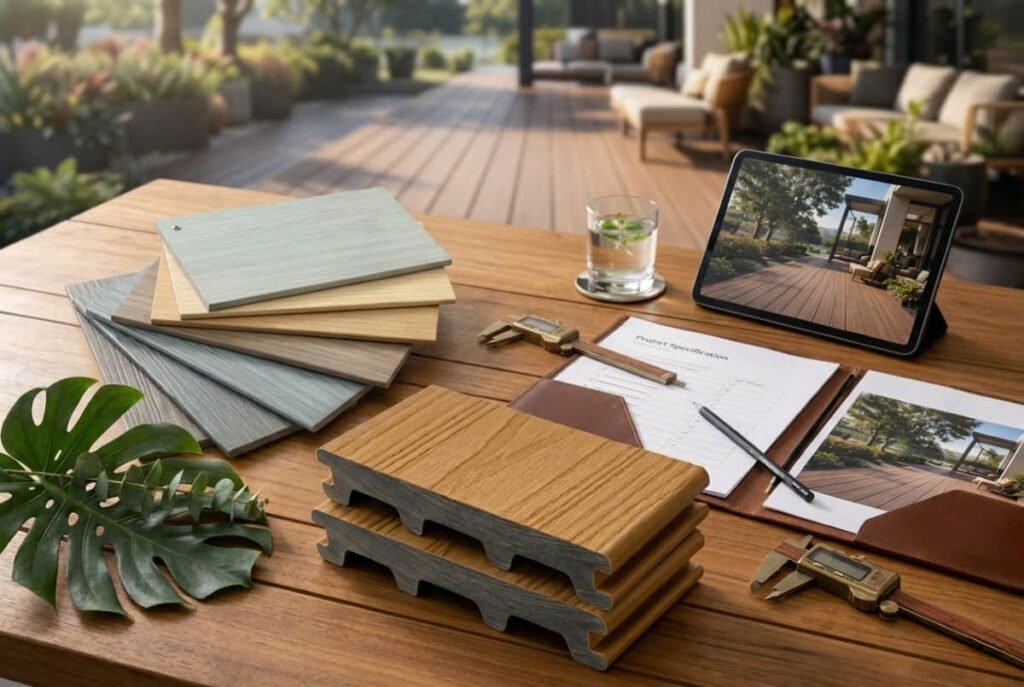
Ask about these options before you commit:
- Custom lengths — standard boards run 3 m, but some projects need other sizes. Confirm the range the supplier can accommodate.
- Custom colours — sampling is usually required first. Ask for the sampling lead time and minimum volume for a custom colour run.
- Surface textures and grain patterns — different textures suit different projects. Some suppliers offer custom moulds for high-volume buyers.
- Board dimensions — composite decking widths typically run 138–150 mm, with thickness options from 20–25 mm. Confirm availability in your preferred profile.
- OEM / private label packaging — relevant for distributors building their own product range.
LastElegance’s composite decking product range covers widths from 138–150 mm and thicknesses from 20–25 mm, across profiles including grooved solid, dual-flat solid, and hollow. Custom moulds for surface textures are available at qualifying order volumes.
If you need something outside the standard range, raise it early. Custom orders carry longer lead times — and some composite decking suppliers can’t accommodate them at all.
→ Considering a custom order? Enquire About Custom OEM/ODM
Questions to Ask Before You Place an Order
Get these answered in writing before committing to a volume order. If a supplier stalls on any of them, that’s the answer.
- Can you provide test reports for AS/NZS 4586 slip resistance, ASTM E84 fire rating, and EN 717-1 formaldehyde emissions?
- What BAL rating applies, and is this product suitable for bushfire-prone zones?
- What does your warranty cover — specifically the structural and appearance terms? What voids it?
- What is your production MOQ, and do you offer trial order terms for new accounts?
- What are the production and freight lead times for a full container order?
- Do you hold local stock in Australia — and what’s the lead time for in-stock items?
- Can I get the full accessories system — clips, joists, end caps — in the same order?
A supplier who can’t produce AS/NZS 4586 test results shouldn’t be supplying a pool deck or any commercial outdoor space.
FAQ
What is the difference between a composite decking manufacturer and a distributor?
A manufacturer makes the boards; a distributor buys and resells them. Factory-direct buying means fewer hands in the supply chain and lower prices passed to you. Distributors may offer faster local delivery, but usually can’t customise orders.
How important are reviews when choosing a composite decking supplier?
Reviews matter more for customer service signals than product quality. Look for patterns around delivery reliability, claims handling, and technical support — not just star ratings. For B2B buyers, references from other builders or distributors carry more weight than general consumer reviews.
Is it better to buy from a local Australian supplier or import directly?
A local supplier offers shorter lead times and easier returns — but at a higher price. Importing factory-direct cuts costs but requires planning around freight timelines, typically 26–34 days to Australia. For high-volume, repeat buyers, factory-direct is often the better long-term model.
Should I visit a showroom before choosing a supplier?
Physical samples are more useful than a showroom visit for colour and texture decisions. Request samples in your shortlisted colours before ordering. For large-volume or custom orders, a factory inspection or video walkthrough of the production process is a stronger trust signal than any showroom.
What is the minimum order quantity for composite decking?
MOQ varies by supplier and product. For production orders from factory-direct suppliers, 100 m² is a common benchmark. Some suppliers offer more flexible terms for first-time or trial orders — always ask before assuming.
Does composite decking meet Australian building codes?
It depends on the supplier and the product. Ask for documented compliance with AS/NZS 4586 (slip resistance), ASTM E84 or equivalent fire testing, and EN 717-1 (formaldehyde emissions). For bushfire-prone areas, confirm the applicable BAL rating before specifying any composite decking product.
The right supplier has the test reports ready, the warranty in writing, and the lead times confirmed before you commit. If they hesitate on any of those, keep looking.
Ready to compare? Browse our composite decking range and see the full specs for yourself, or contact our sales team — we’ll get you the details you need.